%20(2)_edited.png)

Voice Analytics Software: Boost Compliance with voice analytics software

Voice analytics software is technology that uses artificial intelligence to analyze spoken conversations, but it goes far beyond simple recording and transcription. Instead of just capturing what was said, it reveals the critical insights hidden in how it was said—uncovering the sentiment, emotional tone, and behavioral patterns buried in human speech.
Unlocking the Meaning Hidden in Conversations
Imagine having the ability to understand the deeper context of thousands of conversations all at once. That’s the real value of modern voice analytics. While traditional call monitoring might involve a human manually reviewing a tiny fraction of interactions—often less than 5%—this technology automates that process across every single recorded communication.
It acts as a powerful analytical engine, sifting through massive amounts of unstructured audio data to find the signals that would otherwise be completely missed. This isn't about surveillance; it's about intelligence. The software identifies the patterns, risks, and opportunities buried in the nuances of spoken language. Think of it less like a security camera and more like a sophisticated early-warning system for your entire organization.
Moving Beyond Simple Transcription
The true power here is the ability to move beyond words on a page. While accurate transcription is the essential first step, the real game-changing insights come from analyzing the metadata of speech itself. This includes:
Sentiment Analysis: Is the overall tone of the conversation positive, negative, or neutral?
Emotional Tone: Can it detect subtle emotional cues like frustration, stress, or excitement in a speaker’s voice?
Behavioral Indicators: Is it flagging specific conversational patterns that are associated with risk, non-compliance, or even high performance?
This multi-layered analysis gives you a complete, holistic view of every interaction. For instance, the software can easily tell the difference between an employee calmly stating a required disclosure and one rushing through it with a stressed tone—a subtle but vital distinction for any compliance team. You can learn more about how this connects to broader risk detection in our guide to choosing a behavioral analytics platform.
A Strategic Tool for Risk Management
Departments responsible for governance and security—like HR, Compliance, and Insider Risk—now see this technology as an essential part of their toolkit. It helps them finally shift from a reactive, after-the-fact stance to a proactive one. Instead of investigating misconduct after the damage is already done, they can identify the early warning signs and intervene before things escalate.
Ethical voice analytics platforms are designed to convert raw voice data into objective, non-judgmental indicators. This approach empowers human decision-making and aligns with strict organizational policies, preserving employee dignity while strengthening security.
By focusing on objective behavioral patterns rather than personal judgments, voice analytics software provides the critical insights needed to manage human-centric risks effectively. It helps build a smarter, more secure enterprise where potential issues are spotted and addressed early, all without compromising privacy or trust.
How AI Unlocks Meaning from Spoken Conversations
Modern voice analytics software thinks a lot like the human brain does, using a few specialized processes to turn raw sound into real intelligence. It isn't just one piece of technology, but a trio of powerful AI engines working together. Each one has a specific job, and together they build a complete picture of a conversation from the ground up.
This layered approach is a huge leap from older systems that did little more than transcribe calls. The global voice analytics market, now valued at over USD 1.4 billion, has grown from a niche tool into a core part of how companies manage risk. Much of this growth is driven by organizations that used to manually analyze less than 10% of their recorded calls, a practice that left massive blind spots in compliance and conduct. With the market projected to expand at nearly 20% a year, it's clear that getting ahead of these risks is a top priority.
This concept map shows how voice analytics helps find risks and opportunities, paving the way for proactive management.
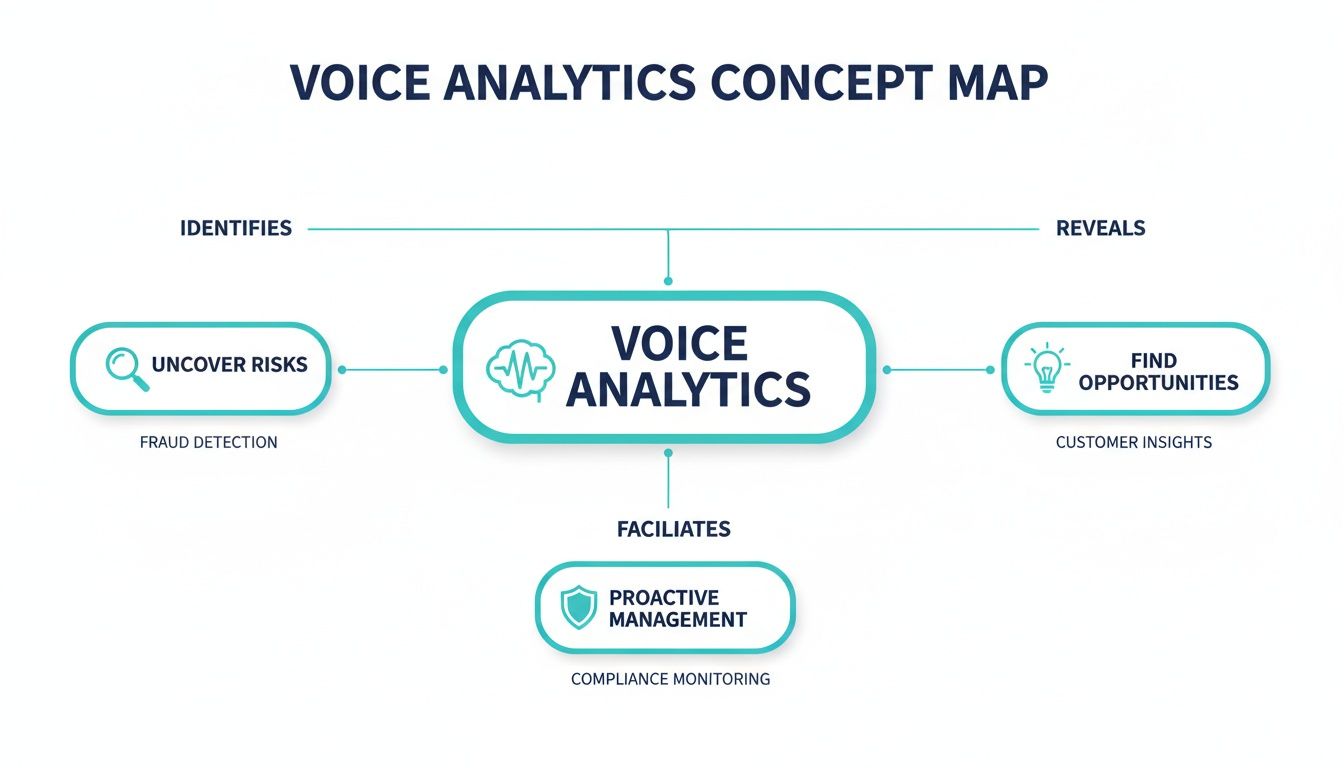
As you can see, the technology acts as a central intelligence hub. It takes unstructured audio and turns it into structured insights that support key parts of the business.
The First Step: Speech-to-Text Conversion
The whole process kicks off with Speech-to-Text (STT) technology, which acts as the system's "ears." Its only job is to turn spoken audio into written words, creating a searchable transcript of everything that was said. Think of it as a highly advanced court stenographer, capturing every word with precision.
Before that can happen, the audio has to be cleaned up. A solid understanding of AI audio noise reduction is key here, as it ensures the STT engine gets clean, clear sound to work with. This dramatically reduces errors caused by things like background noise or a bad connection.
The Second Step: Natural Language Processing
Once the conversation is in text form, the "brain" of the operation kicks in. This is Natural Language Processing (NLP), a field of AI focused on understanding the meaning, context, and intent behind human language. NLP goes far beyond just spotting keywords.
Instead of just flagging the word "cancel," an NLP engine can tell the difference between a customer saying, "I need to cancel my appointment," and "Please don't cancel my subscription." It looks at grammar, sentence structure, and how words relate to each other to figure out what’s really being said. This allows the system to:
Identify Key Topics: Automatically sort conversations by subject, like "billing inquiry" or "compliance disclosure."
Detect Intent: Figure out what the speaker wants to do, whether it's complain, ask a question, or make a purchase.
Extract Entities: Pull out specific bits of information like names, dates, and account numbers.
The Third Step: Paralinguistic and Sentiment Analysis
This final layer is where the deepest insights come from. Paralinguistic analysis doesn't care about what is said, but how it's said. This engine is the system's "emotional intelligence," interpreting all the non-verbal cues hidden in the human voice.
It analyzes acoustic features like pitch, tone, volume, and the speed of speech to identify emotional states. This is what allows the software to pick up on stress, frustration, or hesitation in a person's voice, even when their words are completely neutral.
This technology provides objective indicators of emotional states without making psychological judgments. It quantifies vocal patterns associated with high-pressure situations, giving compliance and HR teams crucial context that a simple transcript could never provide.
When you combine this with sentiment analysis from the NLP engine, you get a complete emotional and contextual map of the entire interaction. Our guide on AI emotional intelligence for ethical risk management digs into this concept in much more detail. By weaving these three AI engines together, voice analytics software delivers a 360-degree view, turning simple conversations into a rich source of strategic risk intelligence.
Where Voice Analytics Delivers Real Business Value
Understanding the tech is one thing, but seeing its impact is what really matters. Across the enterprise, voice analytics software is being put to work solving serious business challenges in ways that are both effective and ethical. The goal isn't to police employees; it's to arm the organization with objective insights that strengthen governance and protect everyone involved.
Modern voice analytics software is breaking out of its traditional home in customer service. It’s now a critical tool for compliance, fraud detection, and workforce integrity, signaling a major shift away from manual, spreadsheet-driven investigations. This isn't a niche market—it's projected to hit USD 3.9 billion by 2025, with North America leading the charge with a 38.9% share, thanks to huge adoption in regulated fields like banking and healthcare. You can explore the full breakdown in this speech analytics market growth report.
The key to doing this right is a governance-first mindset. The best platforms are designed to turn raw voice data into structured, non-judgmental indicators that help humans make better decisions, ensuring every action lines up with strict internal policies and regulatory demands.
Enhancing Compliance and Adherence
In high-stakes industries like finance and healthcare, compliance isn't just a suggestion—it's the law. A single missed disclosure or an incorrect statement can trigger massive fines and shatter a company's reputation. Voice analytics software acts as your automated, around-the-clock compliance officer, scanning 100% of recorded interactions for adherence to required scripts and protocols.
Instead of just sampling a tiny fraction of calls and hoping for the best, the system automatically flags any conversation that deviates from the script. Think of a financial advisor failing to provide a mandatory risk warning or a healthcare agent forgetting a required privacy notice.
These aren't subjective calls. The software simply flags the absence or presence of specific phrases, creating a clear, auditable trail. This lets compliance teams spot systemic training gaps and fix issues proactively, long before an auditor shows up at the door.
Detecting Early Signals of Insider Risk
Insider risk is one of the toughest nuts for any organization to crack. Whether malicious or just accidental, employee actions can lead to data breaches, fraud, and other serious headaches. Ethical voice analytics offers a crucial layer of defense by identifying early behavioral signals linked to risk, without ever crossing the line into invasive surveillance.
The system is built to focus on objective, quantifiable indicators, such as:
Elevated Stress Indicators: Analyzing paralinguistic cues to spot unusually high stress levels during sensitive conversations.
Use of Evasive Language: Flagging patterns of non-committal or deflective language when discussing critical procedures.
Procedural Deviations: Identifying conversations where employees seem to be sidestepping established security protocols.
This approach is all about pattern recognition, not mind-reading. By flagging anomalies in communication behavior, the software gives security and HR teams an early warning that warrants a closer, human-led review—always within the bounds of due process.
This enables organizations to step in constructively, perhaps by offering support or clarification, before a potential risk blows up into a full-blown incident. It’s a strategy that protects both the individual and the organization by fostering a culture of prevention.
Optimizing Contact Center Performance
Beyond the world of risk and compliance, voice analytics software remains a powerhouse for boosting performance in contact centers. By analyzing thousands of interactions, it uncovers the specific behaviors and techniques that separate your top performers from the rest of the team.
This data is a goldmine for targeted coaching and training. Managers can finally ditch generic feedback and provide personalized guidance based on cold, hard evidence from real conversations.
Identify Best Practices: The system can pinpoint the exact phrasing top agents use to de-escalate an angry customer or successfully resolve a complex ticket.
Pinpoint Coaching Opportunities: It can flag moments where an agent fumbled a product question or failed to show empathy, creating a perfect, specific coaching moment.
Measure Training Impact: After a training session, managers can track whether agents are actually applying their new skills in live calls.
This data-driven approach ensures coaching is relevant, effective, and fair. It gives agents the insights they need to get better, which in turn boosts customer satisfaction and drives better business outcomes across the board.
The table below illustrates how these applications translate into tangible value across different parts of the business.
Ethical Voice Analytics Applications Across Departments
Department | Problem Solved | Ethical Application (Indicator-Based) | Business Value |
|---|---|---|---|
Compliance | Ensuring adherence to mandatory scripts and disclosures in regulated industries. | Scans 100% of calls for the presence/absence of required phrases (e.g., "This call is recorded," "Past performance is not indicative of future results"). | Reduces risk of regulatory fines, strengthens audit trails, and identifies systemic training needs. |
Internal Security & HR | Identifying early behavioral indicators of potential insider risk or misconduct. | Detects anomalies like elevated stress, evasive language, or deviations from security protocols in high-risk conversations. | Enables proactive, non-invasive intervention, protects company assets, and supports a culture of prevention. |
Contact Center Operations | Improving agent performance, consistency, and customer satisfaction (CSAT). | Identifies communication patterns of top performers (e.g., empathy cues, effective problem resolution language) to create coaching models. | Lifts team-wide performance, reduces agent churn, improves first-call resolution rates, and enhances the customer experience. |
Sales Enablement | Understanding what makes top salespeople successful and replicating it across the team. | Analyzes call recordings to identify key phrases, question patterns, and objection-handling techniques used in successful deals. | Shortens the sales cycle, increases conversion rates, and provides data-driven insights for sales training programs. |
As you can see, when implemented thoughtfully, voice analytics moves beyond a simple monitoring tool to become a strategic asset for strengthening governance, optimizing performance, and building a more resilient organization.
Navigating the Ethical and Regulatory Maze
Bringing voice analytics software into your organization opens up incredible capabilities, but it also comes with a heavy dose of ethical responsibility. Let's be perfectly clear: this technology is not a tool for surveillance or automated judgment. Its real purpose is to give you objective, data-driven signals that help your people make fairer, smarter decisions while fiercely protecting individual privacy and dignity.
Think of it like a sophisticated navigation system for risk. It highlights potential hazards up ahead—like a conversation straying from a compliance script or unusual stress patterns on a high-stakes call—but it never, ever takes the wheel. Your leaders, guided by clear governance and company policy, are always the ones driving.
This distinction is everything. Ethical voice analytics is about prevention and support, not punishment and policing. By focusing on objective behavioral signals, it helps your organization understand what is happening without making dangerous assumptions about why.
Understanding the Regulatory Guardrails
The use of voice analytics is fenced in by a patchwork of strict international and national laws designed to protect the rights of employees and customers. These regulations draw firm lines in the sand that any reputable platform must be built to honor from the ground up. Ignoring them isn't just unethical; it's a fast track to severe legal and financial pain.
Two of the most important frameworks you need to know are:
The General Data Protection Regulation (GDPR): This EU law has set the global standard for data privacy. It demands that any organization handling the personal data of EU citizens—and yes, that includes voice recordings—must have a clear legal reason for doing so, keep it secure, and respect an individual's right to control their own information.
The Employee Polygraph Protection Act (EPPA): While this is a U.S. law, its core principles are universal. It flat-out prohibits most private employers from using lie detectors on their staff. Any ethical voice analytics platform must operate miles away from this territory, offering behavioral indicators without ever pretending to determine truthfulness.
These laws make one thing crystal clear: covert monitoring and AI-driven judgments are completely off the table. Any analysis must be transparent, justified, and focused on legitimate business needs like ensuring compliance or flagging operational risks.
What Ethical Voice Analytics Is Not
To really get the proper role of this technology, it’s just as important to define what it should never, ever be used for. A platform built with ethics at its core will have technical and procedural walls in place to stop it from being misused.
Ethical voice analytics is not a replacement for human investigation or due process. It is a decision-support tool that generates objective, auditable signals, allowing organizations to apply their internal governance frameworks consistently and fairly. The final decision always remains in human hands.
Here are the red lines that an ethical system will not cross:
It is not a lie detector. The technology is explicitly forbidden from making any judgment about truthfulness. Doing so would violate laws like EPPA and the basic principles of workplace dignity.
It is not for psychological profiling. The software analyzes vocal patterns to generate objective indicators of stress or agitation, but it does not—and should not—make psychological assessments or emotional judgments about a person.
It is not for automated conclusions. The AI doesn't decide if someone did something wrong. It only flags statistical anomalies or deviations from a baseline, which then require a thorough, human-led review based on your company's policies.
Platforms built "under regulation" are designed with these prohibitions baked in. They turn raw voice data into structured signals that align with your organization’s specific rules and procedures. This approach is fundamental to building a solid program for regulatory compliance risk management that protects both the company and its people.
By embracing these ethical and regulatory guardrails, companies can turn compliance from a burden into a strategic advantage. It builds a culture of trust and transparency, proving that performance, security, and privacy can absolutely go hand-in-hand.
Choosing the Right Voice Analytics Software

Picking the right voice analytics software is far more than a simple tech purchase. It's a strategic decision that cuts right to the heart of your company's governance, ethics, and operational spine.
The market is flooded with tools that promise incredible insights, but many just generate mountains of raw data. This doesn't lead to clarity; it leads to "analysis paralysis." You're left with noise, not actionable intelligence.
The key is finding a partner whose technology aligns with your commitment to ethical risk management. Your goal isn't just to listen—it's to translate messy conversational data into structured, objective indicators that empower your team to act decisively and fairly. This means you need to look beyond the feature list and evaluate the core philosophy of the software itself.
Your Core Evaluation Checklist
When you start vetting vendors, your evaluation has to be rigorous and built on a few non-negotiable principles. A weak platform will expose you to serious legal risks and crush employee trust. The right one, however, will become a cornerstone of your compliance and risk management framework.
Use this checklist to cut through the marketing fluff and ask the questions that actually matter.
Privacy-by-Design Architecture: Was the software built from the ground up to enforce data privacy? Look for concrete features like data minimization, strict role-based access controls, and the automated redaction of sensitive personal information.
Indicator-Based Analysis: Does the platform deliver objective, structured indicators, or does it push subjective judgments? A good system should flag a specific, predefined behavior (like "required disclosure was absent") without trying to interpret a person's intent or emotional state.
Full Auditability and Traceability: Can you track every single action taken within the system? A top-tier solution must provide a complete and unalterable audit trail. This is non-negotiable for both internal reviews and any external regulatory inquiries.
These three pillars—privacy, objectivity, and auditability—are the bedrock of any ethical voice analytics program. They ensure the technology is used as a decision-support tool, not an automated decision-maker.
Integration and Interoperability
Even the most powerful voice analytics software is useless if it's stuck in a silo. A platform that can’t plug into your existing tech ecosystem is just a data graveyard where valuable insights go to die.
The most effective voice analytics solutions act as a central nervous system for risk intelligence, connecting insights directly to the platforms your teams already use for case management, HR oversight, and compliance reporting.
Before you even think about signing a contract, confirm that the vendor's platform can connect with your core systems. You need to see robust API capabilities and proven interoperability with operational platforms like E-Commander, which centralizes risk intelligence and mitigation workflows.
This is critical. It means when the software flags a risk, the alert flows directly into a structured process for review and resolution. You create a closed-loop system of governance, not just another noisy alert.
Vendor Philosophy and Support
Finally, look past the software and evaluate the vendor. Are they just another tech provider, or are they a true governance partner? The best vendors live and breathe the complex legal and ethical world you operate in and have designed their solution to navigate it safely.
Ask them if their platform was "built under regulation." This is your litmus test. It means they proactively designed their system to comply with frameworks like GDPR and EPPA, intentionally prohibiting functions like lie detection or psychological profiling.
This commitment is your best guarantee that the software will strengthen your governance framework instead of introducing new, unforeseen risks. Choosing the right software means choosing a partner who shares your dedication to ethical, effective, and sustainable risk management.
Your Plan for Implementation and Measuring Success
Rolling out voice analytics software isn't about flipping a switch and walking away. It’s a strategic process. To get it right, you need a thoughtful, phased approach that builds a culture of prevention, not just reaction. A methodical plan is the only way to ensure the technology is adopted ethically, effectively, and in a way that actually hits your company’s goals.
The journey has to start with clear objectives. Before you analyze a single conversation, you need to define what a "win" looks like for each team. Is your compliance department trying to cut disclosure errors by 15%? Does HR need to spot the procedural gaps that are causing friction with employees? These specific, measurable goals will be your north star for the entire implementation.
A Phased Roadmap to Success
A structured, step-by-step rollout is non-negotiable. It minimizes risk and gets you the internal buy-in you need. If you rush this part, you’ll end up with mistrust and poor adoption, completely undermining the whole point of the initiative.
Build a Clear Governance Framework: First things first, get Legal, HR, and Compliance in a room. Together, create a rock-solid governance policy. This document needs to spell out exactly how data will be used, who gets to access it, and the precise steps for reviewing any flagged indicators. Transparency is everything here.
Launch a Focused Pilot Program: Don't try to boil the ocean. Pick one specific team or a single use case for an initial pilot. This controlled test run lets you validate your governance policies, fine-tune your risk indicators, and prove the system's value with a small, manageable dataset.
Analyze, Refine, and Share the Wins: Use what you learn from the pilot to tweak the system and your internal processes. Just as important, share any early wins with key stakeholders. This builds momentum and gives you a chance to address concerns before you even think about a wider rollout.
Scale Methodically Across the Business: Once you’ve proven the model works, you can start expanding the solution to other departments. This deliberate expansion ensures every team is properly trained and that the system is configured for their unique needs.
Measuring What Actually Matters
Success with voice analytics isn't about counting how many calls you analyzed. The KPIs that truly matter are the ones that track real improvements in your governance and operational efficiency. To get the full picture and pull out actionable insights, integrating your system with a robust call center reporting software is a smart move.
Meaningful metrics go beyond simple activity logs to measure real-world business outcomes. The ultimate goal is to create a traceable, auditable process that turns raw conversational data into documented improvements in your organization's integrity and trust.
Focus on tracking KPIs that tell a story, like:
A Drop in Compliance Breaches: Monitor for a steady decrease in flagged non-compliant events over time.
Faster Case Resolution: Measure the time it takes from the moment an indicator is flagged to its final resolution.
Better Procedural Adherence: Track how consistently your teams are applying required scripts and protocols.
This data-first approach is how you prove the ROI of your voice analytics software. It solidifies its role not just as another tool, but as an essential part of building a more secure and trustworthy organization.
Your Questions About Voice Analytics, Answered
When you're exploring voice analytics, you're bound to have questions. Let's dig into some of the most common ones we hear from leaders trying to manage risk without creating a culture of distrust.
How Do You Protect Employee Privacy?
This is the most important question, and the answer has to be built in from the ground up. Ethical voice analytics platforms are designed with a privacy-by-design philosophy. It’s not an add-on; it’s part of the core architecture. The software is laser-focused on objective, pre-defined behavioral indicators tied to compliance or operational risk—never personal conversations or opinions.
Here are a few of the core privacy protections you should expect:
Data Minimization: The system only ever analyzes data that’s relevant to a legitimate business need, like checking for adherence to a compliance script.
Role-Based Access: Strict controls mean only authorized personnel can review flagged events, and their access is limited to their specific job function.
Automated Redaction: Sensitive data like credit card numbers or personal ID information is automatically scrubbed from both transcripts and the audio itself.
The goal is to get the insights you need for risk management without ever infringing on personal privacy. It’s a system of support, not surveillance.
Isn't This Just a Fancy Name for Call Recording?
Not even close. The difference is night and day.
Call recording is a passive tool. It just captures and stores audio files for someone to manually listen to later. In contrast, voice analytics software is an active intelligence engine. It analyzes 100% of your recorded conversations to spot patterns, risks, and opportunities that are impossible to find manually.
Think of it this way: Call recording gives you a library of books. Voice analytics gives you a librarian who has read every single one and can instantly point you to the exact page containing critical information.
A simple recording can't tell you if a mandatory disclosure was missed on thousands of calls last week. Voice analytics can flag every single one of those instances, help you spot the root cause, and give you the data you need to fix the training gap. It turns raw, useless data into real, actionable business intelligence.
At Logical Commander Software Ltd., we provide an AI-driven platform designed for ethical, proactive risk management that protects both your organization and your employees. Learn how our indicator-based approach strengthens governance without surveillance at https://www.logicalcommander.com.