%20(2)_edited.png)

Understanding Ethic and Ethics to Prevent Internal Risk

Updated: Feb 9
When business leaders discuss ‘ethic’ and ‘ethics,’ the terms are often used interchangeably. But for decision-makers in Compliance, Risk, and HR, this distinction is not just semantic—it is the foundation for a proactive strategy to mitigate human-factor risk and protect the organization from liability.
An ethic is an individual's personal moral compass. Ethics, in contrast, is the formal system of rules and conduct an organization mandates. Understanding the gap between these two is the key to preventing internal threats before they lead to costly, reactive investigations.
Clarifying Ethic and Ethics in a Business Context
In the high-stakes environment of corporate governance, the disconnect between an individual employee’s personal principles (ethic) and the company's collective framework (ethics) is where internal threats originate. For leaders tasked with protecting the organization, mastering this distinction is the first step toward building a resilient, prevention-focused culture.
Think of it this way: an employee's personal ethic is like a musician's individual talent. The corporate ethics policy is the sheet music the entire orchestra must follow. You need both aligned to prevent a disastrous performance that damages your reputation and bottom line.

The Individual Compass vs. The Corporate Map
An employee's personal ethic is their internal compass, shaped by their individual values and experiences. It guides their decisions when policies are unclear or when no one is watching. This internal code dictates how they will respond to pressure, opportunity, and ethical dilemmas at work.
Corporate ethics, meanwhile, is the organization's map—the formal code of conduct, policies, and procedures defining acceptable behavior. This framework is not just for show; it is a critical governance tool designed to ensure legal and regulatory compliance, maintain operational integrity, and protect the business from liability.
The core challenge for any organization is aligning the individual compass (ethic) with the corporate map (ethics). When misaligned, the door opens to internal threats, from minor misconduct and data misuse to catastrophic fraud.
Why This Distinction Matters for Risk Management
Understanding the difference between ethic and ethics is central to proactive, ethical risk management. A strong ethics program is not a handbook that gathers dust; it's a dynamic system that creates an environment where individual judgment is actively guided by clear corporate standards.
When a gap opens up, the business impact is direct:
Ethical Lapses: An employee whose personal ethic conflicts with company policy might rationalize cutting corners on safety protocols, padding an expense report, or sharing sensitive data.
Compliance Failures: Relying only on the corporate map without influencing the individual compass leads to a "check-the-box" culture that fails to prevent misconduct, inviting regulatory scrutiny.
Insider Risk: Human-factor risk almost always begins with a subtle deviation from the rules, driven by an individual’s personal choice. This is where the most damaging threats are born.
By addressing both the individual and the system, an organization can shift from a reactive, costly investigative posture to a genuinely preventive one. To explore this further, see how different areas of ethics in business directly impact modern risk strategies.
The Real Cost of Ethical Failures
Viewing ethical blind spots as a "cultural issue" is a critical business mistake. They represent a direct and immediate threat to your bottom line, reputation, and operational stability. For leaders in Compliance, HR, and Internal Audit, the conversation must shift from abstract principles to the tangible financial impact of failing to manage human-factor risk.
The costs of an ethical lapse cascade through the organization, starting with staggering regulatory fines and ending with the slow, corrosive erosion of your brand. Too many organizations remain trapped in a reactive loop, launching expensive investigations only after the damage is done. This approach is fundamentally broken. It fails to prevent the initial failure and leaves the business exposed to repeated incidents.
From Financial Penalties to Reputational Collapse
The moment an ethical failure becomes public, the financial bleeding starts. Regulatory bodies now levy fines that can cripple even large enterprises. U.S. firms alone have paid over $1 trillion in penalties since the year 2000.
A single investigation can become a massive financial drain. An FCPA investigation, for example, costs the average company a stunning $1.8 million per month. Our guide on the true cost of reactive investigations details these financial burdens.
But direct penalties are just the beginning. The damage spreads quickly:
Legal Battles: Protracted litigation consumes resources, creates years of uncertainty, and distracts leadership from core business objectives.
Brand Damage: Lost customer trust is incredibly difficult and expensive to regain, directly impacting revenue and market share.
Employee Morale: A work environment perceived as unethical or unfair destroys productivity, increases turnover of top talent, and fosters disengagement.
This isn't limited to financial misconduct. Overlooked areas like the environmental impact of electronic waste also carry significant reputational and financial tolls when ethical corners are cut.
The Measurable Value of an Ethics Premium
While the cost of failure is steep, there is a clear financial upside to operating with proactive integrity. Companies that embed a strong ethical framework consistently outperform their peers. This "ethics premium" is a documented market reality, not a theoretical concept.
An analysis of publicly listed companies named as the World's Most Ethical Companies shows they outperformed a comparable global index by 7.8 percentage points over a recent five-year period. This demonstrates that a commitment to proactive ethic and ethics management is not a cost center but a powerful driver of long-term value and resilience.
This data sends an unmistakable message to decision-makers. Investing in a proactive, non-intrusive approach to ethical risk management is one of the smartest strategies for sustainable growth. It shifts the entire focus from punishment to prevention, protecting both the institution and its people from harm.
Building a Framework for Ethical Decision Making
Effective ethics programs require more than well-intentioned statements; they need a defensible, practical framework. For leaders in risk, compliance, and HR, the goal is to translate complex principles into a functional toolkit that guides behavior and protects the organization.
When you establish this structure, you create a shared language for navigating ethical dilemmas. Your ethics program evolves from a static compliance checklist into a dynamic governance system. This shift empowers you to design strategies that are not only effective but also legally and ethically sound. Failing to build this framework triggers a predictable and painful chain reaction.
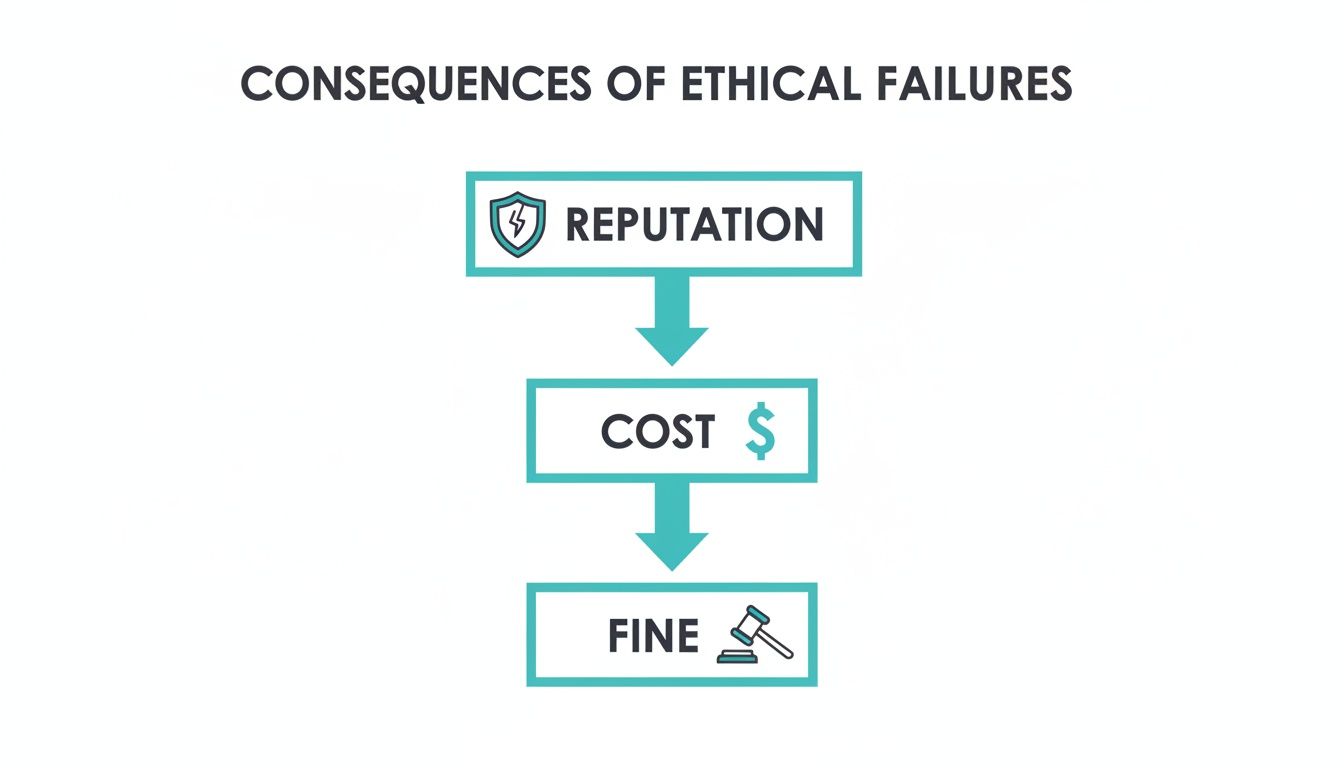
As this infographic shows, ethical failures initiate a domino effect, beginning with reputational damage before escalating into severe financial costs and regulatory fines. A proactive framework is your first line of defense.
The Three Branches of a Modern Ethics Program
Ethical theory can be distilled into three core branches that are directly applicable to business. Each branch answers a critical question that helps shape how your organization prevents and responds to internal threats and human-factor risk.
This table breaks down the three branches with real-world business applications.
Three Branches of Ethics in the Workplace
Ethical Branch | Core Question | Business Application Example |
|---|---|---|
Normative Ethics | "What should we do?" | This is your Code of Conduct. It includes concrete rules like your anti-bribery policies and procedures for handling sensitive customer data. |
Applied Ethics | "How do we do it here?" | This is where you handle a specific dilemma, such as managing a conflict of interest between two employees or responding to a data privacy request from a customer. |
Meta-Ethics | "Why is this the right thing to do?" | This is the foundation—your company's core values and mission statement. It’s the reason why bribery is wrong for your organization, not just that it’s against the rules. |
Let's unpack these for a business context:
Normative Ethics — The "What": This is the most familiar branch, defining moral standards and rules. It answers, “What actions are right or wrong?” Your policies on harassment, gifts, and data privacy are all outputs of normative ethics.
Applied Ethics — The "How": This is where policy meets reality. Applied ethics takes your rules and puts them to work in complex, real-world situations. It answers, “How do we handle this specific ethical dilemma right now?” Navigating a harassment claim or addressing a potential data leak are exercises in applied ethics.
Meta-Ethics — The "Why": This foundational branch examines the origin and meaning behind your principles. It asks, “Why are our values the right values?” For a business, this is about defining your purpose and the fundamental beliefs that support your entire compliance framework.
A strong meta-ethical foundation ensures your policies aren't just arbitrary rules. It provides the justification for your normative standards and guides their application, making your entire framework defensible under scrutiny from regulators and stakeholders.
By building out all three pillars, you create a system that is clear, actionable, and aligned with your company’s identity. For a more detailed guide, learn more about creating an ethical framework for your business. This proactive structure is the first step in moving beyond reactive investigations and toward a new standard of ethical risk management.
How Everyday Ethical Dilemmas Fuel Insider Risk
Significant insider risk rarely begins with a malicious master plan. It is a slow burn, ignited by a series of small, unaddressed ethical dilemmas. For leaders in Compliance, Security, and HR, understanding this progression is essential to shifting from a reactive posture to one of genuine prevention. The most potent human-factor risk is not born in high-profile incidents; it is rooted in the thousands of minor decisions employees make every day.
Common workplace scenarios are breeding grounds for major threats. An undeclared conflict of interest may seem harmless, but it erodes impartiality and can lead to biased procurement or favoritism. Similarly, an employee misusing company data for a "quick personal project" normalizes behavior that can lead directly to intellectual property theft or a catastrophic data breach.
Each minor ethical breakdown creates a ripple effect, gradually normalizing behavior that deviates from corporate standards. This slippery slope is where the real danger to the organization lies.
From Small Lapses to Major Threats
Tracing the path from a minor issue to a major incident reveals how quickly risk escalates when the human factor is ignored:
Expense Report Padding: An employee adds a few extra dollars to a meal expense. Unchecked, this can become a pattern, evolving into significant expense fraud that costs the company thousands.
Misuse of Company Time: An employee regularly uses work hours to manage a side hustle. This is not just time theft; it creates serious conflicts of interest and exposes company systems to unnecessary external risks.
Ignoring Harassment: A manager witnesses inappropriate comments but stays silent to avoid conflict. This inaction fosters a toxic work environment, increasing legal liability and employee turnover while crushing morale.
These situations highlight a critical truth: ignoring small ethical problems allows them to grow into systemic risks. Supporting a whistleblower is a necessary component of risk identification, but a purely reactive approach that waits for a report is insufficient. The damage has already been done.
The most significant internal threats are the final stage of a behavioral pattern that started with minor, unaddressed ethical choices. Proactive internal risk prevention focuses on identifying these early behavioral indicators before they cause irreparable financial, legal, and reputational harm.
By recognizing that major risks are fueled by everyday dilemmas, organizations can finally move beyond outdated, after-the-fact investigative models. The new standard of risk management involves using ethical, non-intrusive systems to gain early intelligence on behavioral risk indicators. This allows for timely, constructive intervention, protecting the organization before a minor lapse becomes a major crisis.
Moving Beyond Outdated Risk Management Methods
The old playbook for managing internal risk is broken. For decades, companies have been stuck in a reactive loop: wait for fraud, a data leak, or misconduct to occur, then launch a costly, disruptive investigation. This approach is misaligned with building a culture of integrity and fails to prevent the human-factor risks that cause major ethical failures.
This legacy model relies on outdated tools that are slow, expensive, and often create more liability than they solve. Whistleblowing hotlines are, by definition, reactive—they only work after significant damage has occurred. Post-incident forensics and internal investigations are a massive drain on resources, pulling key personnel away from their duties to piece together events that should have been prevented.
Worse, many legacy "solutions" rely on intrusive surveillance tools that are the antithesis of a modern, ethical workplace. These methods destroy employee trust, create a culture of suspicion, and pose significant legal risks, especially with regulations like the EPPA. Attempting to manage ethic and ethics with tools that are fundamentally unethical is a losing strategy that undermines the very culture you aim to build.
The Failures of the Reactive Model
The traditional approach to internal risk is defined by critical failures that actively harm organizational health and expose the business to unnecessary risk. Other risk management platforms often fall into these traps, while a new standard offers a better way.
Here's where the old model and its associated technologies fall apart:
High Costs and Disruption: Reactive investigations are incredibly expensive. Surveillance-based tools are also costly to implement and manage, and the entire process derails productivity.
Erosion of Trust: Surveillance and monitoring create an adversarial "us vs. them" environment. This treats employees like potential criminals, which is toxic for morale and engagement—a stark contrast to a proactive, EPPA-aligned approach that respects dignity.
Legal and Compliance Liability: Many monitoring technologies are not EPPA compliant, creating significant legal exposure. Using methods that are coercive or invasive puts the organization itself at risk, unlike ethical AI that operates within clear legal boundaries.
The core problem with the old way is its timing—it only activates after a failure. This guarantees the organization is always one step behind, perpetually cleaning up messes instead of preventing them. This is not risk management; it is damage control.
Embracing a New Standard of Prevention
The new standard in ethical risk management, E-Commander / Risk-HR, flips the script from reaction to prevention. It’s about leveraging AI to spot behavioral red flags early, ethically, and without intrusion, allowing you to intervene before a minor lapse becomes a crisis. This modern approach is built on respect for employee dignity and a commitment to proactive governance.
This new standard is set by AI-driven, EPPA aligned platforms that deliver true ethical risk management without surveillance. By analyzing business data for behavioral patterns that indicate risk—like conflicts of interest or data misuse—these systems provide early-warning intelligence. This empowers HR, Compliance, and Risk leaders to manage human-factor risk constructively, reinforcing the organization's ethical framework and building a secure, high-integrity work environment.
Shifting from Policy to Practice with Proactive AI
Turning ethical principles into a living part of your organization requires moving beyond static policy documents and into proactive systems. Modern technology is an indispensable ally for Compliance and HR leaders, operationalizing your ethical framework to identify integrity risks before they cause harm.
AI-driven platforms provide the tools to embed your company's commitment to both ethic and ethics into the fabric of daily operations, creating the new standard for internal risk prevention.

This new standard is built on ethical, non-intrusive technology that safeguards the organization while respecting employees. Instead of relying on outdated surveillance that poisons trust, modern platforms focus on AI human risk mitigation by analyzing business data for behavioral indicators that signal potential misconduct.
How AI Brings Your Ethical Framework to Life
Advanced platforms like Logical Commander’s E-Commander and Risk-HR modules are engineered to transform your ethics program into a continuous, intelligent oversight function. Built on an EPPA compliant foundation, our technology ensures your risk management practices are effective, legal, and ethical. This approach delivers actionable intelligence without resorting to invasive methods that create liability.
Here’s how our technology works to prevent risk:
Flags Potential Conflicts of Interest: The system identifies relationships and activities that could compromise impartiality, providing a crucial early warning.
Identifies Integrity Risks: It analyzes patterns in data handling and transactions to detect subtle indicators of potential fraud, data exfiltration, or policy violations.
Delivers Actionable Intelligence: You receive clear, contextual alerts on emerging risks, empowering you to intervene preemptively instead of launching costly, reactive investigations.
This shift from a reactive posture to proactive oversight is fundamental. It empowers organizations to manage human-factor risk with precision, reinforcing a culture where ethical conduct is the operational norm, not just a policy statement.
Understanding the principles guiding this technology is key, which is why exploring the foundations of artificial intelligence governance can provide deeper context.
Join the New Standard of Ethical Prevention
We invite B2B SaaS providers, consultants, and managed service providers to help lead this new era of proactive integrity. Our PartnerLC program is designed for allies committed to delivering ethical, effective solutions for internal risk.
By joining our partner ecosystem, you can offer your clients the new standard in prevention technology—one that protects their assets while building a stronger, more resilient culture.
Your Questions About Business Ethics, Answered
When navigating the complex relationship between an individual's ethic and organizational ethics, leaders in risk and compliance have critical questions. Here are direct answers to the most common inquiries.
What Is the First Step to Building a Strong Ethical Culture?
The first step is a commitment from leadership to move beyond policy and into practice. This means implementing systems that embed your ethical principles into daily operations—how decisions are made, how performance is measured, and how risk is managed. It's about using technology to proactively identify and neutralize ethical risks before they escalate into costly, reputation-damaging incidents.
How Can Technology Support an Ethics Program Without Being Invasive?
This is the central challenge that defines the new standard of risk management. Legacy tools rely on surveillance, which destroys trust and creates a toxic culture. In contrast, modern, EPPA-compliant platforms like Logical Commander use non-intrusive AI to analyze behavioral risk indicators from existing business data. This provides early warnings on red flags like fraud or conflicts of interest without infringing on employee privacy. It is the ethical alternative to surveillance.
Are Personal Ethics and Business Ethics Ever in Conflict?
Absolutely, and this conflict is a primary source of internal risk. An employee’s personal ethic might see no harm in accepting a generous gift from a vendor, but the company’s code of ethics strictly forbids it to prevent conflicts of interest. A strong corporate ethics program, supported by proactive technology, provides clear guidance in these moments, helping align professional conduct with organizational standards and protecting the business from the resulting human-factor risk.
At Logical Commander, we empower you to build a proactive, ethical culture that prevents internal threats. Our EPPA-aligned, AI-driven platform helps you manage human-factor risk without resorting to intrusive surveillance, setting the new standard for risk prevention.
Ready to move from reactive investigations to proactive prevention?
Request a demo to see our E-Commander / Risk-HR platform in action.
Join our PartnerLC program to become an ally in ethical risk management.
Start a free trial to get immediate platform access.
Learn more about our non-intrusive, prevention-first approach at https://www.logicalcommander.com.