%20(2)_edited.png)

A Guide to Proactive Corporate Governance and Ethics Ethics

Updated: Feb 2
Let’s be clear: in today's business landscape, corporate ethics ethics is not about checking a compliance box. It's a strategic advantage. It’s about reframing corporate responsibility as a core operational driver that actively boosts financial performance, protects your brand reputation, and builds long-term organizational resilience. For decision-makers in Compliance, Risk, and HR, mastering proactive ethics is no longer optional.
Defining the New Standard for Enterprise Ethics Ethics
For too long, companies have approached ethics ethics with a reactive mindset. They establish rules, hope for the best, and then scramble with costly damage control and forensic investigations when an internal threat surfaces. This old model is fundamentally broken. It leaves organizations dangerously exposed to human-factor risks that grow undetected, only revealing themselves after significant damage—in the form of multi-million dollar fines and shattered reputations—has occurred.
It’s time for a new standard: proactive ethical risk management. This forward-thinking approach focuses on implementing an AI-driven framework to identify and neutralize human-factor risks before they can cause harm. It’s a fundamental shift from cleaning up a mess to preventing it from ever happening.
This isn't just theory. The business case for a proactive ethical posture is directly linked to better performance, a stronger reputation, and a more resilient organization.
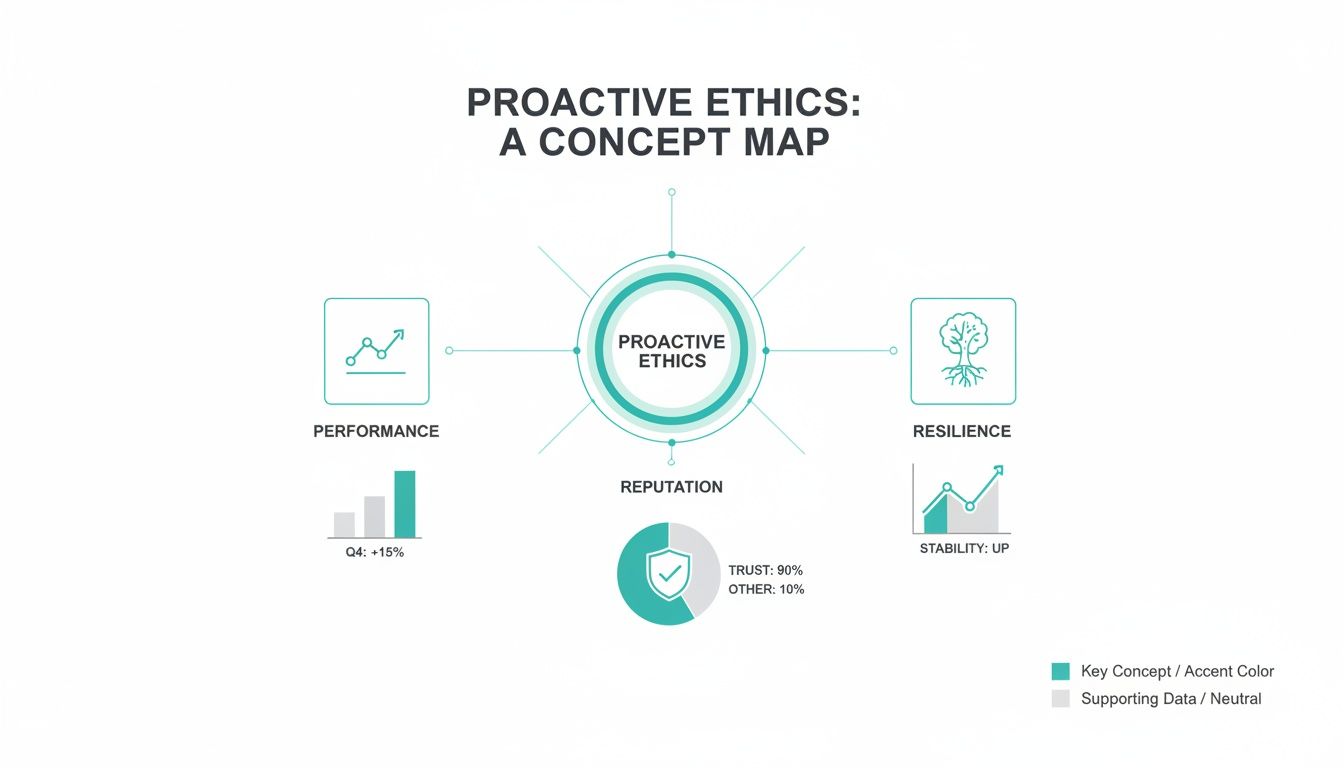
As you can see, a proactive stance isn't an isolated HR initiative; it's a core driver of business success. For leaders in Compliance, Risk, and HR, embracing this shift is the key to building a competitive and sustainable enterprise.
From Compliance Checklist to Strategic Advantage
Viewing ethics ethics as just a compliance chore is a massive strategic error. When embedded correctly, it becomes a powerful engine for creating business value. Organizations with strong, integrated ethical principles consistently outperform their peers. The data proves it: a deeply integrated ethics program is a powerful financial asset that lowers liability and enhances brand equity.
Unfortunately, many organizations are stuck in a reactive posture, struggling with common roadblocks:
Siloed Information: Risk intelligence is scattered across HR, Legal, and Security, preventing a complete view of internal threats.
Reactive Tools: Most methods rely on whistleblowers or annual audits, meaning you’re always reacting to past events.
Invasive Surveillance: Some "solutions" turn to employee surveillance, which demolishes trust, violates EPPA regulations, and creates immense legal liability. This approach is not only unethical but also ineffective, as it drives risky behavior further underground.
The table below starkly contrasts the old, reactive model with the modern, proactive approach that defines the new standard in ethical risk management.
Reactive vs Proactive Ethical Risk Management
Aspect | Reactive Approach (The Old, Broken Way) | Proactive Approach (The New Standard) |
|---|---|---|
Philosophy | "Wait and see." Address issues only after misconduct is reported or discovered. | "Prevent and prepare." Identify and neutralize risk indicators before they escalate. |
Primary Tools | Whistleblower hotlines, annual audits, and post-incident forensic investigations. | Non-intrusive, EPPA-aligned AI, continuous risk assessments, and integrated data analytics. |
Focus | Punishment and remediation. Centered on assigning blame after the damage is done. | Prevention and cultural improvement. Focused on strengthening integrity from within. |
Business Impact | High costs from fines, investigations, and reputational damage. Creates a culture of fear and silence. | Lowered liability, enhanced brand trust, and improved employee morale. Fosters a culture of integrity. |
This comparison highlights a fundamental choice: do you want to be constantly putting out fires, or do you want to build an organization that’s fire-resistant from the ground up?
The Proactive, Non-Intrusive Alternative
The future of enterprise ethics ethics lies in technology that respects employee dignity while delivering the risk intelligence you need. This is where a new standard, powered by non-intrusive, EPPA-aligned AI, makes all the difference. Instead of monitoring private chats or deploying surveillance—practices that are often illegal and always destructive to culture—this approach analyzes consented, structured data to spot the early warning signs of human-factor risks like fraud or conflicts of interest.
By focusing on prevention over reaction, organizations can move from a state of constant vulnerability to one of confident resilience. This model empowers teams to address human-factor risks before they escalate into crises, all while upholding the highest ethical standards.
This proactive method isn't just about dodging legal trouble. It's about building a healthier, more transparent, and ultimately more profitable business. To see how this works, check out our guide on building an ethical ethics framework.
The Hidden Costs of Ethical Blind Spots
Ethical failures aren't isolated events; they are seismic shocks that send destructive tremors through an entire organization. For too long, companies have taken a reactive stance, treating internal risk as something to deal with after the damage is done. This approach isn't just outdated—it’s a catastrophic financial gamble that ignores the true cost of prevention failure.
An undetected conflict of interest or a minor compliance breach can quietly fester, growing into a full-blown crisis that paralyzes operations and costs millions.
The fallout from an ethical blind spot goes far beyond the initial incident. It triggers a cascade of expensive and disruptive consequences, starting with multi-million dollar regulatory fines and escalating into protracted legal battles. Every headline detailing misconduct chips away at your brand, shattering customer trust and employee morale. Rebuilding that reputation is a slow, arduous, and costly process.

From Minor Lapse to Major Crisis
Consider a common scenario: a mid-level manager has an undisclosed financial stake in a vendor. In a reactive system, this conflict of interest goes completely unnoticed. Over time, this relationship leads to inflated contracts, substandard service, and eventually, a major fraud scheme. The problem only comes to light during an audit or whistleblower report—long after significant damage has occurred.
The organization is then forced into a reactive spiral. Operations are disrupted as invasive forensic investigations begin, pulling key personnel away from their duties. The cost of these investigations alone can be staggering.
Every reactive investigation is an admission of failure. It signifies that the systems designed to uphold ethics ethics and protect the organization were insufficient. It’s a clear signal that the preventative framework was missing, exposing the company to unnecessary liability.
The financial bleed continues long after the initial discovery, creating a domino effect of direct and indirect costs.
The True Financial Toll of Reaction
The costs of a reactive approach are multi-layered and dangerously underestimated. Leaders in Compliance, Risk, and Legal must look beyond the obvious fines and see the full picture of what’s at stake when prevention fails.
Direct Financial Losses: This includes the initial fraud or theft and the staggering costs of regulatory penalties. In regulated industries, these fines can easily reach tens of millions of dollars.
Investigation and Legal Expenses: Forensic accountants, external legal counsel, and internal investigation teams represent a massive, unbudgeted expenditure that can drag on for years.
Reputational Damage: A damaged brand directly impacts the bottom line through lost customers, decreased sales, and a devalued stock price. A single misconduct headline can wipe out billions in market capitalization.
Operational Disruption: Productivity plummets when teams are distracted by internal turmoil. Key projects are delayed, and forward momentum grinds to a halt.
Loss of Human Capital: Ethical scandals destroy employee morale and trust in leadership, leading to higher turnover among top performers who refuse to be associated with a compromised brand.
These costs highlight a critical truth: waiting for an ethical failure is no longer a viable strategy. Explore the true cost of reactive investigations and see why a proactive, AI-driven model is the only financially sound path forward. Prevention is not just an ethical imperative; it’s a financial necessity.
Why Psychological Safety Is Your Best Risk Defense
An organization's ethical framework is only as strong as its culture. The absolute bedrock of a healthy, ethical culture is psychological safety. It’s the shared belief that team members can flag concerns, ask questions, and admit mistakes without fear of retaliation or humiliation. It’s the engine that powers a genuine speak-up culture.
When people feel secure, they become your first and most effective line of defense against internal threats. But when fear dominates, you get silence—and silence is the ideal breeding ground for human-factor risk.
The Direct Link Between Fear and Failure
In a workplace with low psychological safety, fear is the primary motivator. Employees will not report a compliance breach, question a dubious instruction, or flag potential fraud if they worry about being labeled a troublemaker or risking their job. This hesitation creates a dangerous blind spot for HR and Risk leaders. Your policies become meaningless if your people are too scared to uphold them.
Cultivating a safe environment isn’t a “soft skill.” It's a core risk mitigation strategy.
When employees fear speaking up, they inadvertently become complicit in the risks that threaten the organization. Psychological safety breaks this cycle by transforming fear into proactive engagement and shared responsibility for upholding your ethics ethics standards.
This is how you get ahead of the internal threats that lead to expensive, messy, and reactive investigations.
The Damaging Impact of Surveillance on Safety
In a misguided attempt to mitigate risk, some organizations turn to old-school employee surveillance tools. This move is a disaster. First, it is fraught with legal landmines under regulations like the EPPA. Second, and more importantly, it is completely counterproductive. Surveillance absolutely demolishes the psychological safety required for an ethical workplace.
When employees feel they are being watched or secretly monitored, the fallout is severe:
Trust Evaporates: It sends a clear message: "We don't trust you," creating a toxic "us vs. them" divide.
Transparency Disappears: Afraid of being misjudged, people hide mistakes and avoid reporting issues, making early risk detection impossible.
Collaboration Grinds to a Halt: Innovation dies when people are afraid to take even small interpersonal risks.
To build a real defense against internal threats, you must foster psychological safety. It’s the only way to create an environment where ethical concerns are brought to the surface.
Building a Resilient, High-Trust Environment
The data is overwhelming: psychological safety is a non-negotiable cornerstone of high-performing, ethical companies. A recent PwC survey found that employees with high levels of psychological safety are 72% more motivated. Conversely, workplaces that punish failure create a culture of concealment. You can explore how workforce sentiment connects to risk in the full PWC report.
This is why non-intrusive, EPPA-compliant tools are so vital. Instead of destroying trust with surveillance, a modern approach uses AI to analyze consented, structured data for specific risk indicators. This method respects employee dignity and privacy, reinforcing the psychological safety you need to build a truly resilient organization. By prioritizing safety, you empower your people to become your greatest asset in protecting the enterprise.
Navigating Compliance With EPPA-Aligned Technology
For any modern enterprise, balancing internal risk management with respect for employee rights is a defining challenge. Legal and Compliance teams know that navigating complex regulations like the Employee Polygraph Protection Act (EPPA) is a pillar of sustainable ethics ethics. The EPPA draws a hard line, forbidding any methods that imply lie detection or psychological coercion.
This places organizations clinging to outdated risk management tools in a precarious position. Many so-called "solutions" operate in a legal gray area, using methods that create staggering liability. Invasive surveillance or tools claiming to analyze behavior often clash with what the EPPA outlaws. Adopting such technology isn’t just an ethical misstep—it's an invitation to costly lawsuits and regulatory penalties.

Understanding EPPA's Red Lines
The EPPA was enacted to outlaw invasive, high-pressure tactics that violate employee dignity. For any professional managing human-factor risk, understanding what the act forbids is critical. These are firm legal mandates.
No Lie Detection: The law bans polygraphs and any other device or method claiming to offer a diagnostic opinion on an individual's honesty.
No Coercive Methods: Any process that psychologically pressures an employee or implies their job is at risk for not submitting to a test is illegal.
Strict Limitations: Even in the rare cases where polygraphs are permitted (e.g., ongoing investigations into economic loss), the rules are incredibly strict and easy to violate.
The core of the EPPA is protecting employee dignity and privacy. Any technology that acts as a backdoor lie detector or surveillance system directly clashes with this principle, exposing the company to unacceptable legal and reputational damage.
This is where the conversation about ethics ethics becomes a practical matter of liability. The tools you select to manage internal threats must be built for compliance, not patched over with flimsy legal justifications.
The Proactive and EPPA-Aligned Solution
The challenge is to gain necessary risk intelligence without crossing these critical legal lines. A proactive, non-intrusive approach is the only way to strike that balance. This marks the new standard for internal risk prevention, moving away from reactive investigations and invasive monitoring.
Logical Commander was designed to solve this exact problem. Our AI-driven platform delivers essential insights into human-factor risks without ever using the methods EPPA forbids. We believe that strong ethics ethics and effective risk management aren't opposing forces—they reinforce each other.
Our approach is fundamentally different from legacy and surveillance-based systems:
No Surveillance: We do not monitor employee communications, track keystrokes, or conduct any form of secret observation.
No Lie Detection Logic: Our system is not built to judge truthfulness. It is an analytical tool for identifying predefined risk indicators, not an interrogation machine.
Focus on Consented Data: The platform analyzes structured, consented data to find specific risk indicators tied to issues like fraud or conflicts of interest.
This methodology keeps your organization firmly on the right side of the law. It protects the psychological safety of your people and shields the business from the liabilities that come with non-compliant tools. For a deeper look, learn more about operating an EPPA compliant AI platform and how it fortifies your entire risk management framework.
Putting Proactive Ethics Into Practice
Moving from high-level principles to real-world action is where a commitment to ethics ethics proves its value. For too long, companies have been trapped in a reactive loop, with HR, Legal, and Security teams operating in silos and only sharing information after a crisis. This fragmented model creates dangerous blind spots, letting human-factor risks fester undetected.
A proactive ethical framework demands a different operational model—one that unifies risk intelligence and empowers teams to act before damage occurs. This is the new standard for internal risk prevention.
Centralizing Risk Intelligence With E-Commander
The first step is to tear down the information silos that leave your organization vulnerable. This is precisely what Logical Commander’s E-Commander platform was built to do. It serves as a centralized intelligence hub, creating a single, coordinated operational layer for every team involved in risk management.
Instead of working with scattered data and delayed communications, E-Commander gives HR, Compliance, and Legal a unified view of potential internal threats. It ensures all stakeholders are armed with clear, actionable insights to manage human-factor risk collaboratively.
The current landscape of declining trust makes this unified approach more critical than ever. A 2025 trends report from Great Place To Work highlights that global trust in employers has fallen, with only 55% of employees viewing their managers as reliable. For risk and compliance leaders, these trends signal an urgent need for proactive, integrity-focused platforms that can address the root causes of internal threats. You can explore more about these global workplace trends.
The Risk-HR Module: A New Standard for Prevention
At the heart of this proactive model is the Risk-HR module, an AI-driven engine designed to identify the early indicators of human-factor risk without resorting to invasive methods. This is where ethics ethics becomes a functional reality.
Risk-HR analyzes consented, structured data to flag potential warning signs related to:
Conflicts of Interest: Identifying undisclosed relationships that could compromise impartiality.
Workplace Fraud: Spotting anomalies that suggest potential financial misconduct.
Compliance Breaches: Alerting teams to actions that deviate from regulatory and internal policies.
Ethical Misconduct: Recognizing patterns that indicate a departure from the organization's code of conduct.
Crucially, this is achieved without surveillance. The system does not monitor private communications or analyze behavior in a way that infringes on employee dignity. It is a non-intrusive, EPPA-aligned tool that provides risk intelligence while reinforcing a culture of trust.
This platform empowers your teams to move from a reactive posture of forensic investigation to a proactive stance of prevention, protecting both the organization and its people.
Logical Commander Platform Features
The E-Commander platform is built on features that directly map to the goals of proactive and ethical risk management. Each component is designed to deliver intelligence while upholding the highest standards of compliance and employee respect.
Feature | Description | Ethical & Business Benefit |
|---|---|---|
Unified Risk Hub | Centralizes risk data from HR, Legal, and Security into a single platform for a holistic view. | Breaks down information silos, ensuring consistent and fair application of policies across the organization. |
Risk-HR Analytics | Uses AI to analyze consented, structured data for predefined indicators of fraud, misconduct, and conflicts of interest. | Provides early warnings without resorting to surveillance, respecting employee privacy and EPPA regulations. |
Configurable Workflows | Allows organizations to route alerts and intelligence to the appropriate teams based on risk type and severity. | Ensures that sensitive information is handled by the correct personnel, maintaining confidentiality and proper governance. |
Non-Intrusive Design | Operates without monitoring emails, chats, or personal activity, focusing solely on consented business data. | Preserves psychological safety and employee trust, fostering a culture where ethical concerns can be raised openly. |
By integrating these features, organizations can build a resilient defense against internal threats that is both powerful and principled.
Build a More Resilient Enterprise Today
In today's complex business environment, a proactive ethical framework is a strategic necessity. For too long, organizations have been stuck in a reactive loop, treating internal risk like a fire to be put out only after the alarm sounds.
That entire approach is an admission of failure. It leaves your organization perpetually exposed to financial loss, operational disruption, and the kind of reputational ruin that takes years to repair. Waiting for an incident to happen isn't a strategy; it's a massive liability.
A commitment to ethics ethics must move beyond policy documents and become part of your daily operations. By embracing a modern, non-intrusive model, you aren’t just managing risk—you’re actively investing in resilience, governance, and long-term value creation.

Embrace the New Standard in Prevention
The shift toward proactive prevention is what separates a forward-thinking enterprise from one constantly looking in the rearview mirror. It demands a move beyond outdated, invasive surveillance methods that destroy employee trust and create serious legal exposure. A system that respects human dignity while delivering critical risk intelligence is the new benchmark for excellence in corporate governance.
Logical Commander's EPPA-aligned platform was purpose-built to meet this need. Our AI-driven approach gives you the actionable insights required to identify and mitigate human-factor risks before they escalate—all without resorting to illegal or unethical techniques.
This is what it means to build a truly resilient organization:
Strengthen Governance: Unify risk intelligence across departments for a coordinated, effective defense against internal threats.
Protect Your Reputation: Prevent the ethical lapses that destroy brand trust and shareholder value.
Drive Sustainable Value: Foster a culture of integrity that supports genuine, long-term growth.
It's time to abandon the costly cycle of reaction and embrace the new standard in internal risk prevention. A proactive stance on ethics ethics is the most effective way to build a stronger, more secure, and more competitive enterprise.
Partner for a Stronger Future
Building a resilient enterprise requires a new way of thinking—and the right technology to make it a reality. By joining our PartnerLC program, B2B SaaS providers and consultants can equip their clients with the leading solution for ethical risk management. Help your clients move beyond reactive forensics and toward a future of proactive prevention.
Your Questions on Enterprise Ethics, Answered
When leaders move from theory to action on enterprise ethics ethics, a few key questions arise. It's one thing to have a policy on paper; it's another to build a proactive, modern system that actually works without creating new liabilities. Let's tackle the most common concerns from Compliance, Legal, and HR teams.
How Can We Identify Internal Risks Without Becoming Big Brother?
This is the critical question. The answer is simple: effective, ethical risk management has nothing to do with invasive surveillance. The old way—reading emails, tracking keystrokes—doesn't just destroy trust; it walks you into a legal minefield with regulations like the EPPA.
A modern approach shifts the focus entirely. Instead of monitoring people, you analyze consented, structured business data for specific risk indicators. A platform like Logical Commander, for instance, flags potential conflicts of interest or fraud indicators based on predefined risk scenarios. It's about getting actionable intelligence to prevent a crisis while respecting employee privacy and dignity.
Isn't Our Annual Compliance Training Enough?
While your code of conduct and training are essential, they are passive defenses. They set the rules but give you zero visibility into what's actually happening. A reactive model forces you to wait for a whistleblower report or a painful audit, but by then, the damage is already done.
Think of it this way: training is the seatbelt, but a proactive system is the collision-avoidance sensor. A platform like E-Commander complements your existing framework with an active, early-warning mechanism. It helps you see if the ethical standards you've set are being followed in practice, not just in theory.
How Does an AI Platform Fit Into Our Workflows Without Disrupting Everything?
A modern risk platform is designed for seamless integration, not a rip-and-replace overhaul. The E-Commander platform, for example, is built to be a unified intelligence hub that makes your existing HR and security systems smarter. It’s designed to break down the departmental silos that let major risks fester unnoticed.
Workflows can be configured to route alerts and actionable intelligence to the correct teams—be it HR, Legal, or Compliance—ensuring a coordinated and efficient response to potential threats. This makes your entire risk management ecosystem more effective.
The goal isn't to add another complicated tool. It's to empower the teams you already have with better intelligence, making it easier for them to uphold the organization's commitment to ethics ethics.
Ready to build a more resilient and ethical enterprise? Logical Commander provides the new standard in proactive, non-intrusive internal risk prevention.
Request a Demo: See our EPPA-aligned platform in action.
Start a Free Trial: Get hands-on access to the E-Commander platform.
Join PartnerLC: Become an ally and bring the future of risk management to your clients.
Contact Us: Contact our team today to learn how to move from reaction to prevention.