%20(2)_edited.png)

A Practical Guide to Insider Threat Detection Solutions

Updated: Dec 26, 2025
Insider threat detection solutions are your first line of defense against risks coming from the inside—from the employees, contractors, and partners who already have the keys to the kingdom. Unlike old-school security focused on keeping bad actors out, these modern systems analyze user behavior to spot the early warning signs of misconduct, data theft, or simple negligence before a crisis erupts.
The best platforms do this ethically, focusing on objective risk signals instead of invasive, trust-destroying surveillance.
Why Ethical Insider Threat Detection Is Non-Negotiable
Let’s be honest: managing internal risk without creating a "Big Brother" culture is one of the toughest challenges leaders face today. You’re walking a tightrope, trying to protect sensitive data and intellectual property while also maintaining a workplace built on respect and trust.
Traditional methods, which usually mean reactive surveillance and invasive monitoring, are completely out of step with the modern world. They just don't work in an era defined by remote work, tough privacy laws, and rising ESG (Environmental, Social, and Governance) expectations.
Shifting to proactive, ethical risk management isn’t just about staying compliant anymore. It’s a genuine strategic advantage that reframes security from a punitive function to a protective one, safeguarding both the organization and its people.
The Soaring Demand for Modern Solutions
You can see this shift happening in the market data. The global demand for insider threat protection is exploding, with some forecasts projecting the market could reach $38 billion by 2036. This incredible growth is being driven by the realities of remote work, the massive shift to the cloud, and intense regulatory pressure from laws like GDPR.
While North America is currently the biggest market, Europe is catching up fast, largely because of its strict data-protection laws. It's a clear signal of a worldwide move toward smarter, proactive governance. You can explore more data on these market dynamics to see the full scope of this industry shift.
This isn't just another security trend; it’s a fundamental change in how modern businesses have to operate. If you fail to adapt, you're not just risking a data breach—you're looking at legal penalties, serious reputational damage, and a complete erosion of employee trust.
An ethical approach to insider threat detection isn't a "nice-to-have"—it's a core component of a resilient and trustworthy organization. It demonstrates a commitment to protecting assets while respecting the dignity and privacy of the workforce, which is essential for long-term success.
Moving Beyond Outdated Surveillance
The real difference between the old way and the new way comes down to philosophy. Outdated systems are built on the assumption that every employee is a potential suspect, using constant monitoring that feels invasive and demoralizing.
Modern insider threat detection solutions are far more intelligent and humane. Instead of watching every keystroke, they focus on identifying objective risk indicators that deviate from established norms and company policies—without ever making a judgment about an employee's intent.
This modern approach helps organizations solve several critical challenges:
Protecting Intellectual Property: Pinpointing unusual data access or transfer patterns that could be early signals of IP theft.
Preventing Fraud: Flagging procedural violations or potential conflicts of interest that often show up before financial misconduct occurs.
Ensuring Workplace Integrity: Detecting signals related to harassment or other serious policy violations, allowing HR to intervene early.
Strengthening Compliance: Providing a clear, auditable trail of risk detection and mitigation that satisfies regulators.
The table below breaks down the fundamental differences between these two philosophies. It highlights the crucial shift away from reactive, invasive methods toward a model that builds resilience and trust.
Modern vs. Traditional Insider Risk Approaches
Attribute | Traditional Approach (Reactive & Invasive) | Modern Approach (Proactive & Ethical) |
|---|---|---|
Core Philosophy | Assumes negative intent ("trust but verify"). Treats employees like potential suspects. | Assumes positive intent ("verify, then trust"). Focuses on protecting people and assets. |
Methodology | Invasive surveillance: keystroke logging, email scanning, screen recording. | Non-invasive analysis: focuses on objective risk signals and policy deviations. |
Timing | Reactive. Generates alerts after a potential violation has already occurred. | Proactive. Identifies early warning signs before an incident can escalate. |
Legal Risk | High potential for privacy violations (GDPR, CCPA) and creating legal liability. | Designed for compliance. Respects privacy and avoids creating unnecessary legal exposure. |
Cultural Impact | Creates a culture of fear, suspicion, and distrust. Damages morale and retention. | Fosters a culture of integrity, accountability, and psychological safety. |
Outcome | Massive alert fatigue from false positives, making it hard to spot real threats. | Delivers clear, actionable intelligence on true risks, enabling targeted intervention. |
By focusing on objective signals rather than subjective surveillance, you can build a security posture that is both incredibly effective and deeply ethical.
This guide gives you a clear roadmap to navigate this complex landscape and implement a solution that truly protects your organization from the inside out.
First Things First: Blueprint Your Insider Threat Program
Jumping straight into product demos for insider threat detection solutions without a plan is like building a house with no blueprint. Sure, you might end up with something standing, but it almost certainly won't be what you actually need or wanted. Before you even think about evaluating technology, the first critical step is to map out your organization's unique risk landscape and get your requirements down on paper.
This isn’t just an exercise for the IT or security teams. A successful blueprint demands a unified front, bringing leaders from Human Resources, Legal, and IT to the same table. Each of these departments offers a vital perspective on what constitutes a risk, ensuring the final program is balanced, effective, and won’t get rejected by the company culture.
Identify Your Unique Risk Landscape
Every single organization has a different risk profile. A pharmaceutical company is probably obsessed with protecting its intellectual property, while a financial institution is far more focused on preventing fraud and staying on the right side of regulators. You have to start by asking some tough, targeted questions to figure out what you're actually trying to protect.
What are your crown jewels?
Intellectual Property: Think trade secrets, patents, proprietary formulas, or critical source code.
Sensitive Data: This includes customer PII, internal financial records, or employee health information.
Operational Integrity: Who has access to critical infrastructure? What about sensitive supply chain data?
Reputation: What kind of leak could cause catastrophic brand damage?
Once you know what's at stake, you can start mapping potential threats to those assets. Get specific. Brainstorm scenarios like a departing employee swiping a client list, a contractor poking around in project files they shouldn't have access to, or even simple negligence that leads to a massive data leak.
This process transforms the vague idea of an "insider threat" into a set of concrete, plausible scenarios your organization has to be ready for. For a more structured approach, a comprehensive guide to insider risk management can offer a deeper framework for this crucial identification phase.
Align Stakeholders and Define Requirements
With your potential risks mapped out, the next move is to get your key stakeholders in a room. This collaborative step helps you dodge the common pitfall of picking a tool that solves one department's problem while creating a dozen new headaches for everyone else.
The goal of these initial meetings is to hammer out a unified set of requirements.
IT and Security will naturally focus on the technical side: integration capabilities, data sources, and how alerts will work. They live and breathe the existing tech stack and know how any new solution has to fit in.
Human Resources will be the champions for employee experience and cultural fit. They're there to make sure the program is seen as protective, not punitive, and can help define risk indicators tied to things like workplace misconduct or disengagement.
Legal and Compliance are there to provide the guardrails. Their input is non-negotiable for ensuring the entire program operates within legal and ethical lines, respecting privacy regulations like GDPR from day one.
A truly effective insider threat program is not just a security tool; it's a cross-functional business process. Without alignment between HR, Legal, and IT, even the most advanced technology is destined to fail due to cultural rejection, legal challenges, or operational friction.
The visual below shows a simple, three-step framework for managing these risks ethically once they've been identified.
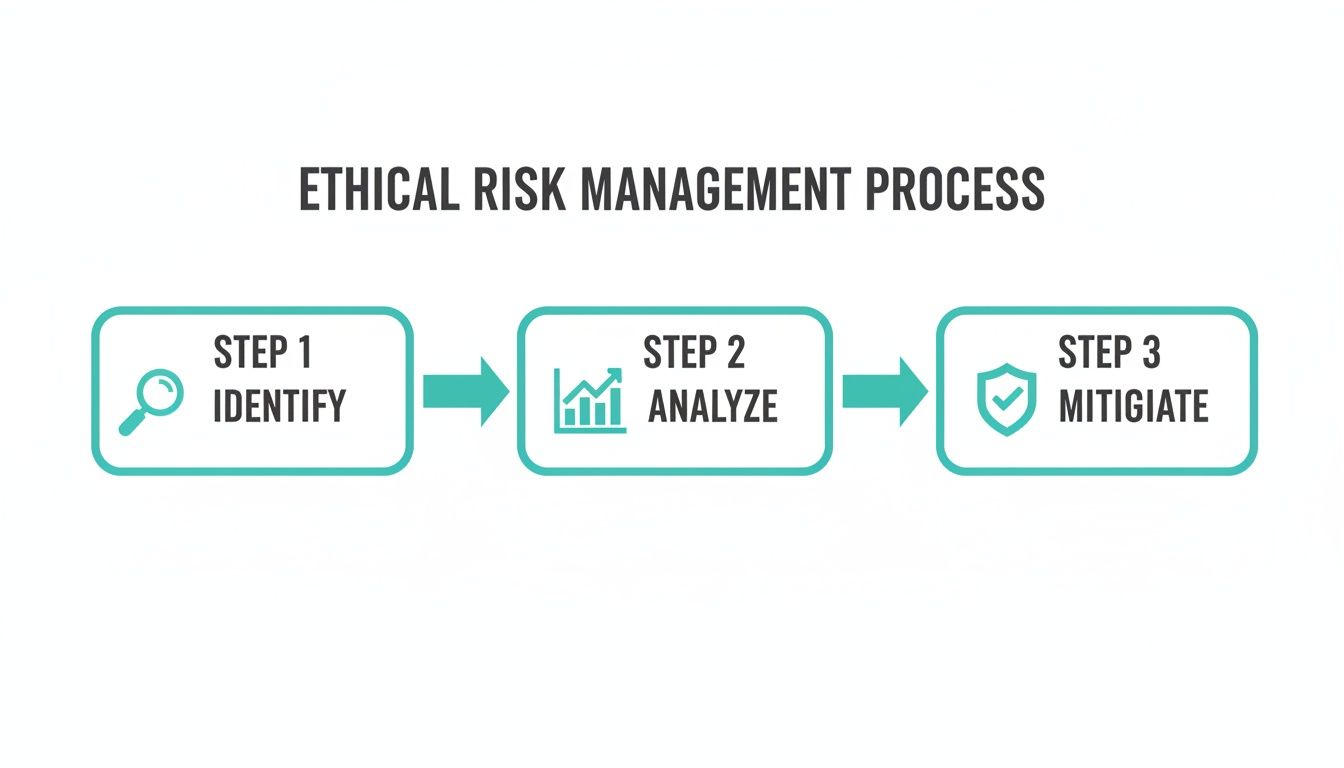
This process highlights a critical point: after identifying a potential risk, it has to be analyzed for context and severity before any mitigation happens. This ensures a measured and fair response every time.
Create a Documented Needs Assessment
The final output from this blueprinting phase should be a formal needs assessment. This document becomes your North Star for the entire procurement process. It needs to clearly outline the specific problems you’re trying to solve, the technical and operational requirements for a solution, and the legal and cultural principles your program must live by.
By investing the time to build this blueprint upfront, you ensure that when you finally start evaluating insider threat detection solutions, you’re measuring them against your actual needs—not just a vendor's slick feature list. This foundational work is what keeps you from buying a powerful tool that ultimately doesn't solve your real-world problems.
Navigating the Complex Legal and Ethical Landscape
Implementing any kind of employee monitoring technology is walking into a minefield. You're immediately surrounded by a dizzying alphabet soup of regulations like GDPR and CPRA, where a single misstep can lead to crippling fines, a PR nightmare, and the complete collapse of employee trust.
But here’s the thing: building your program with these regulations in mind from day one isn't a limitation. It's your greatest strategic advantage.
This approach forces you to be clear, transparent, and fair in everything you do. It shifts the entire conversation from invasive surveillance to ethical risk management, ensuring your insider threat detection solutions are designed to protect both the company and its people.
Privacy and Transparency Aren't Optional
The bedrock of any legally sound insider threat program is total transparency. Your employees have a right to know how their data is being used and why. Let's be blunt: practices like psychological profiling, covert surveillance, or using AI to guess someone's intent are not only unethical but flat-out illegal in many places.
An ethical program never tries to read minds. Instead, it focuses on objective, observable actions that deviate from clear company policies. For example, a system might flag that an unusual amount of data was downloaded from a secure server, but it won't try to guess why the employee did it. That critical step—providing context and verification—is always left to human oversight.
This all starts with establishing an acceptable use policy that spells out the rules of the road for everyone. No ambiguity, no surprises.
Building your insider threat program on a foundation of legal and ethical principles is the only sustainable path. It builds trust, strengthens your company culture, and protects the organization from the staggering costs of both incidents and litigation.
The financial case for getting this right is massive. The numbers don't lie. Incidents that take over 90 days to detect saddle companies with average annual costs of nearly $18.7 million. And the reactive cleanup is a money pit, with organizations spending about $211,000 per incident on containment after the damage is done. Compare that to the average $37,700 spent on proactive monitoring. It's a powerful argument for shifting your budget toward early, ethical signal detection.
The Guardrails of a Compliant Program
To stay on the right side of the law and foster a culture people actually want to work in, your program needs to be built around a few non-negotiable principles. These aren't just suggestions—they are the guardrails that keep your efforts effective and ethical.
Policy-Driven Monitoring: Every monitoring activity must be tied directly to a specific, documented company policy. If you don't have a written rule against it, you shouldn't be monitoring for it. Simple as that.
Data Minimization: Only collect the data you absolutely need to spot risk indicators. Avoid the "collect it all" mindset that scoops up massive amounts of personal or irrelevant information.
Proportionality: The response must fit the risk. A minor policy slip-up shouldn't trigger a full-blown forensic investigation.
Human Oversight: Technology should only serve up objective indicators. The final call—every investigation, every conclusion—must be made by trained human professionals.
Sticking to these principles ensures you respect employee privacy while still being effective. To go deeper on this, you should read also about detecting insider threats with ethical AI, which explores how to balance security needs with employee rights.
Creating a Process That's Auditable and Defensible
If you ever face a legal challenge or a regulatory audit, you have to prove that your program is fair, consistent, and compliant. That means you need an auditable trail for every single action taken.
Modern insider threat detection solutions are designed for exactly this. Every alert, every investigative step, and every decision must be logged in a tamper-proof system that's easily accessible to auditors. This traceability is your proof that you're following due process and applying policies the same way for every employee, from the front lines to the C-suite.
Ultimately, a well-designed, ethical insider threat program does more than just catch bad actors. It reinforces a culture of integrity, shows a real commitment to employee privacy, and gives you a legally defensible framework to protect what matters most.
How to Properly Evaluate Insider Threat Solutions

Alright, you've done the hard work of defining your needs. Now it's time to step into the marketplace and start talking to vendors. This is where you have to cut through the flashy marketing demos and get to the heart of what a platform can actually do for you.
Choosing the right insider threat detection solutions comes down to asking tough, pointed questions and knowing a good answer from a bad one.
A vendor's sales pitch will always sound perfect, but your job is to pressure-test their claims. I've found it's best to focus on three critical areas: the core technical capabilities, their commitment to privacy-by-design, and the governance framework the tool actually supports. Getting this right means finding a true partner, not just another piece of software.
Core Technical Capabilities That Matter
Beyond a slick user interface, the real power of any solution is in its technical guts. Can it plug into your existing ecosystem without a massive IT project? And more importantly, can it grow with you without falling over?
When you’re digging into the tech, zero in on these areas:
Seamless Integration: How easily does this platform talk to your other systems? You need to ask for specifics. Does it have deep, API-first integrations with your HRIS (like Workday or SAP SuccessFactors), your IT service management tools (like ServiceNow), and your identity providers? A vendor who tells you "we can build a custom script for that" is waving a huge red flag. That means manual work and data silos for you.
True Scalability: Will this solution perform just as well when you grow from 5,000 employees to 50,000? This is a crucial question. Grill vendors on their architecture. How do they handle data processing and storage at enterprise scale? Performance degradation is a classic problem with platforms that weren't truly built for growth.
Transparent AI Methodology: The term "AI-powered" is thrown around so much it's almost meaningless. Your job is to make them define it. Ask them to explain their data models. Are they using a "black box" algorithm they can't explain, or can they clearly articulate how the system flags risk indicators based on objective data and your established policies?
A solution that fails on any of these technical fronts will create more headaches than it solves. You’ll be stuck with a frustrating implementation and a terrible return on your investment. For a closer look at the different technologies out there, this overview of insider threat detection tools is a great resource.
Asking the Tough Privacy and Ethical Questions
This is, without a doubt, the most important part of your evaluation. A powerful tool that violates employee trust or breaks privacy laws is a massive liability, not an asset. Modern, ethical insider threat detection solutions are built on a foundation of privacy, not surveillance. Period.
Your evaluation has to include questions designed to expose a vendor's core philosophy on this.
The most crucial distinction you can make is whether a tool delivers objective risk indicators or subjective judgments. A system that tries to guess an employee's intent is crossing a dangerous ethical and legal line. An ethical solution simply flags a deviation from policy and leaves the contextual analysis to human professionals.
Use these questions to see where a vendor really stands:
Does the tool make judgments or provide objective indicators? * Green Flag: The vendor stresses that their platform only surfaces factual, policy-based signals (e.g., "Data was accessed outside of business hours") without trying to guess why. * Red Flag: The vendor uses loaded phrases like "predicting malicious intent" or "scoring employee trustworthiness." Run.
Is every single action within the platform auditable? * Green Flag: The platform keeps a complete, tamper-proof log of every analyst's action, every query, and every decision. Full accountability is non-negotiable. * Red Flag: The vendor gets vague about logging capabilities or admits that some administrative actions aren't tracked.
Does it actively avoid surveillance techniques? * Green Flag: The solution is designed to avoid collecting unnecessary personal data. It steers clear of invasive methods like keystroke logging or screen recording. * Red Flag: The vendor proudly lists surveillance features as a key selling point. This is a huge sign they don't understand the modern legal and cultural landscape.
The Vendor Evaluation Checklist
Choosing the right partner requires a structured and consistent approach. You need to ask every vendor the same core questions so you can compare their answers on an even playing field. I've put together this checklist to guide your conversations and help you cut through the noise.
Use this table to keep your evaluations of different insider threat detection solutions organized and objective.
Category | Key Question | What to Look For (Green Flags) | What to Avoid (Red Flags) |
|---|---|---|---|
Technology | How does your platform integrate with our core HR and IT systems? | Offers pre-built, API-first integrations with major platforms. | Relies on custom scripts or manual data uploads. |
Privacy | Can you explain how your AI avoids making judgments about intent? | Focuses on objective, policy-based indicators. The AI is explainable. | Uses black-box algorithms or "sentiment analysis" to score users. |
Governance | How does the platform support a legally defensible investigation process? | Provides a complete, unalterable audit trail for every action. | Lacks robust logging or traceability features. |
Scalability | What is your architecture for handling data from over 25,000 users? | Discusses a distributed, cloud-native architecture built for scale. | Vague answers or a focus on single-server on-premise deployments. |
By using this framework, you empower your team to pick a solution that is not only powerful but also fundamentally ethical, compliant, and aligned with a culture of trust. This diligent evaluation process is the single most important factor in a successful long-term partnership.
Rolling Out Your Solution and Driving Adoption

You’ve chosen the right software. That was a major milestone, but now the real work begins. A successful rollout of your insider threat detection solutions is less about flipping a switch and more about executing a smart change management strategy.
The best technology in the world is useless if it’s poorly deployed, misunderstood, or rejected by the very people it’s designed to protect. The goal isn't just to install software; it's to weave a new operational capability into the fabric of your organization. This requires a roadmap that addresses both the technical side and, more importantly, the human element.
Start with a Phased Rollout
A "big bang" launch across the entire company is a recipe for disaster. It magnifies every small issue and will completely overwhelm your implementation team. A phased rollout is a much smarter approach.
Start with a targeted pilot program involving a specific department or business unit. This controlled launch acts as your crucial testing ground, allowing you to work out the kinks in a low-stakes environment.
A pilot program helps you:
Identify and Fix Technical Glitches: Find and resolve any integration snags or configuration problems before they impact the whole company.
Refine Alerting and Workflows: Fine-tune the system's rules to minimize false positives. You need to ensure the alerts hitting your security and HR teams are genuinely actionable.
Gather Real-World Feedback: Get invaluable input from your pilot users. This will help you improve training materials and communications for the wider launch.
Create Internal Champions: The pilot group becomes your first set of advocates who can share their positive experiences and build momentum.
Think of the pilot as your dress rehearsal. It’s your chance to iron out all the wrinkles before the main performance.
Communicate the Why, Not Just the What
Beyond the technical setup, the human element is what will make or break this initiative. Your employees have to understand why this program is being implemented. If you handle the communication poorly, people will immediately see it as invasive "Big Brother" surveillance, and you’ll lose their trust instantly.
Frame the program as a protective measure—for everyone. Your messaging needs to be consistent, transparent, and focused on the benefits. The goal is not to spy on people, but to safeguard company assets, protect sensitive customer and employee data, and ensure a fair and ethical workplace.
Your communication strategy has to be built on transparency. Clearly articulate that the solution focuses on objective, policy-based risk signals, not on judging individuals. This reframes the program from a tool of suspicion to a mechanism for upholding shared company values and protecting everyone’s interests.
Highlighting how the system helps the company act early on potential risks—from accidental data leaks to serious misconduct—positions it as a tool that strengthens the entire organization's integrity.
Train Your Teams for New Workflows
Real adoption hinges on empowering your key stakeholders—HR, Legal, Security, and IT—with the knowledge to use the new system confidently. This training has to go beyond basic software tutorials. It must focus on the new collaborative workflows this platform makes possible.
Your training curriculum should cover:
The Operational Language: Make sure every team understands the platform's terminology. What’s the difference between a "preventive risk" and a "significant risk"? Everyone needs to be on the same page.
The Investigation Process: Walk teams through the step-by-step process of receiving an indicator, conducting a preliminary analysis, and escalating it according to your documented governance framework.
Roles and Responsibilities: Clearly define who does what. Who’s responsible for the initial triage of an alert? When does Legal need to get involved? At what point does HR take the lead?
Maintaining Confidentiality and Due Process: Reinforce the ethical and legal guardrails of the program. Stress the importance of confidentiality and sticking to fair, consistent procedures every single time.
This kind of cross-functional training ensures everyone is speaking the same language and trusting the process. When your teams are confident in both the tool and the workflows around it, they become the driving force behind the program’s success. This is how your new insider threat detection solutions become a true cornerstone of your risk management strategy.
Proving the Value of Your Insider Threat Program
How do you prove your insider threat program is actually working? To get and keep leadership buy-in, you have to move beyond vanity metrics like the sheer number of alerts generated. Nobody cares about that. They care about business outcomes.
It's time to focus on Key Performance Indicators (KPIs) that show tangible results and a clear return on investment. Effective measurement shifts the conversation from reactive damage control to proactive, strategic risk management, demonstrating how your insider threat detection solutions are making the organization stronger and safer.
From Alert Volume to Business Value
The real goal is to connect your program’s activities to meaningful business results. Drowning in thousands of low-level alerts doesn’t prove you’re effective; it just proves your system is noisy and poorly tuned. The real story is told through metrics that demonstrate a concrete reduction in risk and a boost in operational performance.
Start tracking the KPIs that leaders actually care about:
Mean Time to Detect (MTTD): How fast are you spotting potential risks from the moment they emerge? A shrinking MTTD is hard proof that your solution is giving you early, actionable signals.
Mean Time to Respond (MTTR): Once a risk pops up, how long does it take your team to investigate and shut it down? Faster response times directly slash the potential impact of any incident.
Reduced Investigation Time: A unified platform should make investigations faster. Measure the average hours saved per case because all the relevant data is in one place. That number translates directly into cost savings.
The most powerful KPI you can track is Risks Mitigated Before Impact. This metric fundamentally proves the value of a proactive approach. It shows how many potential disasters—from data exfiltration to major policy violations—were stopped cold before they could cause financial or reputational harm.
The Power of an Auditable Platform
You can't improve what you can't see. Continuous improvement is impossible without clear visibility into your processes. A modern, unified platform provides the auditable trail needed to analyze performance, spot bottlenecks, and refine your strategy over time.
Every single action, from the initial detection to the final case closure, should be logged and traceable. This isn't just about satisfying compliance requirements; it’s about arming yourself with the hard data needed for smart, strategic planning.
This level of auditability lets you answer the tough questions:
Where are our response workflows bogging down?
Which specific policies are generating the most frequent violations?
Are our training programs actually reducing certain types of risk, or are we wasting our time?
This data-driven feedback loop is essential for maturing your program from a simple security tool into an engine for continuous organizational improvement. It gives you the confidence to act fast and with precision, knowing your insider threat detection solutions are built on a foundation of solid, auditable facts.
Your Questions, Answered
When you're looking at solutions for insider threats, a lot of valid questions come up. Let’s tackle some of the most common ones we hear from leaders who are trying to protect their organizations without creating a culture of distrust.
How Can We Monitor Risks Without Violating Employee Privacy?
This is the big one, and it’s where the right philosophy makes all the difference. An ethical, modern solution flat-out rejects surveillance. No screen recording, no keystroke logging, no creepy monitoring. Period.
Instead, the entire focus is on objective risk indicators that are directly tied to your existing company policies. For example, the system flags that a sensitive file was moved to an unsanctioned cloud service. It doesn’t guess why the employee did it or try to read their mind. This approach respects privacy by separating the action from the person, leaving it to your trained professionals to add context and handle the situation fairly.
The goal is to spot policy deviations, not to watch people. That distinction is everything. A modern insider threat solution should protect the organization while preserving the dignity and privacy of its people, which is absolutely critical for maintaining a culture of trust.
Is This Only for Large Enterprises with Big Budgets?
Not at all. While giant corporations have complex risks, the fundamental need to protect sensitive data and maintain a fair workplace exists in companies of all sizes. Frankly, the cost of a single insider incident—whether it's data theft or a compliance disaster—can be far more devastating for a small or mid-sized business.
Modern platforms are almost always built as scalable SaaS solutions. This makes them accessible and affordable without needing a massive upfront investment in servers or infrastructure. The ROI isn't just about preventing huge losses; it's also about cutting down investigation times and strengthening your compliance posture, which saves money in the long run.
How Long Does It Take to Implement a Solution?
It's faster than most people think, especially with a cloud-native platform. A typical rollout is done in phases, usually starting with a pilot program in a single department to dial things in. This often takes just a few weeks.
The real key to a speedy deployment is choosing a solution that has pre-built integrations for your core HR and IT systems. That’s what cuts down the complexity and implementation time from months to weeks.
At Logical Commander Software Ltd., we provide an ethical, AI-driven platform that identifies early risk signals without surveillance. Our solution helps HR, Security, and Legal teams act fast while upholding employee privacy and regulatory compliance.