%20(2)_edited.png)

Policies for the Workplace: A Modern Playbook That Delivers

Updated: Jan 15
Think of your workplace policies as just a dusty, three-ring binder of rules? It's time for a major rethink. In a world of hybrid work, shifting employee expectations, and an ever-more-complex regulatory web, your policies are no longer just a defensive shield—they're a core part of your business strategy.
Why Modern Workplace Policies Are a Strategic Asset

Let's move past the outdated view of workplace policies as a restrictive rulebook nobody reads. Today, they are foundational to building a culture of trust and proactive risk management. They are the operational DNA of your company.
The biggest challenge for leaders in HR, Compliance, and Risk is creating a policy framework that balances legal duties with the realities of day-to-day operations. This guide is your roadmap to building policies for the workplace that are not only compliant but also supportive, clear, and genuinely effective.
The Shift from Reaction to Prevention
Historically, policies were often seen as blunt instruments for punishment after something went wrong. That model is broken. Modern, effective policies completely flip the script, focusing instead on ethical prevention.
They provide clear guardrails that help good employees make the right decisions and give managers the tools to intervene constructively before a minor issue spirals into a major liability.
A well-crafted policy framework is your first line of defense against internal risks. It communicates your organization's values and sets a clear, consistent standard for behavior, which is essential for maintaining trust and integrity.
The goal is to create a system that protects the organization while fiercely respecting employee dignity. This approach boils down to a few key principles:
Clarity over Complexity: Policies must be written in simple, accessible language. If a frontline employee can't understand it, it's useless.
Proactive Guidance: They should empower your team with the information needed to navigate tricky situations with confidence.
Consistent Application: Fairness is everything. Policies must be applied consistently across all levels of the organization, from the C-suite to the newest hire.
Adapting to the New World of Work
The very nature of work is transforming. The rise of remote and hybrid models demands a whole new way of thinking about everything from security and communication to performance and well-being.
Global workplace policies are in the middle of a seismic shift, largely driven by employee demands for flexibility in the face of evolving regulations. Even with a recent uptick in office mandates, a massive 73% of employees reported that policy changes allowing for more flexibility actually increased their personal productivity.
Understanding the foundational rules by which a company operates is crucial. A solid grasp of corporate governance principles shows how policies are the operational expression of your company's core values—they connect your high-level mission to the day-to-day actions of your team.
To dig deeper into how to ensure your team adheres to both regulatory and internal rules, check out our article on the importance of compliance in business.
Designing Policies That Protect and Empower
Let's be honest: generic, off-the-shelf workplace policies are practically useless. The most effective policies aren't just boilerplate documents; they're precision tools designed to address specific risks while giving your employees clear, unambiguous guidance. This means getting your hands dirty and diving into today's most critical risk areas—remote work, data security, codes of conduct, and conflicts of interest—with a practical, real-world mindset.
The goal is to find the right balance. On one side, you have the non-negotiable legal frameworks like GDPR that dictate how you handle data. On the other, you have the day-to-day operational realities of your business. A policy that works has to live comfortably in the space between those two worlds.
From Ambiguity to Actionable Clarity
A policy fails the moment an employee has to guess what it means. Vague language like "act professionally" or "use company assets responsibly" is a recipe for inconsistency and leaves the door wide open to risk. Good policies don't micromanage; they provide clear benchmarks that define acceptable and unacceptable behavior.
Think about a common scenario: a remote employee using their personal laptop for work. Without a specific Bring Your Own Device (BYOD) policy, you’re sitting on a pile of unanswered questions:
Who's on the hook if that device gets hacked and company data is breached?
What security software, like antivirus or a VPN, is mandatory?
Can the company wipe the device if it’s lost or stolen?
How is sensitive client data stored and accessed on personal hardware?
A well-drafted BYOD policy tackles these questions head-on. It establishes clear, enforceable rules that protect the company's data and the employee's privacy, turning a high-risk situation into a managed process. This is the level of detail you need to create robust policies for the workplace that actually hold up under pressure.
True empowerment comes from clarity. When employees know exactly where the lines are drawn, they can operate with confidence, creativity, and autonomy, knowing they are aligned with the company’s standards and protected by its framework.
Focusing on Core Risk Areas
While every business has its own unique quirks, a few policy areas are universally critical in today's work environment. Each one needs a tailored approach that balances protection with practicality.
1. Remote and Hybrid Work PoliciesThese policies have to go way beyond just saying who can work from home. They need to define expectations for availability, set communication protocols, and detail home office security requirements. For example, a policy might require employees to use a company-provided VPN and ensure their home Wi-Fi network is password-protected with WPA2 encryption.
2. Data Security and PrivacyThis is non-negotiable. Your policy has to detail how employees should handle sensitive data, from client information to internal financial records. It should specify rules for password complexity, data sharing on platforms like Slack or Teams, and the exact steps for reporting a suspected breach. This is where compliance with regulations like GDPR becomes a practical, daily activity.
3. Code of Conduct and Anti-HarassmentYour code of conduct is the ethical backbone of your workplace. It should clearly define expectations for respectful communication, anti-discrimination, and professional integrity. Instead of just listing what's forbidden, use scenarios to illustrate what harassment or a conflict of interest looks like in practice. For highly specific situations, you might even draw on external resources, like a guide for developing a noise policy for industry, to ensure comprehensive safety in physical workspaces.
4. Conflict of InterestThis policy is all about helping employees navigate situations where personal interests could cloud their professional judgment. It should provide clear examples, such as accepting gifts from vendors, hiring a family member, or working on a side project that competes with the company. Crucially, it must also outline a clear process for disclosing potential conflicts to a manager or HR.
If you need a head start on structuring these critical documents, our detailed guide on building an essential governance policy framework offers a solid foundation. Ultimately, designing policies that protect and empower is about creating a predictable, fair, and secure environment where everyone can do their best work.
Securing Buy-In and Building Consensus
Even the most brilliantly written policy is just words on a page if nobody supports it. A document that sits unread in a shared drive offers zero protection and creates absolutely no value. This is where so many organizations stumble—they pour energy into drafting perfect policies for the workplace but completely neglect the critical process of building consensus among the people who have to approve, implement, and live by them.
Without a real strategy for securing buy-in, even the most necessary policies get stuck in an endless loop of committee reviews and departmental pushback. The trick is to reframe the entire conversation. Instead of presenting policies as a new set of restrictive rules, you have to position them as essential safeguards that protect the business, its leaders, and its employees from very real, tangible risks.
This means creating a shared language that actually resonates with different stakeholders. The Legal team is focused on mitigating liability, IT is worried about cybersecurity threats, and department heads just need practical rules that don't grind productivity to a halt. Your job is to connect those dots and show how a single, well-structured policy serves all of those needs at once.
Engaging Key Players and Forging Alliances
Getting a policy from a rough draft to an official, signed-off document requires a deliberate roadmap for engaging the right people. You can't just email a document into the void and hope for the best. Proactive, hands-on engagement with HR, Legal, IT, and operational leadership is completely non-negotiable.
Each of these departments brings a unique and vital perspective to the table. If you ignore one, you create blind spots that can render a policy ineffective or, even worse, totally unenforceable.
Human Resources (HR): HR is the champion of the employee experience. They’re there to ensure policies are fair, equitable, and align with the company's culture and values.
Legal and Compliance: This team is your shield. They vet every word of a policy for compliance with labor laws and regulations, making sure it minimizes legal exposure.
IT and Security: In our digital-first world, IT’s role has never been more critical. They assess the technical feasibility of policies, especially those touching on data security, remote work, and asset usage.
Operational Leaders: Department heads are on the front lines. They provide the much-needed reality check, ensuring a policy is practical and can be implemented without derailing core business functions.
The journey a policy takes from concept to reality is a collaborative one. It’s all about drafting a solid starting point, balancing the needs of these different stakeholders, and getting ready for enforcement from day one.
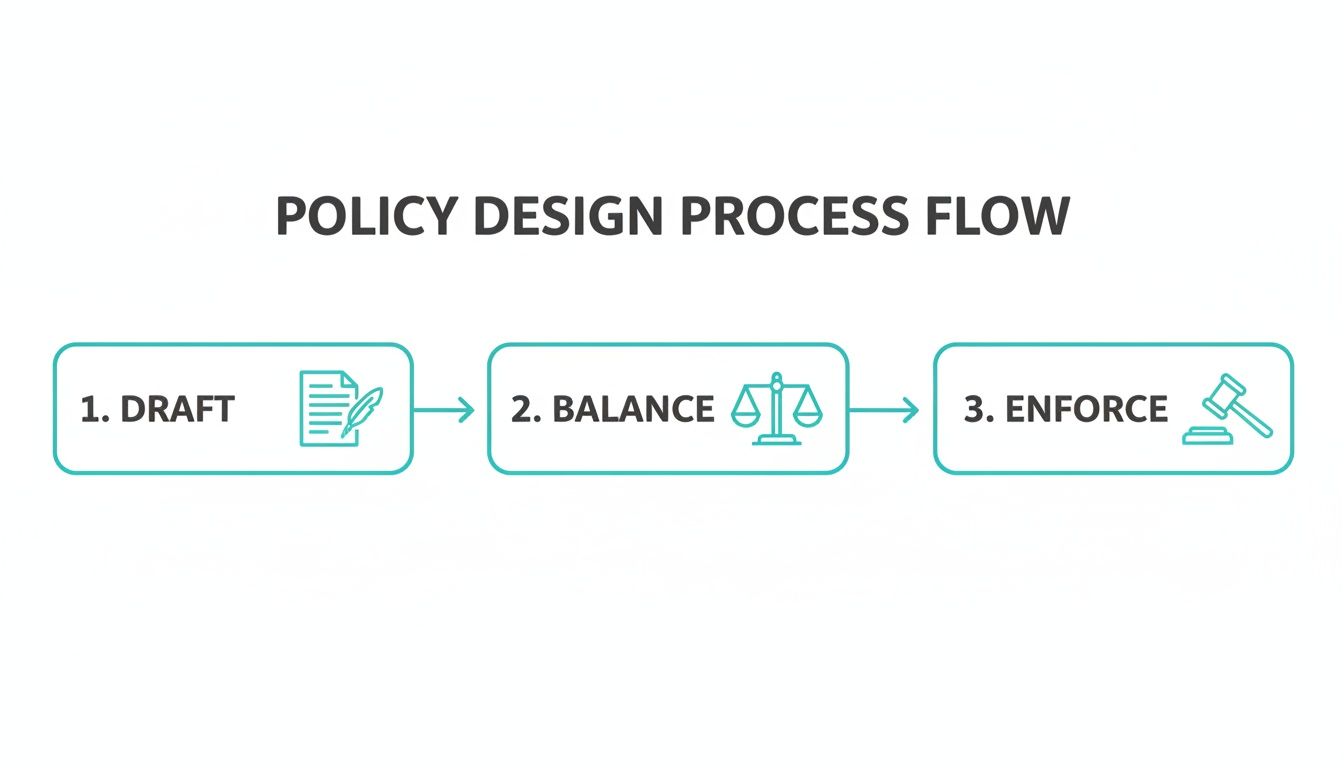
This process isn't a straight line. It's a cycle where different departmental inputs have to be harmonized to create a final product that actually works in the real world.
Establishing a Clear Accountability Workflow
One of the fastest ways for a policy to stall out is confusion over who owns what. Who is responsible for the initial draft? Who needs to provide feedback, and who has the final say? Ambiguity is the enemy of progress, leading to frustrating delays. A simple accountability matrix can solve this problem before it even starts.
The goal is to create a predictable, transparent process where every stakeholder knows their role and responsibility at each stage. This clarity prevents bottlenecks and ensures the approval workflow moves smoothly and efficiently.
To get everyone on the same page, a clear stakeholder matrix is your best friend. It defines who is responsible for what at each stage of the policy's lifecycle, from the first draft to the final rollout.
Stakeholder Approval and Accountability Matrix
Policy Stage | HR | Legal/Compliance | IT/Security | Department Heads | Executive Leadership |
|---|---|---|---|---|---|
Initial Draft | Drafts/Owns | Reviews for legal risk | Consults on technical feasibility | Provides input on operational impact | N/A |
Technical Review | Consults | Consults | Reviews & Approves | N/A | N/A |
Final Review | Reviews | Final legal review | Final technical review | Final operational review | Provides Final Approval |
Implementation | Leads communication & training | Provides guidance | Implements technical controls | Manages team rollout & enforcement | Champions policy adoption |
This kind of structure ensures the right experts are involved at exactly the right time.
Of course, the most important buy-in you can get often comes from the very top. Executive leadership sets the cultural expectation that policies are to be respected and followed. To learn more about how leadership behavior shapes organizational compliance, explore our insights on the importance of the tone from the top. When leaders actively champion this process, it signals to the entire organization that these guidelines are a priority, making consensus-building far, far easier.
Implementing Policies for Maximum Adoption

Rolling out new policies for the workplace is so much more than firing off a company-wide email and crossing your fingers. A policy’s true value isn’t in the document itself—it’s in its adoption. If your team doesn't understand or buy into it, even the most perfectly worded policy is just a file taking up space on a server.
I've seen the difference between a chaotic 'policy dump' and a strategic, engaging rollout. It's night and day.
A successful launch is built on three pillars: clear communication, hands-on training, and easy access to information. The real goal is to get employees beyond just acknowledging a new rule to truly understanding it. They need to see these policies as a framework for fairness and consistency, not just a new list of ways to get in trouble.
A Communication Plan That Actually Communicates
Your initial announcement sets the entire tone. A generic, legal-heavy email is a guaranteed trip to the trash folder. To get this right, your communication has to be multi-channel, crystal clear, and, most importantly, focused on the "why" behind the change.
Start with your managers. They are the front line for any new policy, and they'll be the first ones fielding questions from their teams. Before you tell anyone else, hold dedicated sessions with your leadership team. Arm them with talking points and answers to the questions you know are coming. They need to be able to champion the policy with genuine confidence.
Then, map out a communication sequence for all employees. It could look something like this:
A kickoff announcement from a senior leader explaining the policy's purpose and its benefits to everyone.
A dedicated resource hub on your intranet with the full policy document, a quick summary, and a solid FAQ section.
Follow-up messages during team huddles or in company newsletters to reinforce key points.
The idea is to make the information impossible to miss and easy to digest. A central resource hub is non-negotiable; it stops confusion in its tracks and ensures everyone is on the same page.
Training That Drives Real Understanding
Training is the moment a policy goes from words on a page to a living, breathing standard in your workplace. Passive, check-the-box sessions are a waste of everyone's time because they don't stick. Good training has to be interactive, specific to different roles, and all about real-world situations.
Try a scenario-based approach. For a new data security policy, for example, don't just give them a list of "don'ts." Walk the team through a realistic phishing email or a situation where they might be tempted to use a personal laptop for sensitive work. This builds critical thinking and muscle memory far better than any slide deck ever could.
Effective training isn't about reciting rules; it's about building muscle memory. By immersing employees in realistic scenarios, you empower them to make the right decisions instinctively when faced with a real-world challenge.
You also need to make acknowledgments easy and trackable. Integrate sign-offs directly into your HRIS or a compliance platform. This creates a clear audit trail showing who has read and agreed to the new policies. It’s a simple but vital step for accountability and proving due diligence.
Aligning Policies with the Future of Work
As you roll out today’s policies, it's smart to keep an eye on tomorrow. The modern workplace is always changing, and your policies need to be able to keep up. One of the biggest shifts happening right now is the need to prepare our workforce for technological disruption.
The World Economic Forum estimates that a staggering 50% of employees will need significant reskilling by 2025 just to keep pace. As you introduce new guidelines, ask yourself if they support your upskilling initiatives or create roadblocks. To get a better handle on these shifts, you can read more about what's ahead in workplace policies.
Ultimately, a thoughtful implementation strategy turns a bureaucratic task into a cultural win. It reinforces your company's commitment to fairness, security, and growth, making your policies a tool that helps the business thrive instead of a source of friction.
Maintaining and Measuring Policy Effectiveness
Getting your policies for the workplace written and rolled out is a huge win, but the job is far from over. Policies aren't static artifacts you can just file away. They’re living documents.
If they don't evolve with your business, they quickly become irrelevant and, worse, create new risks instead of preventing them. Effective maintenance is a constant cycle of review, measurement, and adaptation that keeps your policies sharp, fair, and aligned with both your culture and the legal landscape.
Establishing a Dynamic Review Schedule
The first thing you have to do is kill the "set it and forget it" mindset. You need a structured, proactive schedule for policy reviews. While a full annual review is a decent baseline for everything, certain policies demand a much closer watch.
Think of it as a tiered system based on risk.
Quarterly or Biannual Reviews: Policies covering data security, remote work, and AI usage need to be on a short leash. New tech, emerging security threats, and shifting best practices can make these documents obsolete in just a few months.
Annual Reviews: Your core policies—like the code of conduct, conflict of interest, and equal opportunity employment—usually just need a thorough review once a year.
Immediate Trigger Reviews: Certain events have to trigger an instant policy review, no matter the schedule. These include new federal or state laws, a major internal incident, a company restructuring, or the adoption of new enterprise-wide technology.
This approach ensures you’re always operating in the world you’re actually in, not the one that existed when the policy was first written.
Measuring What Truly Matters
So, how do you know if a policy is actually working? Tracking acknowledgment signatures only tells you if people have seen it—not if they understand it or if it’s having the intended effect. To get a real sense of effectiveness, you have to measure outcomes.
This means you need to move beyond simple compliance checks and start tracking Key Performance Indicators (KPIs) that reflect your cultural health and risk reduction.
Measuring policy effectiveness is about tracking behavioral outcomes, not just procedural compliance. A reduction in internal conflicts or a rise in employee trust scores is a far more powerful indicator of a successful policy than a folder full of digital signatures.
Consider tracking these more meaningful metrics:
Reduction in Specific Incidents: Are you seeing a measurable drop in safety violations, harassment complaints, or data security breaches after a policy change?
Employee Survey Data: Questions on psychological safety, employee trust, and perceived fairness give you direct feedback on how policies are being felt on the ground.
Manager Feedback: Regularly ask managers how easy or difficult it is to apply policies consistently. Are they clear, or are they creating confusion?
Time to Resolution: How long does it take to resolve a reported policy violation? A good policy should streamline your internal processes, not complicate them.
These KPIs give you a rich, data-driven picture of whether your policies for the workplace are hitting their strategic goals.
Creating a Continuous Feedback Loop
Data is critical, but so is the qualitative feedback from your team. You have to create clear, accessible channels for employees to ask questions, report concerns, and offer suggestions about policies without fearing reprisal. This feedback is a goldmine for spotting confusing language or unintended side effects.
A simple policy review checklist is a great way to structure this process and ensure every review is consistent and thorough.
Sample Policy Review Checklist:
Review Area | Checkpoint | Notes/Action Items |
|---|---|---|
Legal Compliance | Is the policy still aligned with current federal, state, and local laws? | |
Clarity & Language | Is the language clear, simple, and free of jargon? | |
Operational Impact | Is the policy practical for daily operations or does it create undue friction? | |
Relevance | Does the policy still address a relevant risk or has the business changed? | |
Consistency | Does this policy conflict with any other company policies? |
By combining a dynamic review schedule, meaningful KPIs, and a robust feedback loop, you transform your policies from static rules into a responsive risk management system. This ongoing process of maintenance and measurement is what keeps your policies effective, relevant, and a true strategic asset for your organization.
Answering Your Top Workplace Policy Questions
Even with a solid plan, you're going to have questions when you’re in the trenches creating and managing workplace policies. It’s just part of the process. This is where we tackle some of the most common—and pressing—concerns we hear from leaders in HR, Risk, and Compliance. The goal here is to give you concise, practical answers that reinforce that core mission: balancing legal must-haves with a culture people actually want to be a part of.
How Often Should We Review Our Workplace Policies?
One of the easiest traps to fall into is treating your policies like they’re set in stone. The old advice was to schedule a big, comprehensive review of all policies once a year. Frankly, that’s not good enough anymore. A one-size-fits-all schedule is just a recipe for risk.
Think about it. Your data security and remote work policies are living in a world that changes by the month, not the year. These need a fresh look at least every six months, or immediately after a major trigger event—like adopting new tech or seeing a new cybersecurity threat pop up on the radar. The same goes for policies on harassment and discrimination; the second new legal guidance or a landmark court case drops, they need an immediate update.
The key is to think in terms of triggers, not just timelines. A static schedule is lazy. A dynamic one is smart. Here are the triggers that should set off alarm bells for an immediate review:
New legislation at the federal, state, or local level.
A major internal incident that put one of your policies to the test (and maybe found it lacking).
Big organizational shifts, like a merger, acquisition, or major restructuring.
The rollout of new enterprise-wide technology.
What Is the Biggest Mistake Companies Make?
By far, the most damaging pitfall is creating policies in an ivory tower. When the Legal or HR department drafts a new rule without getting any real input from the people who will actually have to live with it, the result is almost always a disaster. You end up with a policy that’s impractical, confusing, or just plain unenforceable on the front lines.
This siloed approach doesn't just lead to low adoption rates; it ironically ends up creating more organizational risk. Right behind that is the mistake of using dense, impenetrable legalese. Your goal is for people to understand and comply, not to win a Scrabble tournament. A policy is only a success if every single employee can read it, grasp how it applies to their job, and use it to make good decisions.
The ultimate test of a policy isn't its legal perfection but its practical clarity. If a frontline manager can't use it to make a consistent, fair decision, the policy has failed.
How Can We Enforce Policies Consistently Without Creating Fear?
Real consistency doesn’t come from a culture of punishment. It comes from a fair, transparent, and well-documented process. It all starts with excellent training. When everyone understands the rules—and just as importantly, the "why" behind them—the need for disciplinary action drops off a cliff.
Enforcement should always follow a clear, predictable workflow. No surprises. More importantly, you have to frame enforcement as a corrective and educational moment, not a punitive one. This mindset empowers managers to step in with coaching or clarification first, which preserves employee dignity and stops small issues from blowing up into major problems.
By focusing on supportive intervention and education, you build a culture of accountability and trust, not one of fear and silence. And in that kind of environment, people are far more likely to raise concerns and ask questions before things go wrong.
What Is the Best Way to Handle Policies for a Global or Hybrid Workforce?
For a workforce spread across different locations and work styles, a two-tiered strategy is almost always the most effective path. You establish universal, bedrock principles that apply everywhere, then layer on localized addendums to handle regional specifics.
First, your core policies—things like your code of conduct, data ethics, and anti-corruption standards—have to be universal. These are non-negotiable. They establish a consistent company culture and set a global standard for how you do business, period.
Second, you develop specific riders or addendums for different countries or regions. These account for local labor laws, unique cultural norms, and specific regulatory hurdles that differ from your headquarters. For a hybrid workforce, your focus has to shift from "where" people are working to "what" they're delivering. Policies need to be crystal clear on expectations for communication, availability, and the security of company data on home networks.
This is where a centralized, cloud-based policy management platform becomes essential. It’s the only way to make sure everyone, no matter where they are, has instant access to the single, authoritative source of truth for all policies for the workplace.
At Logical Commander Software Ltd., we believe that effective risk management starts with clear, ethical, and proactive policies. Our E-Commander platform helps you centralize internal risk intelligence and align your entire organization with your governance standards, turning your policies into active strategic assets.