%20(2)_edited.png)

Your Guide to the OIG Office of Inspector General

Updated: Dec 29, 2025
The OIG, or Office of Inspector General, is essentially a federal agency’s internal watchdog, built to promote efficiency and root out fraud and waste. Born from the Inspector General Act of 1978, these offices are designed to be completely independent internal affairs divisions that report their findings to both the head of their agency and directly to Congress.
What Exactly Is the Office of Inspector General?

Think of a massive federal department—like Health and Human Services or the Department of Defense—as a sprawling corporation. The OIG is its dedicated, built-in oversight board, responsible for making sure every dollar is spent correctly and every program runs the way it was designed to.
Crucially, they are not part of the agency’s day-to-day operational chain of command. This separation gives them the independence they need to conduct truly impartial reviews without fear of internal pressure. An OIG doesn't create policy or run programs; it puts them under a microscope with a critical eye.
The OIG’s Dual Mission
Every OIG operates with a dual mission that is both proactive and reactive. These two core functions work together to protect taxpayer money and maintain public trust in the government.
Promoting Economy and Efficiency: OIGs conduct audits and evaluations to see if government programs are hitting their goals without wasting money. They look for systemic weaknesses, operational bottlenecks, and inefficient processes that can be fixed.
Preventing Fraud, Waste, and Abuse: Through investigations, OIGs hunt down specific instances of misconduct. This could be anything from a contractor overbilling for services to an employee misusing their position for personal gain.
In a nutshell, one side of the OIG acts like a sharp management consultant, offering recommendations to make the agency run better. The other side operates like a law enforcement detective, investigating potential wrongdoing.
To make this clearer, let's break down the OIG's primary responsibilities.
Key Functions of the Office of Inspector General
Function | Description | Example Action |
|---|---|---|
Audits | Systematic reviews of financial and operational activities to ensure compliance with laws and regulations. | Auditing a grant recipient's financial records to verify that federal funds were spent as intended. |
Investigations | Probes into specific allegations of criminal, civil, or administrative violations. | Investigating a whistleblower complaint about a contractor submitting false invoices for payment. |
Evaluations | Assessments of program effectiveness, efficiency, and overall performance. | Evaluating whether a new healthcare initiative is meeting its public health goals and staying on budget. |
Inspections | Quick, targeted reviews of specific agency operations or facilities to identify vulnerabilities. | Conducting an unannounced inspection of a federal facility to check for security and safety compliance. |
These functions give the OIG broad authority to examine nearly every aspect of an agency’s operations and the entities it does business with.
An OIG’s jurisdiction is not limited to government employees. It extends to any private organization, vendor, or individual that receives federal funds, making its function critically important for corporate compliance, HR, and legal teams.
This is the part that really matters for private industry. If your organization is a government contractor, gets federal grants, or participates in programs like Medicare, you fall under the OIG’s microscope. Understanding their role isn't just for public sector employees; it’s a core piece of risk management for any company that interacts with the federal government.
This is where proactive internal controls and auditable documentation, like those managed within Logical Commander's E-Commander platform, become your best defense. Strong, well-documented internal systems don’t just meet a compliance burden—they turn it into an operational strength by demonstrating a commitment to integrity, which is exactly what the OIG expects to see.
The OIG's Core Powers: Audits and Investigations
To carry out its mission, the Office of Inspector General (OIG) relies on two primary tools: audits and investigations. People often use the terms interchangeably, but they are worlds apart in practice.
Think of it this way: an audit is like a scheduled, wide-angle health checkup for an agency’s programs. An investigation, on the other hand, is a focused, forensic deep-dive launched when there’s a specific reason to suspect something is wrong.
Together, these powers give the OIG a complete toolkit to examine an agency and its partners from every possible angle. For any organization under their watch, understanding how each function works is critical, because the approach, stakes, and required response are completely different.
The Proactive Power of Audits
An OIG audit is far more than a bean-counter’s review of the books. It’s a full-blown performance evaluation designed to answer the big questions: Is this program actually working? Are taxpayer dollars being spent wisely and legally?
Auditors dig into everything—financial records, operational data, and program results. Their main goal is to spot systemic weaknesses, inefficiencies, or compliance gaps before they snowball into major scandals. This is the OIG’s proactive, preventive function in action.
For example, an audit might discover that a federal grant program has reimbursement rules so confusing that recipients are accidentally overbilling the government. The public audit report wouldn’t just flag the problem; it would give the agency specific, actionable recommendations on how to clarify its guidelines and fix its processes.
An OIG audit is less about finding a single "bad apple" and more about strengthening the entire orchard. The focus is on improving systems, enhancing controls, and ensuring the agency’s mission is carried out effectively.
This is precisely why having rock-solid internal documentation is non-negotiable. When an OIG auditor comes knocking, the ability to produce clear, organized, and auditable records from a system like E-Commander sends a powerful message. It demonstrates a culture of compliance and can dramatically shrink the time and friction of the audit process.
The Reactive Force of Investigations
Things get serious when the OIG gets a specific tip about potential wrongdoing, like a whistleblower complaint or a referral from another law enforcement agency. This is when the investigative arm swings into action, and the OIG starts to look and feel a lot like a federal law enforcement agency.
OIG special agents are sworn federal law enforcement officers armed with significant authority. They have the power to conduct a wide range of activities to uncover fraud, waste, abuse, and criminal misconduct.
Their key investigative powers include:
Subpoena Authority: OIG investigators can legally force individuals and organizations to turn over documents, emails, and any other records relevant to their case.
Testimony Under Oath: They can interview witnesses and subjects under oath, where lying can lead to separate criminal charges.
Broad Record Access: By law, an OIG has the right to access all records, reports, and data from its parent agency and any contractors or grantees touching federal funds.
Collaboration with Law Enforcement: OIGs often work hand-in-glove with the Department of Justice (DOJ) and the FBI to build criminal cases when they uncover evidence of fraud or corruption.
This power reaches far beyond the walls of a government building. Any private contractor, healthcare provider, or grant recipient doing business with the government falls under this authority. If your organization sends an invoice to a federal agency, you are within the OIG’s reach.
The fallout from an OIG investigation can be severe. It can range from massive financial penalties and fund repayment to suspension and debarment, which is a corporate death sentence that blocks a company from future federal contracts. When criminal fraud is involved, investigations can lead to prison time for individuals, making a coordinated and defensible response an absolute necessity.
How to Read OIG Reports for a Competitive Edge
Public reports from the Office of Inspector General (OIG) are far more than just bureaucratic paperwork. For any organization operating in the federal space, they are a goldmine of strategic intelligence. Knowing how to read these documents reveals enforcement trends, flags industry-wide vulnerabilities, and gives you a clear roadmap to strengthen your own controls before you ever become a target.
Think of these reports as a free consultation from the government's top auditors. They are publicly telling you exactly what they’re looking for, where they're finding problems, and what they expect to see in a well-run organization. Ignoring this is like a ship’s captain ignoring the weather forecast before sailing into a storm.
Cracking the Code of OIG Reports
When you open an OIG report, you'll run into specific terminology that has a very precise meaning. Understanding these terms isn't about memorizing dictionary definitions; it's about knowing what they signal for your own risk management strategy.
Finding: This is an official conclusion that a process, control, or action failed to meet a specific standard, law, or regulation. A finding is a documented problem, and you can bet it's backed by a mountain of evidence.
Recommendation: This is the OIG’s proposed solution to fix the problem identified in a finding. These are not mere suggestions. Agencies are required to formally respond, and the OIG tracks their implementation relentlessly.
Questioned Cost: This is a specific dollar amount the OIG has determined was spent in a way that is potentially unallowable, poorly documented, or just plain unreasonable. It signals a direct and immediate financial risk.
By tracking these elements across different reports in your sector, you can start to see patterns emerge. Are auditors repeatedly flagging issues with subcontractor oversight? Are recommendations constantly focused on better documentation for billed services? These are your early warnings.
Mining OIG Work Plans and Semiannual Reports
Beyond individual audits, two documents offer the biggest strategic payoff: OIG Work Plans and Semiannual Reports to Congress. Work Plans lay out an OIG's audit priorities for the upcoming year, essentially publicizing their future hit list. Semiannual reports summarize their accomplishments over the last six months, giving you a data-rich look at completed audits and investigations.
These reports reveal the tempo and priorities of the oversight bodies. OIGs generate a high volume of work, and their reports quantify everything. For example, when an OIG reports that 75% of its investigations were tied to a specific priority area, it shows exactly where they’re putting their resources. When the HHS OIG details the exact number of audits and monetary recoveries in a six-month period, it paints a clear picture of enforcement intensity.
By actively monitoring these publications, you shift from being a passive observer to a proactive strategist. You can align your internal audit schedule and compliance training with the OIG’s stated priorities, shoring up potential weaknesses before they ever attract unwanted attention.
As you dissect these complex OIG reports, it's crucial to apply strong information literacy, understanding how to start evaluating information sources to grasp the full context and its implications.
The ability to create structured, auditable documentation, like the kind facilitated by a solid workplace investigation report template, directly reflects the integrity OIGs demand. This alignment reduces friction and shows a commitment to transparency should your organization ever face a review. A platform like E-Commander centralizes this evidence, creating defensible, time-stamped records that meet regulator expectations from the start.
Your Playbook for Navigating an OIG Inquiry
That knock on the door from the Office of Inspector General (OIG)—or the official letter that lands on your desk—can feel like a seismic shock. Normal operations grind to a halt, and a sense of panic starts to creep in. But panic isn’t a strategy. A calm, methodical response is your best defense, transforming a potential crisis into a manageable process that showcases your organization's commitment to compliance.
This isn't just about handing over documents. It’s about managing a high-stakes project where every move you make is under a microscope. Those first few hours after an OIG agent visits or a subpoena arrives are absolutely critical. Your immediate actions will set the tone for the entire investigation.
Assembling Your First-Response Team
The second an OIG inquiry begins, your first call should be to legal counsel. Period. While they get up to speed, your next job is to immediately stand up a core internal response team. This group will be your command center, ensuring every communication is unified, every action is deliberate, and nothing falls through the cracks.
This isn't a job for a committee. You need a small, dedicated team with leaders from:
Legal: They’ll interpret the scope of the inquiry, manage all official communications, and vigorously protect the organization's legal rights.
Compliance: This is your subject matter expert who can provide immediate context on the internal policies, controls, and procedures relevant to the OIG's focus.
Human Resources: They’re essential for handling all employee-related matters, from preparing staff for potential interviews to managing internal messaging.
One of this team's first official acts must be to designate a single point of contact for all OIG communications. Funneling everything through one person is non-negotiable. It stops mixed messages cold and guarantees that every interaction is intentional and thoroughly documented.
Executing Critical First Moves
With your team in place, it’s time for immediate action. The mission is to lock down all relevant information, understand precisely what the OIG is asking for, and start organizing your response in a way that demonstrates cooperation without accidentally waiving your rights.
The process below breaks down the core workflow for any data-driven inquiry. It’s about finding the right information, analyzing what it means, and then taking decisive, documented action—a perfect parallel for how you should manage your response.
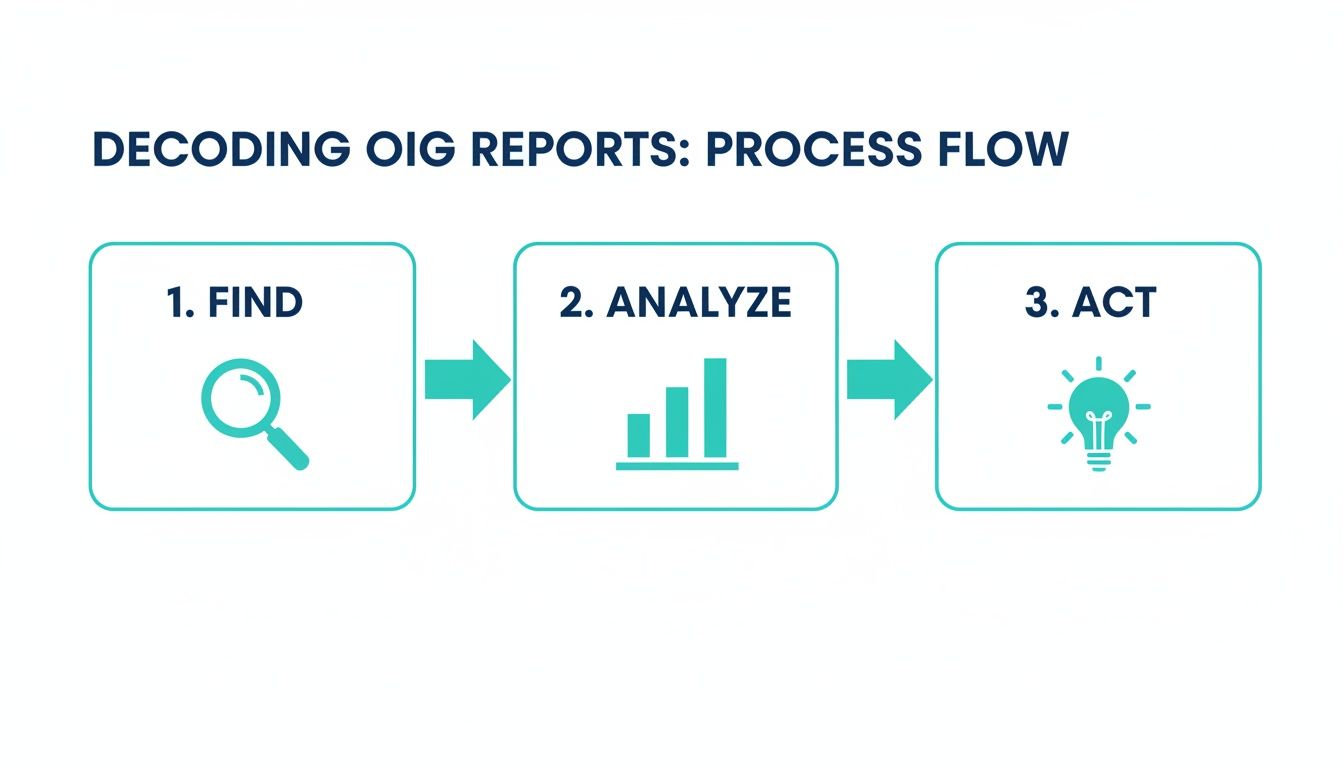
This systematic approach is your lifeline. To put it into practice, there are three steps that must happen right away:
Issue a Legal Hold: Your legal team must immediately issue a formal, written directive to all potentially involved employees. This order preserves every document—emails, drafts, reports, financial records—related to the inquiry. Failing to do this can be viewed as obstruction of justice.
Analyze the Request: Get your response team in a room and dissect the OIG’s request line by line. You need to understand exactly what information they want and for what time period. This creates the boundaries for your entire document production effort.
Establish a Document Control System: Don't just start forwarding files. You need a secure, centralized system to collect, review, and log every single document before it gets handed over. This creates a defensible, auditable chain of custody.
Managing Document Production and Employee Interviews
Responding to an OIG request is a meticulous process, not a race. You must be thorough and cooperative, but it’s just as critical to produce only what has been explicitly requested. Handing over extra documents is a rookie mistake that can unnecessarily widen the scope of the entire inquiry.
If the OIG requests employee interviews, preparation is everything. Counsel should advise every staff member on their rights and responsibilities. The instructions are simple: answer truthfully, stick to the facts you know firsthand, and never, ever speculate. Honesty and precision are paramount.
The table below provides a clear checklist to guide your response from the initial notice to the final resolution, ensuring a structured and defensible process.
OIG Inquiry Response Checklist
Phase | Action Item | Key Objective |
|---|---|---|
Immediate Response (First 24 Hours) | Contact Legal Counsel | Secure immediate legal guidance and establish attorney-client privilege. |
Immediate Response (First 24 Hours) | Assemble Core Response Team | Centralize control with leaders from Legal, Compliance, and HR. |
Immediate Response (First 24 Hours) | Issue a Comprehensive Legal Hold | Prevent spoliation of evidence and demonstrate good faith. |
Initial Assessment (Days 1-3) | Analyze the OIG Request/Subpoena | Define the precise scope, timeline, and subject matter of the inquiry. |
Initial Assessment (Days 1-3) | Designate a Single Point of Contact | Control all communications to ensure consistency and prevent missteps. |
Data & Document Management | Establish a Centralized Document Repository | Create an auditable system for collecting, reviewing, and tracking all responsive documents. |
Data & Document Management | Begin Document Collection & Review | Systematically gather relevant data while filtering for privilege and non-responsiveness. |
Employee & Team Coordination | Brief All Relevant Employees | Inform staff of their obligations under the legal hold and prepare them for potential interviews. |
Employee & Team Coordination | Conduct Regular Team Huddles | Maintain alignment across Legal, HR, and Compliance, tracking progress and addressing roadblocks. |
Long-Term Strategy | Maintain a Detailed Action Log | Document every decision, communication, and action taken to create a defensible record. |
Long-Term Strategy | Use the inquiry as a catalyst to strengthen internal controls and prevent future issues. |
A well-managed response demonstrates control and a pre-existing culture of integrity. By following a structured plan, you not only address the immediate challenge but also reinforce the very compliance standards the OIG expects to see.
A successful inquiry response hinges on auditable workflows and centralized evidence management. This is where a platform like E-Commander becomes indispensable. It provides the structured environment needed to log every action, manage documents securely, and coordinate the team's response in a completely traceable and defensible manner.
Ultimately, the best preparation for an OIG inquiry is to have robust, proactive internal affairs procedures in place long before anyone ever comes knocking. When you treat the response like a structured, auditable project, you prove your commitment to doing things the right way.
Building Proactive Compliance to Stay Off the OIG's Radar
The absolute best way to handle an Office of Inspector General (OIG) investigation is to make sure one never happens in the first place. This means getting out of a reactive, crisis-management mode and into a proactive compliance mindset. It’s not just about having good policies; it's a strategic necessity for any organization that touches federal funds.
You have to build an internal culture where integrity isn't just a word in a handbook—it's woven directly into how you operate every day. It starts with the basics: a crystal-clear code of conduct, regular training that actually engages people, and a genuine 'speak-up' culture where employees feel completely safe reporting concerns without fearing retaliation.
Identifying Your Internal Vulnerabilities
To build a real defense, you need to start thinking like an auditor. OIGs are constantly publishing reports on the biggest management and performance challenges facing federal agencies, and these documents are basically a cheat sheet for spotting your own internal risks.
These reports highlight the same recurring themes over and over—problems that have direct parallels in the private sector. You'll see things like human capital shortages, slow technology modernization, and gaps in program integrity. For example, the Government Publishing Office OIG’s FY2025 Top Management Challenges report called out AI planning as a new challenge and identified human capital as its single biggest hurdle.
These aren't just high-level theories. They give you specific, data-driven examples of failure, like one report that found postoperative visit data for 45 of 105 sampled surgeries were inaccurate, leading to millions in overpayments. By studying these public screw-ups, you gain incredible insight into your own potential blind spots. You can dive deeper by reviewing the OIG's top management challenges report.
This lets you stress-test your own operations. Are your controls over data entry and financial reporting really tight enough? Is your team properly staffed and trained to handle complex compliance rules?
Creating a Culture of Early Detection
A proactive culture is one that sniffs out and fixes ethical risks and systemic weaknesses long before they blow up. The whole point is to catch small problems before they grow into the kind of widespread issues that get a regulator’s attention. This means moving beyond simple compliance and toward a comprehensive regulatory compliance risk management framework.
This involves a few key actions:
Conduct Regular Risk Assessments: Periodically tear down your operations to find the areas most vulnerable to fraud, waste, or abuse.
Empower Internal Audit: Give your internal audit team the independence and resources to conduct meaningful, no-holds-barred reviews.
Implement Strong Controls: Develop and enforce internal controls that create clear accountability and a clean, auditable trail for every key transaction.
An organization that can demonstrate a consistent, documented effort to police itself is in a much stronger position. It shows the OIG that any potential issue is an anomaly in a strong system, not a symptom of a weak one.
Maintaining this proactive stance, especially in complex financial sectors, can be tough. This is where sophisticated tools can give you an edge. Some organizations are now using AI finance compliance advisor tools to help monitor transactions and flag anomalies.
Platforms like E-Commander are built for this. They provide a central system to document your controls, manage early-signal detection, and create the traceable, audit-ready records that prove you have a culture of integrity from the ground up.
Turning Oversight into an Operational Advantage
Let's be honest: when most people hear "Office of Inspector General," they don't exactly jump for joy. The relationship is usually seen through a lens of risk and pure apprehension. While that's understandable, it completely misses the point—and a massive opportunity.
Instead of dreading oversight, smart organizations reframe it as a benchmark for operational excellence. The very principles an OIG stands for—accountability, efficiency, and integrity—are the same pillars that define a resilient and successful modern company. Embracing this mindset transforms the challenge of OIG scrutiny into a powerful catalyst for improvement. After all, the goal of a strong compliance program isn't just about avoiding penalties; it's about building a trustworthy, ethical, and sustainable business from the inside out.
From Compliance Burden to Business Strength
The sheer scale of federal spending puts an immense fiduciary duty on every single organization that handles public funds. The Offices of Inspector General collectively oversee trillions of dollars, and their audits regularly flag billions in potential improper payments and weak controls.
For instance, the Department of Labor OIG flagged a potential improper payment risk of over $40 billion tied to unemployment insurance programs during just one crisis period. You can see how OIGs quantify these risks by exploring the Department of Labor OIG's work plan.
Those staggering numbers make one thing crystal clear: strong internal controls aren't just bureaucratic checkbox-filling. They are a fundamental defense against material financial risk and reputational ruin.
Instead of fearing the OIG’s microscope, use it as a blueprint. Every OIG report on waste or fraud is a free lesson in what not to do—a clear roadmap for strengthening your own operations before they ever come under review.
This proactive approach turns compliance into a genuine competitive advantage. It fosters a culture of accountability that weaves through every department, from finance to HR. When you align your internal processes with the high standards of federal oversight, you're not just preparing for an audit. You're building a fundamentally stronger, more efficient, and more trustworthy organization.
This is where a platform like E-Commander provides the framework for that transformation. It embeds auditable workflows and traceable documentation directly into your daily operations, turning abstract principles into concrete, defensible actions. This final step empowers your organization to move beyond fear and toward true operational mastery.
Your OIG Questions, Answered
When you're dealing with federal contracts or funding, the term OIG (Office of Inspector General) comes up a lot, and it’s natural to have questions. Let's dig into some of the most common ones we hear from leaders trying to navigate these complex waters.
What's the Difference Between the OIG and the GAO?
It’s easy to mix these two up, but they have very different roles. Think of it this way: the OIG is an internal watchdog, embedded within a specific federal agency. Its entire job is to keep that one agency clean by hunting down fraud, waste, and abuse within its own programs. They report their findings straight to the agency head and to Congress.
The Government Accountability Office (GAO), on the other hand, is an external watchdog that works directly for Congress. The GAO is independent and non-partisan, often called the "congressional watchdog," and its scope is massive. It audits and investigates federal spending and performance across the entire government, usually when a congressional committee asks it to.
So, OIG is internal and agency-specific. GAO is external and government-wide.
What Triggers an OIG Investigation into a Private Company?
An OIG investigation into a private company almost never happens by chance. It’s almost always triggered by a direct link to federal funds and a specific red flag that demands a closer look.
The most common triggers we see are:
Whistleblower Hotlines: This is a huge one. An employee or insider reports something that doesn't feel right, like questionable billing practices or safety shortcuts.
Agency Referrals: The contracting agency itself might spot irregularities in your invoices or notice performance issues and decide to call in its OIG.
Data Analytics: OIGs are getting smarter. They use powerful tools to comb through payment data, looking for statistical anomalies or unusual patterns that scream fraud.
Routine Audit Findings: Sometimes, a standard, run-of-the-mill audit uncovers something suspicious. If it looks serious enough, that review gets escalated into a full-blown investigation.
If you’re a federal contractor, subcontractor, or a healthcare provider in the Medicare program, you’re squarely in the OIG's jurisdiction. Any credible allegation of misconduct can put you on their radar.
Can an OIG Investigation Actually Lead to Criminal Charges?
Yes, absolutely. This is a point that can't be stressed enough. While an OIG can hit a company with civil fines or even get them barred from federal contracting (debarment), their power extends much further.
OIG Offices of Investigations are staffed with sworn federal law enforcement agents. These aren't just auditors; they are investigators who can conduct full-scale criminal investigations into things like intentional fraud, bribery, or making false statements to the government.
When they find evidence of criminal wrongdoing, they don’t go it alone. They team up with the Department of Justice (DOJ) to pursue criminal prosecution. That partnership can lead to indictments, felony convictions, and very real prison time for the individuals involved, on top of crippling financial penalties for the company itself.
Managing these high-stakes risks requires a proactive, structured approach to internal integrity. Logical Commander's E-Commander platform provides the unified operational backbone to centralize risk intelligence, document compliance, and ensure a coordinated, defensible response to any inquiry. Learn how to turn oversight into an advantage at https://www.logicalcommander.com.