%20(2)_edited.png)

Mitigating Counterproductive Workplace Behavior With AI

Updated: Oct 14, 2025
You’ve likely seen it before—not a dramatic blow-up, but the quiet, corrosive actions that tank a team. It’s the chronic lateness, the passive-aggressive comments, or the employee who drags their feet on every project. This is counterproductive workplace behavior (CWB): deliberate actions that chip away at your organization and its people. Left unchecked, CWB silently drains morale, productivity, and your bottom line. Traditional HR methods are reactive and too slow. By the time an issue is reported, the damage is done. Logical Commander’s AI-powered platform offers a new, proactive approach. Our ethical, non-intrusive system identifies early risk indicators, enabling you to address issues before they escalate—all while complying with EPPA, GDPR, and ISO 27K standards.
Why Counterproductive Workplace Behavior Is a Silent Business Killer

Think of CWB as an invisible leak in your company’s foundation. It isn’t just one big event. It’s a series of small, negative actions that create a domino effect, leading to missed deadlines, lost talent, and even serious compliance breaches.
These actions are far more than just an HR headache; they represent a critical business risk that demands a real strategy. What starts as a "minor" issue can quickly snowball into a major financial and cultural liability.
The True Cost of Inaction
When you ignore CWB, you send a clear message: this is acceptable here. A toxic environment starts to form, where your best people disengage and eventually walk out the door, while negative behaviors become the norm.
The costs stack up quickly:
Productivity Loss: Time spent managing conflicts, redoing sloppy work, or covering for absent colleagues hits your bottom line directly.
Increased Turnover: High performers won't stick around in a toxic workplace. This leads to expensive and time-consuming recruitment and retraining cycles.
Reputational Damage: Word gets out. A company known for internal drama or unethical behavior will struggle to attract top talent and maintain its brand integrity.
Compliance & Legal Risks: Certain behaviors, like harassment or misusing company data, can spiral into serious legal penalties and fines.
Take substance abuse on the job, a major form of CWB with staggering costs. Employee drug abuse costs U.S. employers an estimated $25.5 billion annually in lost productivity and absenteeism alone. It shows up as excessive sick days, missed deadlines, and poor work quality—all while increasing the risk of workplace accidents.
CWB isn't just a collection of isolated incidents. It's a symptom of deeper problems in your culture—like poor leadership, perceived unfairness, or chronic stress. It needs proactive attention, not just reactive punishment.
A Modern Solution for a Complex Problem
Traditional methods for dealing with CWB—like waiting for a formal complaint or relying on an annual review—are too slow. They are purely reactive. By the time an issue makes it to HR, the damage is already done. The goal has to shift from damage control to prevention.
This is where ethical, privacy-first AI gives you an edge. Logical Commander’s platforms, like E-Commander and Risk-HR, are built to spot the early warning signs without resorting to invasive surveillance. Our system analyzes behavioral patterns in a way that is fully compliant with EPPA, GDPR, and CPRA, helping you know first and act fast.
This approach lets you get in front of potential issues before they escalate, protecting your assets and your people while always upholding employee dignity. You can see the clear financial upside in our article on the ROI of proactive risk detection.
Understanding the Full Spectrum of Counterproductive Actions
Counterproductive workplace behavior (CWB) isn't just one thing. It's a whole spectrum of actions, and to get a handle on it, leaders in HR, security, and compliance first need to know what they’re looking at. The goal is to move from a vague sense that something’s wrong to a clear framework that helps you identify, classify, and systematically address these issues.
Think of it like a doctor diagnosing an illness. A symptom like a headache could signal anything from dehydration to something much more serious. Just labeling an employee as "unproductive" isn't a useful diagnosis. You have to dig deeper to see if the root cause is withdrawal, production deviance, or a more direct threat.
From Minor Infractions to Major Threats
Counterproductive actions exist on a continuum. At one end, you have subtle, almost passive behaviors that slowly poison productivity and morale. At the other end, you find overt, aggressive actions that can cause immediate and catastrophic damage.
Understanding this spectrum is key because it helps leaders prioritize risks and choose the right response. For instance, a manager might tackle chronic lateness with a performance improvement plan, but an act of property destruction demands an immediate security and legal intervention.
The infographic below lays out the diverse range of actions that fall under the CWB umbrella.
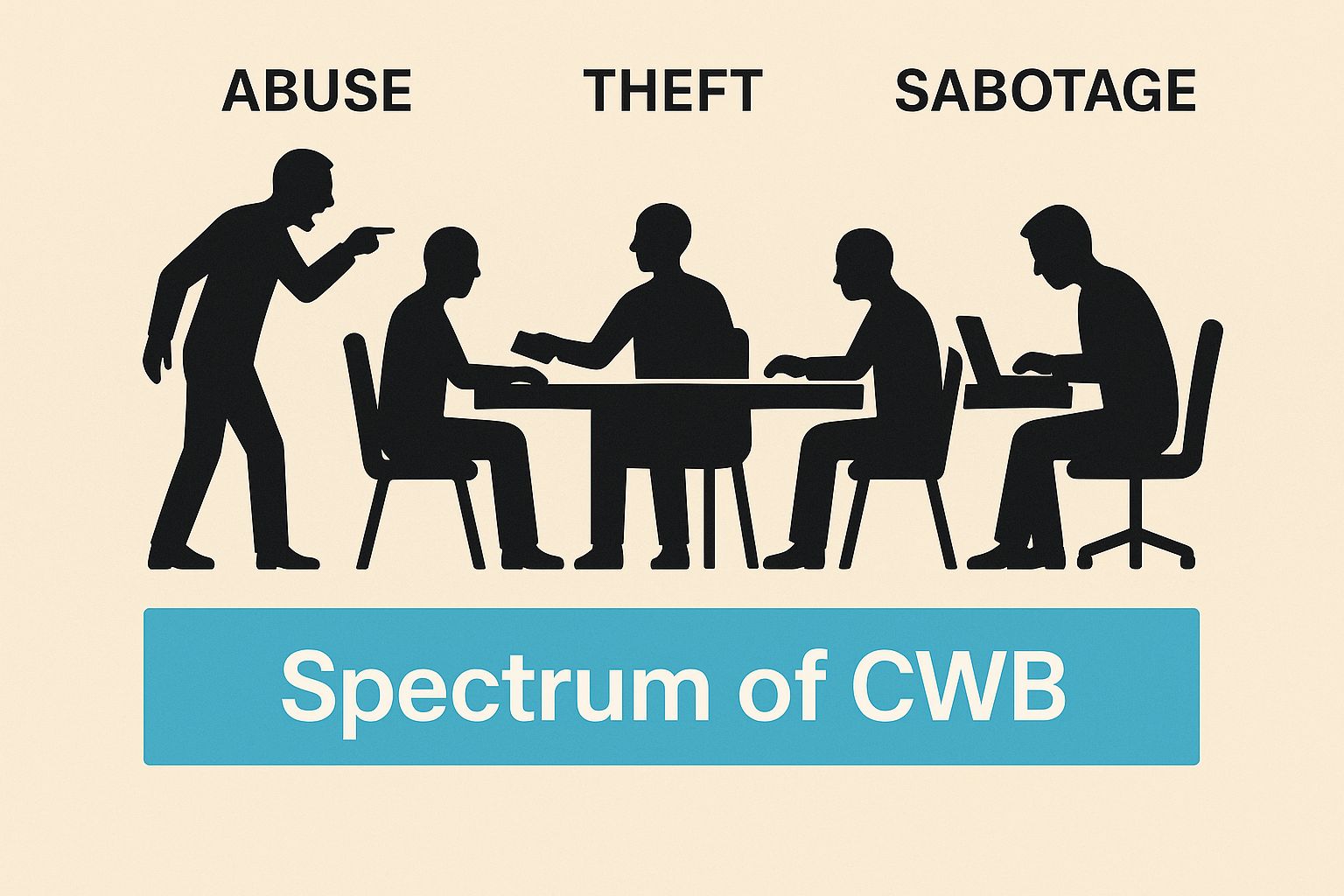
This visual shows how seemingly minor issues like gossip exist in the same risk ecosystem as severe actions like sabotage. That's why a comprehensive detection strategy is non-negotiable.
A Framework for Classifying Counterproductive Behaviors
To bring real clarity to this problem, we can group these behaviors into distinct categories. This creates a shared language so that different departments—from HR to Compliance—can actually collaborate effectively when managing internal risks. A structured approach is the first step toward proactive risk management.
Here is a practical framework that breaks down the different types of CWB and their direct impact on the organization.
A Framework for Understanding Counterproductive Workplace Behaviors
This table categorizes different types of CWB, providing clear examples and outlining their potential impact on organizational health, productivity, and compliance.
Category | Behavior Examples | Primary Organizational Impact |
|---|---|---|
Production Deviance | Intentionally working slowly, cyberloafing, taking excessive breaks, ignoring quality standards. | Reduced output, missed deadlines, decreased efficiency, and higher operational costs. |
Property Deviance | Sabotaging equipment, defacing company property, stealing supplies or data. | Financial loss, security breaches, operational disruptions, and legal liabilities. |
Political Deviance | Spreading rumors, gossiping, showing favoritism, blaming colleagues for mistakes. | Eroded trust, toxic team culture, poor collaboration, and decreased employee morale. |
Personal Aggression | Harassment, workplace bullying, verbal abuse, intimidation, and unprofessional conduct. | High employee turnover, psychological distress, legal action, and reputational damage. |
Withdrawal | Chronic absenteeism, persistent lateness, long lunches, disengagement from team activities. | Lowered team productivity, increased workload for colleagues, and project delays. |
This framework demonstrates how very different actions are all connected to tangible business outcomes. It's vital to consider all the forms CWB can take, such as employee theft in the workplace, which can gut a company’s financial health and destroy internal trust.
Why a Holistic View Is Essential for Modern Risk Management
Treating each counterproductive action as an isolated incident is a critical mistake. These behaviors are often interconnected. An employee experiencing personal aggression (like bullying) might respond with withdrawal (chronic absenteeism) or production deviance (sloppy work).
A siloed approach just doesn't work. When HR only sees the attendance issue and a manager only sees the missed deadline, no one connects the dots. This is where modern AI-powered risk management platforms deliver incredible value.
Actionable Insight #1: Create a shared CWB classification system across departments. When HR, Security, and Compliance use the same language to define behaviors like 'production deviance' or 'political deviance,' it streamlines reporting and accelerates a coordinated response.
An advanced system like Logical Commander’s [Risk-HR solution](https://www.logicalcommander.com/risk-hr) is designed to analyze patterns across this entire spectrum. It doesn't just flag a single event; it identifies clusters of risk indicators that point to a deeper, systemic issue, giving you a holistic view of human capital risk.
Actionable Insight #2: Train managers to recognize behaviors across all five categories, not just the obvious ones. Equip them to document instances of political deviance or withdrawal with the same diligence they would for property deviance, creating a richer data set for risk analysis.
By understanding the full range of counterproductive workplace behavior, your organization can move beyond just reacting to problems. You can start building a proactive strategy that addresses the root causes, protects your culture, and preserves your bottom line.
The next step is leveraging technology to do this ethically and at scale. Request a demo of our E-Commander platform.
Uncovering the "Why" Behind Negative Workplace Behaviors
To truly get a handle on counterproductive workplace behavior (CWB), leaders have to look past the obvious symptoms and ask, "Why is this happening?" Just punishing an employee for being late or slacking off is like painting the leaves of a dying plant green—it covers up the issue but doesn't fix what’s killing it from the inside. Real prevention starts when you dig into the root causes pushing good people toward bad actions.
These behaviors don't just appear out of nowhere. More often than not, they are a direct response to a flawed or unhealthy work environment. Treating the symptoms is a temporary patch, but diagnosing and fixing the core problems can spark lasting, positive change across the whole company.
The Primary Triggers Driving CWB
When you start digging, you’ll find a few key factors that consistently pop up as catalysts for counterproductive actions. These triggers are often tangled together, creating a nasty feedback loop where one problem makes another one worse. Getting to know these drivers is the first real step toward building a more resilient and ethical culture.
Here are the usual suspects:
Perceived Organizational Injustice: When people feel that decisions around pay, promotions, or discipline are biased or unfair, their loyalty evaporates. This feeling of being wronged is a powerful motivator for payback behaviors, like deliberately slowing down work or even theft, as employees try to "even the score."
Chronic High-Stress Environments: Workplaces that run on impossible deadlines, crushing workloads, and not enough support are breeding grounds for burnout. This isn't just a buzzword; it's a direct cause of withdrawal behaviors like absenteeism, total disengagement, and a sharp decline in the quality of work.
Lack of Recognition and Appreciation: When employees feel like their hard work is invisible, they start to check out. If no one notices or cares, it’s easy to develop a "why bother?" attitude. This leads directly to doing the bare minimum, wasting time online (cyberloafing), and generally ignoring company goals.
Ineffective or Toxic Leadership: Bad management is probably the single biggest driver of CWB. Bosses who micromanage, play favorites, can't communicate, or straight-up bully their teams create a climate of fear and resentment. This toxic environment is the perfect soil for all kinds of counterproductive behavior to grow.
A toxic culture isn't just a fuzzy HR concept; it's a measurable business risk. It's the ground where the most damaging behaviors take root, and it needs to be watched just as closely as the company's financials.
The Undeniable Link Between Bullying and Retaliation
Workplace bullying is one of the most corrosive elements you can have in a company culture. Its damage spreads far beyond the person being targeted, poisoning team dynamics and making everyone feel unsafe. And the research is crystal clear: there's a direct, statistically proven link between being bullied and lashing out with counterproductive acts.
For instance, one major study found a strong positive connection between employees experiencing bullying and their tendency to engage in CWB. The analysis revealed that bullied employees are far more likely to engage in deviant actions like retaliation or simply withdrawing from their duties—both of which kill organizational performance. You can dive into the full research on these CWB findings and their statistical backing.
This connection points to a critical truth: when people feel powerless and attacked, some will inevitably try to claw back a sense of control through negative actions.
From Root Cause to Proactive Solution
Trying to spot these root causes manually is a slow, often biased, and frustrating process. It depends on things like surveys, exit interviews, and formal complaints—all of which are lagging indicators. They tell you about a problem long after the damage has been done. This is where ethical AI offers a powerful advantage.
Logical Commander’s E-Commander platform is built to identify the systemic issues driving CWB without ever resorting to invasive surveillance. Our privacy-first AI analyzes anonymized behavioral patterns to flag risk indicators tied to toxic leadership, high stress, or perceived injustice.
Actionable Insight: Use anonymized data to find departmental hotspots where CWB indicators are piling up. Instead of zeroing in on individuals, look at the environment. Is there a pattern of burnout under a specific manager? Did disengagement spike right after a certain company change? This shifts the focus from blaming people to finding systemic solutions.
By revealing these patterns, our platform helps you get to the root of the problem, whether it's a need for leadership training, a review of your promotion process to ensure fairness, or a smarter way to allocate resources to prevent burnout. You get to fix the core issue and create real, lasting change.
How High-Risk Personality Traits Amplify CWB
While the work environment is a massive factor, we can't ignore individual predispositions. Some people are just more inclined toward negative actions, and a single high-risk individual can do a disproportionate amount of damage to a team’s morale, productivity, and psychological safety.
Understanding these risk factors isn't about slapping labels on people. It's about recognizing that certain personality traits act as amplifiers for CWB, turning minor frustrations into major organizational threats. This is where seeing the link between personality and risk becomes a real strategic advantage.
The Dark Triad and Its Organizational Impact
One of the most studied concepts in this area is the "dark triad" of personality traits. These are three distinct but related characteristics that consistently show up alongside harmful and manipulative behaviors. When an employee exhibits these traits, it signals a significantly higher risk for severe CWB.
The three traits are:
Narcissism: This shows up as a grandiose sense of self-importance, a constant craving for admiration, and a profound lack of empathy. In the workplace, this looks like taking credit for others' work, brushing off feedback, and exploiting colleagues to get ahead.
Machiavellianism: This is defined by a cynical, manipulative worldview where the ends always justify the means. These individuals are strategic and calculating, often spreading rumors or sabotaging peers to gain a personal edge.
Psychopathy: Marked by high impulsivity, a chilling lack of remorse, and antisocial behavior. This is the most dangerous of the three, as it can lead to serious actions like bullying, harassment, or even fraud and theft without a second thought.
These aren't just abstract concepts; they have a measurable impact. Groundbreaking research shows that CWB isn't committed uniformly across the workforce. A person-oriented study found that one specific group—making up just 14% of the sample—was responsible for the highest levels of harmful behaviors. This group also showed elevated dark triad traits and had more than double the rates of disciplinary actions. You can read the complete research on CWB profiles to see the full scope of this typology.
The Case for Proactive, Ethical Screening
This data points to a critical reality: a small fraction of individuals can introduce a massive amount of risk into an organization. If you wait to spot these patterns until after someone is hired, you’re already in damage-control mode. The best strategy is to identify these risk indicators before they ever enter your ecosystem.
This is why pre-employment integrity and ethics screening is so valuable. The problem is, traditional methods can be subjective and often fail to meet modern legal and ethical standards.
The goal of screening isn't to judge character. It's to assess the alignment between an individual's behavioral predispositions and the organization's core values of integrity and compliance. It’s about ensuring a foundational match for a healthy culture.
This is precisely where Logical Commander’s technology makes a difference. Our Risk-HR solution offers an EPPA-compliant, ethical, and non-intrusive way to assess integrity alignment before you make a hiring decision.
Our privacy-first design, certified under ISO 27K, GDPR, and CPRA, ensures the process is fair, secure, and respects human dignity. By analyzing risk indicators related to ethical consistency, we help you protect your culture from the ground up. To explore this topic further, check out our guide on addressing unethical behavior in the workplace with AI.
By understanding the personality traits that amplify CWB, organizations can shift from reacting to incidents to proactively building a more resilient, high-integrity workforce.
A Real-World Scenario: When Hidden Threats Derail a Winning Team
Theory is one thing, but seeing counterproductive workplace behavior unfold in real-time shows you its true, corrosive power. Let's walk through a common story to see how small, almost invisible issues can snowball into a major business threat, draining your company of its best people and resources.
Picture a star software development team at a fast-growing tech company. For three straight quarters, they've crushed every goal. Then, suddenly, performance slips. A key project deadline is missed. Then another. Soon after, two of their sharpest mid-level developers quit within weeks of each other, giving vague reasons like "looking for a new challenge."
Leadership is stumped. The usual tools—performance reviews, one-on-one meetings—aren't revealing anything useful. The team lead swears everyone is working hard, and the project management software shows all tasks are assigned. From the outside, it just looks like a temporary slump. But under the surface, a pattern of subtle CWB has taken root, and it's poisoning the team from the inside out.
The Hidden Dynamics of Team Decay
The problem wasn't one big breakdown. It was a toxic cocktail of interconnected behaviors flying completely under the radar of traditional management.
Here’s what was really going on:
Information Hoarding: A senior engineer, feeling insecure about the team's rising talent, was quietly holding back critical project details. This forced junior members to waste days reinventing the wheel and created bottlenecks that nobody could explain.
Passive-Aggressive Communication: The team lead, overwhelmed and terrified of direct conflict, started dropping passive-aggressive comments in the team chat. Remarks like, "It would be great if someone could finish the documentation," didn't foster collaboration—it created an environment of anxiety and mistrust.
Chronic Cyberloafing: Burned out by the toxic atmosphere, several team members checked out. They started "cyberloafing," spending hours each day on websites that had nothing to do with work. Their activity logs looked fine, but their real output had cratered, shifting an unfair burden onto their motivated colleagues.
These individual acts created a devastating domino effect. The two developers who left weren't just "seeking new challenges"—they were escaping a dysfunctional culture where their hard work was being sabotaged and their efforts went unnoticed. The financial hit wasn't just about missed deadlines. It was the $150,000+ it would cost to recruit, hire, and train their replacements.
How Ethical AI Could Have Rewound the Clock
Now, let's rewind. What if the company had a way to spot these patterns months earlier, before the damage was done?
This is where an ethical, non-intrusive AI platform like Logical Commander’s E-Commander completely changes the game. Without ever reading an email or a chat message, its privacy-first design would have flagged the critical warning signs.
By analyzing anonymized metadata, the system could have detected a sharp drop in collaboration between teams. It could have identified communication breakdowns between the senior engineer and junior staff. And it could have noted a sustained dip in productive output from specific team members—a classic sign of disengagement.
This isn't surveillance; it's ethical consistency analysis. These insights would have armed leadership with a data-driven reason to step in—not with accusations, but with targeted support. They could have offered the team lead leadership coaching, run a workshop on psychological safety, or restructured project workflows to make sure knowledge was shared openly.
This proactive approach, powered by a tool like our Risk-HR solution, could have saved the team, kept top talent from walking out the door, and prevented massive financial and cultural damage.
Ready to see how you can get this kind of proactive insight? Request a demo of the E-Commander platform.
Practical Strategies to Proactively Manage CWB

Knowing what drives counterproductive workplace behavior (CWB) is one thing. Actually stopping it requires concrete, actionable strategies. It’s about shifting from a reactive, fire-fighting mode to a proactive stance that combines foundational cultural work with smart, modern technology.
This means building an environment where CWB simply struggles to take root. It also means having systems in place that give you an early warning when it does.
The goal isn't a workplace with zero conflict—that’s unrealistic. The goal is to build a culture resilient enough to manage friction constructively. These strategies provide a clear roadmap, moving from essential cultural principles to the powerful role ethical technology plays in modern risk management.
Foster a Culture of Psychological Safety
The absolute bedrock of any healthy workplace is psychological safety. It's the shared belief that people can take interpersonal risks—like speaking up, admitting a mistake, or challenging an idea—without being humiliated or punished for it.
When employees feel safe, the fertile ground for political games and quiet withdrawal dries up fast. Building this culture takes intentional effort, starting from the top.
Set Clear Behavioral Standards: Your code of conduct needs to be a living document, not just a PDF someone signs during onboarding. Define what respect, transparency, and collaboration look like in practice with real, concrete examples.
Encourage Open and Honest Communication: Leaders have to model this first. When a manager can admit they don't have all the answers and actively asks for feedback, it dismantles the fear that drives information hoarding and passive aggression.
Train Leaders in Conflict Resolution: Don't assume managers know how to handle tough conversations. Equip them with the skills to address issues constructively and early, stopping minor disagreements from escalating into something far worse.
Implement Fair and Consistent Processes
A huge driver of CWB is the feeling of perceived organizational injustice. When employees believe decisions about promotions, pay, or discipline are biased or random, their commitment tanks. That sense of unfairness is a powerful motivator for retaliatory behaviors like slacking off or even theft.
To fight this, you have to embed fairness into your core processes.
Actionable Insight: Conduct regular, anonymous "fairness audits." Ask employees how they perceive promotion processes, resource allocation, and disciplinary actions. The data you get back will reveal hidden biases and flag departments where a sense of injustice is brewing, letting you intervene before it boils over into CWB.
Consistency is everything. When rules apply equally to everyone, from an intern to a senior executive, it builds trust. It reinforces the message that the organization actually values integrity. Inconsistent enforcement just tells people that the rules are negotiable, which is an open invitation for bad behavior.
Leverage Technology for Proactive Risk Intelligence
Cultural initiatives are essential, but they are incredibly difficult to scale and measure without the right tools. Today’s organizations need a way to spot the subtle patterns that come before a major incident. This is where ethical AI becomes an indispensable ally for HR, Legal, and Security teams.
A platform like Logical Commander’s E-Commander delivers the proactive intelligence needed to shift from damage control to genuine prevention. Our approach is what sets us apart, ensuring this is done ethically and effectively:
Privacy-First, EPPA-Compliant AI: We analyze anonymized behavioral patterns, not people. Our system never conducts surveillance and fully respects employee dignity. It's aligned with GDPR and CPRA and certified under ISO 27001, providing governance-grade reporting tools you can actually trust.
Real-Time Risk Indicators: Instead of waiting for a formal complaint to land on your desk, our platform flags the early warning signs of trouble, like communication breakdowns or disengagement. This allows for real-time detection and measurable ROI by preventing costly turnover and project meltdowns.
Cross-Department Collaboration: The platform gives HR, Compliance, Security, and Legal a single, unified dashboard. This breaks down the information silos that let risks fester and enables a coordinated, strategic response. You can see how this works in our article on human capital risk detection.
Of course, organizations should also provide employees with training and resources. For more targeted guidance, there are detailed strategies to handle workplace bullying that can help.
By combining a strong, fair culture with powerful, ethical technology, you create a resilient organization that can identify and shut down CWB before it inflicts lasting harm.
Shifting from Reaction to Prevention
Dealing with counterproductive workplace behavior is a complex challenge, but it's not unmanageable. The secret is to shift from a defensive, reactive posture to an offensive, proactive strategy that addresses risks before they cause irreparable harm. Ignoring these behaviors silently erodes profitability and culture, while proactively managing them builds a resilient, high-performing organization where people thrive.
This is where Logical Commander's AI-powered solutions set a new standard. Built on a foundation of ethical & non-intrusive AI (EPPA-compliant) and a privacy-first design (ISO 27K, GDPR & CPRA compliant), our platform enables you to identify risks responsibly. With real-time detection and a measurable ROI, we empower cross-department collaboration between HR, Compliance, and Security to foster a true culture of integrity.
Ready to move from damage control to proactive risk management?
Request a demo to see how the E-Commander platform provides the insights you need to Know First and Act Fast.
Know First. Act Fast. Ethical AI for Integrity, Compliance, and Human Dignity.