%20(2)_edited.png)

Governance Risk & Compliance: A Modern GRC Playbook

Updated: Feb 10
If you’ve ever heard the term GRC, it probably came buried in corporate jargon that made it sound overly complicated. In reality, Governance, Risk, and Compliance (GRC) is just a structured way for a business to stay on track, see what’s coming, and play by the rules. It’s the framework that connects a company’s big-picture goals with its day-to-day duties and legal obligations.
When it works, it ensures every part of the business—from the executive suite to the front lines—is pulling in the same direction, all while keeping potential disasters at bay.
What Is Governance Risk And Compliance In The Real World
Let's cut through the buzzwords. Think of GRC as the operating system for a trustworthy, modern business. It’s a unified approach that connects three critical functions that, when handled separately, often create chaos, blind spots, and painful surprises.
Without a smart GRC strategy, a company might have a brilliant growth plan but completely miss a new data privacy law, walking straight into massive fines. Or the finance team might spot a financial risk, but that warning never reaches the operational team it directly impacts.
The core idea is to stop treating these functions as separate chores handled by siloed departments. GRC merges them into a single, cohesive strategy where information flows freely, giving leaders a complete, honest picture of the organization's health and vulnerabilities. This connected view is what turns GRC from a simple cost of doing business into a powerful competitive advantage.
The Three Pillars Of GRC
To really get what GRC is all about, you have to understand its three core parts and how they lean on each other. Imagine you're building a high-performance race car.
Governance (G): This is the car's blueprint, the steering wheel, and the driver's rulebook. It defines the company’s mission, sets the strategic direction, and establishes the internal policies that guide every decision. Governance makes sure everyone is driving toward the same finish line, ethically and efficiently.
Risk (R): This is your pit crew and spotter, constantly scanning the track for sharp turns, debris, or signs of engine trouble. Risk management is all about identifying, assessing, and preparing for any threat—internal or external—that could stop the company from hitting its goals.
Compliance (C): This is about following the official race regulations to the letter. Compliance ensures the company adheres to all applicable laws, industry standards, and regulatory mandates. A failure here can get you disqualified, fined, or worse.
Why A Unified GRC Strategy Matters More Than Ever
In the real world, Governance, Risk, and Compliance directly impacts areas like effective risk management and account unblocking, which are absolutely critical for business stability. Trying to manage these functions in isolation just doesn't work anymore. The modern business landscape is simply too complex, with overlapping regulations and interconnected digital threats.
The pressure to get this right is immense. According to PwC's Global Compliance Survey 2025, a staggering 85% of respondents reported that compliance demands have become significantly more complex in the last three years. On top of that, corporate governance is now the top priority for 40% of executives. You can explore additional insights on how GRC trends are evolving in this report.
A siloed approach is like having the driver, the spotter, and the rule official never speak to each other. The driver is focused on speed (objectives), ignoring the spotter’s warning about a hazard on the track (risk), while accidentally breaking a rule they never knew about (compliance). A unified GRC strategy puts them all in constant communication.
This integration creates a single source of truth, making it possible to see how a risk in one department might trigger a compliance failure in another. To see this concept in action, check out our deep dive on the benefits of Enterprise Risk Management. This kind of visibility is what transforms reactive firefighting into proactive, strategic decision-making.
The Pressures Forcing a New GRC Approach
The days of treating governance, risk, and compliance as a sleepy, back-office function are long gone. Today, a proactive GRC strategy isn't just good practice—it's a core survival mechanism. A perfect storm of powerful forces is converging, forcing companies of all sizes to pull GRC from the bottom of the checklist right to the top of the boardroom agenda.
This isn't about a single issue. It's an interconnected wave of pressure coming from regulators, investors, customers, and even your own employees. The demand for transparency, accountability, and ethical conduct has never been higher. Ignoring it is no longer an option; it's a direct threat to your reputation, financial stability, and long-term survival.
The Labyrinth of Global Regulations
The regulatory landscape has become an unforgiving maze. Laws like Europe's General Data Protection Regulation (GDPR) and the California Consumer Privacy Act (CCPA) set a new global standard for data privacy, armed with massive fines that can cripple a business overnight.
But it’s not just about data. The complexities of laws like the Employment Standards Act in Ontario create a dense web of obligations that demand constant vigilance. These rules require continuous monitoring and adaptation, turning compliance from a simple chore into a high-stakes operational necessity.
The Rising Tide of Stakeholder Demands
Beyond the regulators, a new wave of pressure is coming from stakeholders who are looking past profit margins and scrutinizing how a company actually operates. GRC is now a critical part of a company's brand identity.
Investors: They're zeroing in on Environmental, Social, and Governance (ESG) performance, using GRC metrics to gauge a company's resilience and ethical backbone. A weak GRC framework is now a huge investment risk.
Customers: People vote with their wallets, and they're actively choosing brands that prove they operate ethically. A single compliance failure can destroy customer trust for good.
Employees: Top talent wants to work for companies with a strong moral compass. A culture built on a solid GRC foundation is essential for attracting and keeping the skilled professionals who value integrity and a fair workplace.
The Hidden Threat of Internal and Third-Party Risks
While external pressures are intense, some of the most devastating threats come from inside an organization or through its extended network. Internal risks—like employee misconduct, fraud, or even simple human error—can cause catastrophic financial and reputational harm, especially when disconnected systems fail to give you a clear view of what’s happening.
This vulnerability stretches right into your supply chain. According to Gartner, over 82% of compliance leaders have faced serious consequences from third-party risks in the past year alone. This statistic highlights the explosive danger lurking in external partnerships, a key reason modern GRC has become so critical. You can find more insights on these critical compliance challenges on Compliance & Risks.
In this high-stakes environment, GRC is no longer a cost center to be minimized. It is a strategic investment in resilience and agility—one that protects the organization from catastrophic failure while building the trust needed to attract customers, investors, and top talent.
Building Your GRC Framework: A Practical Roadmap
Knowing why you need a solid GRC program is the easy part. Now, let’s get into the how. Building a GRC framework isn't about buying a pricey piece of software and hoping for the best. It’s about creating a disciplined, structured program that gets your entire organization pulling in the same direction.
For leaders in HR, Compliance, and Risk, this roadmap offers a clear path to building a foundation that’s both strong and practical.
It all starts with a single, non-negotiable step: securing executive buy-in. A GRC initiative without leadership’s full support is dead on arrival. Frame the conversation not as a cost center, but as a strategic investment in resilience, reputation, and long-term growth. Once you have their backing, the real work begins.
Assemble Your Cross-Functional GRC Team
A successful GRC program can’t live in a silo. You need a cross-functional team of champions from across the business who bring diverse perspectives and make sure the framework is actually woven into daily operations.
Your dream team should include folks from:
Legal and Compliance: The experts on regulatory demands and corporate policies.
Human Resources: For critical insights on employee-related risks, training, and making the culture stick.
IT and Security: To handle tech vulnerabilities, data protection, and system controls.
Finance and Audit: To connect GRC activities directly to financial risk and internal controls.
Operations: To make sure the framework is practical and doesn’t grind business to a halt.
This collaborative approach is the only way to break down silos and build a framework that reflects how your organization actually works.
Conduct A Comprehensive Risk Assessment
With your team assembled, it’s time to figure out exactly what you're up against. A comprehensive risk assessment is like a diagnostic scan of your organization, designed to uncover and prioritize your unique vulnerabilities. You can't fight threats you don't even know exist.
Start by identifying potential risks across every business unit. These can run the gamut from regulatory slip-ups and data breaches to internal fraud and supply chain meltdowns. Once you have a list, evaluate each risk based on its potential impact and the likelihood it will happen. This process helps you aim your resources at the threats that truly matter, instead of trying to boil the ocean.
This diagram shows how external and internal forces are constantly squeezing an organization, making a structured risk assessment an absolute necessity.
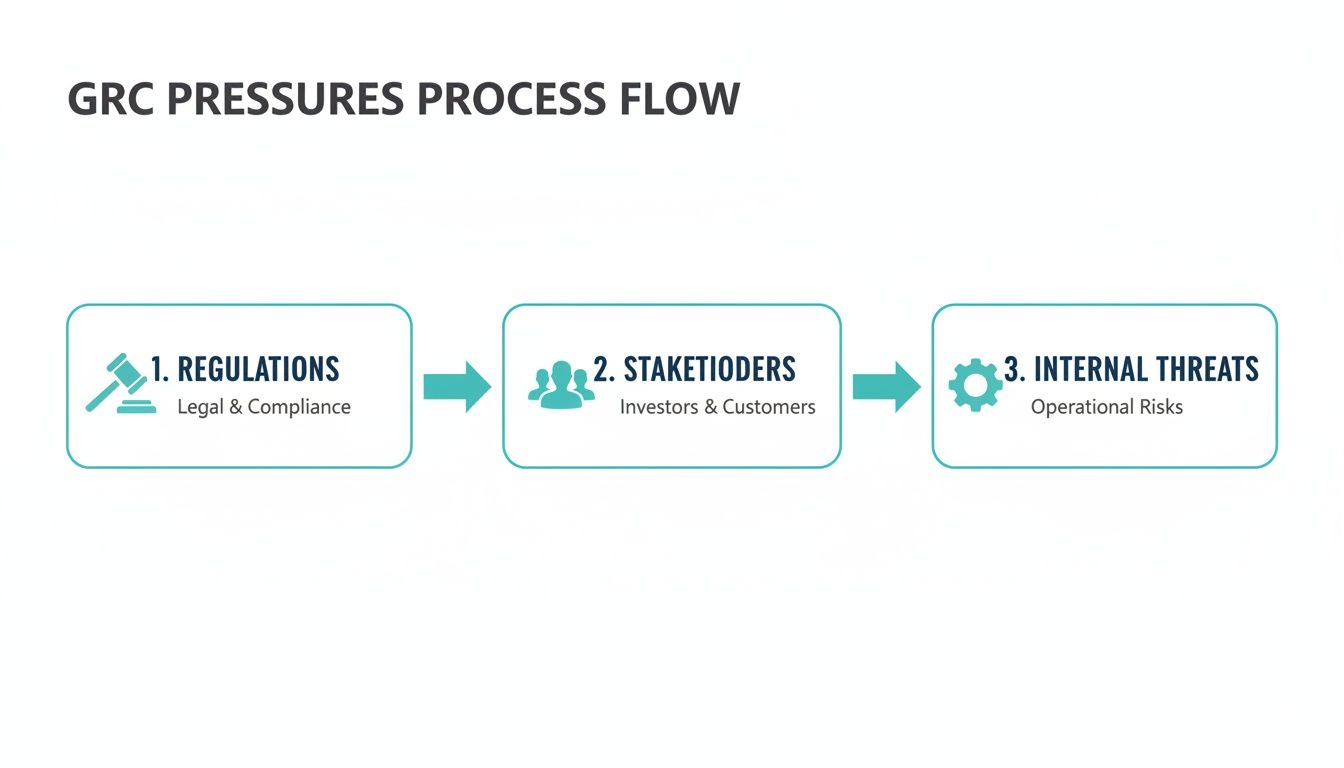
The flow from regulations and stakeholder demands down to internal threats makes it clear: risk isn't a one-off event. It's a continuous stream of challenges you have to manage.
Define Clear Policies and Controls
Your risk assessment tells you what to worry about. Your policies and controls define how you’re going to handle it. This is where you translate your GRC strategy into clear, actionable rules.
These policies are the backbone of your governance structure, setting firm expectations for conduct and procedure. To dive deeper into this critical step, you can explore our guide on building an essential governance policy framework.
Controls, on the other hand, are the specific actions you take to enforce those policies. For example, if a policy bans conflicts of interest, a control might be an automated system that flags when an employee and a vendor share the same address. The key is to design controls that are directly tied to the specific risks you’ve already identified.
A policy without a corresponding control is just a suggestion. Effective GRC requires both a clear rulebook and a practical way to ensure the rules are being followed.
Embrace Technology To Unify And Automate
Trying to manage GRC with spreadsheets, emails, and manual check-ins is like trying to navigate a highway on a bicycle. It’s slow, wildly inefficient, and dangerously prone to error. In the modern world, technology is essential for bringing your GRC framework to life.
A unified GRC platform acts as a single source of truth, centralizing your policies, controls, risk assessments, and incident responses. It automates tedious compliance tasks, serves up real-time dashboards for leadership, and creates a clean, auditable trail of all GRC activities.
This doesn't just make you more efficient; it gives you the data-driven insights needed to make smarter, faster decisions about risk. The goal is to finally move from reactive firefighting to proactive, organized risk management.
Shifting From Reactive Enforcement To Ethical Prevention
For decades, the model for managing internal risk has been fundamentally broken. It’s a reactive, surveillance-heavy approach that focuses on catching people doing wrong after the damage is done. This outdated philosophy treats employees as liabilities to be monitored, not as trusted assets.
This traditional method breeds a culture of fear, making employees hesitant to innovate or take ownership. It erodes trust, creates an "us vs. them" mentality, and almost always fails to stop the biggest threats until it’s far too late. It's time for a radical shift in how we approach governance risk & compliance.
The Rise Of Ethical Prevention
A modern, effective GRC strategy leaves this flawed model behind and embraces a new concept: ethical prevention. This isn't about invasive surveillance or pointing fingers; it’s about identifying objective, early-warning signals and structured risk indicators before a small problem spirals out of control.
Instead of monitoring personal behavior, ethical prevention hones in on process-related flags. Imagine an automated system that identifies a potential conflict of interest because a new vendor’s address matches an employee's home address—not by reading private emails. It’s a dignifying strategy that protects both the organization and its people.
This allows leaders to step in with support, training, or clarification, turning a potential crisis into a constructive conversation. It’s about building guardrails, not cages.
Moving From Judgment To Decision Support
This is where GRC becomes a true strategic asset. Ethically designed technology acts as a decision-support tool, not as judge and jury. It keeps human judgment at the center of the process while giving leaders the objective data they need to act responsibly.
Ethical GRC technology is designed to highlight objective anomalies and procedural inconsistencies. It presents indicators, not conclusions, empowering human experts to investigate with context, fairness, and due process.
This shift is crucial. An AI-driven platform like E-Commander can analyze structured data to spot patterns invisible to the naked eye. But it is explicitly built without the ability to make judgments, profile behavior, or invade privacy. Its entire purpose is to present objective, fact-based signals for human review.
How Ethical Prevention Works In Practice
Let's look at how this changes the game for a typical governance risk & compliance scenario.
Old Model (Reactive Enforcement): Months after the fact, an internal audit uncovers that an employee has been approving invoices for a company owned by a family member. The money is gone, trust is shattered, and the only options are termination and legal action.
New Model (Ethical Prevention): A GRC system flags a structural risk indicator: the new vendor’s setup data contains information linking it to a current employee. An automated alert goes to a compliance officer, who can now proactively address the potential conflict of interest, ensure proper disclosures are made, and prevent any wrongdoing before it happens.
This proactive approach protects the company's finances and reputation while preserving the employee's dignity by addressing a policy issue, not making a moral accusation. This is the core of modern GRC.
This shift isn't just a trend; it's a necessary evolution. By focusing on objective signals and supportive intervention, organizations can build a resilient culture based on trust and integrity, transforming GRC from a punitive function into a strategic enabler of ethical business.
How A Unified Platform Transforms GRC Operations
Imagine trying to conduct an orchestra where every musician has a different set of sheet music. The result would be a chaotic, disjointed mess. This is exactly what governance, risk, and compliance feels like when HR, Legal, and Security all operate from their own isolated silos.
Each department ends up using its own tools and spreadsheets, creating multiple versions of the truth and leaving dangerous visibility gaps. Critical risk signals get lost in endless email chains, and information simply doesn't connect. This fragmented approach isn’t just inefficient; it's a direct threat to the entire organization.
A unified GRC platform acts as the conductor, giving everyone the same score to play from. It pulls all your scattered data and disjointed workflows into a single source of truth for every risk and compliance activity.
Breaking Down Departmental Barriers
The most immediate win from a unified platform is that it tears down information silos. When all GRC-related data lives in one central hub, every stakeholder—from an HR investigator to legal counsel—is working from the same validated information.
This creates a shared language that finally allows for real collaboration. For instance, a security incident flagged by the IT team can be seamlessly escalated to Compliance for a regulatory check and to HR for a policy violation review, all inside the same system. No more chasing down updates or wondering who has the latest version.
This interconnected view is essential for seeing the whole picture. You can learn more about the strategic advantages of breaking down these walls in our article on creating an integrated risk management solution. It ensures a risk spotted in one corner of the business is understood and managed across the entire organization.
Shifting From Manual Effort to Automated Insight
Let’s be honest, traditional GRC management is a grind. It’s notoriously manual and labor-intensive. Teams burn countless hours chasing down information, hand-crafting reports, and manually tracking compliance tasks in spreadsheets. A unified platform automates these tedious processes, freeing up your experts to focus on strategic analysis and making smart decisions.
This automation isn't just about saving time; it's about adding intelligence. Key areas that get an immediate upgrade include:
Compliance Tracking: The platform can automatically monitor regulatory changes and map them to your internal controls, alerting the right teams when something needs their attention.
Workflow Management: Incident response becomes faster and far more consistent. Predefined, automated workflows guide teams through every required step, ensuring nothing gets missed.
Reporting and Dashboards: Leadership gets a real-time, live view of the organization’s risk posture through comprehensive dashboards, killing the need for manual report generation.
By automating the mechanics of GRC, a unified platform transforms your program from a backward-looking administrative function into a forward-looking strategic asset. It turns raw data into actionable intelligence.
To really grasp the difference, it’s helpful to see a side-by-side comparison of the old way versus the new standard.
Siloed GRC Vs A Unified Platform Approach
The table below breaks down the fundamental shift that occurs when an organization moves from fragmented, manual processes to an integrated, intelligent platform.
Aspect | Traditional (Siloed) Approach | Unified Platform Approach |
|---|---|---|
Data Visibility | Fragmented data across spreadsheets and emails. No single source of truth. | Centralized data hub providing a complete, real-time view of risk. |
Collaboration | Departments work in isolation, leading to miscommunication and gaps. | Seamless cross-functional workflows connecting HR, Legal, and Security. |
Efficiency | Highly manual, labor-intensive tasks drain resources and slow response times. | Automated workflows, tracking, and reporting free up teams for strategic work. |
Decision-Making | Based on outdated, incomplete information, leading to reactive fixes. | Driven by real-time data and predictive insights, enabling proactive decisions. |
Audit Trail | A chaotic scramble to piece together evidence from multiple sources. | A single, immutable, and easily auditable record of all GRC activities. |
This transition is not just an operational upgrade; it’s a strategic imperative for building a resilient and defensible organization.
Creating A Defensible And Auditable Record
In today’s high-stakes regulatory world, being able to prove your GRC program is effective is just as important as having one. A scattered, manual process makes this nearly impossible. Audits become a frantic fire drill as you try to piece together evidence from a dozen different sources.
A unified platform solves this problem by creating a clear, defensible, and auditable record of every GRC activity. Every policy update, risk assessment, incident investigation, and key decision is logged and timestamped within a single, immutable system.
This traceability is priceless during an audit or a legal challenge. Instead of saying, "We believe we followed the procedure," you can present a complete, documented history that demonstrates due diligence and consistent governance. It’s the difference between a weak defense and a strong, evidence-backed position that protects your reputation and your bottom line.
Answering Your Key Questions About GRC
Even with the best roadmap, real-world questions always pop up when you start putting a governance, risk & compliance strategy into practice. This section tackles some of the most common questions we hear from leaders, giving you clear, straightforward answers to help you move forward. The idea is to turn the core concepts we've discussed into practical, confident next steps.
Where Should A Small Business Start With GRC?
For a small business, the idea of a massive GRC framework can feel like trying to boil the ocean. Forget that. The key is to start small and build a solid foundation that can grow with you. You don’t need to rush out and buy expensive software; the first step is just getting the right habits and processes in place.
Start by identifying what matters most. Pinpoint the top three to five regulations that actually affect your industry. This could be anything from data privacy rules like the CCPA to specific workplace safety standards.
Next, do a simple, honest risk assessment. Ask yourself: what could realistically go wrong and cause serious harm to our business? Think about the big ones, like a data breach, losing a key employee, or a major supply chain hiccup.
The initial groundwork of understanding your specific risks and rules is the most critical first step for any small business. A platform can automate these processes later, but it can't replace this fundamental strategic thinking.
Finally, get your core policies down on paper. Who is responsible for what? What’s the official plan for handling a major customer complaint or a data security incident? Put this information in one controlled, accessible place—like a secure shared drive—instead of letting it get lost in scattered email threads and random files. This simple discipline creates a scalable framework that will support you as you grow.
How Does A GRC Program Actually Help Human Resources?
A solid GRC program is a total game-changer for Human Resources. It elevates the function from a reactive, administrative role into a proactive, strategic partner by giving HR a clear, consistent, and defensible framework for managing all the risks tied to people.
At its core, GRC provides official, board-approved policies on everything from employee conduct and whistleblowing to conflicts of interest. This gives HR a firm, objective foundation for every action it takes, cutting through ambiguity and dramatically reducing legal exposure. When an issue comes up, HR isn’t relying on subjective judgment anymore; it's enforcing established governance.
A GRC framework also streamlines misconduct investigations with a structured, repeatable workflow. This is crucial because it protects both the employee and the company by ensuring due process is followed, every single time. It creates an auditable trail that proves fairness and consistency—something that’s invaluable if you ever face a legal challenge.
But the real power of modern GRC lies in what it helps HR do before things go wrong.
Early Intervention: It helps HR spot objective risk indicators, like access control anomalies or odd patterns in expense reports, allowing them to offer support or training before a small issue becomes a full-blown crisis.
Culture Building: By weaving GRC principles into hiring, training, and performance management, HR can actively shape a culture of integrity and accountability.
Strategic Insight: The data gathered through a GRC platform gives HR incredible insight into the organization's health, helping to spot systemic issues that need to be addressed at a higher level.
This shift does more than just protect the organization’s integrity; it actively fosters a culture of support, fairness, and psychological safety.
Is All GRC Technology Ethical And Non-Invasive?
Absolutely not, and this is one of the most important distinctions in the governance, risk & compliance field today. A GRC platform’s ethical stance comes down to whether it was "ethical by design." Many traditional tools are built on a foundation of invasive surveillance—like keyword monitoring in emails or employee chats—which fundamentally destroys trust and creates a hostile work environment.
An ethical GRC platform operates on a completely different philosophy. It’s built from the ground up to comply with the world’s strictest privacy laws, like GDPR, and it explicitly rejects features that rely on psychological profiling, lie detection, or any form of covert monitoring. Its entire purpose is to uphold dignity and privacy, not to violate them.
Instead of reading private messages or making behavioral judgments, an ethical system focuses only on structured, objective data. For example, it might flag a potential conflict of interest by seeing that a new vendor’s registration details match an employee’s data in the HR system. That’s a factual, process-based indicator, not a conclusion pulled from snooping on personal emails.
A truly ethical GRC system never makes automated judgments about people. It provides objective risk indicators for human review, empowering leadership with better information, not replacing their judgment with a biased algorithm.
This approach keeps technology in its proper place as a decision-support tool. The system highlights anomalies for human experts to review with full context and due process, never presuming guilt or intent. By keeping humans firmly in the driver's seat, this model protects employee dignity while still giving the organization the early warnings it needs to manage risk responsibly. For any company trying to build a resilient, trust-based culture, this ethical line is non-negotiable.
At Logical Commander Software Ltd., we believe GRC technology should empower leaders, not police employees. Our E-Commander platform is built on an "ethical by design" foundation, enabling you to proactively manage internal risks while upholding the dignity and privacy of your team. Discover how to shift from reaction to prevention with Logical Commander.