%20(2)_edited.png)

Pre-Employment-Assessment-Tools: Your Guide to Proactive Risk Prevention
- Marketing Team

- Dec 4, 2025
- 14 min read
Updated: Dec 9, 2025
Pre-employment assessment tools are standardized platforms that organizations use to evaluate a candidate's skills, abilities, and behavioral risk indicators before an employment offer is made. In today's complex business environment, they are essential for adding objective, data-driven insights to the hiring process, moving beyond resumes and interviews to mitigate internal threats and prevent costly hiring mistakes.
Why Pre-Employment Assessment Tools Are No Longer Optional
In a competitive market, a single bad hire can have catastrophic consequences. The damage extends far beyond recruitment costs; it can erode team morale, cripple productivity, and expose your organization to significant insider risk. This is why pre-employment assessment tools have become a strategic imperative for leaders in HR, Compliance, and Risk. They transition hiring from subjective gut feelings to a defensible, data-driven strategy focused on prevention.
The primary driver for their adoption is the urgent need to address human-factor risk at the very beginning of the employee lifecycle. A misaligned hire can create vulnerabilities leading to compliance breaches, data exfiltration, or workplace misconduct. By using objective, ethical criteria to screen candidates, businesses can build a more resilient, compliant, and efficient workforce.
The Rush Toward Data-Driven Hiring
This shift toward objective evaluation is not a passing trend—it's a market imperative. The global pre-employment assessment tools market was valued at approximately USD 1.5 billion in 2023 and is projected to more than double to USD 3.2 billion by 2032. This explosive growth signals a clear demand for technologies that provide deeper risk insights than a resume screen ever could. You can explore more about the pre-employment assessment tools market growth on dataintelo.com.
This momentum is fueled by critical business drivers:
Mitigating Insider Risk: Proactively identifying candidates whose behavioral indicators may conflict with corporate policy or ethical standards.
Reducing Costly Turnover: Securing a better fit for both the role and the company's risk culture from day one, which is directly linked to higher employee retention.
Strengthening Compliance: Establishing a standardized, fair screening process that minimizes hiring bias and supports regulatory frameworks, particularly in regulated industries.
The Core Challenge Facing Today's Leaders
For decision-makers in Compliance, Risk, and Legal, the central challenge is balancing effective risk screening with strict legal and ethical boundaries. The Employee Polygraph Protection Act (EPPA), for example, strictly prohibits any tool that functions as a lie detector. Navigating this requires a new standard—one that champions proactive, non-intrusive, and EPPA-aligned risk identification.
Traditional assessments focus on skills or personality, often missing the subtle behavioral indicators of human-factor risk. The goal isn't to make a judgment call on a candidate. It is to objectively understand their potential alignment with your organization’s risk tolerance and ethical framework in a compliant, non-invasive manner.
Ultimately, the right pre-employment-assessment-tools are more than just applicant filters. They are a foundational component of a robust internal risk management program, ensuring your organization's stability and compliance begin with the people you hire. This proactive prevention strategy is essential for protecting your bottom line and corporate reputation.
Comparing Traditional Assessment Tool Types
Choosing the right pre-employment assessment tools requires understanding what each type measures and, more critically, what it misses. While many tools can test for skills or cognitive aptitude, they almost universally fail to address the nuanced human-factor risks that escalate into internal threats. For leaders in compliance and risk, relying on these outdated methods introduces bias, legal liability, and a dangerous false sense of security into the hiring process.
Each traditional assessment has a function, but they all suffer from significant blind spots. Cognitive tests measure problem-solving but reveal nothing about a candidate's ethical disposition. Skills challenges confirm technical proficiency but cannot predict the potential for misconduct. Relying on these tools alone leaves a gaping hole in any serious internal threat management strategy.
This simple flowchart shows the first critical decision point organizations face when building a hiring process.
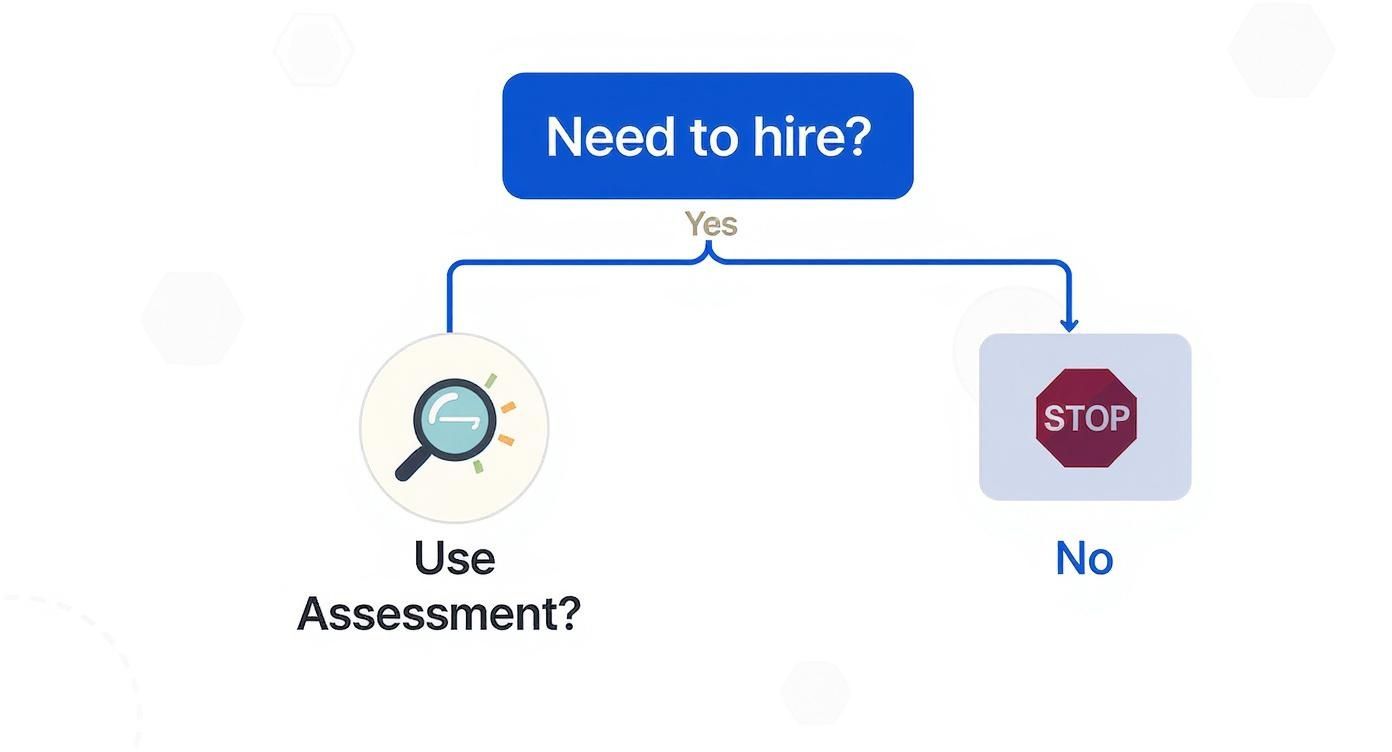
Once the decision to hire is made, implementing a modern, ethical assessment layer is what separates a reactive hiring model from a proactive one.
Cognitive And Skills Based Assessments
Cognitive ability tests are designed to evaluate a candidate’s reasoning, memory, and problem-solving skills. While they can indicate intellectual capacity for complex roles, these tests are poor predictors of on-the-job behavior, ethical alignment, or potential for insider risk.
Skills-based assessments directly measure a candidate’s ability to perform specific tasks, such as a coding challenge. While effective for confirming technical competence, they provide zero insight into a candidate’s propensity for fraud, compliance violations, or other human-factor risks. They answer "can they do the job?" but not "how will they behave while doing it?"
Personality And Integrity Tests
This category presents the greatest legal and ethical risks. Personality tests attempt to map a candidate’s traits to predict their fit within a team. However, they are notoriously flawed and legally hazardous.
Risk of Bias: These tests can inadvertently penalize neurodiverse candidates or individuals whose personalities do not fit a narrow, predefined "ideal."
Lack of Predictive Power: A personality type has no bearing on a person's integrity or their likelihood of engaging in misconduct.
Legal Scrutiny: If a personality test is deemed a medical or psychological examination, it can trigger legal challenges under the Americans with Disabilities Act (ADA).
Integrity tests are even more dangerous from a compliance perspective. Many of these overt assessments directly ask about attitudes toward theft and misconduct, effectively functioning as de facto lie detectors. This places them in direct conflict with the Employee Polygraph Protection Act (EPPA).
Any assessment tool that attempts to measure a candidate's honesty creates significant legal exposure. EPPA strictly prohibits the use of lie detector tests in private sector pre-employment screening. Modern "integrity" tests often cross this line, exposing organizations to severe penalties and reputational damage. Our E-Commander platform is the EPPA-aligned alternative, focusing on risk indicators, not prohibited character judgments.
For a deeper dive into the different kinds of integrity tests and the legal minefields they create, explore our detailed guide on the 6 types of integrity test sample questions for 2025: https://www.logicalcommander.com/post/6-types-of-integrity-test-sample-questions-for-2025. This resource clarifies exactly which formats are legally hazardous.
To bring these differences into focus, the table below breaks down the purpose, best use case, and critical limitations of each assessment type.
Comparing Pre Employment Assessment Tool Types
Assessment Type | Primary Purpose | Best Use Case | Key Limitations and Risks (Bias, EPPA) |
|---|---|---|---|
Cognitive Ability Test | Measures reasoning, problem-solving, and general mental aptitude. | Roles requiring complex data analysis and quick decision-making (e.g., finance, consulting). | Fails to predict ethical behavior or integrity. Can introduce bias against certain cognitive styles. |
Skills-Based Assessment | Validates technical proficiency for specific job-related tasks. | Technical roles where hard skills are paramount (e.g., software development, graphic design). | Offers zero insight into human-factor risks like fraud or misconduct. |
Personality Test | Maps behavioral traits to predict cultural fit or work style. | Team-building exercises or roles heavily dependent on specific interpersonal styles. | High risk of bias against neurodiversity. Poor predictor of actual integrity. Can trigger ADA legal challenges. |
Integrity Test | Attempts to measure a candidate's honesty and attitude toward misconduct. | High-risk roles involving cash handling or sensitive data (used with extreme caution). | Significant EPPA legal risk. Many formats are considered illegal lie detector tests, creating severe liability. |
This comparison clarifies that while each tool has a narrow function, none provides a holistic view of a candidate, especially regarding insider risk.
Even more specialized tools like work style assessments only offer insights into a candidate's approach to tasks, stopping short of true risk mitigation. They may identify traits, but they fail to connect them to actionable risk indicators. This gap is precisely where a modern, non-invasive, EPPA-aligned approach becomes necessary to build a resilient and compliant workforce.
Hidden Costs and Limitations of Conventional Tools
The advertised price of most pre-employment-assessment-tools is dangerously misleading. For leaders in risk, compliance, and legal, the true cost is not the subscription fee—it's the hidden liabilities that accumulate long after deployment. Conventional methods create significant organizational exposure, undermining the very risk framework you’re trying to build.
The most damaging costs are those that surface as legal battles over biased algorithms, a tarnished employer brand from a poor candidate experience, or a convoluted assessment process that deters top talent. Worse, these tools often instill a false sense of security, leaving your organization vulnerable to the exact human-factor risks you thought you had addressed.
The Blind Spot of Skills-Based Assessments
Consider a common scenario that exposes a fundamental flaw in traditional screening: a candidate aces every technical skills test, demonstrating proficiency for the role. Yet, that same individual could pose a significant internal threat.
These tools are built to answer one question: "can they do the job?" They completely fail to address the far more critical question for risk management: "how will they behave while doing it?"
This creates a massive blind spot. You might hire a brilliant developer with a high propensity for intellectual property theft or a finance expert who is primed to commit fraud. This gap exists because these tools measure capability, not behavioral risk indicators.
The core limitation of conventional pre-employment assessment tools is their reactive nature. They identify existing traits or skills but cannot proactively flag the potential for specific, risk-related actions. This leaves organizations vulnerable to nuanced human-factor risks that standard assessments were never designed to catch.
The Financial Drain from Reactive Investigations
When these hidden behavioral risks materialize, the financial fallout is severe. The failure of traditional screening to identify these indicators forces organizations into a reactive posture, launching disruptive and expensive internal investigations after an incident has occurred.
These investigations are a massive drain on resources, destroy morale, and cause significant financial and reputational harm. Understanding the true cost of reactive investigations is key to grasping the value of proactive prevention. Every investigation is a direct consequence of a failure in the hiring process—a risk that could have been identified and neutralized from the start.
This reactive cycle also creates ongoing operational friction. Companies relying solely on conventional screening are constantly managing problems instead of preventing them, a strategy that is both costly and unsustainable.
Legal and Reputational Liabilities
Beyond the financial impact, certain pre-employment-assessment-tools bring direct legal and reputational threats to your organization.
Algorithmic Bias: Many tools are plagued by inherent biases that unfairly disqualify candidates from protected groups, opening the door to discrimination lawsuits and damaging public perception.
EPPA Violations: So-called "integrity tests" that are merely disguised lie detectors are a direct violation of the Employee Polygraph Protection Act (EPPA), exposing companies to serious legal penalties.
Candidate Mistrust: An intrusive or psychologically invasive assessment process creates a negative experience that poisons your company’s reputation, making it harder to attract high-quality talent.
These limitations prove that conventional tools are inadequate for robust, modern risk management. They focus on surface-level attributes while ignoring the deeper behavioral indicators that actually predict insider threats. This makes a compelling case for an advanced, ethical, and proactive approach to managing human risk before an employee joins your team.
Navigating The Legal and Ethical Landscape
For compliance, risk, and legal leaders, the world of pre-employment assessment tools is a minefield. While the objective is to mitigate human-factor risk, selecting the wrong tool can introduce far greater liabilities, including costly litigation, reputational damage, and severe regulatory penalties. The stakes are incredibly high, especially when assessments cross into legally protected territory.
At the center of this complex landscape is the Employee Polygraph Protection Act (EPPA). This federal law places strict prohibitions on using lie detector tests for pre-employment screening in most private companies. The problem is that many "integrity tests" are designed to measure a candidate's perceived honesty, which can easily be interpreted as a polygraph-like device under EPPA, creating significant legal exposure.
This is a critical distinction for any organization. Any tool claiming to verify truthfulness is not just ethically questionable—it's legally perilous. You can learn more about navigating these nuances in our detailed guide on AI ethics and EPPA compliance: https://www.logicalcommander.com/post/navigating-ai-ethics-eppa-compliance-and-risk-management-in-human-resources.
Beyond EPPA: The Broader Legal Framework
While EPPA is a major concern, it is just one piece of the compliance puzzle. Decision-makers must navigate a web of other laws governing pre-employment screening.
Here are the other key legal frameworks to consider:
Anti-Discrimination Laws (Title VII): This law prohibits employment discrimination based on race, color, religion, sex, or national origin. An assessment tool with inherent algorithmic bias that disproportionately screens out candidates from a protected class is a direct violation.
Americans with Disabilities Act (ADA): Assessments that could be viewed as medical or psychological examinations are restricted under the ADA. Personality tests, in particular, can fall into this gray area, creating serious risk if not strictly job-related.
Privacy Laws (GDPR & CCPA): These regulations dictate how candidate data is collected, processed, and stored. Your assessment tools must provide transparency and respect candidates' data privacy rights.
When navigating the legal side of hiring, it's vital to explore comprehensive strategies to reduce bias in your hiring process to build a more defensible and equitable system.
The Real-World Consequences of Getting It Wrong
These legal theories are not abstract concepts—they have led to real-world lawsuits with massive financial consequences. Companies have been sued for using biased AI that systematically filtered out qualified female candidates. Others have faced litigation for deploying personality tests challenged as illegal medical examinations.
These cases highlight a crucial lesson for risk leaders: the pursuit of data can lead to disaster if the tool is not built on a foundation of legal and ethical compliance. The irony is that when done correctly, ethical assessments work. Research shows that companies using proper assessments report a 39% lower turnover rate compared to those that don't, but only when they are implemented correctly.
The core responsibility of any risk or compliance leader is to ensure that screening processes reduce liability, not create it. Choosing an EPPA-aligned, non-intrusive solution like Logical Commander that respects candidate dignity is the only sustainable path to mitigating internal threats without inviting legal challenges.
Ultimately, navigating this landscape requires a shift in mindset. Instead of trying to measure subjective traits, the focus must be on identifying objective, behavioral risk indicators in a way that is ethical, non-intrusive, and fully compliant. This proactive and respectful approach protects both the candidate and the organization.
Moving Beyond Traditional Screening to Proactive Risk Prevention
Most pre-employment-assessment-tools are fundamentally broken. They are stuck in the past, focusing on what a candidate knows (skills) or how their personality fits a generic template. They completely miss the critical indicators of human-factor risk—a massive liability for organizations in regulated industries. It's time for a new standard that moves from reactive trait-matching to proactive, ethical risk screening.
This modern approach, championed by platforms like Logical Commander’s E-Commander, ditches intrusive psychological evaluations and legally toxic integrity tests. Instead, it uses AI to analyze risk indicators without violating candidate privacy or crossing the strict legal lines of the Employee Polygraph Protection Act (EPPA). The objective is not to judge character; it is to objectively understand a candidate's alignment with your organization’s risk tolerance before they are hired.
This is the new standard of internal risk prevention. It delivers a cohesive, data-driven view of potential behavioral risks, allowing you to make informed decisions without resorting to invasive surveillance or legally questionable methods that other vendors promote.
The Shift to Non-Intrusive, AI-Driven Insights
At the core of this new standard is an ethical, AI-driven framework. Unlike platforms that attempt to measure subjective concepts, this approach identifies patterns and behavioral indicators tied to specific internal threats—such as conflicts of interest or susceptibility to fraud. It’s a fundamental shift in how organizations approach human capital risk management.
This AI-driven analysis is non-intrusive by design. It does not use psychological profiling or any method that could be mistaken for a medical exam under the ADA. It provides a clear, objective signal based on how a candidate responds to structured scenarios, helping you understand potential risks before they become costly incidents.
This evolution is happening as the market explodes. In 2024, the pre-employment testing software market was valued at USD 195.52 million and is projected to hit USD 485.1 million by 2033. This surge is driven by the demand for data-centric hiring and advanced AI, with over 630,000 companies screening more than 74 million candidates this year alone. You can learn more about these pre-employment testing market trends to see just how fast the industry is moving.
Contrasting Proactive Prevention with Reactive Failures
The shortcomings of old-school assessments become glaringly obvious when compared to a proactive, risk-focused approach.
Traditional Approach (The Old Way): Relies on personality tests that invite bias and skills tests that ignore behavioral risks. This flawed model gives high-risk candidates a pass, leading directly to post-hire incidents and costly, disruptive internal investigations.
Proactive Standard (The New Way): Uses an EPPA-aligned, AI-driven platform like E-Commander to identify risk indicators from day one. This method helps prevent high-risk individuals from entering the organization, neutralizing threats before they can cause financial, legal, or reputational harm.
This modern standard doesn't just provide better insights; it delivers a defensible, compliant, and ethical process for mitigating human-factor risk.
The new benchmark for pre-employment screening is defined by its ability to deliver deep risk insights without compromising candidate dignity or legal compliance. Logical Commander replaces invasive questioning and flawed metrics with objective, AI-driven analysis focused solely on preventing internal threats.
Ethical Risk Management as a Competitive Advantage
Adopting this new standard is more than a defensive measure—it's a strategic advantage. By implementing an ethical, non-intrusive screening process, you protect your reputation and become an employer of choice. Candidates are wary of invasive assessments, and a respectful process signals your company’s commitment to an ethical culture.
This modern approach empowers compliance, HR, and legal leaders to build a stronger, more resilient workforce. By identifying and mitigating human-factor risks at the earliest stage, organizations can protect their assets, uphold governance standards, and build a culture of integrity from the ground up.
Integrating Ethical Assessments Into Your Hiring Workflow
Integrating a new pre-employment assessment tool is more than a software subscription; it's a strategic initiative that requires alignment across HR, Legal, and Compliance. Successfully embedding a preventative, ethical risk assessment platform into your current workflows is key to getting ahead of internal threats. It starts with a unified business case.
This alignment is non-negotiable. HR leaders need to see how it streamlines screening and ensures compliance. Legal and Compliance teams need definitive proof that the platform is ethically sound and fully EPPA-aligned. When you position the tool as the new standard for internal risk prevention—one that replaces reactive investigations with proactive intelligence—you build an unshakeable foundation for change.

A Practical Roadmap for Implementation
Once you have stakeholder buy-in, the goal is to make the technical and operational integration seamless. A smart rollout follows a structured roadmap that minimizes disruption and maximizes adoption.
Step 1: ATS and HRIS Integration. The platform must integrate with your existing systems. A direct, API-driven connection with your Applicant Tracking System (ATS) and Human Resources Information System (HRIS) is essential. This makes launching an assessment a natural part of the hiring process.
Step 2: Configuration and Customization. One size does not fit all. Work with the provider to configure risk thresholds and assessment criteria that align with your organization’s specific risk appetite and the compliance requirements of different roles.
Step 3: Training and Onboarding. A tool is only as good as its user. Hiring managers and recruiters need training on how to interpret assessment results correctly. The focus is critical: this data is an objective input for decision-making, not the final word.
True integration means the ethical assessment becomes an embedded, frictionless part of your talent acquisition and risk management workflows. The goal is to make proactive risk screening as routine as a resume review, ensuring every hire strengthens your organization’s integrity.
Following this structured path ensures the platform becomes a core part of your risk management framework. It elevates your hiring process from a function for filling roles into a strategic pillar of your internal threat prevention program. You're not just hiring people; you’re building a more resilient and ethical organization.
When evaluating pre-employment assessment tools, you're bound to have tough questions. It's a high-stakes decision that sits right at the intersection of compliance, risk, and HR. Getting it right means protecting your organization from internal threats while upholding the highest ethical standards.
Let's clear up some of the most common concerns we hear from leaders.
Are All Pre-Employment Assessment Tools EPPA Compliant?
No, and this is a critical distinction that carries enormous legal risk. Many tools marketed as "integrity" or "honesty" tests are, in fact, direct violations of the Employee Polygraph Protection Act (EPPA). They try to measure a candidate's truthfulness, which is legally off-limits for most private employers.
This is an area where you have to be extremely careful. Your only safe path is to choose a solution specifically designed from the ground up to be EPPA-aligned. That means it must focus on assessing objective, behavioral risk indicators—not making subjective judgments about a person's character. An ethical platform is built for prevention, not for legally prohibited or intrusive methods.
How Can AI Be Used Ethically In Pre-Employment Assessments?
Ethical AI in this context has nothing to do with psychological evaluations or making discriminatory judgments. Its real job is to identify potential human-factor risk patterns and deliver objective, data-driven insights that help a human make a better, more informed decision.
An ethical AI platform analyzes responses for indicators linked to internal threats, not for personality traits. The whole model is built on transparency, a tight focus on job-related risk factors, and a non-intrusive approach that respects every candidate's dignity and stays fully compliant.
This approach ensures the technology strengthens your risk framework without introducing bias or new legal liabilities.
How Do Modern Assessment Tools Integrate With Existing HR Systems?
Leading risk assessment platforms are built to plug right into the HR ecosystem you already have. Using APIs, they connect directly with your Applicant Tracking System (ATS) and Human Resource Information System (HRIS).
This integration makes the entire process seamless for your teams. It allows them to:
Kick off assessments directly from your ATS.
Track a candidate's progress without juggling different systems.
Review results right alongside all the other application materials.
A smooth integration creates a professional and efficient experience for the candidate while giving your HR, compliance, and risk teams the data they need in one place. It makes proactive risk screening a natural, embedded step in your hiring process, not a clunky add-on.
At Logical Commander, we're setting a new standard for proactive internal threat prevention. Our AI-driven, EPPA-aligned platform helps you identify human-factor risks ethically and non-intrusively, protecting your organization from costly incidents before they ever happen.
Ready to move beyond the limitations of traditional assessments?
Request a demo to see our platform in action.
Join our PartnerLC program to become an ally in ethical risk management.
Contact our team for a personalized enterprise deployment consultation.