%20(2)_edited.png)

Elevate integrity in workplace with E-Commander: Build Ethical Cultures and Compliance

Integrity in the workplace starts when every decision, big or small, aligns with your company’s core values and risk appetite. Transparent leadership and consistent behavior form the beams of a bridge that connects managers with their teams—powered by an EPPA compliant platform and AI human risk mitigation tools.
Bridging Teams And Leadership Through Integrity
Imagine integrity as a sturdy bridge—one spanning the divide between strategy and execution. It stands firm on three pillars:
Transparent Leadership sets clear direction.
Fair Treatment ensures every perspective counts.
Consistent Actions turn principles into practice.

Decision-makers in compliance, legal, HR, and risk management get a step-by-step playbook for aligning integrity in workplace across the organization:
Policy Clarity that steers everyday judgments with clear decision gates.
Cultural Practices designed to spark open, ethical conversations.
Interactive Training Programs embedding core values in role-specific scenarios.
AI-Driven Insights for internal threat detection without invasive monitoring.
Together, these elements map out a proactive path to ethical risk management and prevention.
Shared ethics reduce insider risk before it emerges.
Aligning Leadership And Teams
When leaders walk the talk, their teams follow suit. Key tactics include:
Regular Communications reinforcing shared values and governance priorities.
Public Decision Rationales shining light on why choices are made.
Open Feedback Loops enabling quick course corrections.
This mutual respect lowers the likelihood of human-factor risk.
Next Steps
Up next, we’ll dive into legal implications, performance metrics, and how a non-intrusive EPPA compliant platform like E-Commander fits into your proactive risk strategy.
Learn more about foundational practices in our High Integrity Workplace Framework article.
Concrete Examples That Illustrate The Bridge
Consider these real-world snapshots of integrity in action:
In manufacturing, site visits followed by candid debriefs reinforced safety and quality standards.
In healthcare, leadership teams openly shared process failures to model transparency.
Retail teams weave ethics anecdotes into daily huddles.
Finance groups host workshops reviewing policy exceptions together.
Each consistent action ties policy to everyday behavior, strengthening your ethical risk management posture.
Summary Of Foundations
Integrity foundations link leadership, culture, and actions to keep risks at bay. Just as a bridge needs solid supports, your program relies on:
Transparent Leadership aligning everyone around shared goals.
Fair Treatment sustaining engagement.
Consistent Actions forging a durable culture.
Code Of Conduct providing decision-making guardrails.
With these pillars in place, proactive prevention via internal threat detection software isn’t just possible—it’s already within reach.
Business And Legal Importance Of Integrity In Workplace
When integrity threads through daily operations, companies build a foundation that weathers storms and prevents costly disruptions. Conversely, missing ethical guardrails can open cracks—low morale, lawsuits, and reputation damage carry a steep price.
Productivity Losses from disengaged teams
Financial Penalties like fines and legal fees
Reputation Hit that chips away at brand credibility
Highly regulated fields such as finance and healthcare feel these impacts first. Missed deadlines in finance can lead to multi-million-dollar enforcement actions. In healthcare, hesitation over compliance gaps risks patient safety and invites audits. By the time a reactive investigation starts, the losses have already mounted.
Proactive Prevention Versus Reactive Response
Switching from a “fix-it-after-the-fact” approach to forward-looking safeguards can cut investigation costs by up to 40%. A robust integrity program weaves together clear policies, hands-on training, and AI human risk mitigation.
Catch small issues before they balloon
Keep legal spend lean compared to post-incident probes
Run ongoing compliance checks in step with regulations
Catching a misstep early stops it from turning into a full-blown legal crisis.
Reactive investigations rely on manual audits long after an incident. The E-Commander Risk-HR standard, by contrast, serves leadership real-time dashboards and immediate alerts—all EPPA aligned, non-intrusive, ethical risk management.
According to Gallup’s 2025 State of the Global Workplace Report, slipping integrity and waning engagement have cost businesses an estimated $438 billion in lost productivity, and 37% of U.S. workers left toxic, unethical cultures. You can read the full workplace culture statistics.
You might be interested in our analysis of The Cultural ROI of Integrity for deeper insight.
Legal Consequences And Remediation Costs
A breach brings more than bad press—it piles up legal invoices, settlement checks, and regulator fines. Lawyering up after an ethics event often tops $5 million per case.
Fixing root causes means spending on restitution programs, fresh compliance audits, and culture-recovery campaigns—dollars diverted from innovation and growth.
Yet a modest upfront commitment to integrity programs delivers clear returns: tighter retention and stronger market credibility. Preventing one large-scale breach can save millions of dollars, and stronger reputation can drive revenue long after peers recover from scandals.
Building A Business Case For Integrity
To secure buy-in, lay out the numbers: potential fines, productivity drags, and reputational repair costs—then compare that to the investment in policies, workshops, and Risk Assessments Software.
Lower turnover expenses from an engaged workforce
Reduced legal reserves by spotting issues early
Boosted brand loyalty and customer retention
For example, a mid-size healthcare provider saw a 25% drop in audit costs after rolling out an integrity framework. That freed up $1.2 million to fund new service lines.
Leadership support is crucial. Engage stakeholders early so budgets align and momentum builds. Frame integrity as a strategic investment—this shift turns skeptics into advocates.
Investing in integrity today means sidestepping legal landmines while building resilience. It’s the surest way to minimize risk and maximize organizational strength.
Leadership Elements For A Strong Integrity Program

Integrity starts at the top. When the C-suite walks the talk, it resonates down every corridor of the business.
True leadership in this realm is like tuning an instrument—consistent, precise, and unmistakable. Teams need to hear the same melody from the CEO, the board, and every senior manager.
Think of organizational objectives as the North Star and ethical standards as the compass. When both align, your team isn’t left guessing the direction.
Empathy plays a starring role. Emotional intelligence (EQ) isn’t a buzzword—it’s the lens through which leaders spot brewing concerns before they erupt.
Rotate who leads these sessions to reinforce that accountability isn’t confined to one office. Fifteen minutes around the table can unearth small missteps before they morph into crises.
Consider the story of a factory plant manager who kicked off every Monday by presenting a realistic policy scenario. His team debated potential pitfalls and solutions, sharpening their ethical radar week after week.
Transparency fuels this process. When leaders explain the “why” behind decisions—whether approving an AI-driven module or selecting a vendor—employees see how actions mirror core values.
Recognizing individuals who raise valid concerns sends a clear message: this is a safe space. When staff feel heard, they become partners in prevention rather than bystanders.
Such clarity is critical during technology rollouts. Announcing a new AI feature without sharing its purpose is like launching a ship without a map—rumors spread, alignment falters, and morale dips.
Great Place to Work’s 2025 survey makes this crystal clear. Companies with leaders who live their integrity saw employees in Singapore report 20–30% more positive experiences. Cultures driven by high EQ were 107 times likelier to flourish. Learn more about these findings on Great Place To Work
Leaders who demonstrate empathy and clarity reduce uncertainty and inspire ethical action
When these qualities are in play, you’ll notice quicker buy-in for compliance tools and a dip in turnover rates. Small rituals—integrity huddles or ethics spotlights—become invisible scaffolding that keeps values visible.
The Role Of EQ In Leadership
Emotional intelligence is about reading the room before tension flares up. It’s a skill as essential as any technical expertise.
Pause, listen, and you’ll often catch the first whisper of risk. That early warning prevents an insider risk event from snowballing.
Try these practical EQ steps:
Active Listening with brief summaries to show you’re paying attention
Open-Ended Questions that invite real feedback
Balanced Acknowledgment, celebrating wins and addressing concerns side by side
These habits transform a team into a psychologically safe environment where people speak up without fear.
Learn more about setting the right leadership tone in our Tone From The Top article.
Practical Steps To Build Confidence
Here’s a simple framework to weave integrity into every week:
Schedule a Brief Integrity Check-In
Explain the Why behind any policy update
Share Real Examples of ethical decision making
Then reinforce progress with transparent reporting:
Publish Monthly Ethical Metrics to show progress
Celebrate Integrity Champions publicly
Solicit Cross-Dept Feedback on emerging risks
These steps enhance culture and curb attrition—especially when integrating AI-driven risk management modules.
Great leadership bridges policy and reality. Consistent, human-centered actions turn abstract rules into a genuine culture.
Ultimately, this proactive stance reduces reactive investigations and lays the groundwork for EPPA aligned tools like E-Commander to deliver on their promise.
Implementing A Step By Step Integrity Program
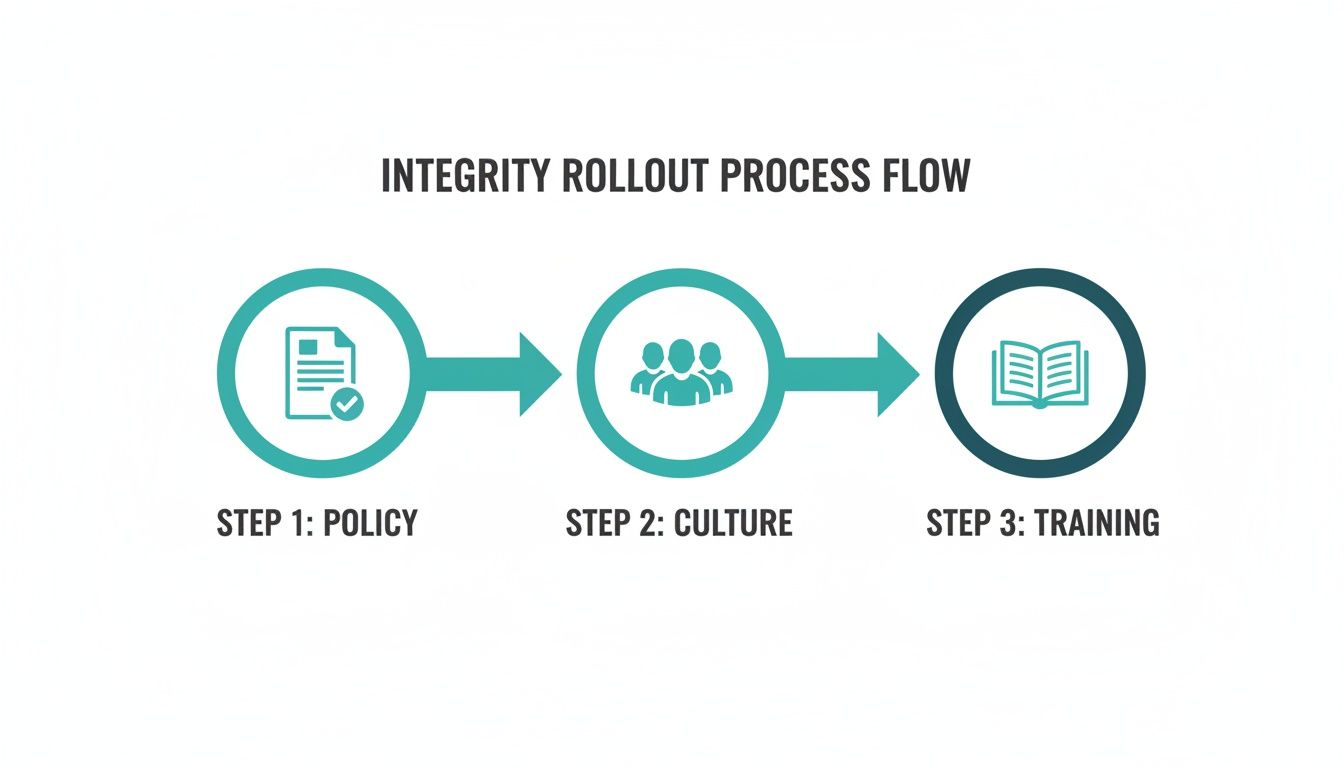
To roll out an integrity program that sticks, use a clear roadmap. A six-step plan—Policy, Culture, Training, Reporting, Investigation, Remediation—keeps the journey manageable and compliant.
From day one, integrate governance and risk assessments software so insider risks surface early, without intrusive methods.
Step One Policy Development
Draft a concise code of conduct that ties each expected behavior to specific job roles. Ensure every clause aligns with EPPA regulations—no hidden surveillance or coercive analysis.
Key Actions At This Gate:
Review existing policies against regulations
Define roles, responsibilities, and decision thresholds
Integrate your Risk Assessments Software from the start
In one hospitality pilot, a peer-review setup flagged issues 30% faster than traditional channels.
Step Two Culture Building
Next, make ethics part of daily routines. Invite leaders to host quick “integrity huddles” in weekly meetings—just five minutes can make a difference.
Key Culture Drivers:
Share stories of employees catching small risks before they grew
Publicly recognize teams that hit compliance milestones
Run short pulse surveys to keep your finger on the organizational mood
Step Three Interactive Training Modules
Training shouldn’t feel like a lecture. Build role-specific scenarios that mirror real dilemmas, and mix in polls to keep people engaged.
Present a scenario with multiple-choice responses
Break into small groups to debate decision gates
Feed insights back into your Risk Assessments Software
Comparison Of Proactive And Reactive Approaches
Aspect | Proactive Prevention | Reactive Investigation |
|---|---|---|
Policy Integration | Built In From Day One | Applied After Incident |
Cost Impact | Lower Training And Legal Spend | High Investigation Expenses |
Detection Timing | Early Warning Signals | Post-Incident Analysis |
This table highlights how prevention upfront slashes costs and catches issues before they escalate.
Step Four Multi-Channel Reporting
Offer both anonymous and named reporting options via digital forms and hotlines—so everyone chooses what feels safest.
Reporting Checklist:
Confirm mobile and desktop channels are active
Publicize clear response-time targets
Track submission trends via software dashboards
After introducing mobile forms, one retail chain cut its reporting backlog by 50%.
Step Five Fair Investigation Workflow
Map out a transparent process with clear decision points. Make respect non-negotiable: use structured interviews that avoid pressure tactics.
Investigation Actions:
Assign neutral reviewers trained in ethical risk management
Log every finding in compliance records
Flag significant patterns automatically in your platform
Step Six Remediation And Continuous Review
Outline corrective actions tied to your code and regulations. Schedule follow-up reviews so controls evolve with fresh data and feedback.
Remediation Checklist:
Create action plans with firm timelines
Communicate outcomes clearly to those affected
Review metrics in your Risk Assessments Software each quarter
Moving forward, integrate ethical AI modules to bolster every step without compromising human dignity.
Key Takeaway: Embed governance checkpoints and software integration at each stage to keep your integrity program proactive, compliant, and resilient.
Integrating Non Intrusive AI Driven Tools
Think of your integrity program as a ship navigating uncertain seas—you wouldn’t sail without radar. E-Commander’s AI-driven “radar” scans metadata, surfaces communication patterns, and highlights policy exceptions—without peeking into private content.
Communication Changes register subtle shifts in sentiment that often precede issues
Policy Exception Alerts catch compliance deviations instantly
Behavioral Trends map recurring human-factor risks
Integration Points With HR And Compliance
Alerts flow directly into HR case management platforms and governance dashboards, so your team can react fast. No more manual ticket juggling or delayed reviews.
For example, an alert about an unusual access request can trigger a compliance gate check instantly—while keeping identities anonymized.
“Our EPPA-compliant AI module flagged policy gaps before any breach occurred,” says a risk officer at a global bank.
This screenshot illustrates artificial intelligence at a high level—underscoring an ethical stance: focus on signals, not personal details.
Non Intrusive Design Choices
Privacy-by-design isn’t an afterthought—it’s baked into every integration point. Identities are anonymized, and user consent is captured before any data flows through the EPPA compliant platform.
Data lives in the metadata layer. That means no raw communications are ever stored or analyzed.
Learn more about internal threat detection with ethical AI in our article on ethical AI detection.
On top of that, E-Commander offers:
Secure API links feeding Risk-HR alerts into your existing HR suite
Custom dashboards showcasing integrity metrics for leadership reviews
Consent logs that let employees control how their metadata is used
This design makes AI a proactive ally—preventing risks before they materialize rather than acting as a policing tool.
Continuous Improvement Practices
Building a living system means tuning it regularly. Your team should meet quarterly to adjust alert thresholds based on real case outcomes and user feedback.
Alert Precision Rate measures how often risk flags are accurate
Review Cycle Time tracks the speed of governance responses
User Feedback Scores capture sentiment around AI transparency
This iterative rhythm ensures your integrity program evolves alongside regulations and emerging threats, maintaining a dynamic shield against human-factor risk.
Governance Alignment Techniques
Integration isn’t just technical—it’s procedural. Alerts feed into compliance committees through configurable workflows that guarantee consistent review cycles.
Every action is logged, creating an audit trail that bolsters accountability.
Audit trail logs preserving action history for compliance checks
Dashboard flags highlighting priority alerts for governance review
Remediation triggers linking AI insights to corrective action plans
By embedding these governance hooks, AI-generated signals become clear, actionable insights that reinforce ethical workplace practices.
Integrating non-intrusive AI-driven tools into your workplace integrity framework delivers proactive detection, respects employee dignity, and meets EPPA standards. AI becomes your strategic partner—nipping ethical breaches in the bud and freeing leadership to focus on growth instead of remediation.
Real World Use Cases And Measuring Success
Stories without numbers can feel incomplete. Data without context often falls flat. When you weave real-world examples together with hard metrics, decision-makers lean in—they see how early action trumps firefighting.
Banking Use Case
Imagine a global bank detecting an unusual pattern in policy exceptions just days before its annual compliance audit.
A non-intrusive report flagged a few data handling missteps in a regional branch. That early warning alone saved $2.1 M in potential fines. A tailored leadership EQ workshop then lifted team morale. Staff turnover slid by 18%, cutting recruitment costs and preserving institutional knowledge.
Rather than trawl through emails, the bank hooked an EPPA compliant AI module into its metadata flow. HR and compliance huddled weekly around a unified risk dashboard—not spreadsheets—to triage alerts and close gaps.
Healthcare Example
In a mid-sized hospital, whispers of billing inconsistencies started bubbling up through anonymous tip lines.
Before errors cascaded, managers stepped in and prevented $1.4 M in penalties.
Early detection through ethical reporting tools saves time and resources.
A cross-functional workshop reinforced reporting channels and clarified how to use anonymous feedback. The result?
Policy exceptions dropped by 22%.
Staff confidence in ethics processes jumped to 82%, according to post-training surveys.
Manufacturing Scenario
On the factory floor, a subtle shift in communication tone hinted at safety compliance risks.
A brief pulse survey captured early concerns and set off a rapid response—no incidents occurred.
Engagement scores climbed 25% as workers felt heard and protected.
Safety concerns were resolved in 48 hours, down from two weeks.
Supervisors used quick digital forms for anonymous feedback. That small tweak meant:
35% faster resolution of compliance gaps.
A 12% decrease in incident volume once weekly integrity check-ins were routine.
Metrics Dashboard
To keep these programs humming, you need a clear scoreboard:
Integrity Program Metrics Dashboard
Metric | Purpose | Target Value |
|---|---|---|
Reporting Rate | Frequency of integrity reports | 5 per 100 employees/month |
Engagement Score | Staff participation in feedback programs | 75% average participation |
Resolution Time | Speed of closing reports | 72 hours or less |
Policy Exceptions | Rate of deviations from guidelines | < 2% incidents monthly |
This dashboard is your north star: it guides quarterly reviews, helps you compare against industry norms, and highlights where AI alerts or training need tuning.
Benchmarking And Iteration
Metrics alone won’t carry you forward. You need context and a cycle of continuous improvement.
Compare monthly results to top-quartile benchmarks.
Gather input from HR, risk, and front-line teams to refine your channels.
Tweak AI alert thresholds quarterly to cut down on noise and spotlight true risks.
Refresh training modules every six months based on patterns in flagged reports.
By treating your integrity program like a living organism, it adapts to new regulations, emerging threats, and shifting human behaviors.
Tips For Sustained Success
A program is only as strong as the people behind it. To keep momentum:
Assign clear ownership for each metric to dedicated team members.
Celebrate when milestones are met—public recognition reinforces positive behavior.
Share success stories at all-hands meetings to maintain transparency.
Keep leadership in the loop with concise, data-driven updates.
When integrity becomes part of everyone’s daily routine, hidden risks shrink and a culture of accountability takes root.
Final Takeaway
Real-world examples prove that integrity programs protect both people and profits. A live dashboard transforms lofty goals into concrete business drivers. By pairing compelling narratives with solid metrics, you build a persuasive case for ongoing investment.
Think of your integrity metrics as the compass on a ship: reporting rates warn of approaching storms, engagement scores gauge morale, and resolution times anchor issues before they drift into crises.
Use these use cases and metrics to design a scalable, ethical framework that nips human-factor risks in the bud—and keeps your organization on a steady, secure course.
FAQ
What Defines A Successful Integrity Program And How Do We Benchmark It?
Success in an integrity program comes down to clear policies, an open culture, focused training, reliable reporting channels, and swift remediation—anchored by an EPPA compliant platform.
Key metrics to watch:
Reporting Rate: Number of alerts per 100 employees each month
Resolution Time: Average hours between a report and case closure
Engagement Score: Percentage of staff who complete integrity training
If your team is closing reports in under 72 hours and logging more than 5 reports per 100 employees each month, you’re catching issues before they escalate.
How Do We Ensure EPPA Compliance Without Intrusive Monitoring?
Protecting privacy while staying EPPA-compliant means focusing on patterns, not content:
Rely on metadata pattern analysis instead of message bodies
Obtain explicit, written consent before collecting signals
Anonymize identifiers so you see issues, not personal profiles
Which AI Signals Point To Emerging Human-Factor Risks?
Small glitches often hint at bigger problems. Watch for:
Sudden spikes in policy exceptions
Unusual jumps or drops in communication volume
Irregular access patterns on critical systems
Think of these as your internal radar—spotting the first blips before they turn into alarms.
How Do We Calculate ROI On Preventive Risk Management?
Comparing proactive costs against reactive investigations reveals the true ROI:
40% reduction in investigation expenses
25% decrease in turnover costs
Regulatory fines avoided (varies by incident)
Measure | Cost Saved |
|---|---|
Investigation Expenses | 40% reduction |
Turnover Costs | 25% decrease |
Regulatory Fines Avoided | Varies by incident |
Ready to transform integrity in workplace into proactive prevention?
Start a free trial of E-Commander today
Request a demo of our EPPA compliant platform
Partner with us through PartnerLC to expand your service offerings
Contact our team for enterprise deployment of Risk-HR solutions
Visit Logical Commander Software Ltd. to get started.