%20(2)_edited.png)

A Practical Guide to SaaS B2B Growth and Strategy

Let’s talk about SaaS B2B. It’s a term you hear everywhere, but what does it actually mean for a business? Stripped down, it stands for Software as a Service for Business-to-Business. This is the model where companies license cloud-based software on a subscription basis. Instead of buying a tool outright, businesses simply rent access to it, paying a recurring fee for powerful software that’s hosted and maintained by someone else.
What Is The SaaS B2B Model?
Think about the difference between building your own factory versus using an on-demand manufacturing service. The old software model was like building the factory from scratch. You had to buy the land (your servers), construct the building (install the software), fill it with heavy machinery (buy expensive licenses), and hire a full-time crew for maintenance and repairs (your IT team). It was a huge upfront investment, and if your business needs changed, you were stuck with an expensive, inflexible asset.
The SaaS B2B model is that on-demand service. You don't own the factory; you just pay for the production capacity you need, when you need it. The provider owns, maintains, and upgrades all the machinery, making sure you always have the latest tech without the massive capital hit. This move from ownership to access has completely changed how modern businesses operate.
The Core Advantages Of The SaaS Approach
This subscription-based delivery unlocks some serious advantages, making it the default choice for modern business software. Organizations are no longer chained to the technical debt of maintaining clunky, on-premise systems. Instead, they get agility and efficiency.
Here are the key benefits that really matter:
Lower Upfront Costs: It completely eliminates the need for massive initial investments in software licenses and server hardware. This makes powerful tools accessible to businesses of all sizes, not just the giants.
Scalability and Flexibility: Companies can easily scale their usage up or down based on real-time demand. Adding or removing users and features doesn't require a painful procurement cycle.
Continuous Innovation: The SaaS vendor handles all updates and maintenance. That means customers automatically get the latest features, security patches, and improvements without lifting a finger.
Predictable Expenses: Subscription fees turn a huge, unpredictable capital expense into a manageable, recurring operational expense (OpEx). This makes budgeting and financial planning way simpler.
For a deeper dive into the mechanics of this model, check out this excellent RevOps Guide to the SaaS Business Model.
At its heart, SaaS B2B is about transforming software from a product you own into a service you consume. This allows businesses to focus on their core operations, not on managing IT infrastructure.
This guide will walk you through the entire SaaS B2B ecosystem. We'll cover everything from foundational business models and key financial metrics to advanced go-to-market strategies. We’ll even get into how to navigate the complex enterprise demands for security and compliance, ensuring you understand this powerful model from every angle.
Choosing Your B2B SaaS Business and Pricing Model
The engine room of any B2B SaaS company is its business and pricing model. These aren't just numbers on a page; they define how you deliver value, attract customers, and build a sustainable revenue stream. Getting this combination right is the difference between stalling out and achieving long-term, profitable growth.
Your business model is your core philosophy for getting customers in the door. Traditionally, B2B software relied exclusively on a sales-led growth (SLG) motion. This is the classic approach: a dedicated sales team actively prospects, nurtures leads, and closes complex, high-value deals. It’s a must-have for massive enterprise solutions but can be incredibly slow and expensive.
More recently, a new philosophy has taken over: product-led growth (PLG). Here, the product itself is the main engine for customer acquisition. Think of tools like Slack or Calendly—you sign up, start using the product, and see its value for yourself, often for free, long before you ever talk to a salesperson.
Common B2B SaaS Pricing Strategies
Once you’ve nailed down how you'll attract customers, you have to decide how you'll charge them. The goal is to tie your price directly to the value a customer gets. This concept, known as value-based pricing, is the foundation of the most effective SaaS models. For a deep dive into this, you should check out this guide on mastering B2B tech pricing and positioning.
Here are a few of the most popular structures you’ll see in the wild:
Tiered Pricing: This model offers several packages (e.g., Basic, Pro, Enterprise) at different price points. Each tier unlocks more features, higher usage limits, or better support, letting customers pick the plan that fits their needs and budget.
Per-User Pricing: A dead-simple approach where you charge a flat fee for each person using the software. It’s easy for customers to understand and for you to forecast revenue, making it a go-to for collaboration tools.
Usage-Based Pricing: With this model, customers pay only for what they consume—things like API calls, data storage, or transactions processed. It’s incredibly flexible and guarantees that the price scales perfectly with the value received.
The most powerful B2B SaaS strategies often blend these models. A company might offer a free tier to land new users (PLG), then use a sales team to upgrade high-usage accounts to a custom enterprise plan (SLG).
The Rise of Self-Serve and Product-Led Growth
The shift toward PLG and self-serve options is more than just a trend; it's a strategic imperative. When you let customers discover, evaluate, and buy your product on their own terms, you create a far more efficient and scalable growth engine. This empowerment builds trust and rips out friction from the buying process.
The data backs this up in a big way. In the cutthroat B2B SaaS arena, companies that introduce even a small self-serve revenue stream see dramatic improvements across the board. Transitioning from zero to just $500K in self-serve revenue is linked to 14.5% higher overall performance scores, nearly 26% better pricing optimization, and a 68% probability of profitability—compared to just 36.4% for purely sales-led companies. The 2025 State of B2B SaaS Report has even more insights on its full impact.
This model doesn't just boost your metrics; it forces you to build a better, more intuitive product. A strong self-serve or PLG motion can also open up entirely new channels for growth, including partnerships. You can see how this works by learning more about building a SaaS partner program ecosystem.
Ultimately, the right business and pricing model makes your B2B SaaS solution stickier, more valuable, and fundamentally more profitable.
The Essential Metrics That Measure SaaS B2B Health
To really get a feel for a SaaS B2B company, you have to look past the surface-level profits and see the engine humming underneath. A handful of core metrics act as the dashboard for the business, telling you not just how you’re doing today, but where you’re headed tomorrow.
Getting a handle on these numbers is fundamental to building an operation that can actually scale. They aren’t just abstract data points; they tell a story about whether your customers are happy, if your operations are efficient, and if you’ll still be around in a few years. They reveal if your growth is healthy or if you’re just burning cash to sign up customers who won’t stick around.
The Heartbeat of Your Business: ARR and MRR
Think of recurring revenue as the predictable heartbeat of your company. It’s the stable, ongoing income you can count on, month after month, and it provides the foundation for every strategic decision you make. This predictability is precisely what makes the SaaS B2B model so powerful.
Monthly Recurring Revenue (MRR): This is the total predictable revenue a company expects to bring in each month. It’s the pulse you check for short-term health and momentum.
Annual Recurring Revenue (ARR): This is simply your MRR multiplied by 12. ARR gives you a long-term view, making it the go-to metric for annual planning and investor conversations.
For a SaaS business, a steadily growing ARR isn't just a goal; it's a sign of life. It proves that customers are finding continuous value in what you offer.
The Economics of Growth: LTV and CAC
Acquiring new customers always costs money, but is that investment paying off? The relationship between what you spend to get a customer and how much they're worth over time is the single most important indicator of a sustainable business.
Imagine you own a coffee shop. The Customer Acquisition Cost (CAC) is what you spend on marketing to get one new person to walk in and buy a latte. The Lifetime Value (LTV) is the total amount that person will spend on lattes, pastries, and beans over the all the years they remain a loyal customer.
If you spend $50 on ads to acquire a customer who only ever spends $10 at your shop, you have a failing business. But if that $50 investment brings in a customer who spends $300 over their lifetime, you have a powerful engine for growth.
In the SaaS B2B world, a healthy LTV:CAC ratio is typically considered to be 3:1 or higher. This means for every dollar you put into sales and marketing to land a new customer, you expect to get at least three dollars back over the course of their relationship with your company.
The Leaky Bucket: Churn and Net Revenue Retention
Even with a great growth engine, you'll fail if you can't keep your customers. This is where churn and retention come into play. Churn Rate is the percentage of customers who cancel their subscriptions in a given period.
It’s the hole in your revenue bucket.
But the most sophisticated SaaS B2B companies focus on an even more powerful metric: Net Revenue Retention (NRR). This metric tracks the total recurring revenue from a specific group of customers over time. It accounts for revenue lost from churn and downgrades but also adds revenue gained from expansions and upsells.
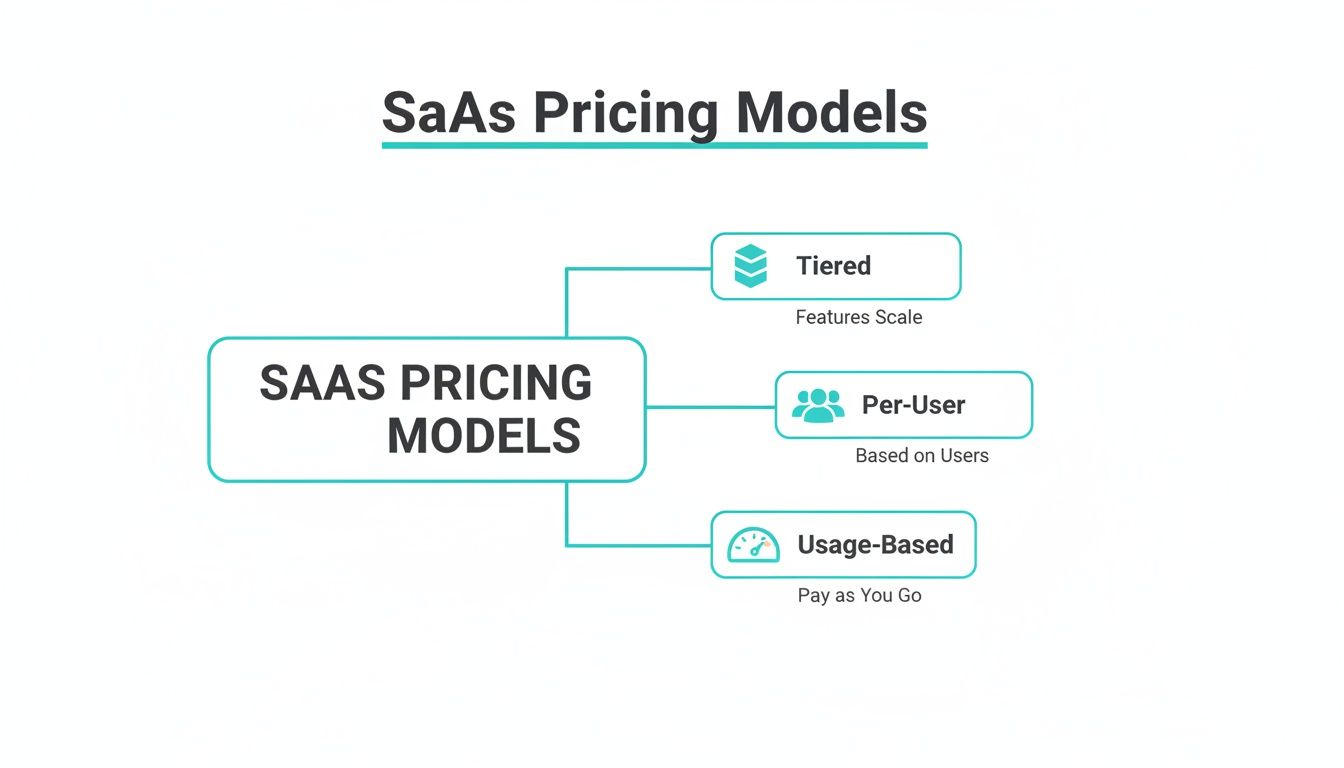
This diagram shows how different pricing models—tiered, per-user, and usage-based—give customers different paths to expand their spending over time, which is the key to driving strong net revenue retention.
An NRR of 100% means your existing customers are generating just as much revenue as they did last year, perfectly offsetting any losses from churn. The real magic happens when NRR is over 100%. This means your existing customers are spending more with you—through upgrades, adding users, or buying new features—than you are losing from churn. This creates "negative churn," where your business grows even without adding a single new customer.
This metric is a direct driver of business health. While private B2B SaaS companies saw moderated growth recently, with equity-backed firms posting a median revenue growth of 25%, this figure is exponentially tied to NRR. The top performers achieve this by using smart tools to predict churn and spot expansion opportunities. You can read the full research on private SaaS company growth benchmarks to see the data for yourself.
To make these concepts easier to digest, here’s a quick summary of the key metrics that truly define a SaaS company’s health.
Key SaaS B2B Metrics at a Glance
Metric | What It Measures | Why It's Critical |
|---|---|---|
MRR / ARR | The predictable recurring revenue generated monthly or annually. | Provides a stable baseline for forecasting, budgeting, and valuation. It’s the heartbeat of the business. |
CAC | The total cost of sales and marketing to acquire one new customer. | Measures the efficiency of your growth engine. If it’s too high, growth becomes unprofitable. |
LTV | The total revenue a single customer is expected to generate over their entire relationship. | Determines the long-term value of your customer base and the ultimate ROI of your acquisition spend. |
LTV:CAC Ratio | The relationship between a customer’s lifetime value and their acquisition cost. | The single most important measure of business model sustainability. A ratio of 3:1 or higher is a strong indicator of health. |
Churn Rate | The percentage of customers who cancel their subscriptions in a given period. | The "leaky bucket" problem. High churn can cripple even the fastest-growing companies. |
NRR | The percentage of recurring revenue retained from existing customers over time, including expansions. | The gold standard. An NRR over 100% means you have "negative churn" and can grow without new customers. |
Mastering these metrics isn't just an accounting exercise. It’s about understanding the fundamental physics of your business—what drives growth, what causes drag, and how to build a company that lasts.
Building Your Go-to-Market and Sales Strategy
Having a killer product and rock-solid metrics is a great start, but it means nothing if you can't actually get it into the hands of the right customers. This is where your Go-to-Market (GTM) strategy comes in. Think of it as the master plan that connects your solution to the businesses that desperately need it. For any B2B SaaS company, this entire strategy really boils down to a choice between two core ways to grow.
Sales-Led Growth (SLG)
The first path is the classic B2B playbook: Sales-Led Growth (SLG). This model is built around a dedicated team of sales professionals. They’re the hunters—the ones responsible for sniffing out high-value prospects, running demos, navigating complex contracts, and ultimately, closing big deals. This high-touch, human-powered approach is absolutely essential when you're selling expensive, complex software to large enterprises with long buying cycles and a whole committee of decision-makers.
Product-Led Growth (PLG)
The second, and increasingly dominant, path is Product-Led Growth (PLG). With PLG, the product itself becomes the primary engine for attracting, activating, and keeping customers. It's basically the "try before you buy" model for software. Companies will offer a freemium version, a free trial, or a slick interactive demo that lets users see and feel the product's value for themselves, often without ever talking to a salesperson. This self-serve motion is incredibly efficient for bringing in a massive volume of users.
Choosing Your Motion: Product-Led vs. Sales-Led
So, which one is better? Neither. The right choice depends entirely on your product's complexity, who your ideal customer is, and how much you charge. A product with a high price tag and a complicated setup screams for a sales-led approach. On the other hand, a simpler tool with a lower price point is a perfect match for a product-led model.
But here’s the thing: the most successful B2B SaaS companies rarely stick to just one. They build a hybrid model where both approaches work together.
A hybrid GTM strategy uses Product-Led Growth as the hook to land new users at scale, and Sales-Led Growth as the spear to expand within the most promising accounts.
This combination creates a powerful flywheel effect. PLG floods the top of your funnel with people who have already kicked the tires and seen the product's value. From there, your sales team can jump in, identify the most engaged accounts—the ones with multiple users or crazy-high usage—and proactively reach out to upgrade them to enterprise plans with all the bells and whistles.
The Marketing Channels That Fuel Your GTM
Your GTM motion is the engine, but your marketing channels are the fuel. A multi-pronged marketing strategy is always the most effective way to attract and engage potential customers.
Here are the essentials:
Content Marketing and SEO: This is the bedrock of B2B SaaS marketing. Creating genuinely useful, educational content (like blog posts, whitepapers, and webinars) that solves your audience's problems builds trust and establishes you as an authority. At the same time, it drives a steady stream of organic traffic through search engine optimization (SEO).
Paid Acquisition: Channels like Google Ads and LinkedIn ads can deliver a predictable flow of qualified leads, especially when you can get super specific and target by job title or industry.
Strategic Partnerships: Teaming up with companies that serve the same audience but don't compete with you can unlock entirely new pools of customers. This could be anything from co-hosting a webinar to building a formal reseller agreement. For companies looking to get serious about this, understanding the mechanics of a referral program software is a crucial first step toward building a powerful partner ecosystem.
By blending the best of PLG and SLG and backing it all up with a smart mix of marketing channels, you build a growth engine that’s both resilient and scalable enough for the modern B2B SaaS world.
Meeting Enterprise Demands with Ethical and Compliant SaaS

As a B2B SaaS company starts aiming for bigger fish, the entire sales conversation changes. Cool features and a slick user interface? They’re still important, but they become the price of entry, not the reason you win.
The real make-or-break issues for enterprise buyers are the non-negotiables: airtight security, ironclad data privacy, and verifiable regulatory compliance. For them, bringing on new software isn't just a tech upgrade; it’s a high-stakes risk management decision.
They are about to hand you the keys to their kingdom—customer data, intellectual property, sensitive internal communications. One slip-up, one breach, or one compliance failure on your end could trigger catastrophic financial penalties, torpedo their reputation, and evaporate customer trust overnight.
The Bedrock of Enterprise Trust
To even get a meeting with these buyers, a B2B SaaS provider has to prove an obsessive commitment to protecting data. You can't just say you're secure. You have to prove it with recognized, independently audited standards.
These certifications are the universal language of enterprise trust:
ISO 27001: This is the global gold standard for information security management. Earning it shows you have a systematic, risk-based playbook for handling your own sensitive data and, more importantly, your customers'.
SOC 2: Designed specifically for service organizations like SaaS companies, a SOC 2 report is a deep dive into how you safeguard customer data and proves that your controls are actually working as designed.
GDPR: The General Data Protection Regulation is the EU's strict law on data privacy. If you have customers in Europe, complying isn't a choice—it's a requirement.
These frameworks aren't just bureaucratic hurdles. They force a company to weave security and privacy into its very DNA, influencing everything from product development to daily operations.
In the enterprise world, you don't just sell software; you sell assurance. Your ability to demonstrate robust compliance and security is a direct reflection of your reliability as a long-term business partner.
AI in B2B SaaS: The Ethical Advantage
The explosion of Artificial Intelligence (AI) has added another tricky layer to these enterprise demands. AI can unlock incredible efficiencies, but it also brings new risks around data use, algorithmic bias, and "black box" decisions that nobody can explain.
Enterprise buyers are, quite rightly, skeptical of AI systems that deliver judgments without clear, auditable logic.
This is where building your platform on an "ethical by design" framework becomes a massive competitive advantage. Instead of using AI for invasive surveillance or automated profiling—practices now facing intense regulatory heat—ethical AI is all about decision support.
A platform built this way uses AI to spot risks, flag anomalies, and surface critical information, but it always leaves the final judgment in human hands. It provides indicators, not accusations. This approach ensures technology empowers good governance without stripping away dignity, privacy, or due process.
The global SaaS market is exploding, projected to grow at a compound annual growth rate (CAGR) of over 19%. As spending skyrockets, B2B SaaS firms that align with compliance standards like GDPR, ISO 27001, and OECD principles are positioning themselves to win big. You can discover more insights about SaaS market growth on sellerscommerce.com.
Turning Compliance into a Strategic Asset
For modern enterprises, risk management is a constant battle, especially when it comes to internal threats and workplace integrity. This is why a platform that provides tools for compliance risk management software becomes a vital part of their operational stack, sitting right alongside HR, legal, and security systems.
By building a solution that is compliant from the ground up, a B2B SaaS company can speak directly to these core enterprise anxieties. It elevates the conversation from a simple feature checklist to a strategic discussion about risk mitigation and ethical governance.
It proves that technology, when designed with strict regulatory guidelines in mind, can be a powerful force for reinforcing ethics and protecting an organization's most valuable asset: its reputation.
How to Select the Right B2B SaaS Solution for Your Business
Picking a new B2B SaaS platform is less like buying equipment and more like hiring a key employee. You're not just getting a tool; you're bringing on a long-term partner that will be woven into your team's workflows, your security posture, and your ability to scale. It’s absolutely critical to look past the flashy feature list and assess the true strategic fit—otherwise, you're setting yourself up for buyer's remorse.
A structured evaluation process is your best defense against getting distracted by a slick sales demo. It forces you and your team to focus on what actually matters. It helps you ask the tough questions upfront to make sure the platform solves your real business problems, delivers a clear return on investment, and acts as a genuine partner in growth and compliance.
A Practical Evaluation Checklist
To cut through the marketing fluff, you need a consistent framework for vetting every vendor. This checklist is a solid starting point for an apples-to-apples comparison, helping you find a solution that fits your business like a glove, not one you have to force into place.
Functional Fit and Problem Solving: Does this platform directly solve the specific, nagging operational headaches we deal with every day? Move beyond the canned demo and insist on a proof-of-concept (POC) that uses your own data or simulates a real-world scenario your team struggles with.
Integration with Your Existing Tech Stack: A great tool that lives on an island is a bad investment. You need to verify that the platform has robust, well-documented APIs and, ideally, pre-built integrations with your mission-critical systems (like your CRM, HRIS, or ERP). Without seamless integration, you're just creating more data silos and manual work for your team.
The best B2B SaaS tools don't just add a new capability; they act as a force multiplier for the technology you already have. They should break down data silos, not create new ones.
Assessing Long-Term Viability
Once you’ve confirmed a solution can do the job and play nicely with your other systems, it’s time to look under the hood. The long-term health and security of your vendor are just as important as the software's features. A platform that goes down or gets breached becomes your crisis, too.
Vendor Security and Compliance Posture: This is completely non-negotiable. Request the vendor's security certifications, like SOC 2 or ISO 27001, and carefully review their data processing agreements. Ask direct questions about their data encryption, access controls, and incident response plans. A vendor who welcomes this level of scrutiny is one you can trust.
Total Cost of Ownership (TCO): The monthly subscription fee is only one piece of the puzzle. You have to map out the full TCO, which includes implementation fees, training costs, data migration expenses, and any extra charges for premium support or going over usage limits. A cheaper sticker price can easily be wiped out by hidden costs down the road.
By following this structured approach, you change the conversation from "what does this tool do?" to "what will this partnership do for our business?" It’s a methodical way to ensure your next B2B SaaS investment becomes a strategic asset, not just another line item on the expense report.
Got Questions About B2B SaaS? We’ve Got Answers.
Whether you're building a SaaS tool or thinking about buying one, a few key questions always come up. Let’s cut through the noise and get straight to the practical answers you need.
What Is the Main Difference Between B2B and B2C SaaS?
It really comes down to one thing: who you’re selling to.
B2B SaaS (Business-to-Business) is built to solve complex problems for entire organizations. The sale isn't an impulse buy; it’s a considered purchase involving multiple decision-makers, longer sales cycles, and a clear expectation of financial return.
B2C SaaS (Business-to-Consumer), on the other hand, is sold directly to individuals. Think streaming services or productivity apps. The sales process is almost always self-serve, the price is much lower, and the focus is on personal value or entertainment.
Why Is Net Revenue Retention So Important?
Net Revenue Retention (NRR) is the ultimate health metric for a SaaS B2B company because it shows if you can grow your business using only your existing customers. It’s calculated by taking all the new revenue from your current clients (upgrades, cross-sells) and subtracting any revenue you lost from them (churn, downgrades).
An NRR over 100% is the gold standard. It means your business is still growing even if you don't sign a single new customer. This is a powerful signal that your product is indispensable, your customers are happy, and your business model is incredibly strong.
At the end of the day, it's far cheaper and more sustainable to keep and grow the customers you already have than it is to constantly chase new ones.
How Can We Ensure a New SaaS Tool Complies with Our Security Policies?
Smart question. You need to put the vendor through its paces. Start by asking for their security credentials, like SOC 2 reports or ISO 27001 certification. These aren't just badges; they're proof of indevpendent audits. Also, dig into their data processing agreements to make sure they align with regulations like GDPR.
Then, get specific with your questions. Don't be shy.
How is our company’s data encrypted, both when it's moving and when it's stored?
What internal access controls do you have in place? Who on your team can see our data?
Walk me through your incident response plan. What happens if there's a breach?
Any vendor worth their salt will welcome this level of scrutiny and have clear, direct answers ready for you. If they get defensive or vague, that’s a major red flag.
At Logical Commander Software Ltd., we built our AI-driven platform on a foundation of ethical, secure, and compliant design. Instead of just reacting to internal threats, our solution gives you the tools for proactive risk management—all while preserving employee dignity and privacy. Find out how we help you turn compliance into a strategic advantage at https://www.logicalcommander.com.