%20(2)_edited.png)

A Guide to Modern Behavioral Assessments for Risk Management

Updated: Dec 30, 2025
For years, organizations have been trapped in a reactive loop, managing internal risk by waiting for a disaster. They wait for fraud, misconduct, or a data breach, and only then do they scramble to investigate the fallout. This approach is not just expensive; it's a strategic failure that completely ignores the human factor at the core of nearly every incident.
Enter modern behavioral assessments. These tools, when implemented ethically, finally allow organizations to shift from a reactive cleanup crew to a proactive prevention powerhouse, protecting business impact and preventing liability before it occurs.
Moving Beyond Outdated Risk Management Strategies

Confronting internal risk is a daunting task for any decision-maker. The traditional playbook involves waiting for a red flag—a whistleblower report, a compliance alert, or a significant financial loss—before launching a costly and disruptive investigation. In today's landscape, where a single incident can trigger a reputational firestorm, this "wait and see" strategy is not just outdated; it's a direct threat to the business.
Reactive forensics are incredibly expensive. The costs accumulate rapidly, from direct financial losses to the staggering resources poured into investigations, legal fees, and regulatory fines. Even worse, this method fosters a culture of distrust and anxiety, where employees feel constantly under suspicion. It’s a strategic failure that only treats symptoms while the root cause—human-factor risk—goes unaddressed.
The Human Factor in Internal Risk
The reality is that the vast majority of internal threats are not malicious. They typically originate from human factors like negligence, intense situational pressures, or unmet expectations. Ignoring these human-factor risks is like trying to fix a leaky pipe by only mopping the floor—you’re busy, but you’re not preventing the real damage. The threat doesn't start with cyber; it starts and ends with humans.
To truly secure an organization from the inside, leaders in Compliance, HR, and Security must move upstream. They need to identify and mitigate human-factor risks before they materialize. This is precisely where a new generation of behavioral assessments sets a new standard. These are not personality tests; they are sophisticated, AI-driven risk management tools designed for a proactive Governance, Risk, and Compliance (GRC) strategy that prevents liability.
An ethical, non-intrusive approach to behavioral assessments empowers organizations to understand potential risk indicators without resorting to invasive surveillance or legally perilous methods. It’s about proactive prevention, not reactive policing.
This modern approach helps leaders finally get answers to their most critical questions:
How can we spot potential conflicts of interest before they turn into misconduct?
What leading indicators can warn us of a heightened risk of fraud or data theft?
How do we maintain a secure environment while respecting employee privacy and dignity?
Shifting from Reaction to Prevention
Making the leap from a reactive to a preventive posture requires a fundamental shift in both mindset and technology. Instead of budgeting for the true cost of reactive investigations, organizations can reallocate those resources to an ethical, AI-driven platform that provides early warnings.
This isn't about replacing human judgment. It's about augmenting it with objective, data-driven insights. By implementing an EPPA-aligned platform, you can identify behavioral patterns that correlate with risk—all without infringing on employee rights. The goal is to build a truly resilient organization by tackling the human element of risk head-on, creating a new standard for internal threat prevention that protects both the company and its people.
Understanding Different Behavioral Assessment Methods
Not all behavioral assessments are created equal. For leaders in Compliance, HR, and Legal, understanding the difference is not a mere technicality—it's critical for avoiding massive legal and reputational liabilities. The market is crowded with options, from outdated personality tests to sophisticated risk platforms, and choosing the wrong one is a business-altering mistake.
Many organizations still rely on methods that carry significant risk. Invasive surveillance analytics, for instance, might appear effective but often violate privacy regulations and completely erode the employer-employee relationship. Worse still, assessments that function like interrogations or claim to measure subjective values are explicitly banned under the Employee Polygraph Protection Act (EPPA), exposing the company to severe penalties.
Traditional vs. Modern Assessment Approaches
The key distinction lies in purpose and methodology. Traditional tools are typically static, designed for a single point in time, like screening a job candidate. While they can be useful for initial vetting, their value in detecting ongoing internal threats is virtually zero. You can learn more about these initial screenings in our look at behavioral assessments for hiring.
Modern, AI-driven platforms like E-Commander, on the other hand, are built for continuous, proactive risk management. They are designed to identify the leading indicators of human-factor risk without infringing on employee rights. These systems are not about policing people; they are about understanding patterns that correlate with potential misconduct, fraud, or compliance failures before they impact the business.
The new standard in risk prevention is about obtaining objective, actionable intelligence ethically. It’s a shift from asking "Who is a good employee?" to identifying "Where are our highest human-factor risks right now?"—a question that is both EPPA-aligned and strategically sound.
This modern approach provides a clear competitive edge by moving past subjective guesswork and focusing on objective data that points to real-world business risk.
A Clear Distinction in Methodology
To grasp the differences, it helps to compare what each type of assessment is built to do. This table contrasts the goals and liabilities of outdated methods versus the ethical, modern platforms shaping the future of risk management.
Comparing Behavioral Assessment Methodologies
This table breaks down the key differences between traditional and modern behavioral assessment approaches, highlighting their purpose, legal exposure, and business impact.
Methodology | Primary Use Case | EPPA and Legal Risk | Operational Focus | Example Approach |
|---|---|---|---|---|
Traditional Assessments | Pre-hire screening, team building | Low to Moderate (if used for screening) | Static, one-time evaluation of personality or skills. | Personality tests (e.g., DISC, Myers-Briggs), situational judgment tests. |
Surveillance Analytics | Employee monitoring, productivity tracking | Very High (violates privacy and EPPA) | Reactive and intrusive, focused on policing activity. A failed model. | Keystroke logging, email scanning, secret monitoring. |
Modern Risk Platforms | Internal threat detection, ongoing compliance | Very Low (designed for EPPA alignment) | Proactive and non-intrusive, focused on prevention. The new standard. | AI-driven analysis of risk indicators without surveillance. |
As the table clearly shows, the legal and operational gap between invasive surveillance and true risk prevention is enormous. Choosing the right path is a strategic decision that protects the entire organization from liability.
The Power of Proactive and Ethical AI
The best behavioral assessment platforms use objective data analysis to provide an early warning system. Many of these modern systems use various predictive modeling techniques to forecast potential risks based on anonymized behavioral patterns, not personal judgments. This is where AI-driven platforms like Logical Commander excel.
By focusing on the "what" and "how" of risk indicators—not the "who" or "why" of an employee's personal life—these tools empower organizations to get ahead of problems. For a risk or compliance leader, this means you can spot and address a potential conflict of interest or fraud risk before it explodes into a full-scale investigation. This doesn't just save a massive amount of money; it protects the organization’s hard-won reputation.
Choosing an ethical, non-intrusive platform is not just a legal safeguard. It's a strategic imperative for building a resilient and sustainable governance framework.
Navigating the Legal and Ethical Framework of Assessments

For any risk, compliance, or legal leader, the primary question is always: are we operating within the law? That concern is amplified when discussing behavioral assessments. The legal landscape is designed to shield employees from intrusive and coercive practices, which turns the choice of an assessment platform into a high-stakes business decision.
This isn’t just about dodging fines. It's about protecting your company's reputation and building a culture of integrity. The wrong tool can drag you into ugly legal battles, trigger regulatory penalties, and completely erode employee trust. One misstep can unravel years of hard work.
In the United States, the main legal guardrail is the Employee Polygraph Protection Act (EPPA). Don’t let the name mislead you. While it sounds narrow, its reach is broad and cuts directly into the world of behavioral assessments. Understanding its boundaries is non-negotiable for any organization serious about managing risk correctly.
The Bright Red Line of EPPA Compliance
The EPPA was enacted to stop employers from using lie detector tests. But its protections go much deeper, banning any assessment that functions as a de facto lie detector or uses psychological pressure. This is precisely where many slick, modern-sounding tools stumble and create massive liability.
Any platform claiming to measure subjective values like "truthfulness" or "honesty" is immediately on the wrong side of EPPA. These are legally toxic words that frame an assessment as an interrogation, which is strictly forbidden. A compliant platform must operate on a completely different premise.
The core principle of an EPPA-aligned assessment is a focus on objective, observable risk indicators—not subjective judgments about an employee's character or intent. The goal is to identify patterns that correlate with risk, not to conduct a secret investigation.
This distinction is everything. An ethical assessment isn’t trying to "catch" employees. Instead, it provides data-driven insights to help the organization proactively mitigate risks tied to conflicts of interest, fraud, or other misconduct. You can get a detailed breakdown of these legal lines and learn more about why EPPA compliance matters in human capital risk management. This approach protects the company by making sure its risk management practices are legally sound and defensible.
Avoiding Legally Perilous Methodologies
The market is flooded with solutions that, intentionally or not, cross legal and ethical lines. Leaders must be vigilant to spot and avoid assessment methods that introduce unacceptable risk. Key red flags include:
Covert Surveillance: Any tool that secretly monitors employee communications, keystrokes, or online activity is a major privacy violation and a lawsuit waiting to happen. These methods are ineffective and illegal.
Psychological Pressure: Assessments using stressful scenarios or invasive questions to gauge a reaction are functionally the same as interrogations and are not compliant.
Medical or Mental Health Claims: Platforms suggesting they can create a "psychological profile" or diagnose behavioral conditions are operating far outside their legal and ethical scope, creating serious liability.
The demand for compliant solutions is growing as companies grapple with internal threats. The behavior analytics market, closely tied to behavioral assessments, was valued at $4.13 billion and is projected to hit $16.68 billion by 2030. This growth is fueled by the reality that internal threats cause 30-40% of security incidents, costing U.S. businesses $50 billion annually.
Ethical analytics platforms meet this demand by identifying risk anomalies without resorting to invasive surveillance, aligning perfectly with EPPA standards. You can discover more insights about the growth of the behavior analytics market on Grandview Research.
Choosing an AI-driven platform like Logical Commander ensures you stay on the right side of the law. By design, our E-Commander system is non-intrusive, privacy-preserving, and fully EPPA-aligned. It provides the actionable intelligence you need to prevent threats without exposing your organization to unnecessary legal or reputational damage.
Putting Behavioral Assessments to Work Across Your Organization
Moving from theory to practice is where the true power of modern behavioral assessments becomes clear. When implemented correctly, these tools are not siloed solutions for one department—they become a strategic asset delivering tangible results across the entire business. From HR to Compliance and Security, a unified approach demolishes dangerous information silos and builds a coordinated, proactive risk strategy.
Instead of each team operating with blinders on, a central platform provides a holistic view of human-factor risk. It allows leaders to finally connect the dots between seemingly unrelated events, revealing patterns that would otherwise go unnoticed. The result is a far more resilient company, capable of preventing threats before they explode into costly disasters.
Unifying HR and Pre-Hire Screening
For Human Resources, the application of behavioral assessments has evolved far beyond old-school personality tests. While pre-hire screening remains a core function, today’s platforms add a critical layer of risk-based intelligence. The goal is not to judge a candidate's character, but to spot potential conflicts of interest or behavioral patterns that might clash with your organization's integrity standards.
This proactive screening helps ensure new hires align with the company's ethical DNA from day one, significantly reducing the likelihood of future misconduct. When considering practical applications, understanding how to conduct fitness to work assessments for employers is also a key part of maintaining organizational health. By weaving these insights together, HR can make smarter, more protective decisions.
Empowering Compliance with Proactive Detection
Most compliance teams are overwhelmed, constantly trying to enforce policies and chase down potential breaches with limited resources. Ethical behavioral assessments change the game entirely, shifting their role from reactive fire-fighting to proactive prevention. By analyzing objective risk indicators, these platforms can flag potential landmines like undisclosed conflicts of interest or behaviors suggesting a high risk of fraud.
For example, an assessment might identify an employee in procurement exhibiting behavioral patterns highly correlated with accepting kickbacks, even with no direct evidence. This allows the compliance team to provide targeted training or re-assign responsibilities as a preventive measure, stopping a crisis before it starts. It’s a powerful way to uphold governance standards without resorting to invasive surveillance.
An integrated assessment strategy allows an organization to see the entire risk landscape. A minor issue flagged by HR and a separate compliance alert might seem insignificant on their own, but together, they could signal a significant emerging threat.
Strengthening Security Against Insider Risk
For security leaders, the human factor has always been the most unpredictable and dangerous variable in managing insider risk. Modern behavioral assessments provide a crucial layer of non-intrusive threat detection. They focus on identifying the leading indicators of risk—like sudden changes in behavior or situational pressures that correlate with data theft or sabotage—without monitoring employees' personal lives.
There’s a reason the behavioral threat analysis field is exploding. It’s currently a $4.25 billion global market and is projected to hit a massive $46.39 billion by 2034. This growth is fueled by the urgent need to stop insider attacks, which now account for a staggering 60% of all enterprise breaches. For compliance officers, these tools are a game-changer, detecting 80% more anomalies than legacy methods. You can read the full research about the expanding behavioral threat analysis market on Market.us.
By integrating intelligence from HR, Compliance, and Security, platforms like Logical Commander provide a unified, actionable view of internal risk. This enables a coordinated defense that protects the organization from every angle, setting a new, ethical standard for internal threat prevention.
Weaving Ethical Assessments Into Your Organization
Switching to a proactive risk framework is not just a technical rollout; it's a strategic shift in how you protect your business. Launching an ethical, AI-driven behavioral assessment program demands a clear plan, robust governance, and a commitment to building a culture of integrity. This is how you move from reacting to incidents to preventing the financial and reputational harm they cause.
The first step is establishing a robust governance structure. This is not an IT project. It’s a cross-functional mission requiring leaders from HR, Compliance, Legal, and Security at the table from day one. This team defines the program's goals, establishes ethical boundaries, and ensures every step aligns with regulations like EPPA and your company's core values.
This governance body is also responsible for defining specific risk thresholds and the protocols for when one is crossed. The goal is a system where AI delivers objective, actionable intelligence, but human experts always make the final call. The platform should empower your teams, not replace them.
Building Your Governance Framework
A successful launch begins with a clear charter for your assessment program. This means defining roles, responsibilities, and the precise scope of what you aim to achieve. Your framework should rest on several key pillars:
Cross-Functional Ownership: Ensure stakeholders from Legal, HR, Compliance, and Security are all involved in shaping the program's policies.
Clear Policy Development: Document exactly how assessment data will be used, who can access it, and the protocols for acting on insights while protecting employee privacy.
Defined Risk Indicators: Work with your platform provider to identify the specific, objective behavioral indicators that correlate with your organization's highest-priority risks.
This structured approach ensures the program is rolled out ethically and effectively, creating a transparent and defensible process. A well-designed governance model is essential for realizing the full benefit of ethical behavioral analytics while maintaining trust and compliance.
The process flow below illustrates how different departments can collaborate within an ethical assessment program.
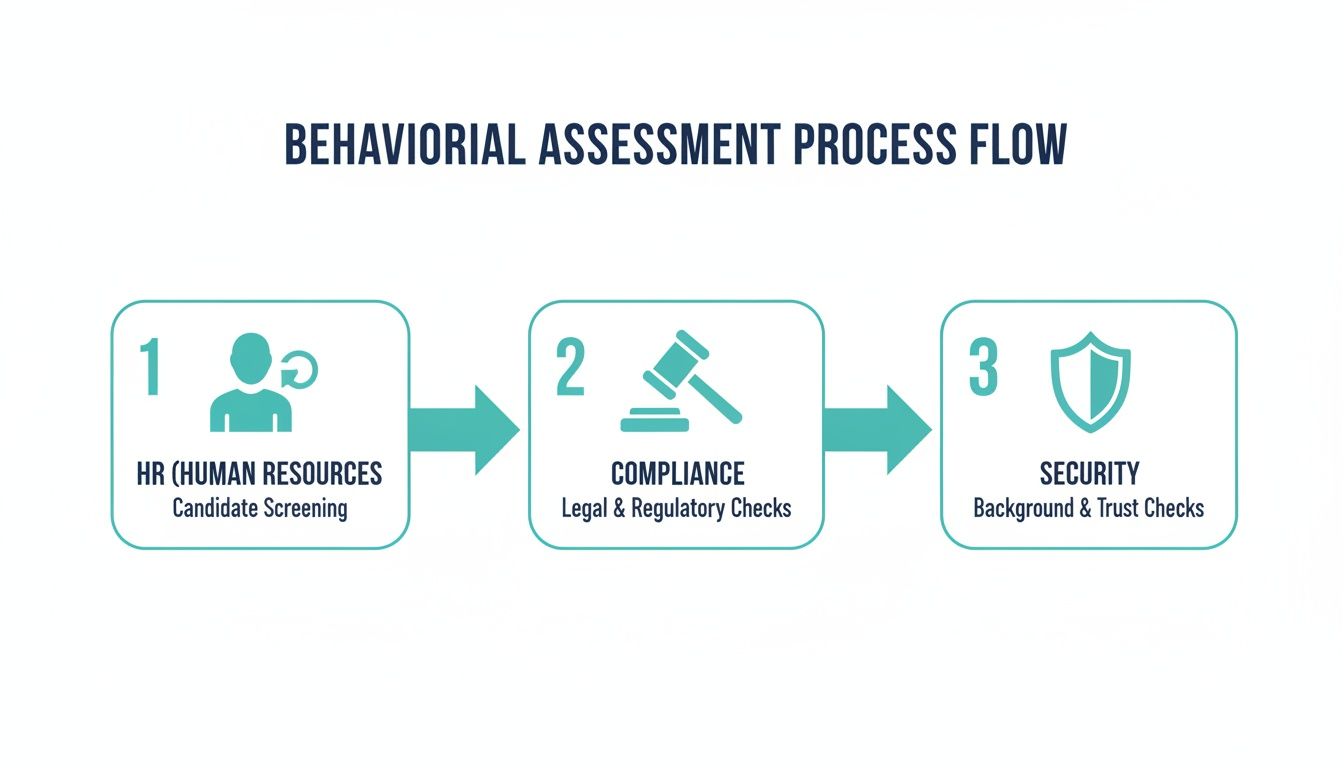
This visual reinforces the point: a unified program breaks down the silos that allow threats to fester, enabling HR, Compliance, and Security to work from a single source of truth to protect the organization.
Partnering for Success in a Growing Market
The global behavioral assessment market is exploding, currently valued at around $3.5 billion and projected to grow at a 12% CAGR through 2033. Companies are increasingly using these tools not just for hiring but for ongoing risk management. For instance, ethical assessments have been shown to improve employee retention by 25-35% by flagging cultural fit issues early on. You can explore more data on this growing market and its impact on Data Insights Market.
For consultancies and B2B SaaS providers, this growth represents a massive opportunity. Guiding clients toward a modern, ethical standard of risk management is a high-value service that sets you apart from competitors stuck on outdated, reactive methods.
This is where the right partnerships become crucial. Our PartnerLC program is designed specifically to help consultancies, MSPs, and other B2B providers implement this new standard of internal risk prevention for their clients. By joining our partner ecosystem, you gain access to a proven, EPPA-aligned platform and the expert guidance needed to deploy it successfully.
This collaboration allows you to guide your clients toward a more resilient and ethical mode of operation. You become the trusted advisor who helps them build a proactive defense against human-factor risk, safeguarding their assets and reputation.
Shifting the Standard for Internal Threat Prevention
The future of risk management is preventive, not reactive. For too long, organizations have been stuck in a costly loop of investigating misconduct after the damage is done—a broken model that ignores the human element behind every internal threat. This reactive posture exposes businesses to massive financial and reputational harm. It's time for a new standard, one built on prevention, ethics, and intelligent technology.
Outdated methods are more than just ineffective; they’re a liability. Invasive employee surveillance and legally questionable behavioral assessments that function like interrogations are failed models. They erode employee trust and create huge legal risks under regulations like the Employee Polygraph Protection Act (EPPA). Relying on these tools isn't just bad practice—it's a strategic failure that leaves your organization vulnerable from the inside.
The Proactive, Ethical Alternative
A new global standard for preventing internal threats is here, defined by an ethical, non-intrusive, AI-driven approach. Instead of policing employees, this model gives organizations the objective intelligence needed to spot and mitigate human-factor risks before they escalate into incidents.
This modern framework delivers critical advantages:
EPPA-Aligned Compliance: It operates strictly within legal boundaries, using zero surveillance or psychological pressure. This protects your organization from the steep penalties of non-compliance.
Actionable Intelligence: AI-driven analysis provides early warnings on potential conflicts of interest, fraud indicators, and other misconduct risks, all without compromising employee privacy.
Lower Investigation Costs: By getting ahead of incidents, organizations can slash the enormous expenses tied to reactive forensic investigations and legal battles.
Adopting this new standard is about more than technology. It’s a commitment to protecting your assets, your people, and your reputation without compromising on integrity. It empowers you to build a resilient and ethical culture from the ground up.
Platforms like Logical Commander are built on this new standard. Our E-Commander platform provides a non-intrusive system for internal threat detection, giving HR, Compliance, and Security leaders the tools to manage risk proactively and ethically. This is how you build a more secure and resilient business.
Your Questions on Behavioral Assessments, Answered
When leaders in Compliance, HR, and Risk explore modern behavioral assessments, they have important questions. It's a significant strategic decision. Let's tackle some of the most common ones, focusing on the business impact and the ethical foundation that defines a modern platform.
How Is This Different from a Background Check?
This question gets to the core of the issue: are you looking backward or forward?
Traditional background checks are entirely reactive. They are a snapshot of the past—a record of criminal convictions or verification of employment. While useful, they offer zero insight into future behavior or the nuanced human-factor risks that emerge within an organization. They tell you what has happened, not what might happen.
Ethical behavioral assessments are proactive and forward-looking. They are designed to identify the leading indicators of risk—like patterns associated with conflicts of interest or fraud—before an incident occurs. This approach allows you to prevent problems, not just document past failures.
Are These Assessments EPPA Compliant?
Absolutely, provided you choose a platform built with compliance at its core. The Employee Polygraph Protection Act (EPPA) is clear: it forbids any tool that acts like a lie detector or uses psychological pressure. Compliant behavioral assessments are engineered to operate far from that legal line.
A truly EPPA-aligned platform like Logical Commander is fundamentally different:
No Surveillance: It never monitors employee emails, chats, or keystrokes.
No Interrogation: It avoids any form of psychological pressure or accusatory questioning.
No Subjective Judgments: It does not attempt to measure subjective traits that are legally risky.
Instead, it analyzes objective risk indicators to provide non-intrusive, ethical insights for internal threat detection. It's about prevention, not policing, which keeps your organization on the right side of the law.
The key to compliance is focusing on objective, observable risk patterns, not on evaluating an employee's character or state of mind. This ethical approach protects both the organization and its people from liability.
What Is the Role of AI in This Process?
Think of AI as a powerful analytical engine, not the decision-maker. Its function is to process vast amounts of data to spot subtle risk patterns that a human analyst would likely miss. AI brings scale and objectivity to behavioral assessments, removing the potential for human bias during the initial identification of risk indicators.
However, the AI is not in charge. Its role is to deliver actionable intelligence to the human experts—your leaders in HR, Compliance, and Security. The platform flags a potential risk, but the final judgment and any subsequent actions are always left in human hands. This keeps people in control, augmenting their ability to manage risk without abdicating responsibility.
How Do These Assessments Protect Employee Privacy?
Protecting employee privacy is a foundational principle, not just a feature. Ethical behavioral assessments are the antithesis of invasive surveillance tools that track every click or read private messages. A non-intrusive platform is designed to function without collecting personal data or monitoring individual activities.
The system analyzes anonymized or aggregated behavioral data points to identify patterns that correlate with risk. It focuses on the “what” (the risk indicators) rather than the “who” (specific individuals), ensuring privacy is integral to the process. This method delivers critical insights for risk mitigation without crossing ethical or legal lines, helping you build a culture of integrity, not one of suspicion.
Take the Next Step in Proactive Risk Prevention
Ready to move beyond reactive investigations and build a more resilient organization? Discover how Logical Commander’s EPPA-aligned platform can help you prevent internal threats before they impact your business.
Request a Demo
Join our Partner Ecosystem (PartnerLC)