%20(2)_edited.png)

Third party risk management software: Streamline Vendor Compliance & Security

Third party risk management software is your command center for overseeing the entire lifecycle of your relationships with vendors, suppliers, and partners. It’s designed to pull you out of the messy world of manual spreadsheets and scattered emails, replacing them with a single, unified system for spotting, assessing, and neutralizing risks before they can threaten your operations, reputation, or compliance standing.
Your Business Is More Connected and Vulnerable Than Ever

No company is an island anymore. Your organization sits at the heart of a massive, sprawling network of vendors, suppliers, contractors, and partners. This ecosystem is what powers your growth and efficiency, but it also creates a huge—and often invisible—attack surface. Every new connection you add, while valuable, also introduces a potential point of failure.
Think of your digital supply chain like a physical one. A single compromised link—a supplier with weak cybersecurity or a contractor with access to sensitive data—can bring your entire operation to a screeching halt. The damage isn't just financial; a breach that starts with a third party can shred customer trust and wreck a reputation you spent years building.
The Limits of Manual Tracking
For a long time, businesses tried to manage these relationships with spreadsheets and endless email chains. That approach just doesn't work anymore. As your network of partners grows, manual tracking becomes an impossible task, riddled with human error, outdated information, and a complete lack of real-time visibility. It’s like trying to navigate a major highway system with a map you drew by hand.
This old-school method leaves dangerous blind spots. Without a centralized system, you can’t get straight answers to critical questions about your vendor network:
Which of our vendors can access our most sensitive customer data?
Are our partners actually compliant with regulations like GDPR or CCPA?
What is the real-time security posture of our most critical software providers?
The core challenge for every modern business is balancing collaboration with security. Relying on third parties is essential for innovation and growth, but you have to do it with a clear-eyed understanding of the risks involved.
Shifting from Reactive to Proactive
This is where third party risk management software completely changes the game. It delivers the visibility and control you need to manage your entire vendor ecosystem proactively. Instead of reacting to a breach after the damage is already done, these platforms empower you to find and fix vulnerabilities before they can ever be exploited.
By automating due diligence, continuously monitoring for changes in a vendor's risk profile, and centralizing all your documentation, TPRM software transforms a chaotic, manual process into a structured, data-driven strategy. Making this shift is absolutely essential for defending against complex threats, protecting your brand, and avoiding costly compliance failures in a world that’s more interconnected than ever.
What Is Third Party Risk Management Software?
Let's cut through the jargon. What is third party risk management software, really?
Imagine trying to manage your vendor relationships with spreadsheets, scattered emails, and disconnected Word documents. It’s like conducting a symphony where every musician is playing from different sheet music at their own pace. The result is pure chaos—disjointed, out of sync, and dangerously unpredictable. This is what managing third-party risk manually feels like.
TPRM software is the conductor that brings order to that chaos. It’s a centralized platform designed to manage the entire lifecycle of every third-party relationship, from the initial background check all the way to secure offboarding when a contract ends.
Instead of digging through old email chains or hunting for the latest version of a risk assessment, this software gives you a single, authoritative source of truth for everything related to your vendors.
From Reactive Firefighting to Proactive Strategy
The whole point of TPRM software is to fundamentally change how your organization sees risk. It moves you from a reactive, manual posture—where you're only putting out fires after they’ve caused damage—to a proactive, data-driven strategy. It’s the difference between patching a leak after the room has flooded versus regularly inspecting the pipes to stop a burst from ever happening.
With a dedicated platform, you gain the power to see, understand, and act on potential risks across your entire network before they escalate into full-blown crises. A recent report drove this point home, revealing that breaches involving a third party have doubled, now accounting for 30% of all data breaches. That number alone shows just how urgent a systematic approach has become.
At its core, TPRM software isn't a one-time checklist; it's a continuous process. It provides the framework for ongoing evaluation, ensuring your external partnerships remain strategic assets, not liabilities.
Core Functions and Centralized Control
A modern TPRM solution pulls multiple, fragmented functions into one place. This consolidation is the key to building a resilient and compliant operation.
Unified Vendor Inventory: It builds a complete, filterable database of all your third parties, from critical software providers to marketing agencies.
Automated Due Diligence: The platform streamlines initial screening with automated questionnaires and workflows, making a thorough third party risk assessment repeatable and consistent.
Continuous Monitoring: It keeps an eye on changes in a vendor's security posture, financial health, or compliance status, alerting you the moment new risks pop up.
Centralized Documentation: All contracts, security audits, and communication records are kept in one secure, easily auditable location.
The table below breaks down these essential capabilities that define any comprehensive Third Party Risk Management software platform.
Core Functions of Modern TPRM Software
Core Function | Primary Goal |
|---|---|
Onboarding & Due Diligence | To systematically vet new vendors before granting them access to systems or sensitive data. |
Continuous Monitoring | To provide real-time visibility into a vendor's risk profile, long after the initial onboarding is complete. |
Risk Scoring & Prioritization | To quantify and rank vendor risks, allowing teams to focus resources on the most critical threats. |
Workflow & Mitigation | To assign, track, and document all risk remediation activities, ensuring accountability and closure. |
Audit & Evidence Trails | To create a defensible record of every decision and action taken, simplifying compliance audits. |
By weaving these functions together, TPRM software provides the structure you need to build secure, scalable, and trustworthy vendor relationships. It transforms an overwhelming challenge into a manageable and strategic part of the business.
The Five Pillars of an Effective TPRM Platform
Any effective third party risk management software worth its salt is built on five core capabilities. These aren't just features to check off a list; they're interconnected pillars that hold up a strong, proactive, and legally defensible risk management strategy. Understanding how they work together is the key to finally ditching the chaotic, manual vendor oversight process and moving to a smart, automated system.
Let's break down each of these pillars with real-world examples to show you not just what they do, but the tangible business outcomes they deliver.
Pillar 1 Automated Onboarding and Due Diligence
The first pillar is automated onboarding and due diligence. This is your first line of defense. It replaces the endless email chains and outdated manual questionnaires with an intelligent, repeatable workflow. The moment you bring a new vendor into your ecosystem, the software kicks off a standardized process based on that vendor's potential risk level.
For instance, a high-risk vendor handling sensitive customer data might automatically get hit with a detailed security assessment. At the same time, a low-risk office supplier gets a much simpler, streamlined questionnaire. This approach ensures your team’s energy is focused where it matters most, saving countless hours and cutting out the human error that plagues manual processes. The result is faster, more consistent vetting that sets a solid security baseline from day one.
Pillar 2 Continuous Monitoring
Once a vendor is onboarded, the real work has just begun. The second pillar, continuous monitoring, makes sure you're never caught by surprise. Think of it as a 24/7 security guard for your entire vendor network. Instead of relying on annual assessments—which are just a snapshot in time—the software constantly scans for changes in a vendor's risk posture.
This monitoring can trigger alerts for things like:
Cybersecurity Breaches: Notifying you if a vendor shows up in data leaks or has newly discovered vulnerabilities.
Financial Instability: Flagging potential trouble if a critical supplier starts showing signs of financial distress.
Compliance Violations: Alerting you if a vendor gets hit with regulatory sanctions or is mentioned in negative news.
This real-time visibility lets you act on emerging threats immediately, rather than discovering a problem months down the road during a routine check-in. It turns risk management from a static event into a dynamic, ongoing conversation.
A vendor that was secure yesterday might not be today. Continuous monitoring closes the gap between point-in-time assessments and the reality of an ever-changing threat landscape, giving you the power to see and address risks as they happen.
The growing dependence on these advanced capabilities is fueling a major market boom. The global third-party risk management software market shot up from USD 7.42 billion in 2023 and is projected to hit USD 20.59 billion by 2030. This explosive growth shows a clear trend: companies are ditching manual spreadsheets for AI-enhanced tools that offer the real-time monitoring and automated assessments defining modern TPRM. You can explore more insights about this market trend on Grandview Research.
Pillar 3 Dynamic Risk Scoring
Pillar number three is dynamic risk scoring. When you're dealing with hundreds or even thousands of vendors, you can't possibly give them all the same level of scrutiny. This is where AI-driven risk scoring becomes a game-changer. The software pulls in data from onboarding questionnaires, continuous monitoring feeds, and other sources to generate a clear, quantifiable risk score for each third party.
This isn't a static number, either. The score adjusts in real time based on new information. For example, if a vendor suffers a data breach, its risk score automatically spikes, instantly bumping it up your priority list. This lets you focus your team's limited time and resources on the biggest threats, making your entire risk management program far more efficient and effective.
The infographic below shows how modern TPRM software pulls these functions together, turning automation and data into a truly proactive strategy.
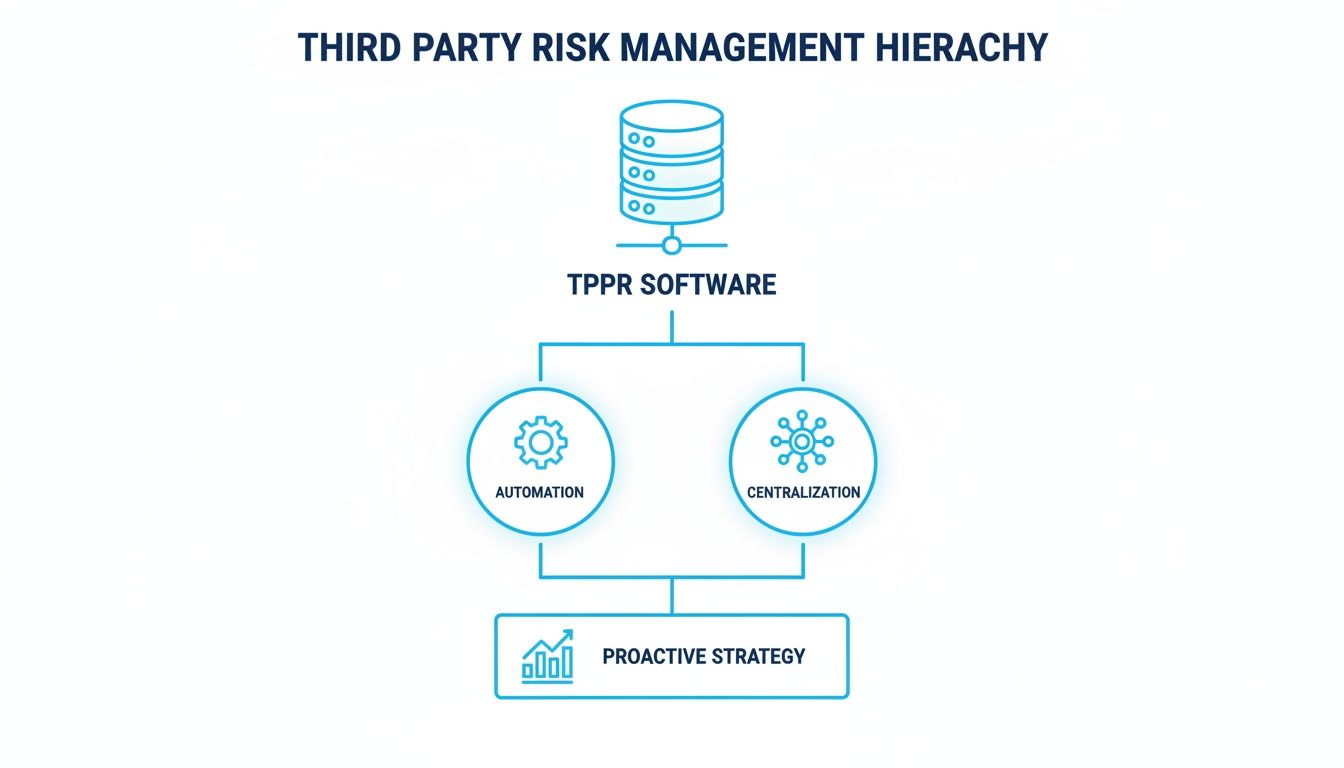
This hierarchy shows that a powerful software platform is the foundation, enabling the automation and centralization needed to build a truly proactive risk management strategy.
Pillar 4 Centralized Workflow and Mitigation
Spotting a risk is only half the battle. The fourth pillar, centralized workflow and mitigation, makes sure those risks actually get fixed. When a high-risk issue is flagged, the platform automatically creates a remediation task and assigns it to the right internal owner and vendor contact.
Every step of the process is tracked right there in the system, creating a clear line of accountability. No more wondering if someone followed up on a critical vulnerability. The software provides dashboards showing all open risks, who owns them, and their current status, ensuring nothing ever falls through the cracks. This structured workflow transforms risk identification into a documented, repeatable, and auditable mitigation process.
Pillar 5 Comprehensive Audit Trails
Finally, the fifth pillar is the comprehensive audit trail. In today's regulatory climate, you don't just have to manage risk—you have to prove you managed it. A solid TPRM platform creates a defensible, time-stamped record of every single action taken.
This includes every questionnaire sent, every response received, every risk identified, and every mitigation task completed. When auditors or regulators come knocking, you can instantly pull reports that demonstrate due diligence and a systematic approach to risk management. This immutable record is your ultimate protection, giving you the hard evidence needed to satisfy compliance requirements and defend your decisions.
Mastering Compliance in a Complex Regulatory World
Let's be honest: navigating the modern regulatory maze is a monumental task. You’re juggling a constantly growing list of rules like GDPR and CCPA, on top of industry-specific frameworks from bodies like the SEC and NIST. Proving your organization is compliant is hard enough, but proving every single one of your vendors is too? That can feel downright impossible.
Relying on manual tracking and spreadsheets is no longer a viable strategy. In fact, it's a direct path to crippling fines, a tarnished reputation, and the permanent loss of customer trust.
This is exactly where third party risk management software steps in, acting as your dedicated compliance engine. Instead of treating compliance like a separate, painful project, these platforms weave it directly into the fabric of your vendor management. It flips compliance from a reactive, check-the-box chore into a proactive, automated, and continuous process.
Your Automated Compliance and Audit Partner
The right software doesn’t just help you manage risk; it helps you prove your due diligence to auditors and regulators with undeniable evidence. It systematically creates a time-stamped, unshakeable record of every single compliance-related action, decision, and control.
This automation is your lifeline for staying aligned with complex standards. Managing third-party risks is especially critical when dealing with physical assets and the sensitive information they hold. For instance, knowing the best practices for secure and compliant corporate data destruction, including vendor selection, shows how risk management extends through the entire vendor lifecycle. TPRM software captures these processes, giving you a complete audit trail from onboarding to offboarding.
This capability is particularly vital in North America, which dominated the TPRM software market with over 38% of global revenues in 2023. Driven by the need to navigate dense regulations and escalating threats, the U.S. market alone is projected to grow at a 13.6% CAGR from 2024 to 2030. With 61% of organizations reporting a third-party breach in the last two years, robust platforms aren't a luxury—they're essential for survival.
TPRM software acts like your organization's compliance memory, automatically documenting every decision and control. It ensures that when an auditor asks, "How do you know this vendor is compliant?" you have a clear, data-backed answer ready to go.
Mapping Controls to Regulations Automatically
One of the most powerful features of a modern TPRM platform is its ability to map a vendor's controls directly to specific regulatory requirements. Imagine you're assessing a new cloud provider. The software can take their security assessment answers and instantly check them against the relevant clauses in GDPR or the specific controls outlined in the NIST Cybersecurity Framework.
This automated mapping gives you immediate visibility into compliance gaps. Instead of manually cross-referencing hundreds of controls against dense legal text, the platform flags potential issues for you. It can even trigger automated workflows to get those gaps fixed. This ensures your partners are held to the same stringent data privacy and security standards you hold for yourself. For a deeper dive, you can explore our detailed guide on navigating regulatory compliance risk management.
By automating documentation, mapping controls, and creating rock-solid audit trails, TPRM software transforms compliance from a major operational headache into a streamlined, strategic advantage that builds trust with regulators and customers alike.
How to Choose the Right TPRM Software for Your Business
Picking a third-party risk management software platform is so much more than a simple purchase. It’s a strategic decision that will define your company's security, compliance, and operational resilience for years. The right solution becomes a genuine partner in your defense, while the wrong one just creates more headaches than it solves. Making the right call comes down to a clear, structured evaluation process.
Your first move is to look past the flashy features and zero in on what really matters. A TPRM solution has to be able to grow with you. Think about its scalability—can it handle your vendor list today and support your projected growth over the next five years? A platform that works fine for 100 vendors might completely fall apart under the pressure of 1,000.
Just as crucial is how the software plugs into your existing tech stack. Seamless integration isn’t just a nice-to-have; it’s non-negotiable. The platform absolutely must connect with your current systems—like your Enterprise Resource Planning (ERP), Human Resources Information Systems (HRIS), and contract management tools. This is the only way to kill data silos and make sure your TPRM program has a complete, unified view of every single third-party relationship.
Building Your Business Case and Assembling Your Team
Before you even look at a single demo, you need to get everyone on the same page internally. Building a solid business case is your ticket to getting the budget and buy-in you need from leadership. You have to frame the investment not as another expense, but as a critical move to protect revenue, keep customer trust, and dodge catastrophic regulatory fines.
A strong business case moves the conversation from "Can we afford this software?" to "Can we afford not to have it?" It pits the immense, unpredictable cost of a third-party breach against the manageable, fixed cost of a proactive TPRM platform.
Once you’ve made the case, it’s time to assemble your selection team. This is a cross-functional mission that needs input from multiple departments to make sure all the bases are covered. Your core team should have people from:
IT and Security: To dig into the software's technical guts, integration capabilities, and security protocols.
Legal and Compliance: To guarantee the platform meets all regulatory demands and provides rock-solid audit trails.
Finance and Procurement: To analyze the total cost of ownership, comb through the contract terms, and vet the vendor's long-term viability.
Core Evaluation Criteria for Your Shortlist
With your team and business case locked in, you can start looking at specific solutions. The key is to focus on practical, outcome-driven features that directly map to your organization’s unique risk appetite and workflows.
An intuitive user interface (UI) is everything. Let's be honest—if the software is clunky and a pain to navigate, your team just won't use it. Your investment will go down the drain. The platform has to be designed to pull people in, not push them away. Look for clean dashboards, workflows you can actually customize, and straightforward reporting that empowers users instead of burying them in data.
Finally, dodge the common implementation traps by asking the tough questions upfront. Does the vendor offer real training and ongoing support? How are their risk-scoring models defined, and can you tweak them? A true software partner will sit down with you to configure the platform for your specific needs, making sure it aligns perfectly with your internal policies. By taking this kind of structured, collaborative approach, you can confidently pick a solution that truly defends your business.
The Future of Risk Management with Ethical AI

For years, third party risk management software has been exceptional at one thing: looking outward. These platforms are masters at scanning a vendor's external footprint, from cybersecurity scores to financial health reports. But what about the risks that blossom inside your organization because of those very relationships? This is where the real future of risk management is taking shape, and it’s being driven by Ethical AI.
This next wave of technology finally gets a handle on the human element of risk—the subtle, internal vulnerabilities that traditional systems are completely blind to. It’s a crucial shift from just guarding your perimeter to also strengthening your core.
Beyond External Monitoring to Internal Integrity
The future isn’t about choosing between external and internal risk; it’s about unifying them. Imagine a platform that doesn’t just tell you if a vendor is secure, but also helps you understand if an employee’s close relationship with that vendor is creating a serious conflict of interest. This isn’t about employee surveillance; it's about smart prevention.
Platforms like Logical Commander’s E-Commander are pioneering this integrated approach. They work by analyzing structured, objective indicators to flag potential integrity risks or conflicts of interest, all without resorting to invasive monitoring. The entire goal is to provide early, preventive warnings—not to pass judgment on individuals.
This model is built on an "Ethical by Design" framework, which is non-negotiable. These systems are carefully built to operate within strict legal and ethical lines, transforming risk management into a tool that protects both the organization and its people. To get a better sense of this responsible framework, exploring established AI governance principles provides essential context.
The Rise of AI-Powered Preventive Platforms
The TPRM market is already pivoting fast. In this evolving space, software platforms are on track to grab over 67.60% market share by 2035, a surge driven largely by the integration of AI for more sophisticated risk monitoring. For businesses thinking ahead, this means adopting platforms that can ethically surface critical risk signals—like integrity red flags—without surveillance, aligning perfectly with standards like ISO 27001.
Ethical AI isn't about predicting bad behavior. It's about identifying the structural and procedural weak points that create vulnerabilities, allowing you to fix them before they escalate into misconduct or compliance failures.
This technology provides the complete picture that’s been missing. When you see how AI is already impacting related business functions, like its growing use in AI in accounting, you can see the clear, logical path for its application in risk management.
A Unified Strategy for Holistic Security
Ultimately, the future of risk management is a unified one. It's a single, holistic security strategy where external vendor threats and internal, human-centric risks are managed under one compliant and ethical umbrella. This approach finally allows organizations to move from a reactive posture—cleaning up messes after the damage is done—to a proactive one.
By connecting the dots between your third-party ecosystem and your own internal environment, you gain an incredible advantage. You can spot and shut down vulnerabilities that were previously invisible, building a more resilient, trustworthy, and secure organization from the inside out. This isn’t just a new feature; it’s a whole new philosophy for managing risk in a deeply interconnected world.
Your Questions, Answered
When you're digging into the world of vendor and partner oversight, you're bound to have questions. Let's tackle some of the most common ones we hear from leaders trying to get a handle on their third-party risks.
TPRM vs. Vendor Risk Management
People often use these terms interchangeably, but there's a real difference, and it matters. Think of it this way: Vendor Risk Management (VRM) is a piece of the puzzle, but Third-Party Risk Management (TPRM) is the whole picture.
VRM is laser-focused on the suppliers you pay for goods and services. TPRM, on the other hand, casts a much wider net.
TPRM is the broader discipline, covering any external entity that touches your data, systems, or operations. This includes not just vendors, but also partners, affiliates, contractors, and other collaborators who could introduce risk.
In short, VRM manages your supply chain. TPRM manages your entire business ecosystem.
Implementation Timelines
So, how long does it take to get a TPRM platform up and running? It’s not an overnight flip of a switch, but it’s faster than you might think. A typical, phased rollout usually takes between 6 to 12 weeks.
The process generally breaks down into a few key stages:
Weeks 1-4: This is the setup phase. We’re talking platform configuration, defining your risk assessment criteria, and connecting the software to existing tools, like your procurement system.
Weeks 5-8: Time for a test flight. You’ll start onboarding your first wave of critical, high-risk vendors to test and fine-tune the workflows.
Weeks 9-12: Now you expand. The rollout continues to the rest of your vendors, and we get all your internal teams trained up and comfortable with the new system.
Accessibility for Smaller Businesses
There’s a common myth that this kind of software is only for massive global corporations. That might have been true years ago, but not anymore. The rise of scalable, cloud-based TPRM solutions has made this technology completely accessible and affordable for businesses of all sizes.
Let's be clear: small and mid-sized businesses (SMBs) are just as vulnerable to supply chain attacks. In fact, attackers often target them precisely because they assume they have fewer security resources. Modern third party risk management software gives SMBs the automated muscle they need to secure their operations and meet the same tough compliance standards as their larger competitors.
ESG Compliance and Vendor Monitoring
How does this software help with Environmental, Social, and Governance (ESG) goals? Modern TPRM platforms are built to weave ESG risk right into the overall vendor assessment process, helping you build and maintain a responsible, ethical supply chain.
The software lets you send out ESG-specific questionnaires to your vendors, collecting hard data on everything from ethical labor practices and environmental impact to diversity policies. The more advanced platforms go a step further, providing continuous monitoring for ESG red flags—like a negative news story about a supplier's labor violations or an environmental incident. This creates a documented, auditable trail of your ESG due diligence that you can stand behind.
Logical Commander Software Ltd. offers an ethical, AI-driven platform to help you proactively manage internal and third-party risks without invasive surveillance. Move from reactive problem-solving to proactive prevention. Know First, Act Fast! with Logical Commander.