%20(2)_edited.png)

A Guide to the Inspector General and Organizational Integrity

Updated: Jan 2
An inspector general is the organization's independent watchdog, the one tasked with making sure government agencies and other large entities operate with integrity and efficiency. Their core mission is to hunt down and eliminate fraud, waste, and abuse, acting as the ultimate guardian of public trust and taxpayer dollars.
Unpacking the Role of an Organizational Guardian

Think of an inspector general (IG) as the structural engineer called in to inspect a skyscraper. The engineer didn’t design the building or manage the construction crew. Their job is to show up, completely independent, and verify that everything is built to code, structurally sound, and free from the kind of hidden flaws that could cause a catastrophe down the road.
In the same way, an Office of Inspector General (OIG) doesn’t run an organization's day-to-day operations. It exists to provide a completely objective, unbiased assessment of how that organization is performing. This strict separation is precisely what gives the IG its power and credibility.
More Than Just a Watchdog
While the "watchdog" label is accurate, it doesn't tell the whole story. The IG's role is far more constructive than just sniffing out problems. They are a critical part of any healthy governance structure, offering a vital check and balance against internal failures before they spiral out of control.
Their mandate is broad, but it boils down to keeping the organization healthy and honest. Here’s a quick overview of what their offices typically handle.
Key Functions of an Inspector General at a Glance
This table provides a snapshot of the primary functions an OIG performs, showing how their work directly contributes to an organization's health and integrity.
Function | Objective | Typical Activities |
|---|---|---|
Audits | Evaluate financial and operational performance. | Financial statement reviews, performance audits, program efficiency analysis. |
Investigations | Uncover and document fraud, waste, abuse, and misconduct. | Criminal and administrative investigations, whistleblower complaint follow-ups. |
Evaluations | Assess the effectiveness of programs and policies. | Policy impact studies, program outcome assessments, management practice reviews. |
Inspections | Provide quick assessments of specific operational areas. | Site visits, process reviews, compliance checks on specific regulations. |
Each of these functions provides leadership and external stakeholders—like Congress or a board of directors—with a reliable source of truth about what’s really happening on the inside.
This system has become integral to modern governance. It was formally established in the U.S. through the Inspector General Act of 1978, which started with just 12 departmental IGs. Today, that community has grown to 73 OIG offices across the federal government, a clear sign of how essential this oversight has become.
The core mission is simple: keep an agency or organization honest, efficient, and effective. An inspector general achieves this by operating with a level of independence that internal audit or compliance teams often cannot match.
Ultimately, a strong inspector general serves as both a shield and a catalyst. It shields the organization from risks like financial meltdowns and reputational ruin while catalyzing improvements in policies, procedures, and the overall culture. Their findings aren't just critiques; they are roadmaps for building a more resilient and trustworthy institution.
The Powers and Boundaries of an Inspector General
To be a real watchdog, an Inspector General needs more than just a title; they need actual authority. These aren't unlimited privileges but carefully crafted tools meant to uncover facts, follow the evidence, and hold people accountable. At the same time, that power is checked by strict legal and constitutional lines that protect individual rights and keep the process fair.
Think of an IG’s power like a master key to an organization. It can open just about any door, but it comes with a rigid set of rules on when, how, and why it can be used. This balance between access and restraint is what makes the Office of Inspector General such a credible and effective force for integrity.
The heart of an IG's authority is baked directly into the law, specifically the Inspector General Act of 1978. This landmark legislation gives them distinct, powerful tools to carry out their mission without being stonewalled.
The Authority to Access and Investigate
An Inspector General is given broad powers to make sure their work is thorough and grounded in evidence. These authorities are essential for slicing through bureaucracy and getting straight to the truth.
Key statutory powers include:
Access to All Records: An IG has the right to get their hands on any and all records, reports, audits, data, and other materials the agency has. This is crucial for audits and evaluations, as it allows them to see the complete picture of how an organization really operates.
Power to Compel Testimony: IGs can require employees to give information and testimony through interviews and depositions. This is a vital tool for digging into misconduct or fraud, making sure critical information isn’t conveniently withheld.
Subpoena Authority: Many IGs can issue subpoenas to compel testimony and documents from people and companies outside their own agency. This power becomes especially important when an investigation involves external contractors or other third parties.
These tools aren't used on a whim. They’re deployed to follow credible allegations and examine systemic problems, making sure no stone is left unturned in the pursuit of facts. For a deeper look at how this all plays out, check out our guide on the essentials of Office of Inspector General oversight.
An inspector general's authority isn't about control; it's about transparency. Their powers are designed to shine a light into the darkest corners of an organization, not to run its day-to-day affairs. This is what allows them to identify waste, fraud, and abuse that might otherwise go unnoticed.
The Bedrock of Independence
The single most critical element of an IG’s power is independence. Without it, their findings would be immediately suspect, and their role would be no different than that of an internal compliance team. This independence is shielded by several structural safeguards designed to insulate them from political games or internal pressure.
An Inspector General is usually appointed without regard to political party and can only be removed for a specific, documented cause. This protection is fundamental, ensuring they can report bad news without fearing retaliation from the very leaders they oversee.
This principle has certainly been tested. The controversial removals of several IGs in 2020 sparked major congressional pushback and led to legislative reforms in 2022. These changes to the Inspector General Act were specifically designed to fortify IG independence and block politically motivated firings, showing a firm commitment to objective oversight.
Ultimately, the boundaries placed on an Inspector General are just as important as their powers. They must operate within the law, respect due process, and protect the confidentiality of sensitive information. They can't take corrective action themselves; instead, they make recommendations to agency leadership and Congress, who are then responsible for making the changes. This separation of duties is what keeps the IG an objective reviewer, not a manager.
The Three Pillars of IG Operations
The work of an Inspector General really boils down to three core functions. While distinct, these pillars—audits, investigations, and evaluations—are deeply interconnected, each providing a different lens to look at an organization's health and integrity.
Think of them as the fundamental tools in the IG's toolkit. Understanding how they differ, and how they work together, is the key to grasping how an IG drives accountability and transparency. They aren’t just abstract concepts; they’re the day-to-day work that turns the mission of fighting fraud, waste, and abuse into reality.
Pillar 1: Audits — The Financial Health Check
Think of an IG audit as a thorough financial and operational health check-up. Audits are structured, disciplined reviews that measure a program or department against established criteria, like laws, regulations, or internal policies. The main goal here isn't to catch a bad guy, but to answer a simple question: "Are we spending this money correctly and running things efficiently?"
Auditors live by a strict set of rules, namely the Generally Accepted Government Auditing Standards (GAGAS), often called the "Yellow Book." They meticulously comb through financial records, contracts, and internal controls to spot discrepancies or find ways to tighten things up. An audit begins with the goal of verification, not suspicion.
For instance, an IG might audit a major contractor’s billing practices. The audit team would systematically review every invoice, line by line, and compare them against the contract terms to make sure the government was only charged for legitimate expenses. The final report would flag any overbilling and, more importantly, recommend new procedures to stop it from happening again.
Pillar 2: Investigations — The Detective Work
If audits are the routine check-ups, investigations are the detective work. They kick off in response to a specific allegation of wrongdoing—think fraud, embezzlement, a serious conflict of interest, or other misconduct. Unlike an audit’s broad review, an investigation is a laser-focused mission to find out if someone broke a specific law or rule.
This is where things get serious. Investigators gather evidence, conduct interviews under oath, and can even work with law enforcement to execute search warrants or subpoenas. It's adversarial by nature, designed to establish the cold, hard facts: the who, what, when, where, and how of the alleged misconduct. The result could be anything from an employee getting fired to a full-blown criminal prosecution.
An investigation is not a wide-ranging fishing expedition. It is a targeted inquiry triggered by credible information, often from a whistleblower hotline or an audit that uncovered red flags. Its purpose is to uncover facts and provide a basis for corrective or punitive action.
A classic example? An investigation into a tip that a manager is steering contracts to a company owned by their cousin. Investigators would dig up emails, financial records, and interview witnesses to see if a conflict of interest exists and if the manager violated federal ethics laws.
Pillar 3: Evaluations — The Big-Picture Assessment
Evaluations zoom out for a much broader, more strategic view. They step back from the nitty-gritty of individual transactions or misconduct to ask a more fundamental question: "Is this program actually working as intended?" This function assesses the overall effectiveness, efficiency, and real-world impact of an organization’s major initiatives.
Where an audit is bound by rigid standards, an evaluation uses a mix of social science and analytical methods to measure outcomes. The focus shifts from strict compliance to actual results.
For example, an IG might evaluate a new workforce training initiative. Instead of just auditing the program’s budget, the evaluation team would analyze data to see if participants landed better jobs, if the program met its stated goals, and whether the return on investment was justified. Their final report would offer recommendations on how to improve the program’s design for better results.
Each of these pillars provides a unique perspective. Together, they create a powerful oversight system that ensures not only that the rules are followed, but that taxpayer money is spent wisely and government programs are truly serving their purpose.
The Real-World Impact of IG Investigations
It’s easy to think of an Inspector General’s work as abstract—something buried in dense reports and tangled up in government regulations. But the real measure of an IG’s value isn’t on paper. It’s in the tangible, real-world results that protect public funds, strengthen organizations, and restore trust.
When an IG investigation wraps up, its findings aren't just criticisms; they're catalysts for real change. These aren't theoretical exercises. They lead to massive financial recoveries, drive critical policy overhauls, and force organizations to build tougher internal controls so the same mistakes don’t happen again.
From dismantling complex fraud rings to spotting the slow, systemic waste that bleeds an organization dry, each finding is a direct line to better operational health. A good Office of Inspector General (OIG) delivers a powerful return on investment, proving it’s far more than a simple cost center.
From Findings to Financial Recoveries
One of the most direct impacts of an IG’s work is clawing back money that was misspent or stolen. Through painstaking audits and investigations, OIGs help recover billions of dollars lost to fraud, waste, and abuse every year. This isn’t just about balancing a ledger; it’s about returning taxpayer money to where it was supposed to go in the first place.
The numbers tell a powerful story. Take the Department of Health and Human Services OIG, for example. Their investigations alone have led to around 450 convictions. Those efforts resulted in financial recoveries of $2.25 million in fines, $230 million in forfeiture, and an incredible $2.7 billion in ordered restitution.
This financial impact is a stark reminder of why independent oversight is so essential. By holding individuals and contractors accountable, an inspector general ensures that public and organizational funds are protected from being exploited.
Driving Systemic and Policy Change
While getting the money back is huge, the real long-term value of an IG often comes from forcing systemic improvements. Their recommendations don't just punish a few bad actors; they attack the root causes that allowed the problem to happen in the first place. This is what makes an organization truly resilient.
An IG report can shine a light on weaknesses in all sorts of areas:
Contracting Procedures: Uncovering loopholes that enable overbilling or favoritism, leading to much tighter procurement rules.
Internal Controls: Highlighting gaps in financial oversight that create glaring opportunities for embezzlement or misuse of funds.
Program Effectiveness: Showing that a major initiative is completely failing to meet its goals, which can trigger a total redesign or even termination.
Employee Conduct Rules: Identifying patterns of misconduct that lead to stronger ethics training and clearer codes of conduct.
The fallout from an IG investigation can also touch on fundamental legal duties. For instance, an organization’s failure to maintain legal 'Right to Work' compliance is a major red flag that an IG would zero in on to prevent illegal employment and its associated risks.
An IG’s recommendation is a roadmap for improvement. It provides leadership with an objective, evidence-based plan for fixing what’s broken, ultimately making the organization stronger, more efficient, and more accountable to its stakeholders.
Successfully navigating these processes demands a solid internal framework. Organizations that invest in modern tools for managing corporate internal risk investigations are far better prepared to cooperate with an OIG and actually implement its recommendations. By building a culture of proactive integrity, a company can turn the challenge of an IG inquiry into an opportunity for genuine, lasting improvement.
How to Navigate an Inspector General Inquiry
Getting a notice from an Office of Inspector General can feel like your world is about to be turned upside down. It’s intimidating, but it doesn’t have to be a full-blown crisis. With a structured, cooperative, and transparent response, you can turn a nerve-wracking inquiry into an opportunity to prove your organization’s commitment to doing things right.
The key is to have a playbook ready to go before you ever get that call.
First, breathe. An IG inquiry isn’t an accusation; it's a fact-finding mission. Your job is to help them find the facts while protecting your organization’s legal rights and making sure the process is fair. Panic is your enemy—it leads to sloppy mistakes. A calm, methodical approach is your best friend.
This flow chart gives you a high-level look at the journey from the start of an IG investigation to real organizational change.
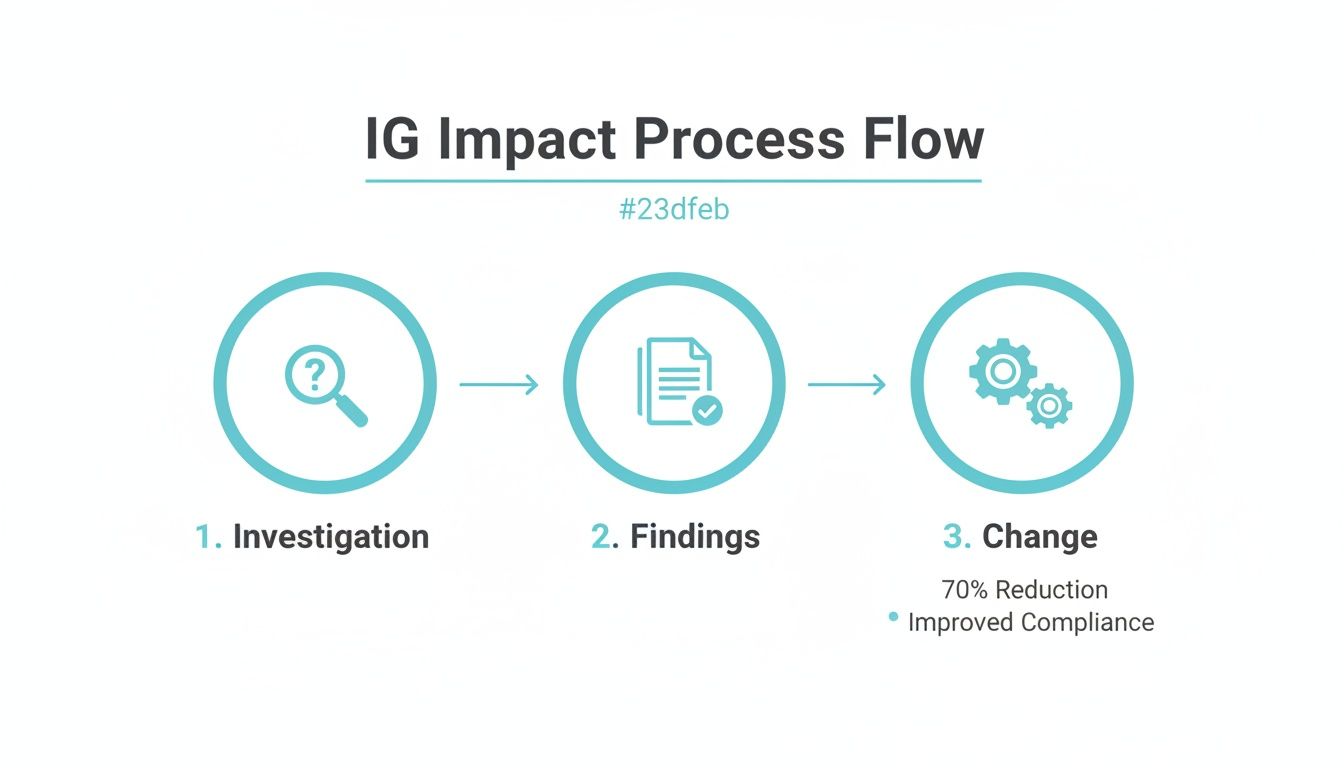
As you can see, the IG's findings aren’t the end of the road. They’re the bridge between the investigation and meaningful improvement, acting as the catalyst for taking corrective action.
Assemble Your Internal Response Team Immediately
The second you receive that inquiry notice, your first move is to pull together a dedicated internal response team. Don't leave this to a single department. You need a mix of expertise to cover all your bases and keep communication centralized and consistent.
Your team should absolutely include people from:
Legal Counsel: They’ll handle all the legal obligations, advise on your rights, and manage every single communication with the IG's office.
Compliance: They know your internal policies and controls inside and out and can provide crucial context for the inquiry.
Human Resources: HR will manage all employee communications, schedule the necessary interviews, and deal with any personnel issues that pop up.
Relevant Department Heads: You need the subject-matter experts who understand the specific programs or operations being reviewed.
This core group becomes the single point of contact. This setup is critical for preventing mixed messages and ensuring everyone is on the same page.
Lock It Down: Implement a Legal Hold
As soon as you know an inquiry is underway, you must preserve all potentially relevant information. This is done by issuing a legal hold (sometimes called a litigation hold), which is a formal order to stop all routine document destruction.
This is not optional. Failing to preserve documents—even if it's an accident—can be seen as obstruction and bring on severe penalties. The hold needs to cover everything from emails and Slack messages to financial records and operational reports. Modern platforms designed for internal risk management, like Logical Commander, can make this much smoother by centralizing documentation in an auditable format so nothing gets lost in the shuffle.
The whole point of a legal hold is to freeze a moment in time. It preserves the factual record exactly as it was when the inquiry began. It’s a foundational act of good-faith cooperation and a critical step in protecting the organization from accusations of tampering with evidence.
Prepare Your People for What's Coming
An IG interview is a stressful experience for anyone. Your job is to prepare employees without coaching their answers or creating a culture of fear. All communications from HR and legal should be clear, calm, and supportive.
Here are the key messages to share with your team:
Tell the Truth: Instruct employees to answer every question honestly and completely. Make it clear that guessing or speculating doesn’t help anyone.
Answer the Question Asked: Employees should listen carefully and give a direct answer without volunteering extra information.
It's Okay to Say "I Don't Know": If an employee doesn't know the answer or can't recall a detail, that is the right response. It's better than making something up.
No Retaliation—Period: Reassure everyone, especially potential whistleblowers, that the company has a strict zero-tolerance policy for retaliation against anyone who cooperates with an investigation.
An organized, ethical response shows you take accountability seriously. It signals to the Inspector General that you’re a partner in ensuring integrity, not an obstacle. This collaborative stance can make a huge difference in the tone and outcome of the entire inquiry.
Building a Culture of Continuous Readiness
The absolute best way to handle an Inspector General inquiry is to have started preparing years ago. It’s not about a frantic, last-minute scramble to find documents. It’s the natural result of a strong, ethical framework that was in place long before any official notice ever arrived.
The ultimate defense against findings of misconduct is a proactive culture of integrity. This is what shifts an organization from a reactive, check-the-box compliance mindset to a dynamic, living model of good governance.
It’s All About Continuous Readiness
This approach is about building continuous readiness. Think of it as the difference between cramming for a final exam versus studying consistently all semester. The organization that crams might pass, but it’s a mess of stress, mistakes, and forgotten information. The one that studies all along is calm, prepared, and actually knows the material, ready for a pop quiz at any time.
Continuous readiness means embedding ethical principles into every daily operation. It’s about creating a transparent environment where issues are surfaced and addressed internally before they have a chance to fester and attract outside attention.
Moving Beyond Reactive Compliance
Traditional compliance often boils down to meeting the bare minimum requirements—a necessary but completely insufficient goal. A culture of readiness, on the other hand, treats integrity as a core operational asset, not a burden to be managed. It’s about building systems that naturally guide people toward ethical behavior and flag risks early on.
This proactive stance doesn’t just get you ready for a potential IG review; it strengthens the entire organization from the inside out. Integrity becomes part of your operational DNA, making the business more resilient, efficient, and trustworthy. The goal is to build an environment where an IG audit would simply validate the strong controls you already have in place.
Continuous readiness transforms the role of an Inspector General from a potential threat into a collaborative partner in governance. When an IG arrives, they find a well-managed organization that is already committed to accountability, turning the inquiry into a validation of existing practices rather than an exposé of hidden failures.
To get there, leadership has to champion a transparent culture where employees feel genuinely safe raising concerns without any fear of retaliation. This psychological safety is the absolute bedrock of any effective internal reporting system. It ensures problems are caught and handled at the lowest possible level, long before they escalate into something requiring external oversight.
The Pillars of a Proactive Integrity Framework
Building this kind of culture takes more than good intentions; it demands a structured, intentional framework. This system should be designed from the ground up to identify and mitigate risks before they ever attract the attention of an Office of Inspector General.
A robust framework for continuous readiness always includes these pillars:
Clear Ethical Guidelines: A code of conduct that is more than a document sitting on a server. It must be actively communicated, woven into training, and reinforced by every action leadership takes.
Accessible Reporting Channels: Multiple, confidential ways for employees to report concerns, from anonymous whistleblower hotlines to trusted internal points of contact.
Structured Internal Investigations: A formalized process for handling internal complaints fairly, consistently, and without bias, proving that every concern is taken seriously.
Proactive Risk Assessments: Regularly scheduled reviews of different operational areas to spot vulnerabilities to fraud, waste, or abuse before an incident can even happen.
By creating this internal ecosystem of integrity, you aren't just preparing for an audit; you're building a high-functioning, ethical workplace. You can find a deeper exploration of these concepts in our complete guide to building a high-integrity workplace framework.
Using Technology to Reinforce Readiness
Modern risk management platforms play a huge role in maintaining this state of readiness. Instead of relying on a chaotic mess of spreadsheets and manual processes, organizations can use unified systems to finally connect the dots between HR, Compliance, and Legal.
Privacy-preserving platforms like Logical Commander allow organizations to identify early risk signals without resorting to invasive surveillance. By focusing on ethical indicators instead of accusations, these tools help teams act early and document everything in a compliant, auditable way. This provides the structure needed to manage risks proactively and demonstrate due diligence to any Inspector General, ensuring you can "Know First, Act Fast!" while always upholding employee dignity.
Got Questions About the Inspector General? We’ve Got Answers.
When you're a leader in compliance, HR, or risk, the idea of an Inspector General can seem a little intimidating. It’s an office that operates with a unique level of authority, and understanding the rules of engagement is critical. Let's clear up some of the most common questions we hear.
Can an Inspector General Actually Make Arrests?
This is a big one, and the direct answer is generally no. The Office of Inspector General (OIG) itself doesn't have the power to make arrests. However, don't mistake that for a lack of teeth. Many OIGs have their own special agents who are sworn federal law enforcement officers, giving them the authority to carry firearms, execute warrants, and, yes, make arrests.
When an IG investigation uncovers evidence of criminal activity, they don't go it alone. The OIG works hand-in-glove with the Department of Justice or other law enforcement agencies. These are the folks who ultimately press criminal charges and cuff the suspects, but it's the rock-solid evidence from the OIG's investigation that makes it all happen.
Is an IG Report a Final Judgment?
Not at all. An IG report isn't a legal verdict handed down from a judge. It’s better to see it as a set of factual findings and expert recommendations based on a deep dive into the evidence, whether from an audit, an investigation, or an evaluation.
Think of an IG report like a structural stress test for your organization. It identifies the weak points and tells you exactly what needs to be fixed. It’s up to the agency's leadership—and sometimes Congress—to actually implement those fixes and hold people accountable.
How Is an IG Different from My Internal Audit Team?
The single most important difference is independence. It’s the entire reason the IG role exists. While both your internal audit team and an IG are focused on accountability, your internal auditors report up the chain to your own leadership.
An Inspector General, especially at the federal level, has a dual reporting structure established by law. They report to both the head of their agency and to Congress. This external line of reporting gives the IG a layer of objectivity and freedom that an internal team simply can't match. They’re designed to deliver an unvarnished, unfiltered assessment, free from any internal politics or pressure, making their findings a powerful force for public trust.
Building a culture of integrity is always the best preparation for any inquiry. Logical Commander Software Ltd. offers a unified platform that helps HR, Compliance, and Risk teams get ahead of internal risks ethically and effectively. It allows you to "Know First, Act Fast!" while always upholding employee dignity and regulatory compliance.