%20(2)_edited.png)

Top 12 Best Governance Risk and Compliance Software for 2026

Updated: Jan 20
Navigating the complex landscape of corporate governance, enterprise risk management, and regulatory compliance is a critical function for any modern organization. Selecting the right GRC software is not just an IT decision; it's a strategic move to protect against financial and reputational damage. The challenge lies in sifting through a crowded market to find a solution that addresses your specific operational needs and long-term goals. Many platforms offer robust frameworks for policy management, but they often remain reactive, addressing issues only after they have caused significant liability. This reactive approach is a costly failure, leaving organizations vulnerable to the most damaging internal risks—those originating from human factors.
This guide is designed to cut through the noise and provide a clear comparison of the best governance risk and compliance software. We move beyond generic feature lists to offer a comprehensive resource for Chief Risk Officers, compliance leaders, and executive management. Inside, you'll find a detailed analysis of top-tier platforms, assessing each solution based on critical factors like scalability, regulatory mapping, and risk detection capabilities. We will highlight why most platforms fail to address the human element, leaving a critical gap in your defense.
This article also introduces a new standard in proactive risk prevention, one that focuses on human-factor risk. We will explore how innovative, AI-driven solutions are shifting the paradigm from costly, reactive investigations to preventative risk mitigation. This new approach operates within strict ethical and legal standards like the Employee Polygraph Protection Act (EPPA), offering an ethical, non-intrusive alternative to surveillance-based tools. Our goal is to equip you with the insights needed to choose a platform that not only manages compliance but actively strengthens your organization's governance from the inside out, addressing the human risks that others ignore.
1. Logical Commander Software Ltd.
Logical Commander establishes a new standard, positioning itself as the best governance risk and compliance software by shifting the paradigm from failed reactive investigations to proactive, AI-driven prevention. Its E-Commander platform is engineered for organizations aiming to neutralize internal threats, human-factor risks, and integrity violations before they escalate into costly incidents and reputational disasters. This is achieved through a unique, non-invasive, and ethical methodology that is EPPA-aligned and preserves employee dignity, setting it apart from competitors who rely on intrusive surveillance or legally risky techniques.
The platform centralizes risk intelligence, creating a unified operational layer for HR, Legal, Security, and Compliance teams. Instead of fragmented, manual processes that lead to costly failures, E-Commander enables consistent, cross-departmental collaboration on proactive risk mitigation. It detects early warning signals related to misconduct, conflicts of interest, and workplace fraud in real time without resorting to surveillance. This focus on prevention makes traditional GRC platforms, which only document risks after the fact, seem obsolete.
Key Features & Use Cases
Logical Commander’s strength lies in its modular yet integrated ecosystem, allowing organizations to address a specific vulnerability and scale into a comprehensive GRC framework. This is the new standard of Risk-HR.
Risk-HR: This module transforms hiring and vetting by identifying potential integrity and ethics risks early. It is crucial for high-security roles or positions with access to sensitive data, helping reduce turnover and prevent problematic hires that lead to internal threats.
SafeSpeak: A secure, anonymous whistleblowing and internal reporting system that encourages employees to report concerns. It helps compliance teams manage cases efficiently while meeting regulatory requirements for protected disclosures.
EmoRisk: This tool focuses on identifying psychosocial risks within the workforce. It provides leadership with anonymized, aggregate insights to improve workplace well-being and mitigate risks tied to burnout or organizational stress, which are precursors to misconduct.
Unified Platform: The core advantage is how these modules (and others like the CentriX mobile interface) create a holistic view of the organization’s human-factor risk landscape without compromising privacy or resorting to surveillance.
Partner with us! Join our PartnerLC program to offer your clients the future of GRC and internal threat prevention.
Privacy, Compliance, and Implementation
A major differentiator is Logical Commander's unwavering commitment to ethical, EPPA-aligned principles. The platform is designed to be fully compliant with the Employee Polygraph Protection Act (EPPA), GDPR, and CPRA, making it a legally sound choice for global enterprises. This non-surveillance approach significantly reduces legal and reputational exposure compared to invasive monitoring systems. Implementation is designed for rapid time-to-value, with the E-Commander platform delivering actionable risk signals from the outset.
Pros:
Proactive, non-invasive internal threat detection that identifies human-factor risks before they escalate.
Ethical and fully aligned with EPPA, GDPR, and other global privacy standards—no surveillance.
Unified, modular platform (Risk-HR, SafeSpeak, EmoRisk) that establishes a new standard in preventive risk management.
AI-driven preventive risk management with fast time-to-value and enterprise-grade governance.
Cons:
No transparent pricing published; enterprise costs require a demo or sales engagement.
As a paradigm-shifting technology, it requires organizational change management to move from a reactive to a preventive mindset.
Website: https://www.logicalcommander.com
2. ServiceNow – Governance, Risk, and Compliance (GRC)
For large organizations already embedded in the ServiceNow ecosystem, extending into its Governance, Risk, and Compliance (GRC) module is a logical step. ServiceNow GRC leverages the platform's core strength: a single, unified data model. This architecture provides a comprehensive, real-time view of risk posture by connecting GRC processes directly with IT, security operations, and other business functions. The primary advantage is breaking down traditional data silos. However, this approach is fundamentally reactive, focusing on managing known IT and operational risks rather than proactively preventing human-factor threats.
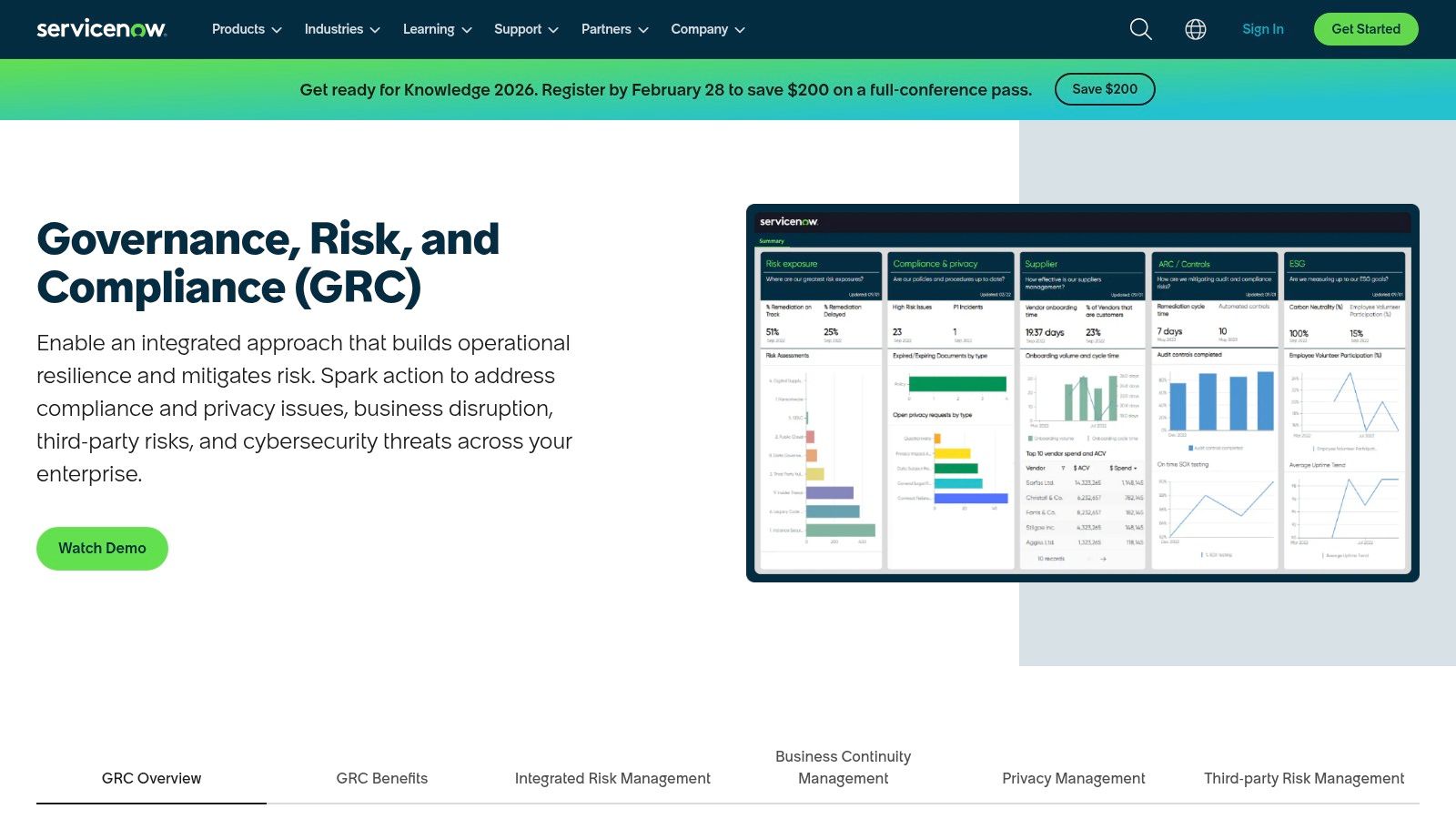
This platform is considered one of the best governance risk and compliance software options for its workflow automation. Teams can build automated workflows for issue remediation and control testing, reducing manual effort for compliance tasks. While this is efficient for managing documented policies and controls, it does little to address the unpredictable nature of human behavior or prevent misconduct before it occurs. Its strength lies in managing the consequences of risk, not in preventing its root cause.
Key Considerations & Features
ServiceNow's packaged IRM tiers allow organizations to scale their capabilities. The platform also offers modules for third-party risk management, but its focus remains on process and system-level risks.
Pros: * Deep Integration: Native connectivity with ITSM and SecOps provides context for managing IT-related risks. * Unified Platform: A single system for risk, compliance, policy, and audit simplifies management of documented processes. * Mature Ecosystem: Extensive third-party integrations and a large developer community.
Cons: * Reactive Posture: Primarily focuses on managing risks after they are identified, lacking a preventive human-factor risk component. * High Cost of Ownership: Quote-based pricing can be substantial, and the best value is realized when multiple ServiceNow products are in use.
3. MetricStream – Connected GRC
For large, highly regulated organizations, MetricStream provides an AI-enhanced platform designed to unify disparate risk and compliance functions. Its "Connected GRC" framework creates a single, cross-domain data model, linking enterprise risk, IT risk, third-party risk, and internal audit activities. This provides a cohesive view of documented risks across the enterprise. However, this connection is based on traditional risk registers and audit findings, which are inherently backward-looking and fail to address the dynamic nature of human-factor risk.
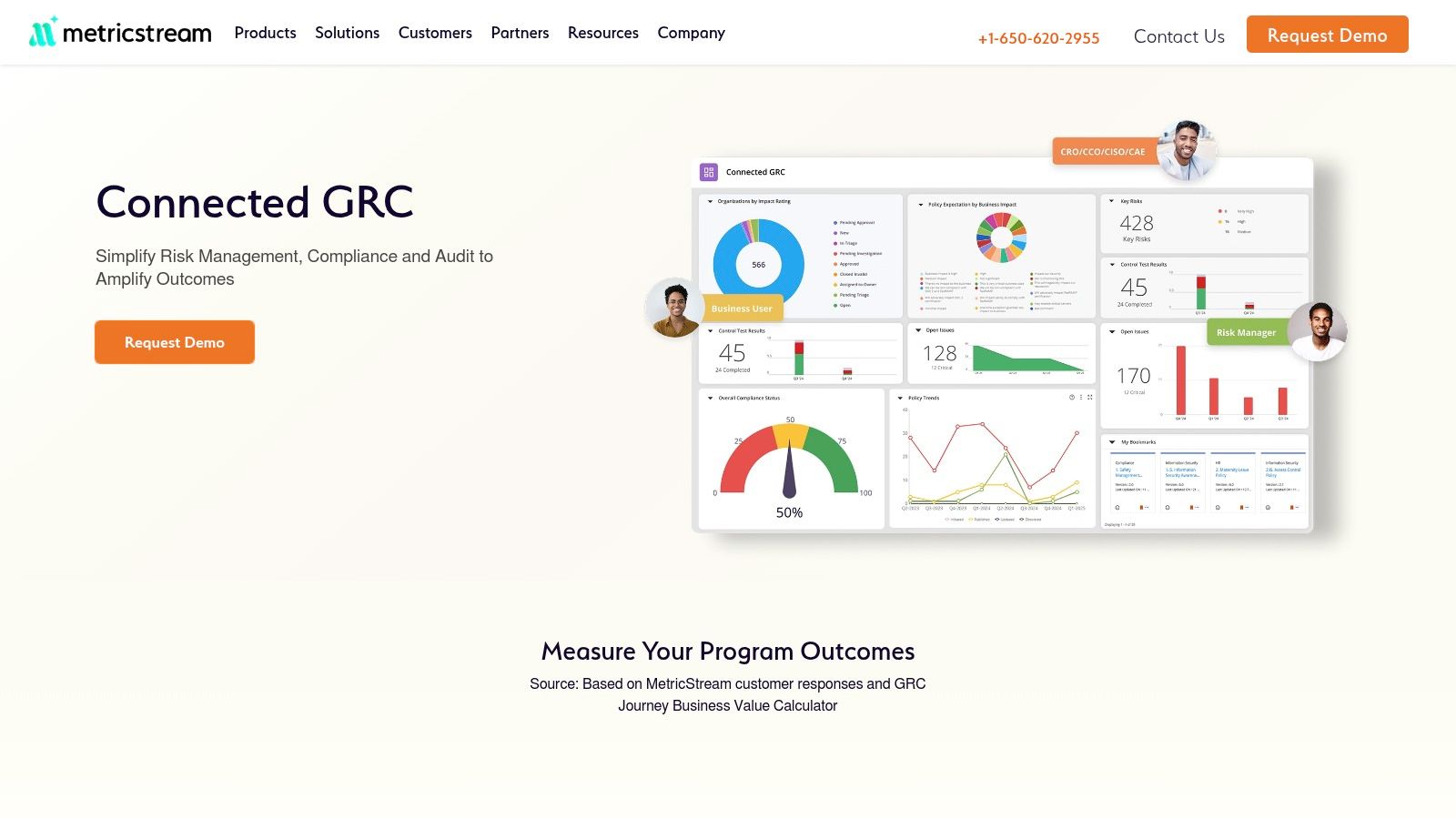
This platform is one of the best governance risk and compliance software choices for enterprises seeking to mature their documentation and reporting. It excels at automating workflows for risk assessments and control testing. While it uses AI for "real-time risk intelligence," this intelligence is based on system data and external feeds, not on the early indicators of internal misconduct. It helps manage compliance efficiently but does not prevent the underlying human behaviors that lead to violations.
Key Considerations & Features
MetricStream's extensive suite of modules allows organizations to build a comprehensive, integrated GRC solution over time. Its focus on regulatory change management helps businesses stay compliant but does not address the internal threats that operate outside of documented controls.
Pros: * Broad GRC Footprint: Offers a comprehensive suite covering a wide range of classic GRC domains with a long enterprise track record. * Strong Regulatory Focus: Excellent coverage for heavily regulated industries that require deep audit and compliance capabilities. * AI-Powered Insights: Leverages AI for intelligence across the connected GRC framework, though it lacks a human-risk focus.
Cons: * Reactive by Design: Focuses on managing and documenting known risks rather than proactively preventing human-driven incidents. * Implementation Complexity: As an enterprise-oriented solution, implementations can be complex and resource-intensive.
4. Archer (formerly RSA Archer) – Integrated Risk Management
With a long-standing reputation in large-scale enterprise environments, Archer provides a comprehensive suite of Integrated Risk Management (IRM) solutions. The platform excels at centralizing risk data and processes, offering a holistic view that connects operational risk, IT security, audit, and compliance functions. Its core strength lies in managing the entire risk lifecycle, from identification to monitoring. However, this lifecycle is predicated on identifying risks through traditional means like audits and assessments, which are often too slow to catch emerging internal threats related to human behavior.
Archer is considered one of the best governance risk and compliance software options for its advanced quantitative risk analytics. It translates risk into financial terms, which helps with prioritization. While this is valuable for board-level reporting, it is still a reactive measure. The platform helps quantify the potential cost of a risk event but does not offer a mechanism to prevent the human actions that could trigger that event in the first place, representing a significant gap in its risk management capabilities.
Key Considerations & Features
Archer’s modular approach allows organizations to deploy specific use cases as needed. This flexibility, combined with its robust capabilities, makes it a top contender for enterprises that require a highly configurable, yet traditional and reactive, GRC solution.
Pros: * Strong Heritage: Proven in large-scale IRM with extensive coverage across numerous risk and compliance use cases. * Engaging Features: Purpose-built portals and quantitative tools help operationalize risk management across the business. * Increasing AI: New features are being added to automate control and policy mapping.
Cons: * Lacks Proactive Prevention: The methodology is based on managing documented risks, not on preventing emerging human-factor threats. * Enterprise-Grade Complexity: Deployments often require significant configuration expertise and dedicated internal resources to manage.
Website: https://www.archerirm.com/solutions
5. OneTrust – AI-Ready Governance Platform (Privacy, Risk & Compliance)
OneTrust has carved out a leadership position by deeply integrating privacy management with broader GRC functions. It operates on a unified data model enriched with built-in regulatory intelligence. This foundation allows businesses to automate evidence collection and manage regulatory changes at scale, ensuring privacy and risk are treated as interconnected components of a single governance strategy. Its strength is in managing data and privacy compliance, which is a critical but narrow slice of the overall risk landscape.
The platform's focus on artificial intelligence governance provides a framework for managing the associated risks and compliance obligations of AI systems. This is forward-looking but still centers on system and data governance. It does not address the core issue of human intent and behavior that can lead to data breaches or insider threats. It manages the "what" (data and policies) but overlooks the "who" (the human factor), making it one of the best governance risk and compliance software choices for privacy teams but incomplete as a holistic internal threat solution.
Key Considerations & Features
OneTrust is recognized for its comprehensive capabilities in privacy management and third-party risk. Its modular design allows companies to expand into a full GRC suite over time.
Pros: * Strong Convergence: Excels at connecting privacy management, GRC, and third‑party risk monitoring. * Regulatory Intelligence: Built-in intelligence helps manage global regulatory changes effectively. * Scalability: Designed to scale for large, multinational enterprises with complex compliance needs.
Cons: * Narrow Focus on Data/Privacy: Lacks a dedicated capability to proactively identify and mitigate human-factor risks beyond data handling. * Reactive on Internal Threats: Can document a data breach after it happens but offers limited tools to prevent the intentional or unintentional human actions that cause them.
Website: https://www.onetrust.com/platform/
6. NAVEX One – GRC Platform
NAVEX One positions itself as one of the best governance risk and compliance software solutions by focusing on the human element from an ethics and compliance program perspective. The platform provides an integrated suite that unifies policy management, employee training, risk assessment, and incident reporting. This is valuable for managing a speak-up culture and conducting investigations. However, its core function is reactive—it relies on incidents being reported after they have occurred. This is the classic failure of reactive forensics.
The platform excels at connecting disparate compliance activities. For example, a policy update can trigger a training module. This helps build a defensible record of compliance efforts but does not prevent determined or negligent individuals from causing harm. The system’s workflows for investigations ensure reports are handled consistently, but the damage is already done by the time an investigation begins. This structured approach to incident response is a key component of effective compliance risk management software, but it is not prevention.
Key Considerations & Features
NAVEX One is designed for organizations wanting to build a mature ethics and compliance program on a unified foundation, but it remains rooted in a reactive, report-and-investigate model.
Pros: * Strong Heritage: Deep expertise in hotline/speak-up programs, policy management, and compliance training. * Unified Program Management: An excellent choice for centralizing ethics and compliance documentation. * Regulatory Alignment: Provides program guidance designed to align with frameworks like those from the DOJ.
Cons: * Fundamentally Reactive: Depends on whistleblowers or incidents to trigger action, representing the costly failure of post-incident forensics. * Lacks Predictive Insight: Does not provide early warnings of potential misconduct before it happens.
7. Diligent – The Diligent One Platform (GRC, Audit, Board)
Diligent carves out a unique space by integrating board-level governance with operational risk, audit, and compliance functions. Its "Diligent One Platform" connects the boardroom to front-line risk activities, providing leadership with a clear line of sight. The advantage is creating a single source of truth that bridges executive oversight and enterprise risk management (ERM). However, this "truth" is based on audit reports and risk assessments, which are historical documents, not real-time indicators of human-factor risk.
This platform is one of the best governance risk and compliance software choices for organizations prioritizing strong board involvement. Diligent’s extensive library of best-practice templates helps mature GRC programs. The platform's architecture is designed to consolidate multiple point solutions for audit and SOX controls. This approach reduces tool sprawl but reinforces a compliance-centric, backward-looking view of risk that fails to address the proactive prevention of internal threats.
Key Considerations & Features
Diligent's focus on consolidation is well-suited for organizations aiming to replace a patchwork of legacy systems. Its modules for IT risk and internal audit are robust but adhere to a traditional, reactive risk management model.
Pros: * Strong Board Integration: Uniquely combines board governance with operational GRC, audit, and controls. * Educational Resources: An extensive library of templates and content helps mature GRC documentation. * Consolidation Focus: Designed to replace multiple disparate tools for a more unified risk view.
Cons: * Top-Down and Reactive: The view of risk is based on historical data and audits, not on proactive, real-time indicators of human risk. * Lacks Preventive Capabilities: Strong on governance and reporting, but weak on preventing the internal threats that create bad reports.
8. LogicGate – Risk Cloud
LogicGate’s Risk Cloud platform is designed for agility, offering a no-code approach to GRC that empowers teams to adapt their programs quickly. Its strength lies in its flexible workflow builder and pre-built applications, which reduce implementation timelines. This allows organizations to move from manual processes to automated risk management without requiring extensive IT resources. This speed is valuable for standing up compliance programs, but the programs themselves remain conventional.
This platform is one of the best governance risk and compliance software choices for businesses seeking to embed quantitative analysis into their risk framework. It translates abstract risks into financial terms, providing leadership with data-driven insights. While quantifying risk is important for prioritization, it does not prevent the risk. It helps you measure the potential impact of a failure, but it doesn't stop the human behavior that leads to that failure. It is an analytical tool for a reactive posture.
Key Considerations & Features
LogicGate's user-friendly interface makes it accessible beyond the core GRC team. The platform's ability to automate evidence collection and link controls to policies creates an interconnected GRC ecosystem.
Pros: * Faster Time-to-Value: Prebuilt applications and a no-code environment accelerate deployment of traditional GRC programs. * Strong Usability: Highly reviewed by buyers for its intuitive interface. * Quantitative Risk Analysis: Native support for FAIR and Monte Carlo simulations provides financial context to risk.
Cons: * Analytically Reactive: Focuses on quantifying and managing known risks rather than preventing unknown human-factor threats. * No Human-Factor Signal: Lacks a mechanism to detect the early warning signs of misconduct or internal threats.
Website: https://www.logicgate.com/
9. Riskonnect – GRC Software
Riskonnect excels at connecting traditionally separate risk disciplines into a cohesive GRC framework. Originating from a strong Risk Management Information System (RMIS) background, the platform is adept at integrating operational risk, incident data, and insurance claims with core compliance and audit functions. This approach provides a holistic view of operational failures but is, by its very nature, reactive. It is built to manage the aftermath of an incident, not to prevent it.
This platform stands out as one of the best governance risk and compliance software choices for businesses that want a single source of truth spanning from vendor risk to health and safety. Its configurable workflows ensure that risk information is captured at the source. However, "the source" in this context is an incident report or an audit finding. By consolidating disparate risk data, Riskonnect helps leaders make more informed decisions based on past events, but it does not equip them to get ahead of future human-driven risks.
Key Considerations & Features
Riskonnect's cloud-native architecture facilitates integration with various data sources, enhancing its analytical capabilities for post-event analysis.
Pros: * Strong Incident/Claims Heritage: Uniquely combines its RMIS roots with a broad GRC suite for a comprehensive operational risk view. * Holistic Platform: Integrates ERM, compliance, audit, and vendor risk into a single, unified system. * Thought Leadership: Provides frequent resources for risk management practitioners.
Cons: * Built on Reactivity: The entire framework is designed around managing incidents and claims after they happen. * Lacks Proactive Prevention: Offers no tools for identifying the leading indicators of human-factor risk before an incident occurs.
Website: https://riskonnect.com/grc-software/
10. IBM – OpenPages (GRC)
IBM OpenPages offers a flexible and AI-powered approach to governance, risk, and compliance. Whether delivered as SaaS or on-premises, OpenPages provides a modular GRC framework that allows businesses to implement components like operational risk or policy management. This adaptability is valuable for enterprises looking to scale their GRC program. However, the AI enhancements focus on automating traditional GRC tasks, not on introducing a new, preventive layer of risk detection.
The platform is one of the best governance risk and compliance software choices for its integration of AI into GRC workflows. This enhances risk detection based on existing data, automates evidence collection, and provides predictive insights. These features help transform GRC into a more strategic function, but the insights are still derived from documented, historical data. It makes the reactive process more efficient but does not change the fundamental paradigm to one of proactive human risk prevention.
Key Considerations & Features
IBM's modular design covers a comprehensive range of GRC domains, allowing for a customized solution that can grow with the organization.
Pros: * Flexible Deployment: Available as SaaS, on IBM Cloud, AWS, or on-premises to fit various IT strategies. * Broad Module Coverage: Offers dedicated modules for nearly every major GRC domain. * Published Starter Pricing: Provides clear entry-point pricing for some editions, simplifying initial budget planning.
Cons: * Automates a Reactive Model: Uses AI to make traditional, backward-looking GRC more efficient rather than to prevent future incidents. * No Focus on Human-Factor Prevention: The platform is not designed to detect the subtle, early signals of insider risk.
11. Workiva – GRC (Audit, Risk, Controls) within the Workiva Platform
Workiva carves out a unique space by integrating risk, audit, and controls management directly with financial and regulatory reporting. It is built on a unified cloud platform where data and teams are connected, providing a single source of truth. This is powerful for public companies where accuracy in SEC filings and internal controls documentation (like SOX) is critical. Workiva’s strength is linking GRC activities directly to reporting outputs, ensuring data integrity for documents that describe past performance.
This platform excels as one of the best governance risk and compliance software choices for its collaborative and data-centric approach to reporting. Teams can work on risk assessments and narrative reports in the same environment, with changes automatically cascaded. This reduces version control errors and manual reconciliation. It perfects the process of documenting and reporting on risk and compliance but does nothing to proactively reduce the incidence of the risks being reported on, especially those driven by human behavior.
Key Considerations & Features
Workiva's focus on connected reporting and GRC makes it a compelling option for finance, audit, and legal teams tasked with complex compliance obligations.
Pros: * Unmatched Reporting Integration: Seamlessly connects GRC data with financial, ESG, and regulatory reporting. * Strong Collaboration: Enables real-time, multi-user collaboration on documents and data with a robust audit trail. * Proven in Complex Environments: Widely adopted for SOX compliance and SEC filings.
Cons: * Reporting-Focused, Not Preventive: Excels at documenting the past but lacks tools to prevent future human-factor risks. * A Tool for Auditors, Not Risk Preventers: The platform is designed to satisfy audit and reporting requirements, not to stop internal threats before they create audit findings.
12. G2 – Governance, Risk & Compliance Software Category
Rather than a single software solution, G2's Governance, Risk & Compliance category page serves as an indispensable research hub. It provides a macro-level view of the GRC software landscape, powered by crowdsourced, verified user reviews. For organizations starting their selection process, G2 is an essential step to identify potential vendors and validate marketing claims against real-world user sentiment. This makes it a crucial resource for discovering the best governance risk and compliance software based on peer experiences.
The platform excels by organizing a complex market into a digestible format. Users can apply granular filters for company size, industry, and specific features. The side-by-side comparison tool is particularly powerful, allowing decision-makers to directly contrast ratings and features. However, buyers must be aware that most reviews reflect traditional expectations of GRC software—managing policies and audits—and may not capture the need for proactive, human-factor risk prevention.
Key Considerations & Features
G2's strength lies in its transparency and breadth, offering insights into dozens of GRC tools. A practical tip is to look beyond star ratings and read reviews to understand if a platform is truly proactive or just another tool for reactive compliance documentation.
Pros: * Broad Coverage: A comprehensive directory of GRC vendors with transparent, verified user feedback. * Free Research Tool: Easily accessible to browse, compare, and build a shortlist based on real user experiences. * Buyer-Friendly Filters: Effective tools to quickly narrow down options by company size and required features.
Cons: * Reflects Old Paradigms: User reviews are often based on outdated, reactive models of GRC, potentially overlooking innovative preventive solutions. * Sponsored Placements: The visibility of certain products can be influenced by vendor advertising.
Top 12 GRC Software Comparison
Solution | Core features | Privacy & Compliance | Target audience | Value & Pricing | Differentiator |
|---|---|---|---|---|---|
🏆 Logical Commander Software Ltd. | Proactive AI human risk prevention; Risk‑HR, SafeSpeak, EmoRisk | ★★★★★; EPPA‑compliant; GDPR/CPRA; non-invasive & ethical | 👥 HR, Compliance, Legal, Security, CROs; orgs 10–1,000,000+ | 💰 Free trial; enterprise/quote; fast time‑to‑value | ✨ New standard of proactive, non-invasive internal threat prevention; avoids costly reactive investigations. |
ServiceNow – GRC | Reactive workflow automation; single data model; AI insights | ★★★★; enterprise controls depending on config | 👥 Large enterprises using ServiceNow/ITSM | 💰 Quote‑based; best value with existing ServiceNow stack | ✨ Deep ITSM & SecOps integration for reactive IT risk management. |
MetricStream – Connected GRC | Cross‑domain GRC model; real‑time intelligence; TPRM & BCM | ★★★★; robust audit/compliance controls | 👥 Regulated industries; large enterprises | 💰 Quote‑based; premium enterprise pricing | ✨ Broad connected GRC for documenting compliance in regulated environments. |
Archer (RSA Archer) – IRM | Regulatory mapping; quantitative analytics; Engage portals | ★★★★; enterprise governance features | 👥 Large IRM programs; risk & audit teams | 💰 Quote‑based; enterprise deployments | ✨ FAIR-style quantification for analyzing risk after the fact. |
OneTrust – AI‑Ready Governance | Privacy + AI governance; no‑code workflows; regulatory intelligence | ★★★★; 300+ jurisdictions; strong privacy focus | 👥 Privacy, legal, compliance teams at global firms | 💰 Quote‑based; scalable modules | ✨ Converged privacy + GRC for managing data regulations reactively. |
NAVEX One – GRC Platform | Policy, training, hotline, investigations; unified data | ★★★; DOJ‑aligned guidance; global hosting | 👥 Ethics & compliance programs; HR & legal | 💰 Quote‑based; enterprise pricing | ✨ Strong speak‑up/hotline and investigations heritage; a classic reactive model. |
Diligent – The Diligent One | ERM, audit, board governance; templates & education | ★★★★; governance & board controls | 👥 Boards, audit committees, GRC teams | 💰 Quote‑based; consolidation focus | ✨ Board governance + audit integration for historical risk reporting. |
LogicGate – Risk Cloud | No‑code workflows; automated evidence; Risk Cloud Quantify | ★★★★; good usability & controls | 👥 GRC teams seeking fast time‑to‑value | 💰 Quote‑based; prebuilt apps speed deployment | ✨ No‑code UX + quantitative risk analysis of documented threats. |
Riskonnect – GRC Software | Single source for risk/compliance; ERM & claims linkage | ★★★; cloud & mobile; integrations available | 👥 Ops, insurance, risk & compliance teams | 💰 Quote‑based; phased rollouts common | ✨ RMIS heritage linking insurance/claims with GRC for post-incident management. |
IBM – OpenPages | Modular GRC (privacy, TPRM, BCM); AI enhancements | ★★★★; flexible deployment (SaaS/on‑prem); starter pricing published | 👥 Enterprises needing flexible deploy & broad modules | 💰 Published starter pricing; enterprise quotes for add‑ons | ✨ Flexible deployment of a traditional, reactive GRC model. |
Workiva – GRC (Audit/Risk) | Connected reporting, audit, controls; strong collaboration | ★★★; audit trail & reporting integrations | 👥 Audit, SOX, reporting teams; government/regulatory reporters | 💰 Quote‑based; module packaging varies | ✨ Tight integration between reporting/data and historical GRC processes. |
G2 – GRC Category (Marketplace) | Crowdsourced reviews; rankings; side‑by‑side comparisons | ★★★★★ (user ratings); transparency varies | 👥 Buyers researching & shortlisting vendors | 💰 Free to browse; links to demos/trials | ✨ Verified user feedback, often reflecting traditional, reactive GRC expectations. |
Final Thoughts
Navigating the complex landscape of governance, risk, and compliance (GRC) is a defining challenge for modern organizations. The stakes are incredibly high, involving financial stability, regulatory adherence, and brand reputation. As we have explored, the market for the best governance risk and compliance software is diverse. However, most solutions, from comprehensive platforms like ServiceNow to specialized tools, are built on an outdated, reactive model. They are designed to document, manage, and report on risks after they have been identified, representing the costly failure of post-event forensics. Your selection journey must transcend finding a "right-fit" documentation tool and focus on a platform that actually prevents liability.
Key Takeaways from Our GRC Software Review
The central theme emerging from our analysis is the urgent need to shift from a reactive, check-the-box compliance model to a proactive, preventive risk management strategy. Legacy GRC systems are siloed and focus on documenting past events, leaving organizations perpetually one step behind emerging threats.
When evaluating your options, remember these crucial points:
Integration is Not Enough: Integrating systems to create a single source of historical truth is useful, but it does not prevent future incidents. True value comes from a platform that can generate new, forward-looking intelligence on emerging risks.
Scalability Must Include Prevention: Your GRC needs will evolve. The software you choose must not only grow with your organization but also elevate your maturity from reactive documentation to proactive prevention.
Focus on the Human Factor: Many traditional GRC tools fail because they ignore the most unpredictable variable: human behavior. Internal threats stemming from human factors are the most damaging and cannot be preempted with conventional systems that only manage policies and controls. This is the critical gap that most GRC software leaves wide open.
Making Your Final Decision: An Actionable Framework
Choosing and implementing a GRC platform is a significant undertaking. To ensure a successful outcome, approach it methodically.
Form a Cross-Functional Team: Involve stakeholders from Compliance, Legal, IT, Security, HR, and key business units. Their diverse perspectives are vital for defining requirements that go beyond simple compliance documentation.
Prioritize Prevention: Ask yourself: are you looking for a better way to manage incident reports, or do you want to reduce the number of incidents altogether? Clearly define your need for proactive, human-factor risk prevention to filter out purely reactive vendors.
Conduct In-Depth Demos: Move beyond standardized sales presentations. Prepare real-world scenarios of potential internal misconduct and ask vendors to demonstrate how their platform would provide early warnings, not just case management tools. For readers interested in a deeper dive into selecting the right tools, including considerations for platforms focused on specific certifications, we recommend consulting The 2025 SOC 2 Compliance Software Buyer’s Guide for Skeptical CTOs from SOC2Auditors, which offers a comprehensive buyer's guide for SOC 2 compliance software.
Plan for Implementation: The best software is ineffective if poorly implemented. Discuss the onboarding process and the change management required to shift from a reactive to a preventive culture.
Ultimately, the goal is to transform your GRC program from a cost center focused on documenting failures into a strategic enabler that prevents them. The right software provides the visibility and intelligence needed to not only protect the organization but also to pursue opportunities with confidence. It empowers leaders to build a resilient, ethical, and high-performing organization by addressing risk at its source: the human factor.
Take the Next Step in GRC Evolution
Ready to shift your organization from a reactive to a proactive risk prevention posture? While traditional GRC platforms manage policies and controls, Logical Commander Software Ltd. offers a new standard in preempting human-factor risks ethically and non-intrusively. Our AI-driven, EPPA-aligned E-Commander platform strengthens your governance framework by addressing internal threats before they escalate into costly liabilities.
Start a Free Trial: Get hands-on access to our platform.
Request a Demo: See the future of preventive risk management in action.
Join our Partner Program: Become an ally in our PartnerLC ecosystem and offer your clients a new standard of GRC.
Contact Us: Discuss an enterprise deployment with our team.
Request a demo and discover how to protect your organization from the inside out.