%20(2)_edited.png)

A Modern Guide to Loss Prevention for Enterprise Leaders
- Marketing Team
- 1 hour ago
- 16 min read
When you hear the term loss prevention, it’s easy to picture security guards at the door and cameras pointed at the aisles. That’s the old model, and it's fundamentally broken. It was built for a world where the biggest threat was someone walking out with stolen goods. Today, that’s just a fraction of the problem.
Modern loss prevention is an enterprise-level function, tasked with protecting organizations from a far more complex and dangerous set of internal and external threats. It’s no longer about reacting to theft; it’s about proactively building a resilient organization that can get ahead of financial and reputational damage. The new standard is driven by ethical, AI-driven strategies that prevent human-factor risk, not just more surveillance. This is the new standard of internal risk prevention.
Redefining Loss Prevention in the Modern Enterprise
The traditional view of loss prevention is dangerously outdated. While external theft is still a concern, today’s risk, compliance, and legal leaders know that the most significant vulnerabilities often come from within. Internal threats—from process fraud and data exfiltration to quiet conflicts of interest—pose a direct and often invisible challenge to a company’s bottom line and integrity. These human-factor risks are where the real liability lies.
Simply reacting with forensic investigations after the fact is a losing game. It’s expensive, disruptive, and only tells you what went wrong after the damage is done. A modern approach flips this model entirely. To truly rethink enterprise loss prevention, you have to embrace early planning to prevent commercial crises and make the shift from reactive clean-up to proactive prevention.
The Alarming Rise of External and Internal Threats
The financial stakes are staggering. Retail shrinkage, which covers everything from theft to operational errors, has exploded into a massive profit drain, projected to hit $132 billion globally in 2024. The problem is getting worse on the ground, too. Shoplifting incidents shot up by 93% between 2019 and 2023, and a concerning 73% of retailers report perpetrators are becoming more aggressive. You can find more details about these alarming retail loss trends on DTIQ.com.
This intense external pressure makes it absolutely critical to get your internal house in order. A proactive, non-intrusive program transforms loss prevention from a cost center into a strategic advantage, creating a more resilient and compliant organization. It’s no longer just about protecting assets; it's a core part of your overall enterprise risk management framework.
Comparing Old vs. New Loss Prevention Philosophies
The evolution is best understood by comparing the old reactive mindset with the new proactive standard. It’s a complete philosophical shift. Traditional methods, often reliant on surveillance, are not just inefficient; they are often not so good at preventing the real, underlying human-factor risks.
Attribute | Traditional Reactive Approach | Modern Proactive Standard |
|---|---|---|
Primary Focus | External theft & post-incident investigation | Internal & external human-factor risks |
Methodology | Surveillance, forensics, reactive audits | Ethical AI, risk assessments, preventive alerts |
Timing | After financial or reputational loss occurs | Before threats can escalate into damage |
Compliance | High risk of violating EPPA and privacy laws | Designed for EPPA alignment and ethical standards |
Employee Impact | Fosters a culture of suspicion and distrust | Promotes a culture of integrity and accountability |
The fundamental goal has changed. It's no longer about reacting to misconduct but about creating an environment where integrity is the path of least resistance, and risks are identified before they become liabilities.
Comparing Proactive Prevention and Reactive Investigation
For decades, the standard playbook for loss prevention was simple but deeply flawed: wait for something to go wrong, then launch an investigation. This reactive model, built around forensic analysis and after-the-fact discovery, treats internal risk like a crime scene. For today's risk, legal, and compliance leaders, that approach is no longer sustainable. It’s a failed strategy that costs more than it saves.
The alternative is a fundamental shift in philosophy, moving from reaction to prevention. A proactive strategy doesn't wait for the damage. It focuses on identifying and mitigating the leading indicators of human-factor risk before they can escalate into financial loss, compliance breaches, or reputational harm.
This diagram illustrates the essential shift from a reactive, investigative stance to a proactive, preventive one in modern loss prevention.
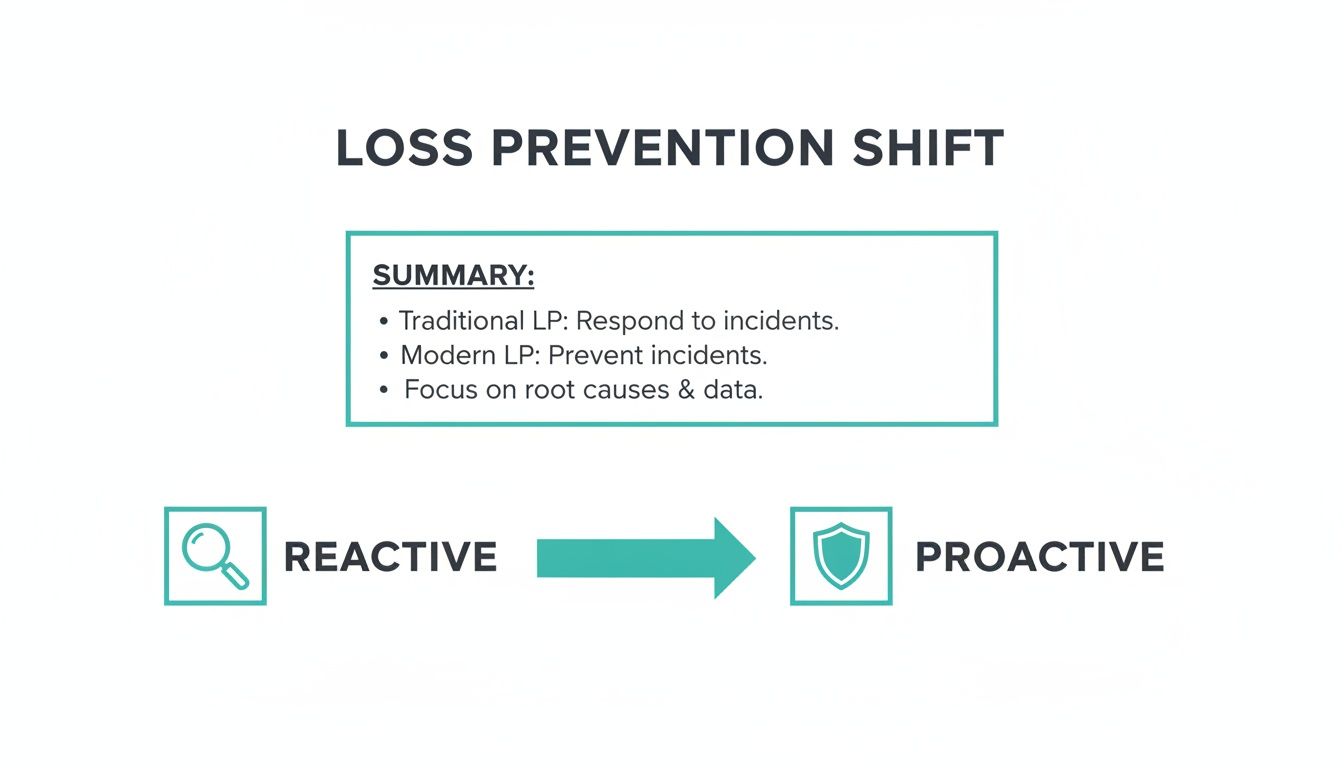
This visualizes how organizations are trading the magnifying glass of post-incident investigation for the shield of proactive defense—a change that redefines the entire approach to internal risk management.
Operational Cost and Business Disruption
Reactive investigations are notoriously expensive and inefficient. They burn through resources, demanding specialized personnel, legal counsel, and forensic tools. Worse, the process itself causes major business disruptions, pulling key employees away from their primary duties and creating operational bottlenecks that can drag on for weeks or even months.
In contrast, a proactive framework operates quietly in the background. By using an AI human risk mitigation engine to analyze process-based data, it flags potential issues without disrupting daily operations. This model prevents the spiraling expenses tied to full-blown investigations and lets the business maintain focus and productivity. To fully grasp the financial drain of legacy methods, it is critical to understand the true cost of reactive investigations and how they hit the bottom line.
A reactive investigation is an admission that existing controls have failed. Proactive prevention, on the other hand, strengthens those controls, turning loss prevention from a cost center into a strategic function that protects value.
Legal Liability and EPPA Compliance
The legal landscape surrounding internal investigations is a minefield. Traditional methods can easily veer into territory that violates employee rights and triggers regulations like the Employee Polygraph Protection Act (EPPA). Any action perceived as coercive, intrusive, or akin to an interrogation—common tactics in reactive models—can expose an organization to significant legal liability.
This is where an EPPA compliant platform offers a clear advantage. A proactive, ethical system is specifically designed to operate within legal boundaries.
No Surveillance: It avoids monitoring employee communications or personal activities.
No Coercion: The methodology is non-intrusive and respects employee dignity.
Focus on Process, Not People: Analysis is centered on business events and data, not personal behavior.
By sticking to these principles, an ethical AI-driven approach minimizes legal exposure and reinforces a commitment to a fair and lawful workplace.
Employee Morale and Organizational Culture
Few things poison a workplace faster than a culture of suspicion. Reactive investigations inherently position employees as potential suspects, breeding an environment of distrust that cripples collaboration and engagement. This adversarial stance is a direct path to higher turnover and a nosedive in productivity.
A proactive prevention model does the opposite. It fosters a culture of integrity and shared responsibility. By focusing on safeguarding processes and upholding clear standards, it reinforces that the organization is committed to fairness. It shifts the narrative from addressing misconduct to "protecting our collective integrity," building a positive and resilient organizational culture instead of eroding it.
Comparing Loss Prevention Methodologies
To make the distinction crystal clear, the table below breaks down how these two philosophies stack up across key business metrics. It highlights the stark contrast between a model that cleans up messes and one that prevents them from ever happening.
Attribute | Reactive Investigations | Proactive Prevention |
|---|---|---|
Timing | Post-incident; after damage is done. | Pre-incident; before risks escalate. |
Primary Goal | Assign blame and recover losses. | Mitigate risks and prevent losses. |
Financial Impact | High, unpredictable costs and operational disruption. | Low, predictable operational expense; protects revenue. |
Legal Risk | High potential for EPPA violations and litigation. | Designed for EPPA alignment; minimizes legal liability. |
Cultural Effect | Fosters distrust, fear, and an adversarial climate. | Promotes integrity, accountability, and psychological safety. |
Ultimately, the choice between these two models defines an organization's entire approach to loss prevention. While reactive measures will always have a place in emergencies, the future of effective and sustainable risk management lies in building a proactive, ethical, and intelligent defense system.
Understanding the Hidden Cost of Internal Threats
When you think about loss prevention, it's easy to picture external threats like shoplifting. But the real damage—the kind that can quietly cripple a company—almost always starts with a human. We're talking about everything from sophisticated process fraud and deliberate data theft to subtle conflicts of interest. These aren't just security problems; they're complex human-factor risks that live at the messy intersection of HR, Legal, and Compliance.
Unlike a smash-and-grab theft, internal vulnerabilities can fester for months, even years. They silently erode profits, expose sensitive data, and create massive legal liabilities long before anyone notices. This quiet bleed of resources is exactly why a unified, cross-departmental strategy is no longer a "nice-to-have." It's essential.
The Financial and Reputational Toll
The scale of internal malfeasance is staggering. According to a recent TransUnion report, fraud is now consuming nearly 8% of global business revenues, with worldwide losses hitting an estimated $534 billion each year. The problem is particularly acute in the U.S., where losses have climbed to 9.8% of revenues—a figure 27% higher than the global average. You can dig into the complete findings on global fraud trends in the TransUnion report.
This financial hemorrhage is made worse by the fact that 77% of recent U.S. data breaches exposed full Social Security numbers, creating a perfect storm for insider abuse and serious compliance failures.
But these numbers only scratch the surface. The true cost of internal threats goes far beyond the initial dollar amount.
Regulatory Fines: A single compliance breach can trigger crippling fines from regulatory bodies.
Brand Damage: News of internal fraud or a data leak can destroy a company's reputation, shattering the trust you've built with customers and investors.
Operational Disruption: The reactive investigations that follow divert critical resources, grind productivity to a halt, and poison the company culture with suspicion.
This reality reframes loss prevention from a simple security chore into a core function of enterprise governance and risk management. For a deeper analysis of these vulnerabilities, check out our guide on what constitutes insider threats and their impact.
Connecting the Dots Across Departments
Internal risks are never one-dimensional. A conflict of interest in the procurement department hits the finance team. An employee leaking intellectual property affects R&D and legal. Workplace misconduct creates huge liability for HR. These issues ripple across the entire organization.
Traditional loss prevention fails because it treats these as isolated incidents. An effective strategy recognizes them as interconnected symptoms of systemic human-factor risk and requires a unified defense.
This is where a centralized, AI human risk mitigation platform becomes indispensable. It creates a single source of truth that finally gets leaders across different departments on the same page.
For HR Leaders: It provides insights into integrity risks that a standard background check will always miss, helping ensure new hires align with corporate values from day one.
For Legal and Compliance Teams: It delivers an auditable trail of proactive risk mitigation, demonstrating due diligence and adherence to standards like EPPA.
For Security and Risk Officers: It offers early warnings on operational vulnerabilities before they can be exploited, shifting the entire posture from reactive cleanup to proactive prevention.
By breaking down these departmental silos, an organization can build a truly holistic defense. This integrated approach ensures that loss prevention is no longer just about stopping theft—it’s about safeguarding the entire enterprise’s integrity, reputation, and financial future.
Putting Your Ethical AI Prevention Framework into Action
Moving from a reactive to a proactive loss prevention strategy takes more than a shift in mindset; it requires a practical, structured game plan. Building a modern, ethical program starts with a clear roadmap that weaves together technology, aligns departmental goals, and reinforces a culture of integrity—all without falling back on invasive surveillance.
The real question is how to implement this new standard. It’s a process that involves a hard look at your current weak spots, deploying an AI-driven platform that is EPPA compliant, and getting your HR, Security, and Legal teams working together under one cohesive system.

Let’s be clear: this isn't about adding more cameras or monitoring software. The goal is to use ethical risk management technology to analyze risk signals from existing business processes. This gives you actionable intelligence while keeping the final decision-making power exactly where it belongs: with your leadership team.
Step 1: Assess Your Current Vulnerabilities
Before you even think about deploying new technology, you need to get an honest look at your organization's specific risk landscape. A real assessment goes beyond a traditional security audit to evaluate the human-factor risks hiding in plain sight across all departments.
This process is all about identifying the potential weak points where internal threats could realistically pop up.
Process Gaps: Pinpoint vulnerabilities in day-to-day workflows like procurement, expense reporting, or inventory management where fraud could slip through undetected.
Data Access Controls: Take a hard look at who has the keys to sensitive information and whether your current controls are enough to stop unauthorized data from walking out the door.
Conflict of Interest Points: Identify roles or relationships that could lead to compromised decisions, especially in areas like vendor management and hiring.
This initial assessment gives you the baseline you need to configure a Risk Assessments Software platform like Risk-HR, making sure it targets the most relevant and high-impact areas of your business. It’s the foundation for building a truly effective prevention strategy.
Step 2: Deploy a Centralized Risk Intelligence Platform
The engine of a modern loss prevention framework is a unified platform that centralizes all your risk intelligence. This system is what drives your proactive strategy, analyzing data from different sources non-intrusively to spot the leading indicators of risk.
The key is choosing an AI human risk mitigation platform that operates ethically from the ground up. The Risk-HR system, for example, is designed to analyze event-based data—like a sudden change in vendor payments or unusual system access patterns—without ever analyzing personal communications or employee behavior.
This approach ensures EPPA compliance by focusing on what is happening within business processes, not who is doing it. The AI provides objective, data-driven alerts, empowering your team to step in before a potential problem becomes a full-blown crisis.
By bringing in this kind of technology, you create a single source of truth for HR, Legal, and Security. This breaks down the information silos that often let internal risks fester, enabling a coordinated and swift response when a potential threat is flagged. For any organization looking to do this, understanding the core tenets of responsible tech is a must, which is why reviewing established guidelines on AI governance principles is so helpful.
Step 3: Foster a Culture of Integrity and Prevention
Technology on its own is never the complete answer. The final—and most critical—step is to build a company-wide culture that champions integrity and prevention. The rollout of an ethical AI platform should be framed as a positive move to safeguard the entire organization and its people.
This comes down to a few key actions:
Clear Communication: Explain that the new system is there to protect processes and ensure fairness, not to watch individuals. Emphasize its non-intrusive, EPPA-aligned design.
Defined Roles: Clearly outline how HR, Security, and Legal will work together within this new framework. Make sure everyone understands how to act on the intelligence the platform provides.
Continuous Improvement: Use the insights from the platform to refine your internal controls and training programs. This helps you continuously strengthen your defenses against new and emerging threats.
Why Your Old-School Tactics Don't Stand a Chance Against Organized Crime
Traditional loss prevention strategies, like cameras and security guards, were built for a different era. They were designed to stop the lone, opportunistic shoplifter. But the biggest external threat your business faces today isn’t an individual—it's a highly sophisticated criminal network.
Organized Retail Crime (ORC) operates less like a petty thief and more like a multinational corporation. They have complex logistics, digital operations, and a crystal-clear profit motive. Your legacy tactics are simply outmatched, and it's time to face that reality.
When siloed security teams are focused only on what’s happening inside a physical store, they can't possibly counter an adversary striking across physical, digital, and supply chain fronts all at once. If a criminal network can coordinate cargo heists, digital fraud, and in-store theft simultaneously, a fragmented defense doesn't stand a chance. This new threat demands a complete strategic shift in how we think about enterprise security.
This Isn't Shoplifting; It's a Multi-Front War
ORC has become a global hydra, attacking businesses from every conceivable angle. The latest data paints a stark picture of this coordinated assault. Over half of all retailers are reporting alarming spikes across the board: a 70% increase in phone scams, a 55% rise in e-commerce fraud, a 52% jump in merchandise theft, and a 50% surge in cargo theft.
Even more disturbing is that 66% of these incidents are orchestrated by transnational groups. This reveals a level of coordination that legacy systems were never designed to handle. You can explore the full scope of these statistics in the 2025 Impact of Retail Theft & Violence report.
These criminal enterprises are experts at finding and exploiting the single weakest link in your entire operation. And more often than not, that weakest link is a human one.
How Internal Gaps Become a Gateway for External Crime
While the visible face of ORC is external, its success often hinges on internal collaboration—whether that collaboration is intentional or completely unwitting. Criminal groups actively recruit employees or just exploit existing process gaps to make their operations run smoothly. This is where a purely external-facing loss prevention strategy completely falls apart.
An organization without a solid internal risk management program is an open invitation for ORC to exploit. Here are a few all-too-common scenarios:
Insider Complicity: An employee leaks inside information on shipment schedules, inventory levels, or security blind spots.
Process Manipulation: A staff member bypasses inventory controls or pushes through fraudulent returns that feed stolen goods right back into your system.
Credential Compromise: Weak access controls allow criminals to waltz into sensitive systems using an employee’s legitimate credentials.
These internal breaches are the doorways that allow external criminal networks to succeed. Bolting the front door is useless if the back door has been left wide open by systemic vulnerabilities.
An organization's resilience against organized crime isn't defined by its external walls but by the strength of its internal core. A proactive internal defense is the most powerful deterrent against sophisticated external threats.
This is exactly why a modern loss prevention framework has to be built from the inside out. An ethical risk management platform acts as that crucial defensive layer, identifying the very internal risk indicators and process gaps that ORC groups are hunting for.
By proactively flagging potential conflicts of interest, unusual data access, or procedural anomalies, an EPPA compliant platform like Risk-HR helps you fortify your organization from within. This approach doesn't just reduce your internal risk; it makes your entire enterprise a much harder and less appealing target for organized crime.
Choosing Your Next-Generation Loss Prevention Partner
Picking the right partner for your loss prevention strategy is a make-or-break decision. It will define your organization's resilience for years to come. As you look at modern solutions, you have to move beyond legacy metrics and focus on the capabilities that actually address today’s complex, human-factor risks. The new standard demands a platform built on a foundation of ethical design, preventive intelligence, and strict compliance.
Your evaluation criteria should put a premium on partners who offer a non-intrusive, proactive approach. You need to steer clear of solutions that rely on surveillance or other methods that could run afoul of regulations like the Employee Polygraph Protection Act (EPPA). The right platform will empower your teams with actionable insights, not bury them in invasive monitoring tools that create legal liabilities and destroy employee morale.
Core Capabilities to Demand from Any Solution
When you're vetting potential partners, insist on a clear demonstration of these fundamental capabilities. A true next-generation platform has to deliver on all fronts, providing a unified and ethical framework for internal threat detection.
EPPA Alignment and Ethical Design: The platform must be fundamentally non-intrusive and built to respect employee dignity. Ask potential vendors to explain exactly how their technology operates without surveillance, psychological pressure, or any methods that could be interpreted as lie detection.
Proactive, AI-Driven Prevention: The system should be laser-focused on identifying the leading indicators of risk within your business processes, not on after-the-fact investigations. It must use AI to analyze event-based data—like procurement anomalies or access irregularities—to give you preventive alerts before a threat can escalate.
Unified Risk Intelligence: Your chosen solution must be able to break down departmental silos. It should serve as a central hub for HR, Legal, Security, and Compliance, providing a single source of truth for all human-factor risk and ensuring everyone is working from the same coordinated mitigation strategy.
The ultimate goal is to adopt a system that strengthens your organizational integrity from the inside out. This means choosing a partner committed to prevention over punishment and to upholding the highest ethical standards in every aspect of their technology and methodology.
The Logical Commander Standard
Logical Commander was designed to meet and exceed these modern requirements. Our Risk-HR platform provides a comprehensive Risk Assessments Software solution that sets a new standard for ethical and effective loss prevention.
We deliver an EPPA compliant platform that uses AI to analyze process-based risk without ever monitoring employees. By focusing on the human factor within your operational workflows, we help you mitigate threats like fraud, conflicts of interest, and other integrity violations before they cause serious financial or reputational harm.
With Logical Commander, you aren’t just adopting another tool; you're embracing a forward-thinking strategy for enterprise-wide risk management. We empower you to build a more resilient and integrity-driven culture, one proactive decision at a time.
Your Questions About Modern Loss Prevention, Answered
When you're shifting from a reactive, old-school model to a proactive loss prevention strategy, you're bound to have questions. It's a significant change. Let's tackle some of the most common ones we hear from enterprise leaders about the technology, the legal landscape, and what it all means on the ground.
How Can AI Improve Loss Prevention Without Being Invasive?
This is a critical question, and it gets to the heart of what separates a modern platform from an outdated surveillance tool. Ethical AI enhances loss prevention by focusing on process and event data, not by watching individuals. It’s designed to spot anomalies and risk indicators inside your business workflows—think procurement logs, inventory adjustments, or unusual access patterns—without ever reading personal emails or using cameras for behavioral analysis.
This approach is intentionally non-intrusive. It completely respects employee privacy and aligns squarely with regulations like the Employee Polygraph Protection Act (EPPA). The AI flags high-risk actions or potential conflicts of interest, giving your HR and compliance teams the intel they need to get ahead of issues before they turn into major losses. It’s about building a culture of integrity, not suspicion.
What's the Real Difference Between EPPA-Aligned Risk Management and a Traditional Investigation?
The difference is everything. It really comes down to timing and mindset. A traditional internal investigation is purely reactive; it only kicks off after a loss or incident has already happened. The whole goal is to figure out who to blame and maybe recover some assets, which almost always creates a culture of fear and carries serious legal risk.
In sharp contrast, EPPA-aligned risk management is all about proactive prevention.
It’s built to spot and neutralize potential risks before they ever cause harm.
It completely avoids any form of lie detection, psychological pressure, or surveillance.
The objective is to protect the organization's processes and uphold standards of integrity, not to create punitive outcomes for employees.
This preventive approach means you’ll have far fewer costly, high-stakes investigations to deal with in the first place, protecting both the company and your people.
How Does a Unified Platform Actually Help Different Departments?
A unified loss prevention platform like Risk-HR is designed to smash the information silos that leave an organization vulnerable to internal threats. It creates a single operational hub where key departments can work from the same intelligence, ensuring everyone is on the same page.
By centralizing risk intelligence, all departments work from a single source of truth, enabling coordinated and effective responses to potential threats. This collaborative approach makes loss prevention an integrated part of enterprise governance.
For your HR team, it surfaces integrity risks at different points in the employee lifecycle. For Security, it flags operational weak points that could be exploited. And for Legal and Compliance, it builds a clear, auditable trail of every risk mitigation effort, making sure all actions are documented and completely defensible.
Ready to build a resilient, ethical, and proactive loss prevention strategy? The Logical Commander Risk-HR platform sets the new standard for identifying and mitigating internal risks before they cause damage.
Request a Demo: See our EPPA-compliant platform in action.
Start Your Trial: Get access and experience proactive prevention firsthand.
Join PartnerLC: Become an ally in our partner ecosystem.
Contact Us: Discuss an enterprise deployment with our team.
Discover the future of internal risk management at https://www.logicalcommander.com.