%20(2)_edited.png)

A Modern Guide to Business Ethics: The New Standard of Proactive Prevention

Updated: Jan 15
For too long, business ethics has been treated like a dusty policy manual sitting on a shelf—something to point to after a crisis, not something to prevent one. But that old, reactive approach is a recipe for disaster. Waiting to react to misconduct is an incredibly expensive and damaging strategy, leaving companies exposed to huge financial liability and reputational hits.
Rethinking Ethics in Modern Risk Management

For decades, many organizations saw ethics as a simple compliance checkbox. This passive, "set it and forget it" mindset doesn't work. Today’s biggest liabilities, from internal fraud to compliance failures, are almost always rooted in human-factor risk, and they demand a proactive, preventive game plan.
The new standard is to stop cleaning up messes and start building a framework that prevents them. Real organizational integrity isn’t measured by how you investigate wrongdoing; it’s demonstrated by how you proactively identify and mitigate the conditions that allow it to happen.
The Gap Between Policy and Practice
A major headache for leaders in Compliance, Legal, and HR is the disconnect between boardroom policies and frontline actions. The 2025 Global Study on Ethics & Compliance Program Maturity found that most programs are unevenly developed, creating a huge gap between what the rules say and what employees actually do.
The problem is especially acute in middle management. With only 31% of organizations bothering to evaluate ethical behavior in performance reviews, there’s no real incentive for people to prioritize integrity. You can explore the full story in the findings on ethics and compliance maturity.
This gap is a critical business liability. Without a systematic way to understand and address human-factor risks, even the best-written policies are just words on a page. This is why a new standard for internal risk prevention is essential.
A proactive ethical framework isn't about policing behavior; it's about creating an environment where integrity is the path of least resistance. It requires tools that safeguard the organization while upholding employee dignity and privacy.
The New Standard for Ethical Risk Management
Adopting a modern, EPPA-aligned approach means bringing in technology that supports a culture of respect, not one that tears it down with surveillance or intrusive methods. An effective strategy must be built on core principles tied to business impact:
Prevention Over Reaction: Shift resources from costly forensic investigations into early-stage, AI-driven risk identification where they can prevent liability.
Non-Intrusive Methods: Use EPPA-aligned platforms that respect employee privacy, avoiding any form of surveillance, monitoring, or lie detection.
AI-Driven Insights: Employ technology to analyze systemic human-factor risk patterns across the organization without targeting individuals, protecting both the business and its people.
This new standard gives organizations the power to protect their assets and reputation before a risk spirals into a full-blown crisis. To see how this works, explore our guide on ethical risk management and its core principles. By embracing prevention, leaders can build a far more resilient and responsible enterprise.
The True Cost of a Reactive Approach to Ethics

Ethical failures are financial time bombs ticking inside an organization. For far too long, businesses have treated internal misconduct as a problem to solve after the damage is done. This reactive model is a fundamentally flawed and financially ruinous strategy that creates massive liability.
Waiting for a whistleblower or for fraud to surface means you've already lost. The costs explode far beyond the initial incident, creating a ripple effect of legal exposure and disruption that can cripple an otherwise healthy company. Treating ethics as a clean-up job instead of a foundational pillar is a gamble no business can afford.
Quantifying the Direct Financial Damage
When an ethical lapse comes to light, the first wave of costs hits hard. These are the tangible expenses that hammer the bottom line. Suddenly you're paying for forensic accountants, external legal counsel, and regulatory penalties that turn a single incident into a protracted financial nightmare.
The numbers are staggering. U.S. firms alone have paid over $1 trillion in fines since 2000 for non-compliance. A single Foreign Corrupt Practices Act (FCPA) investigation can burn through an average of $1.8 million per month. That's a massive hole in the budget that a proactive approach could have prevented.
This reactive spending spiral includes:
Massive Legal Fees: Hiring specialized law firms to conduct internal investigations is immensely expensive.
Regulatory Fines: Government agencies can impose severe penalties that run into the hundreds of millions.
Settlement Costs: Resolving lawsuits from shareholders or employees adds another crippling layer of financial burden.
These figures paint a stark picture: waiting for something to break is exponentially more expensive than investing in prevention. You can get a closer look at these expenses in our deep dive into the true cost of reactive investigations.
The business case for proactive ethics isn't just compelling; it's overwhelming.
The Hidden Costs That Destroy Value
Beyond the direct financial bleeding, the indirect consequences of a reactive approach are often more destructive. These are the costs that are harder to quantify but are deeply corrosive to your organization's health and stability.
A reactive culture sends a clear message to employees: integrity only matters when you get caught. This quietly encourages the very behavior the company claims to condemn, creating a cycle of risk.
This damage shows up in several critical areas:
Operational Disruption: Investigations pull key people away from their roles, grinding productivity to a halt and derailing strategic projects.
Plummeting Employee Morale: A workplace defined by suspicion and internal probes becomes toxic. Your best people will leave, and those who stay become disengaged.
Brand and Reputation Erosion: In an instant, years of brand building can be undone. Lost customer trust and a tarnished public image can take decades to rebuild.
Decreased Shareholder Confidence: News of an ethical scandal sends the stock price tumbling as investors lose faith in leadership and governance.
Comparing Proactive Prevention vs. Reactive Investigation
The choice between a proactive and reactive stance on ethics is a fundamental business decision. Legacy methods based on surveillance or forensics are intrusive and costly, whereas modern, non-intrusive prevention offers a clear competitive advantage.
Attribute | Proactive Prevention (Logical Commander) | Reactive Investigation (Legacy Methods) |
|---|---|---|
Philosophy | Prevention-First: Identifies and mitigates human-factor risk before an incident creates liability. | Reaction-Focused: Waits for a problem, then launches an expensive and disruptive forensic clean-up. |
Cost Model | Predictable Investment: A strategic, budgeted cost for resilience and stability. | Unpredictable Expense: Spiraling, uncapped costs for legal fees, fines, and settlements. |
Employee Impact | Builds Trust: Fosters a culture of integrity and psychological safety with non-intrusive methods. | Destroys Morale: Creates a toxic environment of suspicion and fear with surveillance-like tools. |
Operational Impact | Minimal Disruption: Operates quietly in the background, supporting business goals. | Severe Disruption: Halts productivity by pulling personnel into lengthy investigations. |
Reputation | Strengthens Brand: Signals to stakeholders that the company is well-governed and principled. | Damages Brand: Exposes the company to negative press and erodes public and investor trust. |
Outcome | Organizational Resilience: Creates a stronger, more ethical, and more profitable business. | Organizational Liability: Creates a constant state of vulnerability and financial risk. |
Ultimately, a reactive strategy is a failed strategy. It transforms ethics from a source of strength into a constant source of liability. The only logical alternative is to shift to prevention, building a framework that identifies human-factor risk before it can ignite a crisis. This proactive stance isn't a cost center—it's a strategic investment in long-term resilience and profitability.
Navigating Compliance with EPPA-Aligned Methods
Understanding and respecting legal boundaries is the bedrock of any responsible internal risk management program. For organizations with US operations, the Employee Polygraph Protection Act (EPPA) of 1988 isn’t just legislation—it draws a hard line between a permissible risk assessment and illegal coercion. The core principle of ethics here isn't just about good intentions; it's about staying firmly on the right side of the law to avoid liability.
EPPA was passed to stop employers from using so-called lie detector tests for pre-employment screening or during employment. The act is clear: most private employers are prohibited from even suggesting that an employee take one. It also forbids using test results for employment decisions. This law sets a non-negotiable standard for protecting employee rights.
For modern risk management, EPPA’s reach extends far beyond polygraph machines. Any tool that acts as a de facto lie detector or applies psychological pressure is wandering into a legal minefield.
What EPPA Prohibits and Why It Matters for Your Business
The spirit of EPPA is to prevent employers from using coercive methods that breed a hostile and distrustful work environment. Legacy methods built on surveillance, secret monitoring, or tools claiming to run a psychological analysis fly directly in the face of these principles. Relying on such intrusive tech isn't just an ethical blunder; it's a fast track to serious legal liability.
These outdated approaches create a perfect storm of business risk:
Legal Challenges: Using non-compliant tools can trigger costly lawsuits, regulatory fines, and government investigations.
Reputational Damage: Being publicly exposed for using invasive or coercive employee technologies can inflict irreparable harm on your brand.
Cultural Decay: An environment of suspicion erodes morale, drives away top talent, and grinds collaboration to a halt.
This legal framework makes it clear that any effective risk management solution must operate with complete respect for employee privacy and legal protections. It's non-negotiable for any organization that values its people and its long-term stability.
An Inherently EPPA-Aligned Methodology
This is where a fundamental shift is required. Instead of focusing on individuals, a truly ethical and compliant platform must focus on systemic, anonymized risk indicators. This is the core design philosophy of Logical Commander. Our AI-driven platform is built from the ground up to be EPPA-aligned, ensuring our methods never cross the lines drawn by the law.
We achieve this by completely avoiding any form of prohibited analysis. Our system does not:
Conduct any form of lie detection or polygraph-like assessment.
Engage in surveillance, secret employee monitoring, or individual tracking.
Perform psychological profiling or claim to analyze an employee’s mental state.
Use any coercive techniques to gather information.
By focusing on objective, systemic risk patterns, our platform provides crucial insights without ever intruding on personal privacy or resorting to legally dubious methods. This is the new standard for ethical internal risk prevention.
Our AI analyzes aggregated, non-personal data to identify anomalies that point to potential human-factor risks at an organizational level. For example, it might flag a pattern of unusual access requests combined with process deviations in a specific department—a clear signal of a systemic vulnerability that needs attention.
This allows HR, Legal, and Compliance leaders to intervene proactively and address the root cause of the risk, not police individuals. This approach preserves employee dignity and ensures every action is grounded in objective data, not subjective judgment. To learn more, explore our resources on conducting compliant integrity assessments. This non-intrusive methodology provides an effective, compliant, and fundamentally ethical path forward for managing internal risk.
How AI Is Setting a New Standard in Ethical Risk Mitigation
The old ways of managing internal risk are broken. Organizations have been stuck with manual processes, siloed data, and reactive investigations—a patchwork approach that fails to deliver a clear, unified view of human-factor risk.
This fragmented system leaves dangerous gaps where misconduct can take root. It forces HR, Legal, and Security teams to operate in separate bubbles, blind to crucial risk signals that overlap between them.
This reactive model isn’t just inefficient; it’s an ethical liability. It forces leaders to wait until the damage is done before they can act, turning every internal issue into a costly forensic clean-up. A new global standard is desperately needed—one that uses technology not to police people, but to proactively and ethically protect the entire organization from human-factor risk.
This is where AI-driven platforms like E-Commander and its Risk-HR module are forging a new path. By unifying risk intelligence, we provide a holistic operational view that was previously impossible, setting a new benchmark for ethical risk mitigation.
Unifying Intelligence to See the Whole Business Risk Picture
The core problem with legacy risk management is data fragmentation. HR has performance reviews, Legal tracks compliance issues, and Security monitors access logs. But these critical pieces are almost never connected, meaning no one sees the complete picture of organizational risk.
An advanced AI platform smashes these silos. It integrates anonymized data from across the business to identify systemic patterns that signal emerging human-factor risks. This isn't about judging individuals; it’s about objective, data-driven analysis of operational vulnerabilities that create liability.
The goal of ethical AI in risk management is not to make judgments about people. It is to surface objective, anonymized risk patterns that empower the organization to intervene early and address systemic weaknesses before they lead to a crisis.
This unified approach enables a far more strategic and coordinated response. When risk signals are centralized, teams can collaborate effectively, ensuring interventions are consistent, fair, and based on a complete understanding of the situation. This proactive stance strengthens, not compromises, workplace ethics.
How Ethical AI Identifies Risk Without Crossing Lines
The real power of a platform like Logical Commander lies in how it identifies risk. Our AI is specifically engineered to operate within the strict legal and ethical boundaries set by regulations like EPPA. It flags human-factor risk signals without ever resorting to invasive or prohibited methods.
This is achieved by focusing on objective, operational data points. The system is designed to:
Analyze Systemic Patterns: Instead of targeting individuals, the AI hunts for anomalies in processes, access, and operational behaviors at an aggregated level. For instance, it might flag a department with an unusual combination of high turnover and frequent policy exceptions—a clear systemic issue.
Provide Anonymized Insights: Risk alerts are generated based on patterns, not identities. The system highlights a "what" (a potential risk) and a "where" (a business unit or process), allowing leadership to address the systemic issue, not a specific person.
Preserve Employee Dignity: By design, our methodology avoids any form of surveillance, psychological assessment, or lie detection. This ensures that the process of mitigating risk upholds a culture of respect and trust.
Considering how quickly AI is advancing, it's crucial to evaluate the full scope of ethical risk. Emerging technologies like AI voice generators, for example, introduce new questions about authenticity and consent, highlighting the need for robust ethical frameworks in all AI applications.
Moving from Manual Processes to Proactive Prevention
The difference between this new standard and outdated manual methods is night and day. Manual reviews are slow, biased, and can't process the volume of data needed to spot subtle, cross-departmental risk patterns. They are inherently reactive and prone to failure.
An AI-driven platform flips the entire paradigm from reaction to prevention. It equips decision-makers with the intelligence to act before a risk explodes into a full-blown incident. Learn more about how this works in our guide on detecting insider threats with ethical AI.
By automating the analysis of systemic risk, organizations can finally move beyond the handcuffs of manual oversight. This creates a consistent, scalable, and fundamentally more ethical approach to protecting the business from the liability of internal threats. This is the new standard of risk management.
Building Your Proactive Ethics and Compliance Framework
If your approach to risk is still a reactive "clean-up" model, you're constantly playing from behind. Shifting to a proactive prevention framework is a deliberate, strategic move—one that requires a clear plan. For leaders in HR, Legal, and Compliance, this isn’t just an operational tweak; it’s a fundamental change that strengthens your organization’s core ethics and reduces liability.
An effective framework is built on three pillars: clear governance, a well-defined appetite for risk, and the seamless integration of ethical technology.
This roadmap isn’t about piling on bureaucracy. It’s about arming your teams with the intelligence they need to intervene early. A platform like E-Commander acts as a unified operational layer that supports—not replaces—the critical expertise of your human decision-makers.
Establishing a Clear Governance Structure
First, you must define ownership. A proactive framework falls apart without clear lines of authority for managing human-factor risk. Without this structure, even the most sophisticated technology will fail.
Your governance model should clearly map out:
Decision Rights: Who has the authority to review risk intelligence and initiate an intervention?
Escalation Paths: What is the documented process for elevating significant risk indicators to senior leadership or the board?
Cross-Functional Collaboration: How will HR, Legal, Security, and Compliance teams share insights and coordinate responses within the platform?
A strong ethics and compliance framework needs a solid foundation of clear principles. As a starting point, these 10 Principles of Ethical Workplace Communication can help you build internal policies. Setting these ground rules ensures every action taken is consistent, fair, and defensible.
This visual shows the basic flow of turning raw data into actionable insights through an ethical AI process.
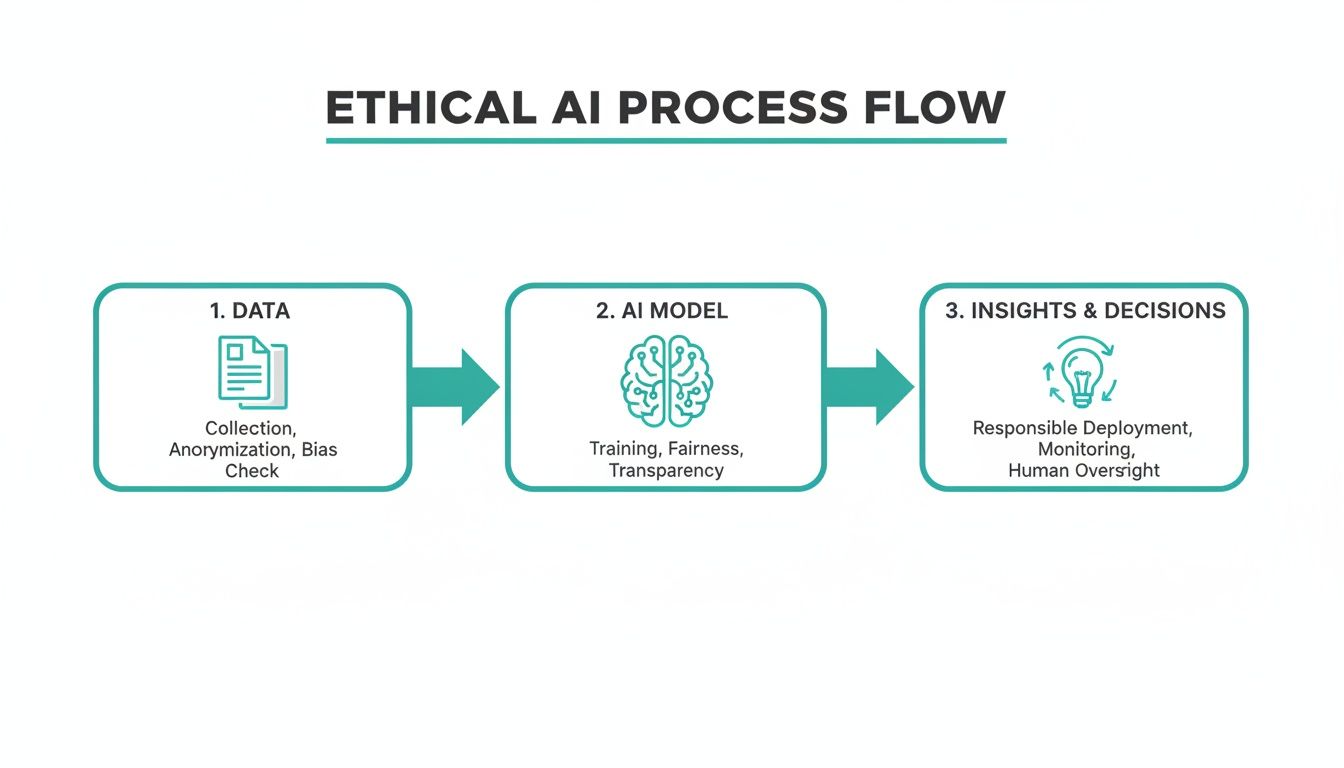
The key takeaway here is that an ethical system is designed to process information methodically. It ensures that human-led decisions are based on objective intelligence, not speculation.
Integrating a Unified Risk Platform
The right technology is the central nervous system of your proactive framework. An ethical risk platform like E-Commander tears down the dangerous information silos where risks fester unnoticed. It plugs into your existing workflows to provide a single, unified view of human-factor risk.
This integration is crucial for managing today’s complex regulatory landscape. The reality is that compliance complexity is through the roof. A recent report found that a staggering 85% of compliance leaders globally have seen an increase in complexity, and 82% of companies are planning to boost their tech investments just to keep pace.
In fact, 2025 will be the first year that a majority of organizations have deployed specialized platforms to manage their ethics and compliance programs. This trend hammers home the urgent need to ditch reactive investigations and embrace proactive, intelligence-led risk management.
The purpose of a unified platform is not to automate ethical decisions but to provide the objective, comprehensive intelligence needed to make better, faster, and more consistent human decisions that reduce business liability.
Defining Risk Tolerance and Key Performance Indicators
Finally, a proactive framework demands that you define what you’re looking for and how you’ll measure success. Your organization must establish its risk tolerance—the specific thresholds and combinations of behaviors that cross the line into an unacceptable level of human-factor risk.
Once that's defined, you can set clear Key Performance Indicators (KPIs) to track program effectiveness. These metrics go beyond just counting incidents; they focus on the leading indicators of organizational health.
Examples of Proactive KPIs:
Reduction in Time-to-Mitigation: Measuring how quickly your team can address identified systemic risk patterns.
Decrease in Policy Violations: Tracking a measurable drop in specific types of non-compliance over time.
Improved Employee Sentiment: Correlating a stronger ethical framework with higher scores in employee engagement surveys.
By establishing this clear, actionable, and measurable framework, you transform ethics from a passive policy document into an active, strategic function that protects your business from the inside out.
Achieving True Organizational Integrity
The path to real organizational integrity isn’t paved with fear, surveillance, or frantic after-the-fact investigations. It’s built on a proactive foundation of ethics that respects your employees while fiercely protecting the business from human-factor risk.
For far too long, companies have been trapped in a reactive cycle, treating internal risk like a fire to be put out, not a condition to be prevented. This old model isn't just inefficient—it's a massive ethical and financial liability waiting to happen.
True integrity is what happens when a company commits to finding and fixing the root causes of human-factor risk before they turn into crises. This demands a fundamental shift: away from the failed methods of monitoring and policing, and toward a new standard of non-intrusive, AI-driven prevention. It means giving your leadership the objective intelligence they need to build a culture of resilience, not suspicion.
Your Partner in Proactive Prevention
For Chief Risk Officers, HR leaders, and Legal Counsel, the choice is clear. Sticking with a reactive posture leaves your organization open to crippling financial penalties, operational chaos, and reputational ruin.
Logical Commander offers a different path forward. Our E-Commander platform is the essential tool for any enterprise serious about protecting its assets, its reputation, and its people through ethical means.
We deliver the EPPA-aligned, non-intrusive technology that empowers you to build a more resilient, compliant, and principled organization. This isn't about replacing human judgment. It's about augmenting it with unparalleled, systemic insight to prevent liability.
The ultimate measure of organizational integrity is not how it punishes failure, but how it builds the framework to prevent it. Now is the time to shift from reacting to risk to preempting it.
This is an invitation to experience the new standard in internal threat prevention. The moment has come to stop chasing yesterday’s problems and start building a stronger, more ethical future for your company. By moving from a reactive stance to proactive prevention, you empower your organization to operate with true integrity.
Your Questions on Proactive Ethics, Answered
Making the switch to a proactive model for internal risk management is a big step. It’s natural for leaders in Legal, HR, and Compliance to have questions about how this new standard works in the real world while protecting the company’s ethics and bottom line. Let's tackle some of the most common ones.
How Can an AI Platform Detect Risk Without Employee Surveillance?
This is the most important question, and the answer gets to the heart of our philosophy. Our platform doesn't monitor employee communications, track keystrokes, or use any form of surveillance. Period.
Instead, our E-Commander / Risk-HR technology analyzes anonymized, aggregated data focused on operational patterns and known risk precursors. The AI is trained to spot systemic anomalies and correlations that point to potential human-factor risks, flagging them for review without digging into an individual employee's private activities. The goal is to understand and mitigate organizational risk, not to police your people.
Is Your Platform Difficult to Integrate with Existing Systems?
Not at all. E-Commander was designed from the ground up to be a seamless operational layer, not another siloed tool. It plugs into your existing systems of record, like your HRIS and GRC platforms, unifying your risk intelligence.
Our implementation team ensures the deployment is smooth and enhances your current workflows. It breaks down the data walls between HR, Legal, and Security, giving everyone a single, reliable source of truth for managing internal risk.
How Does This Approach Support a Positive Workplace Culture?
A proactive, ethical approach is the foundation of a healthy culture. When you focus on prevention and completely reject invasive methods like surveillance or lie detection, you're sending a powerful message of respect to your employees.
This model shifts the entire conversation from the negative goal of 'catching bad actors' to the positive one of 'protecting our collective integrity.' It safeguards the entire workforce from the fallout of major ethical failures—like financial loss and reputational hits—and ensures that any actions taken are based on fair, objective, and consistent data.
A proactive culture built on ethics moves away from a foundation of suspicion and toward one of shared responsibility for the organization's health and resilience.
What is the Primary Benefit of Joining the PartnerLC Program?
Our PartnerLC program is built for B2B consultants, resellers, and service providers who want to bring their clients the new standard in ethical risk management.
Partners get access to our EPPA-aligned, AI-driven platform, which lets them expand their service offerings and open up new revenue streams. You can offer a unique solution that solves critical client needs in compliance and HR without the massive legal risks that come with surveillance tech. It’s a chance to become a leader in the future of ethical risk prevention.
Ready to establish a new standard for ethical risk management in your organization? At Logical Commander Software Ltd., we provide the tools to proactively protect your business without compromising your values.
Request a personalized demo to see our E-Commander platform in action.
Join our PartnerLC program to deliver next-generation solutions to your clients.
Contact our enterprise team to discuss a deployment tailored to your specific needs.