%20(2)_edited.png)

A Guide to Human Capital Risks and How to Stop Them

Updated: Dec 18, 2025
Let's get one thing straight: the threats your people pose to your business—from an employee taking confidential data to a competitor to a critical skills gap on a key team—are not just "HR issues." They are serious business liabilities that directly impact your bottom line and reputation.
Treating these human capital risks as isolated personnel problems is an outdated and dangerous blind spot. It ignores the reality that human actions, or even a lack of action, are at the core of most major business failures, including compliance penalties, data breaches, and internal fraud. Legal, Compliance, and Security teams are left cleaning up the mess, dealing with financial losses, operational chaos, and reputational damage that can take years to repair. The entire threat landscape starts and finishes with humans; technology is merely the tool.
Reframing Human Capital Risks as Business Liabilities
For too long, companies have focused their risk management playbooks on external hackers or technical glitches, completely overlooking the human element. This is a critical mistake. Every single person in your organization, from the C-suite to the front lines, is either a potential point of failure or your strongest line of defense.
Understanding and proactively managing these risks isn't just a good idea anymore; it's a fundamental part of modern corporate governance and building a truly resilient organization.
The Shift from Reaction to Prevention
The old way of dealing with human-factor incidents was to wait for something to go wrong and then launch a disruptive, expensive investigation. This approach is fundamentally broken because by the time you're investigating, the damage is already done. This reactive model fails to prevent the next incident and often creates a culture of distrust.
Modern regulations, like the Employee Polygraph Protection Act (EPPA), demand a far more ethical and proactive strategy. The new standard isn't about invasive surveillance or assigning blame; it's about prevention.
It’s no surprise that global surveys consistently place human capital risks at the top of the list of threats facing businesses, right alongside technological disruption. The 2025 Global Risks Report, which gathered insights from over 900 experts, puts human capital front and center with cybersecurity concerns, especially as AI adoption explodes. The report projects that the perceived risk from digital disruption will jump from 39% to 59% in just three years, showing just how intertwined technology and workforce dynamics have become. You can explore the full findings of the global risk landscape for a deeper look.
Shifting your perspective from reactive forensics to proactive prevention is the single most effective way to protect your organization. It's about ethically and non-intrusively identifying risk indicators before they escalate into full-blown crises.
An effective strategy needs a framework that can:
Identify potential risk indicators without resorting to invasive surveillance or monitoring.
Provide objective, data-driven insights that empower decision-makers to act early.
Align with strict ethical and legal standards like EPPA, preserving employee dignity.
This preventive mindset is about much more than just managing people. It's about protecting the entire enterprise from human-factor threats.
Reactive vs Proactive Human Risk Management
The difference between old, reactive methods like surveillance tools and a modern, proactive strategy is night and day. One approach costs you money, time, and trust, while the other builds resilience and protects your bottom line, setting a new standard for internal risk management.
Aspect | Reactive Approach (The Old, Broken Way) | Proactive Approach (The New Standard) |
|---|---|---|
Timing | Post-incident investigations and forensics | Continuous, real-time analysis of risk indicators |
Focus | Assigning blame and gathering evidence | Understanding behavioral patterns and preventing escalation |
Cost | High costs (legal fees, fines, remediation) | Lower, predictable investment in preventive tech |
Culture | Fosters a culture of fear and distrust | Builds a culture of integrity and accountability |
Data | Siloed, incomplete information after the fact | Unified, contextual insights for early intervention |
Compliance | High risk of violating standards like EPPA | Designed to be compliant with privacy regulations |
Ultimately, a proactive approach doesn't just catch problems earlier; it fundamentally changes how an organization views and manages its most valuable asset—its people. It transforms risk management from a necessary evil into a strategic advantage.
Spotting Your Biggest Human Capital Vulnerabilities
If you want to get a handle on human capital risks, you have to know where they’re hiding first. These aren't just vague, abstract concepts; they are specific, real-world behaviors that create massive liabilities for your business. Pinpointing them is the first step toward building a defense that actually works.
These risks are so much more than simple employee mistakes. We’re talking about actions—both intentional and accidental—that can expose your company to serious financial, operational, and reputational damage. Unlike an external attack on your firewall, these vulnerabilities come from the inside, often armed with legitimate access and internal know-how.
Common Hotspots for Human-Centric Risk
While the scope of human capital risk is wide, most incidents bubble up from a few key areas. Each one represents a blind spot that traditional security tools, which are built to look outward, are completely unprepared to handle.
Data Exfiltration and Misuse: This is all about employees taking sensitive company information where it doesn't belong. It could be a salesperson emailing a client list to their personal account before they quit, or someone mishandling confidential data because they weren't trained properly. The business impact includes competitive disadvantage and regulatory fines.
Intellectual Property (IP) Theft: For tech and R&D companies, this is a killer. It can be as blatant as a departing engineer walking out the door with proprietary code or as subtle as a sales director taking strategic marketing plans with them to a competitor. The liability is a direct loss of market value.
Internal Fraud: This bucket covers everything from someone fudging their expense reports and procurement scams to far more complex financial schemes. These actions hit the bottom line directly and can go undetected for months, if not years, creating significant financial liability.
Compliance and Policy Breaches: When employees ignore established rules, it can trigger huge regulatory fines and legal battles. Think of a trader violating financial regulations or a manager who decides to bypass mandatory safety checks to save time. This leads to legal exposure and reputational harm.
This concept map shows exactly how these human-driven risks splinter off into real-world damage across the entire business.
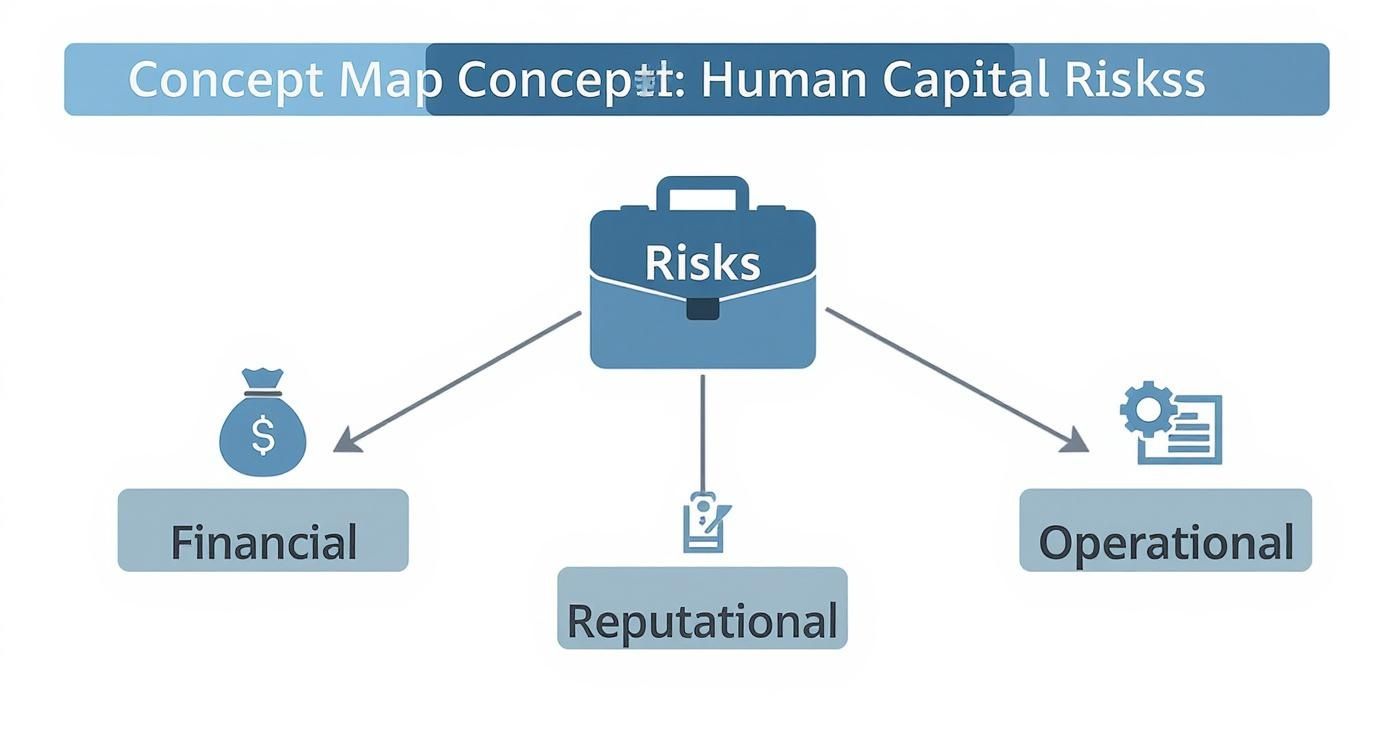
As the visual makes clear, a single human-related incident is never just a single incident. It branches out, touching every critical part of the organization.
The Ripple Effect of a Single Incident
The consequences of these vulnerabilities almost always stretch far beyond the initial event. A single compliance breach can kick off audits and legal fights that drain your resources for years. In the same way, the theft of intellectual property isn’t just a data loss; it can completely wipe out your competitive edge.
The core issue here is that these are human problems, not technology problems. Technology might be the tool, but the intent, the negligence, or the mistake starts with a person. This is exactly why standard security defenses so often fail to stop threats from within.
Tackling these vulnerabilities demands a different, more specialized approach. To dig deeper into this, check out our guide to proactive internal threats assessments. A modern framework doesn’t just react; it focuses on identifying the behavioral warning signs of risk—ethically and non-intrusively—before an incident happens. This allows Compliance, Legal, and HR teams to step in early, shifting from a costly, reactive investigation model to one built on prevention and resilience. This is the new standard in ethical risk management.
How the Skills Gap Creates Hidden Dangers

That ever-widening gap between the skills your people have and the skills your business actually needs? It's one of the most insidious human capital risks out there. This isn't just about sluggish productivity or missing out on a new market. It’s a direct line to security failures, compliance breaches, and operational meltdowns that create significant business liability.
When teams are stretched thin, undertrained, or just plain overwhelmed by new tech, they’re far more likely to make critical mistakes. These aren't malicious acts. They’re honest errors born from a lack of preparedness, but the fallout can be just as catastrophic.
And this problem is getting worse, fast. A recent World Economic Forum report found that the core skills of 44% of workers are set to be disrupted by 2027. This gap is most dangerous in high-stakes fields like AI, analytics, and data security, where an undertrained employee can accidentally open a door to massive damage.
The Connection Between Skill Gaps and Business Liability
Under-skilled employees don't just work a little slower; they create real, tangible liabilities that land squarely on the desks of legal and compliance teams. The hidden dangers go way beyond simple performance metrics.
These vulnerabilities pop up in a few critical ways:
Compliance Violations: An employee who doesn’t grasp the fine print of regulations like GDPR or HIPAA can mishandle sensitive data without even realizing it, triggering massive fines and legal headaches.
Data Breaches from Human Error: Lacking proper security training, someone might fall for a phishing scam or improperly configure a cloud server, creating a major security incident.
Operational Failures: When your team isn't skilled enough to run new machinery or software, you're looking at production shutdowns, safety incidents, and downtime that bleeds money.
A skills gap isn't a training issue—it's a core business risk. Every unaddressed knowledge deficit is a potential point of failure just waiting for a trigger, turning a preventable problem into a full-blown crisis.
Turning Skill Gaps into a Strategic Advantage
The only way to deal with this risk is to get out ahead of it. Waiting for an incident to expose a skills gap means the damage is already done. The real key is spotting these vulnerabilities before they can be exploited.
This is where a proactive framework is essential. By assessing your workforce ahead of time, you can pinpoint the exact teams or departments where skill shortfalls pose the biggest threat. Using a [skills gap analysis template for strategic growth](https://aidarsolutions.com/skills-gap-analysis-template/) is a smart way to identify and tackle these deficiencies before they become hidden dangers.
This kind of foresight allows you to make targeted investments in training that directly defuse your most significant human capital risks. It flips the script, turning the skills gap from a hidden danger into a chance to build a more resilient, capable, and secure workforce.
Why Traditional Investigations Don't Stop the Next Threat
For decades, the go-to response for any suspected internal wrongdoing has been the same: launch a reactive investigation. While sometimes necessary, this model is a fundamentally broken risk management strategy. Why? Because by the time you kick off an investigation, the damage is already done.
Whether it's stolen data walking out the door, a major compliance breach, or a direct financial hit, the incident has already happened. The liability is already on your books.
This reactive approach isn’t just late; it’s an expensive and disruptive one. Investigations pull your best people away from their real jobs, injecting a culture of suspicion and fear. Meanwhile, the legal and forensic bills start piling up. It’s a costly cleanup operation, not a strategy for prevention. The whole point becomes assigning blame after the fact, which does nothing to fix the underlying weaknesses that let the problem happen in the first place.
The High Cost of Looking Backward
Post-incident forensics treats human capital risks like a crime scene, focusing on gathering evidence after the mess has been made. It’s an inherently adversarial process that can drag your organization into a legal minefield, especially with intrusive methods like surveillance that violate employee privacy.
The core issue is that investigations don't actually reduce future risk. They're a backward-looking exercise that offers painful lessons but zero forward-looking protection.
Relying on investigations as your main defense against internal threats is like waiting for a house fire to install smoke detectors. It’s an expensive, disruptive, and ultimately ineffective way to protect your business.
Shifting from Forensic Reaction to Proactive Prevention
A modern, effective strategy has to pivot from reaction to prevention. Instead of waiting for an alarm to go off, you need a system that can ethically and non-intrusively spot risk indicators before they spiral out of control. This proactive stance is the new standard in real risk management.
Just look at the shortcomings of the old reactive model:
It Kills Productivity: Investigations bring critical operations to a grinding halt, forcing teams to shift from driving the business forward to managing the damage.
It's a Legal Nightmare: Trying to navigate employee rights and privacy laws during an investigation is incredibly tricky and can easily spark new legal challenges.
It Damages Trust: The moment word of an investigation gets out—internally or publicly—it can crush morale and erode the trust of your employees and stakeholders.
You Never Get the Full Story: Investigators are often working with scattered pieces of information, making it nearly impossible to see the big picture or stop it from happening again.
By identifying behavioral risk indicators early, organizations can step in before a simple policy violation turns into a full-blown crisis. You can learn more by exploring the true cost of reactive investigations and see why a preventive framework is far superior. This approach protects the business without resorting to the intrusive and legally risky methods of the past, aligning with EPPA standards and preserving employee dignity.
Burnout and Disengagement as Silent Risk Multipliers
Not all threats come from malicious actors or obvious skill gaps. Some of the most dangerous human capital risks are the quiet ones that fester in a negative workplace environment. Employee burnout, chronic disengagement, and a toxic culture don't just kill morale; they act as silent risk multipliers, paving the way for costly errors and compliance failures.
When your team is running on empty, feeling unsupported, or just plain checked out, their attention to detail is the first thing to go. They’re far more likely to sidestep a crucial security protocol to save a few minutes, miss the obvious warning signs in a phishing email, or make a simple mistake that spirals into a major data breach. This isn't deliberate sabotage—it's the completely predictable result of a workforce pushed past its limit, creating clear business liabilities.
The Business Impact of a Disengaged Workforce
From a risk management standpoint, a disengaged employee is a walking vulnerability. Their weak connection to the company’s mission and values naturally translates into a weaker commitment to its policies and procedures. This creates the perfect breeding ground for both accidental and intentional risks to take root.
This isn't a small problem. A staggering 59% of employees across the globe report feeling disengaged at work. This massive disconnect is often fueled by a poor work-life balance and a lack of psychological safety, which in turn leads to high turnover and sinking productivity.
A negative environment also makes people more susceptible to outside manipulation, like social engineering attacks, or internal pressures that can lead to unethical choices. In short, a poor culture directly eats away at your security and compliance posture from the inside out.
Ignoring employee well-being isn't just a leadership failure; it's a critical oversight in risk management. A burned-out workforce is an exposed workforce, and the resulting liabilities fall directly on legal, compliance, and security teams.
Proactively Addressing Cultural Risks
Tackling these cultural risks demands a proactive game plan, not a reactive cleanup. The first step is to explore practical strategies for overcoming burnout and implement measures that strengthen your human firewall.
A complete strategy also means digging into the root causes of disengagement. You can learn more about effective tools to boost employee engagement and build a more resilient culture. By focusing on the human factors fueling these vulnerabilities, you can turn what was once a major liability into a source of organizational strength and stability.
Adopting an AI-Driven Preventive Framework

The old model of waiting for damage and then launching a costly investigation is broken. It’s a reactive approach in a world that demands proactive defense. Leading organizations are making a fundamental shift, moving away from after-the-fact cleanups to a modern standard of prevention powered by AI.
This new framework is all about identifying behavioral risk indicators before they spiral into serious incidents. It’s a move from defense to offense.
Let’s be clear: this is not surveillance. An ethical, EPPA compliant platform delivers objective, data-driven insights without intrusive monitoring. It’s designed to preserve employee dignity and trust, not destroy it. The goal is to arm decision-makers in Compliance, Legal, and HR with the contextual intelligence they need to intervene early, rather than forcing them to work off assumptions after the damage is done.
The Shift to Ethical AI Human Risk Mitigation
Your traditional security tools were built to stop attacks from the outside. They’re gatekeepers, not detectives. This leaves them completely blind to the subtle behavioral patterns that signal an internal threat is brewing.
An AI-driven system is designed to fill that critical gap. It analyzes behavioral data patterns to flag potential risks that could signal anything from fraud and IP theft to major compliance breaches. The system doesn't need to read private content or monitor screens; it just needs to spot the anomalies in activity.
The whole point is to give leadership a clear, objective view of potential human-factor risk across the entire enterprise. It allows you to move from a defensive, reactive posture to a strategic, preventive one. We explore this in our comprehensive [guide to AI-powered human risk management](https://www.logicalcommander.com/post/a-guide-to-ai-powered-human-risk-management).
The new standard in managing human capital risks is not about catching people doing wrong. It's about creating an environment where risks are identified and mitigated ethically, protecting the organization and its people before damage occurs.
Ethical Prevention vs Invasive Monitoring
It is absolutely critical to understand the difference between an ethical, AI-driven prevention platform and older surveillance tools. One builds organizational resilience through intelligence; the other creates enormous liability through intrusion. For governance and compliance leaders, the choice is clear.
Here’s a direct comparison of the two approaches.
Feature | Logical Commander (The New Standard) | Traditional Surveillance (The Old, Broken Way) |
|---|---|---|
Methodology | Analyzes behavioral risk indicators non-intrusively | Actively monitors employee communications and activity |
Compliance | Designed to be fully EPPA-aligned and ethical | Carries a high risk of violating labor laws and privacy regulations |
Focus | Proactive risk identification and prevention | Reactive evidence gathering for post-incident investigations |
Employee Impact | Preserves trust and focuses on organizational integrity | Creates a culture of suspicion and erodes employee morale |
Output | Delivers objective, actionable intelligence to leadership | Generates vast amounts of data requiring manual review |
By making the switch to an AI-driven preventive framework, organizations can finally get a handle on their human capital risks. You can protect your reputation and uphold the highest standards of corporate governance—all without compromising on ethics or trust.
Your Questions Answered: Human Capital Risks & Proactive Defense
When we start talking about a modern, proactive approach to human capital risks, it's natural for leaders in compliance, legal, and HR to have some sharp questions. Let's tackle the most common ones head-on.
How Is This Different From Our Standard HR Analytics?
That's the million-dollar question. Standard HR analytics are great for tracking operational health—things like turnover rates or time-to-hire. They tell you what’s happening in your workforce.
But an AI-driven human risk platform is built for an entirely different purpose: protecting the entire enterprise from liability. It's designed to spot the behavioral red flags tied to serious business liabilities like fraud, compliance violations, or IP theft. Think of it as moving from personnel management to enterprise protection.
Is This Platform EPPA Compliant?
Absolutely, and this is non-negotiable. A modern, ethical platform for managing human capital risks is built from the ground up to be fully EPPA compliant.
It’s crucial to understand this isn't surveillance. We're not talking about lie detectors, psychological pressure, or secret monitoring. The system works by analyzing behavioral metadata—the patterns of activity, not the content—to flag potential risks without being intrusive. It’s about protecting the organization while always upholding employee dignity.
Why Not Just Stick With Internal Investigations?
Relying only on internal investigations means you’re always playing catch-up. By the time an investigation kicks off, the damage—whether financial or reputational—is already done. It’s a reactive, costly, and disruptive model that does little to stop the next incident from happening.
A proactive AI framework flips the script. It identifies risk indicators before they escalate into a crisis, giving you the chance to intervene early. This shift from reaction to prevention is the new standard for effective governance and ethical risk management, protecting your bottom line by solving problems before they begin.
Ready to move from reactive investigations to proactive prevention? Logical Commander offers an EPPA-aligned, AI-driven platform that sets a new standard for managing human capital risks ethically and effectively. Our Risk Assessments Software, E-Commander, provides the intelligence you need to protect your organization from internal threats.
[Request a demo to see our platform in action](https://www.logicalcommander.com) and get a free trial.
[Join our PartnerLC program to become an ally](https://www.logicalcommander.com) and grow with us.
Contact our team to discuss an enterprise deployment tailored to your needs.