%20(2)_edited.png)

A Practical Guide to Compliance and Risk Assessment

Think of your organization as a ship sailing through unpredictable waters. Compliance and risk assessment are your map and your lookout crew, working together to spot the icebergs—regulatory storms, internal hazards, and digital threats—long before they can cause a crisis. This guide isn't about just ticking boxes; it's about building a strategic framework for genuine resilience.
Navigating Risk in the Modern Business Landscape

In today's business world, risk isn’t just a possibility; it's a constant. From ever-changing regulations to sophisticated cyberattacks and internal misconduct, the challenges are relentless. A reactive approach—simply waiting for problems to happen—is a surefire way to invite financial loss, reputational damage, and operational chaos.
The only sustainable solution is a proactive strategy built on a solid compliance and risk assessment framework. This means getting rid of scattered spreadsheets and disconnected email chains. The goal is to create an intelligent, unified system that lets you anticipate threats and protect your organization from the inside out.
The Growing Complexity of Compliance
The pressure to maintain compliance has never been higher. A recent study by PwC puts this into sharp focus, revealing that regulatory demands are surging across every industry. Their 2025 Global Compliance Survey found that nearly 90% of organizations face negative impacts on their IT systems because of this growing complexity.
A staggering 85% confirmed that compliance requirements have become far more demanding over the last three years. This isn't just an annoyance; it's driving major investments, with 75% of companies increasing their spending on risk assessment just to keep up.
This environment requires more than simple awareness. It demands a structured methodology to identify, analyze, and neutralize potential harm before it happens. An effective program turns abstract rules into a concrete competitive advantage.
From Silos to Synergy
One of the biggest failure points in traditional risk management is the silo effect. When HR, Legal, Security, and Compliance teams all operate in their own bubbles, critical information gets lost in the gaps. Each department might hold one piece of the puzzle, but without a shared view, the full picture of an emerging threat never comes into focus.
A modern approach tears down these walls. It fosters a culture of shared ownership and gives all stakeholders a common operational language to work from. This is where a centralized platform becomes absolutely essential.
Single Source of Truth: It consolidates all risk-related data, documentation, and communication in one secure place, eliminating confusion and version control nightmares.
Enhanced Collaboration: Teams can work together seamlessly, ensuring that insights from one department directly inform the actions of another.
Improved Visibility: Leadership gets a real-time, comprehensive view of the organization's risk posture, enabling sharper, better-informed strategic decisions.
By unifying these disparate functions, an organization transforms risk management from a series of disconnected tasks into a cohesive and powerful strategy. This unified approach is the foundation for building long-term resilience and trust.
Ultimately, a strong compliance and risk assessment program is about protecting your most valuable assets: your people, your reputation, and your future. For a deeper dive, you can learn more about building a comprehensive enterprise risk management strategy.
Understanding Core Compliance Frameworks and Methods
To navigate the complex world of risk, you need reliable blueprints. Compliance frameworks aren't just bureaucratic hurdles; they're the architectural plans for building a secure and resilient business. Think of them as the building codes for your company—they ensure that everything from data security to internal investigations is constructed on a solid foundation.
These frameworks give you a structured way to manage specific types of risk. For instance, ISO 27001 is the global gold standard for information security management. It helps you protect sensitive data, like customer information or intellectual property, by laying out a systematic process for identifying, managing, and shutting down cybersecurity threats.
In the same vein, ISO 37003 provides clear guidance for conducting internal investigations. This framework ensures that when a potential issue arises—like misconduct or a policy violation—it’s handled fairly, consistently, and effectively, protecting both the organization and its employees.
Differentiating Key Regulations and Frameworks
While frameworks provide guidance, regulations are the legally binding rules you have to follow. The General Data Protection Regulation (GDPR) is a perfect example. Enforced by the European Union, it sets strict requirements for how organizations collect, store, and process the personal data of EU citizens. Get it wrong, and you could be facing fines totaling millions of dollars, making it a critical focus for any global business.
Beyond these well-known standards, modern businesses must navigate a whole new set of legal mandates. This includes understanding very specific rules like the various pay transparency laws by state, which create fresh compliance obligations for hiring and compensation. A strong compliance and risk assessment program has to account for this entire spectrum of rules.
To turn these abstract requirements into a concrete strategy, it’s essential to master different risk analysis methods. You can learn more about how all these pieces fit together by exploring a dedicated compliance risk management framework.
Choosing Your Assessment Method: Qualitative vs. Quantitative
Once you’ve identified potential risks, you need to analyze them. This is where two distinct methods come into play: qualitative and quantitative analysis. Each offers a different lens through which to view a potential threat.
A qualitative risk assessment uses descriptive scales to rank risks. It focuses on categorizing the likelihood and impact of a risk as "high," "medium," or "low." This method is more subjective but it's fast, making it perfect for quickly prioritizing a long list of potential threats without getting bogged down in complex calculations.
On the other hand, a quantitative risk assessment assigns a specific monetary value to risks. It uses historical data and statistical models to answer questions like, "What is the probability of a data breach in the next year, and exactly how much would it cost us?" This approach is objective and data-driven, but also more time-consuming.
The choice between qualitative and quantitative analysis isn't about which is better; it's about which is more appropriate for the situation. Often, the most effective approach combines both, using qualitative analysis for initial triage and quantitative analysis for the highest-priority risks.
Let's make this real. Imagine a tech company is launching a new mobile app that collects user data.
A Real-World Example
The company's risk team starts with a qualitative assessment to quickly map out the threats.
Risk: A potential data breach.
Likelihood: They rank this as "High" due to the sensitivity of the data and the app's public-facing nature.
Impact: They also rank this as "High" because a breach would lead to regulatory fines, customer distrust, and severe brand damage.
This initial assessment immediately flags the data breach risk as a top priority. Now, the team drills down with a quantitative approach. They analyze industry data on similar breaches and calculate that a significant incident has a 20% chance of occurring in the first year, with a potential financial impact of $2.5 million in fines, legal fees, and customer churn.
That specific number gives executives a clear, tangible understanding of what's at stake. Armed with this combined insight, they can make an informed decision to invest in advanced encryption and security measures, guided by the ISO 27001 framework. This process transforms abstract rules into a powerful, data-backed business strategy, turning compliance from an obligation into a real competitive advantage.
Your Step-by-Step Guide to Executing a Risk Assessment
Knowing the theory is one thing, but putting it into action is what really separates a successful compliance and risk assessment program from an academic exercise. This section is your blueprint for a repeatable, five-stage process. Think of it like a detective’s methodical approach to solving a case—each step builds on the last, making sure no clue gets overlooked.
A structured process like this is how you move from just talking about frameworks to applying them consistently and effectively.
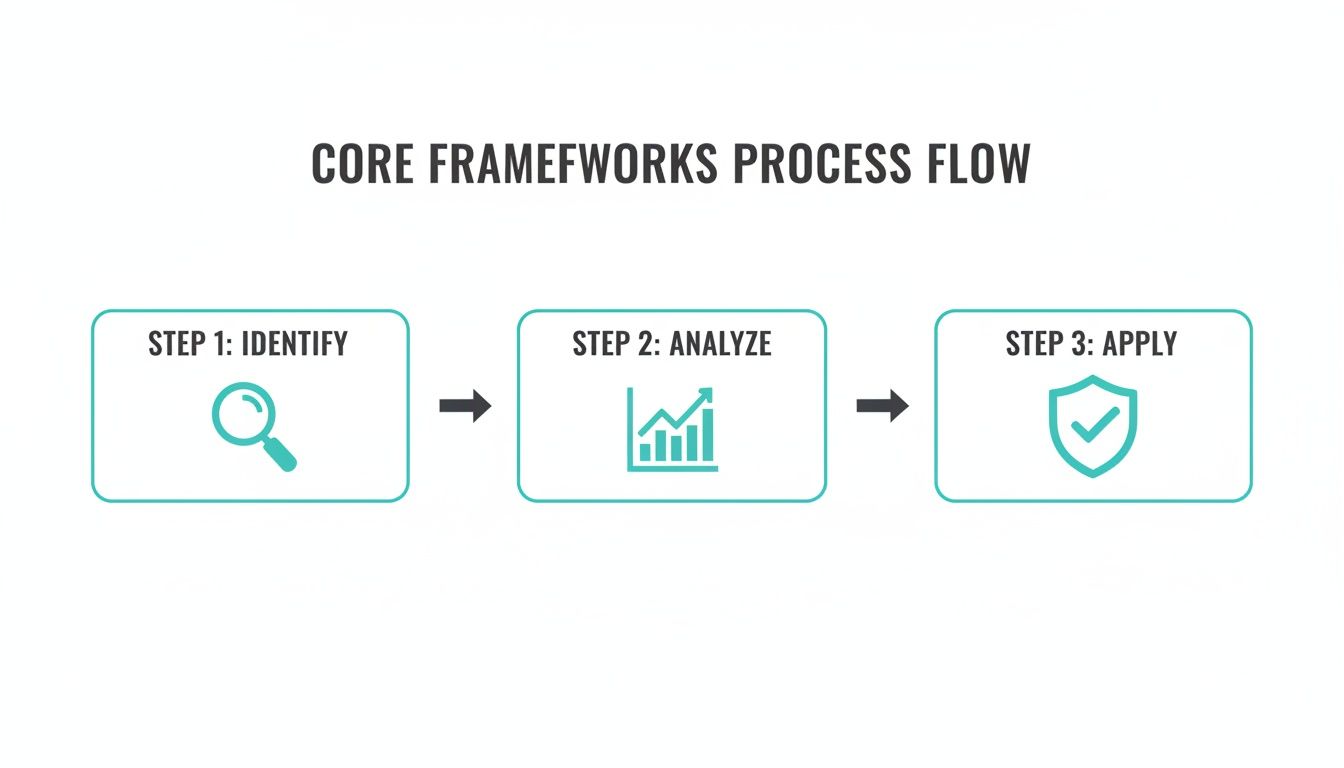
This flow—from spotting threats to understanding their impact and finally applying controls—is the backbone of any solid risk management strategy.
Step 1: Identify the Risks
Your first move is pure reconnaissance. The goal here is to create a complete, no-holds-barred list of every potential risk that could hit your organization. This isn't the time to judge or prioritize; it's all about thorough discovery.
To do this right, you need to look at the business from every angle. Dig into your internal processes, put your technology stack under a microscope, and don't forget the human element. Brainstorming sessions with key people from different departments—think HR, Legal, and IT—are invaluable here. They bring perspectives you’d never see on your own.
Step 2: Analyze the Risks
Once you've got your list, it's time to figure out what you're really dealing with. This step is all about analyzing the nature of each risk, pinpointing its potential causes and its likely consequences. You’ll determine the likelihood of each risk actually happening and the potential impact it would have if it did.
A risk assessment matrix is a fantastic tool for this stage. It helps you visually map out each risk on two simple axes: probability and severity. This exercise transforms a long, messy list into a categorized inventory of threats, giving you a clear snapshot of your risk landscape.
Step 3: Evaluate and Prioritize
Let's be honest: not all risks are created equal. With your analysis done, you can now decide which ones demand your immediate attention. A risk with a high likelihood and a catastrophic impact, like a major data breach, is obviously going to jump to the front of the line, way ahead of a low-impact, low-probability event.
This prioritization is everything. It’s how you allocate your limited resources—time, money, and people—to the threats that pose the greatest danger to your business. To really nail this, you might consider using a few structured problem solving techniques to work through the most complex challenges methodically.
A common mistake is treating all risks with the same urgency. Effective prioritization is the difference between a team that is constantly fighting fires and one that is strategically preventing them.
Step 4: Treat the Risks
With your priorities straight, it's time for action. "Treating" a risk simply means coming up with a plan to deal with it. Generally, you have four main options on the table:
Avoidance: Deciding to sidestep the activity creating the risk altogether. Think not launching a new product in a particularly volatile market.
Mitigation: Putting controls in place to reduce the risk's likelihood or impact, like installing new security software or updating a policy.
Transference: Shifting the financial fallout of a risk to someone else, most commonly through an insurance policy.
Acceptance: Looking a risk square in the eye and deciding that the cost of fighting it outweighs the potential damage.
Your choice of treatment will depend entirely on your organization’s risk appetite and strategic goals.
Step 5: Monitor and Review
Finally, remember that risk management isn't a "one-and-done" project. It’s a continuous cycle. The business world is always shifting, with new regulations, technologies, and threats popping up all the time.
You need to set up a regular schedule to review your risk assessments, check if your controls are still effective, and scan the horizon for any new dangers. This is where a modern, centralized platform really shines, replacing chaotic spreadsheets with a single source of truth that makes every step auditable and fosters genuine collaboration. This ongoing vigilance ensures your compliance and risk assessment program stays relevant and effective year after year.
The Human Element in Your Risk Management Program

You can have the best frameworks and the smartest technology, but a compliance and risk assessment program lives or dies by its people. It’s the human element—your teams, their shared culture, and how they work together—that actually breathes life into a strategy. When departments hoard information and operate in isolation, even the most brilliant plans are doomed.
The truth is, risk doesn’t care about your org chart. A potential data privacy issue isn’t just an IT problem. It’s a legal liability, an HR headache involving employee records, and a major security threat all rolled into one. If these teams aren’t talking, they’re all staring at disconnected pieces of a much bigger, and much uglier, puzzle.
Defining Roles and Responsibilities
For any program to have teeth, every key department needs clear ownership. Ambiguity is the enemy of action. Without it, critical tasks fall through the cracks and accountability simply dissolves into finger-pointing when things go wrong.
Here’s how responsibilities typically break down:
Human Resources (HR): At the frontline of culture, HR owns risks tied to employee conduct, workplace integrity, hiring practices, and policy training. They are the first line of defense in building an ethical workplace.
Legal and Compliance: These are the guardians of the company’s legal standing. They navigate the ever-changing regulatory landscape, interpret new laws, and make sure internal policies meet all required standards.
Security (IT and Physical): This team is responsible for protecting the company’s digital and physical assets from all threats—internal and external. This includes data breaches, unauthorized access, and insider risks.
When these teams collaborate, they form a powerful, unified defense. When they don’t, the consequences can be devastating.
The Dangers of a Disconnected Culture
Let’s imagine two companies. Company A has a “check-the-box” culture where compliance is just another chore. Its HR, Legal, and Security teams work in silos, rarely sharing what they know. One day, the security team flags an employee for repeatedly trying to access sensitive financial data that has nothing to do with their job.
This is a textbook insider threat indicator. But because there’s no shared language or platform, this crucial alert never makes it to HR, which is currently dealing with multiple complaints about this same person’s erratic behavior. Neither team thinks to loop in Legal. The warning signs, so obvious in hindsight, are completely missed, leading to an internal fraud incident that costs the company millions.
Now, let’s look at Company B. It champions a culture of shared ownership, powered by a unified platform like E‑Commander. When its security team spots the exact same anomalous data access, an alert is automatically shared with both HR and Legal in real-time.
Instantly, every stakeholder has the same structured information. HR can cross-reference the alert with its own records, Legal can assess the potential compliance violations, and together, they can launch a coordinated and fair internal investigation based on objective indicators.
This isn’t just about better software; it’s a fundamentally better, more defensible process. By closing the gaps between departments, Company B turns a potential crisis into a managed event, protecting its assets and reinforcing its ethical culture.
Common Pitfalls That Derail Success
A lack of executive buy-in is another common killer of compliance programs. If leadership treats risk management as a low-priority cost center, that attitude will trickle down and create widespread apathy. Without clear, visible support from the top, teams lack the resources and the authority they need to enforce policies effectively.
In the same way, poor communication can turn a program into a series of frustrating dead ends. When teams use different jargon or track data in separate spreadsheets, getting a clear, holistic view of the organization’s risk posture becomes nearly impossible. A unified platform creates a shared vocabulary and a single source of truth, making effective collaboration the default, not the exception. This collective mission is the true heart of a resilient compliance and risk assessment program.
How Ethical AI Is Shaping the Future of Compliance
The next chapter in compliance and risk assessment isn’t about bigger spreadsheets or more frequent audits. It’s about finally moving from a reactive posture—cleaning up after a crisis—to a proactive one where you can spot trouble brewing before it ever boils over. This shift is being driven by a new generation of ethical AI, built on a philosophy of prevention over punishment.
Think of it like a smoke detector for your organization. It doesn't judge why the smoke is there or who might have started it; it simply alerts you to the presence of an indicator—the smoke—so you can investigate before a fire breaks out. This is the heart of ethical AI in risk management: it focuses on objective, structured signals, not on subjective judgments or invasive surveillance.
This approach is designed from the ground up to sidestep the pitfalls of traditional monitoring tools that create a culture of fear and distrust. Instead of tracking keystrokes or reading private messages, it identifies predefined risk indicators that align with your company's own policies and legal obligations.
Indicators, Not Judgments
The power of this modern approach lies in its precision. It takes scattered, unstructured data from different business systems and turns it into actionable, structured intelligence. It’s not about profiling individuals, but about recognizing patterns of behavior that correlate with known risks.
For example, the system might flag a combination of events:
An employee in a sensitive role suddenly starts working highly unusual hours.
That same employee begins accessing files completely unrelated to their job function.
This activity happens to coincide with their recent resignation.
Viewed in isolation, none of these events is necessarily a problem. But woven together, they form a clear, objective indicator of a potential data exfiltration risk that warrants a timely and fair review. This method gives organizations the power to manage internal risks before they escalate into damaging incidents.
This shift to an indicator-based model is crucial. It provides a defensible, auditable trail based on objective data, empowering HR and Legal teams to act confidently while preserving due process and employee dignity.
The need for these tools has become urgent. According to the 2025 Global Compliance Outlook, a staggering 68% of compliance leaders identify cybersecurity and data privacy as their top challenges. This highlights the intense demand for non-invasive solutions that can detect early signals of insider threats without shattering trust, especially as regulations get tighter. You can check out more insights about these compliance challenges and global trends.
Ethical by Design and Aligned with Regulations
A common myth is that advanced technology and strict privacy regulations are at odds. In reality, ethical AI platforms are purpose-built to coexist with and uphold rules like GDPR and the Employee Polygraph Protection Act (EPPA). They prove that security and privacy aren't mutually exclusive—they can and should reinforce each other.
To understand how, it helps to compare this new standard with the old, invasive model.
Ethical AI vs. Traditional Surveillance Tools
Feature | Ethical AI (Indicator-Based) | Traditional Surveillance |
|---|---|---|
Methodology | Analyzes objective risk indicators based on organizational data. | Monitors employee communications, keystrokes, and web activity. |
Focus | Proactive prevention of policy breaches and misconduct. | Reactive detection of "bad actors" after a violation occurs. |
Employee Impact | Fosters a culture of integrity and psychological safety. | Creates a culture of fear, suspicion, and distrust. |
Legal Standing | Designed to be fully compliant with EPPA, GDPR, and other privacy laws. | High risk of violating employee privacy and labor laws. |
Output | Delivers clear, actionable intelligence to human decision-makers. | Generates massive alert fatigue and countless false positives. |
An "ethical by design" system stands apart because it explicitly prohibits:
Surveillance: No covert monitoring of employee communications or activities.
Profiling: No use of AI to make psychological or behavioral judgments.
Deception: No lie-detector logic or coercive methods.
By sticking rigidly to these principles, the technology becomes a powerful decision-support tool. It presents objective signals to human decision-makers, who then use their professional judgment to determine the appropriate next steps according to established internal governance.
This framework transforms the compliance and risk assessment process. It allows organizations to be proactive and preventive while remaining fully compliant with the world's most stringent privacy laws. You can learn more about how ethical AI enables early internal risk detection while respecting legal boundaries. This approach empowers organizations to protect their assets, their people, and their reputation with integrity.
Your Questions, Answered
When you're trying to build a resilient organization, you're bound to have questions. Let's dig into some of the most common ones we hear from decision-makers trying to get ahead of internal risk without creating a culture of distrust.
Getting clarity on these practical challenges is the first step toward building a program that actually works in the real world. Our goal here is to give you straight answers that reinforce the key takeaways from this guide.
How Often Should We Be Doing a Risk Assessment?
There's no magic number that fits every business, but the gold standard is to run a comprehensive, enterprise-wide risk assessment at least once a year. This gives you that crucial top-down view of your entire risk landscape and makes sure your priorities are still pointed in the right direction.
But here's the reality: some risks move a lot faster than your annual calendar. High-stakes areas like cybersecurity or data privacy demand a much closer watch, often requiring quarterly or even continuous reviews to keep up with new threats. The modern way to think about compliance and risk assessment is as a living, breathing process—not a static, check-the-box event.
And remember, your annual schedule goes out the window when certain triggers pop up. You should always kick off a fresh assessment after:
Major Regulatory Changes: A new law like the GDPR or a state-specific mandate is a non-negotiable trigger.
A Significant Security Incident: If you have a breach or a major internal issue, you need to immediately figure out what vulnerabilities allowed it to happen.
Entering a New Market: Launching a new product or expanding geographically brings a whole new world of risks into play.
The most resilient organizations don't just wait for the annual review to change course. They use dynamic platforms that give them real-time visibility into new threats, allowing them to make smart adjustments the moment a risk appears on the horizon.
What’s the Real Difference Between a Risk Assessment and an Audit?
This is a common point of confusion, but the distinction is critical. Think of it this way: a risk assessment and an audit are complementary, but they look in completely different directions.
A compliance and risk assessment is fundamentally proactive and forward-looking. It asks one simple question: "What could go wrong in the future?" The goal is to spot potential problems before they happen so you can build controls to prevent them. It’s like designing a strong fence at the edge of a cliff to stop anyone from falling off.
An audit, on the other hand, is retrospective and backward-looking. Its main question is: "Did we follow the rules in the past?" An audit is all about verifying that the organization stuck to its existing policies and regulations. It’s checking to see if the fence was built to the right specifications and if anyone fell off yesterday. The findings from an audit are incredibly valuable fuel for your next risk assessment, creating a powerful feedback loop for getting better.
How Do We Build a Compliance Program Without Creating a Culture of Fear?
This is absolutely vital. A compliance program rooted in fear is doomed to fail. It just encourages employees to hide mistakes, meaning you won't hear about a serious problem until it's far too late. The key is to shift the entire focus from punitive enforcement to proactive enablement and a strong sense of shared ownership.
First, you have to be crystal clear about the "why." Explain that compliance isn't about catching people doing something wrong; it's about protecting the company, its customers, and every single employee from harm. Frame it as a collective responsibility that makes everyone stronger.
Second, get employees involved in the process. Ask them to help you spot the risks they see every day in their own jobs. They're on the front lines and often know where the real vulnerabilities are. Including them shows you value their expertise and turns compliance from something done to them into something you do with them.
Most importantly, commit to using technology that is ethical by design. Steer clear of invasive surveillance tools that create a "Big Brother" atmosphere and destroy psychological safety. Instead, adopt platforms that focus on objective, structured indicators of risk—not on personal judgments or behavioral profiling. This approach builds trust from the ground up and proves the program is there to prevent and support, not to punish.
At Logical Commander Software Ltd., we believe you can build a resilient organization without sacrificing trust. Our E-Commander platform is engineered to identify early risk signals using an ethical, indicator-based approach that respects employee privacy and dignity. Instead of reacting to crises, empower your teams to proactively manage risk while fostering a culture of integrity.
Discover how to protect your organization from the inside out by visiting https://www.logicalcommander.com.