%20(2)_edited.png)

Enterprise Risk Management Business A Strategic Growth Guide

Updated: Feb 9
For too long, enterprise risk management has been stuck in the basement, treated like an insurance policy you only think about when something’s on fire. Traditional risk management was the fire department—great at putting out blazes, but only showing up after the damage is done.
Modern ERM is something else entirely. It's the architect who designs the fire-proof building from the ground up, weaving safety and resilience right into the company's blueprint.
Beyond Compliance: Why ERM Is Your New Strategic Partner
The entire conversation around risk is changing. For years, it was a purely defensive game—a cost center focused on avoiding fines and keeping the lights on. Today, a proactive enterprise risk management business strategy is seen for what it is: a powerful engine for creating and protecting real value.
This shift moves risk management from the back office straight into the boardroom. Instead of just reacting to threats, strategic ERM embeds risk awareness into every critical decision, whether it's a product launch, a market expansion, or a key hire. This 360-degree view gives leaders a massive competitive advantage, letting them take smart, calculated risks with their eyes wide open.
The Strategic Value of Proactive Risk Management
When you weave risk directly into your core strategy, you build an organization that doesn’t just survive uncertainty—it thrives in it. This approach gets every department on the same page about threats and opportunities, creating a culture that’s resilient by design.
The benefits are immediate and tangible:
Smarter Decision-Making: When leadership truly understands the full spectrum of risks, they can put resources where they matter most and chase opportunities that align with their stated risk appetite.
Enhanced Resilience: A strategic ERM program helps you see around corners, letting you adapt to market shifts, supply chain shocks, and new threats before they become full-blown crises.
Greater Stakeholder Confidence: Nothing says "strong governance" like a mature ERM program. Investors, customers, and regulators see it as a clear sign of long-term stability.
An effective enterprise risk management strategy transforms risk from a potential liability into a source of strategic insight. It’s the difference between navigating with a rearview mirror and using a forward-looking GPS.
This forward-looking view is becoming non-negotiable. The global enterprise risk management market, valued between USD 5.34-6.00 billion, is expected to skyrocket to as high as USD 11.97 billion by 2030. This explosive growth is being driven by intense regulatory pressure and the sheer complexity of modern business, making ERM an essential investment. You can find more details on this market expansion on marketsandmarkets.com.
Ultimately, treating the enterprise risk management business function as a strategic partner creates a stronger, more agile, and more valuable company. For a closer look at the regulatory side of things, you might want to read our guide on achieving compliance in business.
Choosing Your ERM Framework For Real World Impact
Building a strong enterprise risk management program is like constructing a skyscraper. You wouldn't just start pouring concrete without a detailed architectural blueprint. In the world of ERM, that blueprint is your framework.
These frameworks provide the essential structure, principles, and common language you need to manage risk cohesively across the entire organization.
Think of them not as rigid, restrictive rulebooks, but as flexible architectural plans. They offer proven designs you can adapt to your company's unique culture, size, and strategic goals. Choosing the right one is a foundational decision that shapes every subsequent step of your enterprise risk management business strategy.
Two frameworks stand out as the global industry standards: COSO and ISO 31000. While both aim for a structured approach to risk, they have different philosophies and starting points. Understanding these differences is the key to picking the best fit.
COSO: A Focus On Internal Controls And Governance
The COSO (Committee of Sponsoring Organizations of the Treadway Commission) framework is the dominant player in the United States, and it’s laser-focused on internal controls, governance, and tying risk management directly to business objectives. It breaks down ERM into five interrelated components, which are supported by 20 underlying principles.
COSO’s approach is prescriptive and detailed. This makes it a fantastic choice for organizations in highly regulated industries or those that need to show rock-solid internal controls for compliance, like with Sarbanes-Oxley (SOX). It gives you a clear, auditable path for connecting risk activities to strategic performance.
The five core components of COSO are:
Governance and Culture: This sets the organization's tone from the top and establishes oversight responsibilities.
Strategy and Objective-Setting: It's all about defining your risk appetite and making sure it lines up with your strategic goals.
Performance: This is the hands-on part—identifying, assessing, prioritizing, and responding to risks.
Review and Revision: Here, you assess how substantial changes impact risk and continually review performance.
Information, Communication, and Reporting: This ensures you're using the right information systems and communicating risk intelligence effectively.
ISO 31000: A Flexible, Principles-Based Approach
In contrast, ISO 31000 offers a much more flexible, principles-based guideline. Developed by the International Organization for Standardization, it’s designed to be universally applicable to any organization, no matter its size, sector, or location. It’s less of a step-by-step manual and more of a strategic guide focused on weaving risk management into all organizational activities.
ISO 31000 is built on the idea that risk management should create and protect value. Its core strength is its adaptability, allowing businesses to customize its principles to fit their existing processes and management systems. This makes it a popular choice for global companies or anyone looking for a less rigid structure that champions a proactive risk culture.
"A framework isn't about adding bureaucracy; it's about creating clarity. It ensures everyone from the C-suite to the front lines is speaking the same language and working from the same playbook when it comes to risk."
To help you decide which path makes more sense for you, the table below provides a practical comparison of how these two leading frameworks handle key aspects of an enterprise risk management business program.
Comparing ERM Frameworks: COSO vs. ISO 31000
This table breaks down the core philosophies of COSO and ISO 31000, helping you see which one aligns better with your organizational structure, culture, and strategic goals.
Aspect | COSO Framework | ISO 31000 Framework |
|---|---|---|
Primary Focus | Internal controls, governance, and achieving business objectives. | Integrating risk management into all organizational processes and decisions. |
Structure | Prescriptive, with 5 components and 20 supporting principles. | Principles-based and flexible, focused on guidelines rather than rules. |
Best For | Organizations needing a structured, auditable system, often for regulatory compliance (e.g., SOX). | Any organization seeking a flexible, adaptable approach that can be tailored to its culture. |
Approach | Top-down, with a strong emphasis on board oversight and entity-level controls. | Holistic and integrative, aiming to embed risk thinking at every level of the business. |
End Goal | Provide reasonable assurance regarding the achievement of strategic objectives. | Create and protect value by managing uncertainty and enabling informed decision-making. |
Ultimately, there's no single "correct" choice. The best framework is the one that fits your reality. COSO provides a clear, structured path perfect for compliance-heavy environments, while ISO 31000 offers a versatile guide for embedding risk awareness into your company’s DNA. The right decision depends on where you are and where you want to go.
Your Step-By-Step ERM Implementation Roadmap
Knowing you need an enterprise risk management program is one thing; actually building one that works is another challenge entirely. Moving from theory to action requires a clear, structured plan. This roadmap breaks that journey down into manageable stages, turning the abstract idea of ERM into a concrete, value-driving business function.
To make this tangible, let's follow a fictional company, "Innovate Inc.," as it moves from a reactive, spreadsheet-driven approach to a unified, strategic ERM system. Their story will highlight the critical role of cross-departmental collaboration and show how a centralized platform becomes the connective tissue for the entire program.
Stage 1: Secure Executive Buy-In and Establish Governance
First things first: Innovate Inc. needs enthusiastic support from its leadership. Without it, any enterprise risk management business initiative is dead on arrival. This isn’t just about getting a budget approved; it’s about making ERM a genuine strategic priority.
The project champion at Innovate presents a business case that frames ERM not as a cost center, but as a competitive advantage. The focus is on how a structured program will sharpen decision-making, protect the company’s hard-won reputation, and enable smarter risk-taking for growth.
Once leadership is on board, the next move is to build a clear governance structure. This involves:
Forming a Risk Committee: A cross-functional team is created with members from finance, HR, legal, IT, and operations. This ensures diverse perspectives are baked in from the very start.
Defining Roles and Responsibilities: A clear RACI (Responsible, Accountable, Consulted, Informed) chart is drawn up. Everyone knows exactly who owns which part of the risk process.
Appointing a Chief Risk Officer (CRO) or equivalent: This leader gets the authority to oversee the entire program and report directly to the board, giving risk a powerful voice at the top table.
Stage 2: Define Your Risk Appetite and Strategy
With governance in place, Innovate Inc. has to answer a fundamental question: "How much risk are we willing to take on to hit our strategic goals?" This is the organization's risk appetite. It’s not a single statement but a guiding philosophy that sets the boundaries for decision-making across the company.
For example, Innovate decides it has a very low appetite for compliance and safety risks but a higher appetite for calculated financial risks tied to new product development. This clarity gets everyone on the same page. The risk committee then translates this appetite into measurable risk tolerances—the specific metrics that flash a warning sign when a risk level is becoming unacceptable.
This process is critical for any enterprise risk management business strategy because it connects day-to-day work with high-level objectives. The investment in this area is growing fast. The United States risk management market alone hit USD 3.3 billion and is projected to reach USD 8.3 billion by 2033. This growth shows just how seriously organizations are taking the need to protect their assets and navigate complex threats. You can discover more insights about the U.S. risk management market growth on imarcgroup.com.
Stage 3: Conduct a Comprehensive Risk Assessment
Now it’s time for Innovate Inc. to get specific about the threats and opportunities it faces. The risk committee facilitates workshops with department heads to brainstorm potential risks across several categories.
Risk Identification: Teams list everything from supply chain disruptions and cybersecurity threats to employee misconduct and regulatory changes.
Risk Analysis: Each risk is then analyzed for its potential impact and how likely it is to happen. A simple 5x5 matrix helps score and prioritize them.
Risk Evaluation: The prioritized risks are measured against the company’s established risk appetite. This step makes it clear which risks need immediate attention.
A risk assessment is like a comprehensive health check-up for the business. It reveals not only the obvious symptoms but also the underlying conditions that could cause serious problems down the road if left untreated.
This process finally moves Innovate away from scattered spreadsheets and into a centralized risk register. This living document becomes the single source of truth for all identified risks, their scores, and their owners.
The infographic below shows the distinct approaches of the two leading frameworks, COSO and ISO 31000, which guide this assessment process.
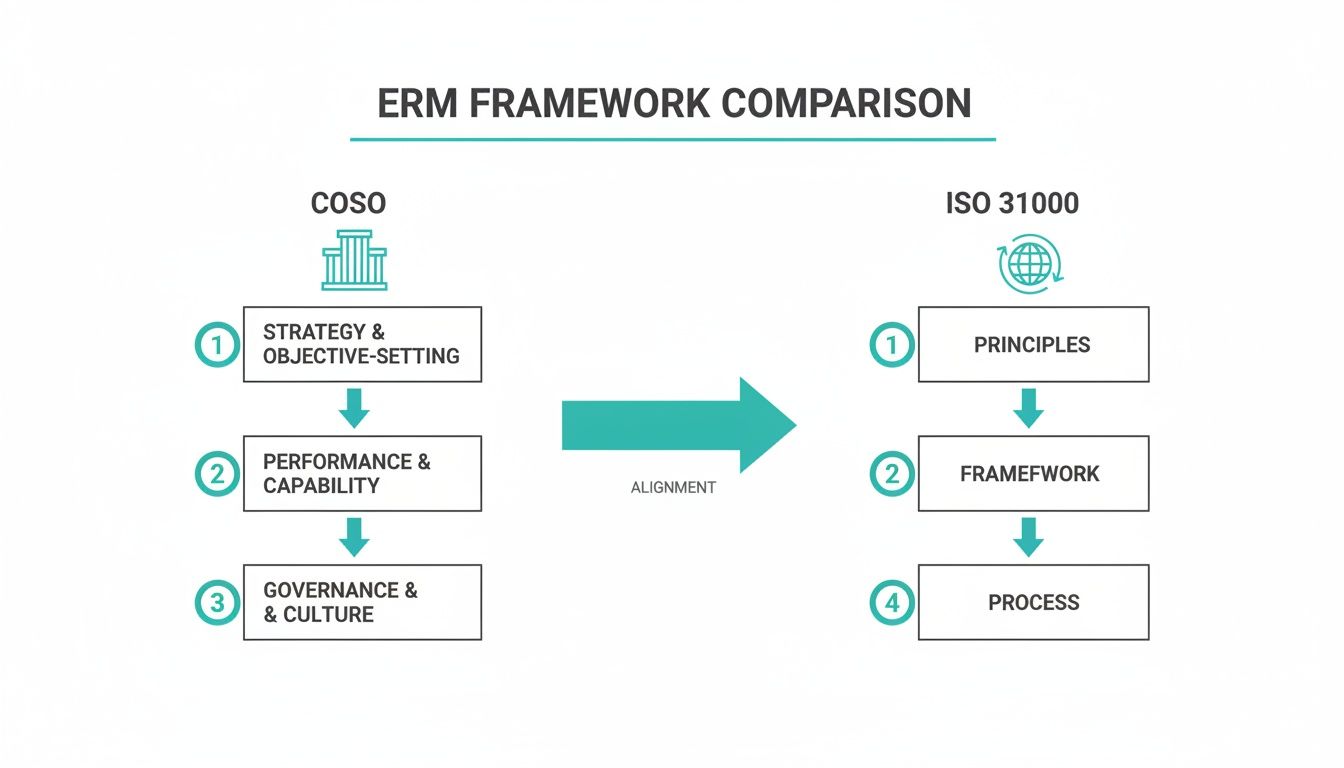
As the diagram shows, COSO offers a more structured, component-based path that’s great for compliance, while ISO 31000 provides a flexible, principle-driven model for weaving risk management into all business activities.
Stage 4: Develop and Implement Response Plans
Finally, with a clear understanding of its top risks, Innovate Inc. can build its response plans. For each high-priority risk, the assigned owner must decide on a course of action.
Avoid: Stop the activity causing the risk.
Mitigate: Put controls in place to reduce the risk's impact or likelihood.
Transfer: Shift the risk to a third party, usually through insurance.
Accept: Formally acknowledge the risk and decide to take no further action.
These plans are documented, and a centralized platform like E-Commander is brought in to track their progress. This step ensures accountability and gives the risk committee and leadership real-time visibility, completing the shift from a reactive to a proactive enterprise risk management business culture.
What Are the Biggest Risks Modern Businesses Are Actually Facing?
If you want to build a truly resilient business, you first need a clear-eyed view of the threats that can actually sink it. The modern risk landscape isn’t just about stock market swings or IT outages anymore. It's a tangled web of interconnected vulnerabilities, and the most dangerous threats often come from the inside—from your people, processes, and strategic blind spots.
To build a smart defense, you have to understand where the real dangers lie. These threats fall into a few critical buckets, and leaving any of them unmanaged can cause serious financial and reputational harm.
Operational Risks: The Backbone of Business Vulnerability
At its core, operational risk is the danger of something breaking down in your day-to-day business. Think of it as the internal machinery of your company; if a single gear grinds to a halt, the whole production line can stop. This category is huge, covering everything from supply chain failures and server crashes to simple human error.
It's no surprise that operational risk management is a massive piece of the overall risk market, accounting for 35.7% of the sector. This number reflects a hard-won lesson among leaders: internal breakdowns are one of the greatest threats to stability and growth. Even seemingly routine tasks, like managing server decommissioning with critical risk awareness, can become major vulnerabilities if handled improperly.
Common operational risks look like this:
System Failures: An unexpected server crash brings your e-commerce site down during the holiday shopping rush.
Process Breakdowns: A clunky invoicing process creates major payment delays, crushing your cash flow.
Human Error: An employee accidentally deletes a critical customer database, causing chaos across the company.
Strategic And Financial Risks: Navigating the Open Market
While operational risks bubble up from within, strategic and financial risks often hit you from the outside. Strategic risks are the ones that threaten your ability to achieve your biggest goals. They pop up when a business plan becomes obsolete, customer demands shift, or a new competitor storms into your market.
Financial risks, on the other hand, are all about money and capital. This can be anything from credit risk (customers not paying their bills) and liquidity risk (not having enough cash to operate) to market volatility wiping out your investments. A strong enterprise risk management business strategy has to connect these external market forces to your internal financial controls.
"The greatest danger in times of turbulence is not the turbulence itself, but to act with yesterday's logic." - Peter Drucker
Drucker’s insight nails the core challenge here. A strategy that was genius five years ago could be a liability today. Good ERM means you're constantly scanning the horizon to make sure the company’s direction still makes sense in a world of changing tech, markets, and customers.
The Overlooked Threat: Human Capital And Insider Risk
Maybe the most complex and underestimated risk of all is human capital. This bucket covers every risk related to your workforce, from talent shortages to compliance failures. But its most potent threat is employee misconduct and insider risk—actions by current or former employees that, intentionally or not, cause real harm.
These aren't just HR problems; they're enterprise-level threats. A disgruntled engineer could leak your intellectual property. A sales director could start offering bribes to close deals. A manager could be submitting fraudulent expense reports for years. The damage goes far beyond the initial financial loss, often leaving deep, lasting scars on a company's reputation and customer trust.
Traditional monitoring is terrible at catching this because it’s invasive and reactive, breeding a culture of suspicion. A modern, ethical approach focuses on spotting objective risk indicators without spying on people. For instance, an AI-driven platform like E-Commander can flag a pattern—like an employee accessing sensitive client files completely unrelated to their job right after receiving a negative performance review—without profiling individuals or making judgments. This allows the organization to step in early, protecting both employee dignity and corporate integrity. This is the future of running an effective enterprise risk management business function.
How Ethical AI Is Changing the Game in Risk Detection

When you hear "AI in risk management," it's easy to picture invasive employee surveillance and automated judgments. That’s an understandable fear, but it’s a dated view of how modern AI actually strengthens an enterprise risk management business strategy. The future isn't about watching people; it's about seeing objective patterns in operational data that flag potential trouble long before it escalates.
Think of an AI that works less like a security camera and more like a brilliant, tireless analyst. Instead of profiling individuals, it connects the dots between structured data points your business already has—things like access logs, expense reports, and project management systems. This ethical, “by design” approach is all about detecting risk indicators, not making subjective conclusions about people.
This distinction is everything. In a world governed by strict privacy laws like GDPR, the ability to identify potential misconduct without violating employee dignity is non-negotiable. The goal is simple: empower leadership to "Know First, Act Fast" based on objective signals, not intrusive monitoring.
From Surveillance to Signal Detection
Traditional risk detection methods are almost always slow and reactive. By the time an internal audit uncovers fraudulent activity or an HR investigation confirms a policy violation, the damage is already done—to your finances, morale, and reputation. Ethical AI flips that model on its head by focusing on prevention through early signal detection.
It works by identifying anomalies in structured, objective operational data—activities that deviate from established norms and controls. This isn't about interpreting someone's intent or emotions; it's about recognizing mathematical patterns that point to a potential breakdown in process.
Here are a few examples of objective signals an ethical AI might flag:
Access Anomalies: An employee in the accounting department suddenly starts accessing sensitive R&D files at 2 AM, an activity completely outside their job function and normal working hours.
Procedural Deviations: A project manager consistently bypasses the mandatory three-quote vendor approval process for a specific contractor, a pattern hidden across dozens of small, seemingly unrelated invoices.
Data Exfiltration Patterns: A user's account begins downloading unusually large volumes of client data to an external drive, just weeks after they were passed over for a key promotion.
In each of these cases, the AI isn't making an accusation. It is simply surfacing a factual, verifiable pattern that warrants a closer, human-led review. This approach helps any enterprise risk management business function move from reacting to crises to anticipating them.
The Power of Ethical AI in Practice
An ethical AI system is a decision-support tool, not an automated judge. It presents objective indicators to the right teams—HR, Compliance, or Internal Audit—who then use their expertise to investigate and act according to established company policies. This preserves due process and keeps human judgment at the center of every sensitive decision.
The true value of AI in risk management isn't replacing human oversight but augmenting it. It gives leaders the ability to see faint signals in a sea of data, turning noise into actionable intelligence while upholding privacy.
This methodology is the foundation for platforms like E-Commander, which are designed from the ground up to align with international regulations like EPPA and GDPR. Such systems explicitly prohibit surveillance, emotional profiling, and AI-driven conclusions about individuals. This ensures the technology serves as a tool for better governance, not as a mechanism for employee monitoring.
As companies face more scrutiny than ever, proving your risk detection methods are both effective and ethical is a powerful competitive advantage. For a deeper look, you can learn more about how ethical AI is transforming early internal risk detection in our related article.
Ultimately, integrating this kind of AI strengthens the entire enterprise risk management business framework. It provides a scalable, consistent way to spot hidden vulnerabilities, enabling organizations to protect their assets, reputation, and most importantly, the trust they've built with their people.
Proving The Value Of Your ERM Program
An enterprise risk management program is only as good as the value it visibly delivers. Securing a budget is one thing; proving the return on that investment is what sustains and grows the initiative.
The key is to shift the conversation from cost prevention to value creation. You have to show how a mature ERM program directly fuels strategic goals, making the business smarter and more agile.
This means moving beyond simple, reactive metrics like the number of incidents reported last quarter. While those numbers matter, they only tell a small part of the story. Real value comes from tracking meaningful Key Risk Indicators (KRIs) that connect proactive risk management to tangible business outcomes.
From Cost Center to Competitive Edge
To articulate the ROI of your program, you need to speak the language of the boardroom. This means translating risk management activities into the metrics that leadership actually cares about.
Instead of focusing only on downside protection, highlight how ERM enables smarter, faster, and more confident decision-making across the business.
Consider these value-driven metrics:
Improved Decision-Making Speed: Track the time it takes for strategic projects to move from proposal to approval. A well-defined risk appetite allows leaders to act more decisively instead of getting stuck in analysis paralysis.
Enhanced Audit and Compliance Readiness: Measure the reduction in time and resources spent on internal and external audits. Efficient ERM processes mean fewer surprises and faster resolutions.
Reduced Insurance Premiums: A demonstrably strong risk posture can often lead to lower insurance costs. This is a direct, quantifiable financial benefit you can take straight to the CFO.
Increased Operational Uptime: For operational risks, show how your proactive mitigation efforts have decreased system downtime or supply chain disruptions year-over-year.
Proving ERM's value isn't about creating complex reports filled with risk jargon. It's about telling a clear story, backed by data, of how managing risk intelligently makes the entire enterprise risk management business function stronger, faster, and more resilient.
Using Data to Showcase Your Success
Real-time dashboards and clear reporting are your best tools for communicating this value. A centralized platform transforms scattered data points into a clear narrative of progress.
It allows you to present a cohesive picture of the risk landscape and show exactly how your team’s efforts are mitigating threats and helping the business capitalize on opportunities.
This data-driven approach transforms ERM from a perceived administrative burden into a visible source of competitive advantage. It proves that proactive risk management doesn't just prevent loss; it builds a more agile and valuable business. You can learn more about how to centralize your program with modern enterprise risk management solutions.
This is how you secure continued buy-in and elevate ERM to its rightful place as a strategic partner.
Your ERM Questions, Answered
When you're building a modern risk strategy, you're bound to have some questions. Let's dig into some of the most common ones we hear from business leaders who are ready to move from a defensive stance to a proactive one.
What’s the Real Goal of an ERM Strategy?
The goal is to stop thinking about risk as just a compliance chore. A modern enterprise risk management business strategy is about weaving risk awareness right into the fabric of your core decisions, helping you both protect and create value.
It’s about building the resilience to confidently take on the right kind of risks—the ones that fuel growth. This completely flips the script, turning risk management from a cost center into a source of sharp, strategic insight that makes sure every major initiative is aligned with your company's bigger goals.
How Do We Get the C-Suite on Board with ERM?
To get executive buy-in, you have to frame ERM as a business enabler, not a cost. Forget the compliance-speak. Focus on how it sharpens decision-making, protects the brand’s reputation, and directly supports the company’s growth objectives.
Bring data and real-world examples to the table that show how getting ahead of risk leads to better business outcomes. This changes the conversation from ERM being a necessary expense to a high-return strategic investment that strengthens the entire company.
Is a Framework Like COSO Actually Mandatory?
While frameworks like COSO or ISO 31000 aren't always required by law, adopting one is a critical best practice. Think of it as a proven blueprint for success that gives your program structure, credibility, and a common language for managing risk across the business.
Putting a formal framework in place shows stakeholders, regulators, and investors that you're serious about sound governance. It gives you a clear, auditable path for building and maturing your enterprise risk management business program, making sure it’s both effective and completely defensible.
At Logical Commander Software Ltd., we provide AI-driven platforms that empower your organization to identify and mitigate internal risks ethically and proactively. Our E-Commander platform centralizes risk intelligence and streamlines workflows, helping you protect your assets and reputation without invasive monitoring. Discover a smarter way to manage risk by visiting us at https://www.logicalcommander.com.