%20(2)_edited.png)

How to Prevent Insider Threats: An Ethical, Proactive Guide

Updated: Jan 15
To truly prevent insider threats, organizations must fundamentally shift from reactive investigations to a proactive, ethical risk management framework. The goal isn't to launch costly forensic analyses after the damage is done; it's to build a system that identifies human-factor risks before they escalate into incidents. This requires a non-intrusive, EPPA-aligned approach that respects employee dignity while protecting critical business assets and reputation.
Move Beyond Reacting to Insider Incidents

For decades, the standard playbook for managing insider risk was simple: wait for a breach, data theft, or fraud, and only then launch a disruptive and expensive investigation. This reactive model is fundamentally broken. By the time a forensic team is engaged, the financial and reputational damage is already done, leaving compliance, risk, and security leaders perpetually one step behind the next human-factor risk.
The Staggering Business Impact and Liability
The financial drain from insider incidents is a significant blow to the enterprise, with the average annual cost per organization now hitting a staggering $17.4 million. This figure is fueled by hybrid work, cloud services, and credential theft, which costs an average of $779,000 per incident. With 76% of organizations admitting internal threats are a greater risk than external attackers, the focus must shift from reaction to prevention.
Beyond the balance sheet, the reputational damage can destroy customer trust, trigger intense regulatory scrutiny, and erode shareholder confidence. Furthermore, reactive investigations foster a culture of suspicion, harming morale and productivity. The true business impact goes far beyond the incident itself, creating significant liability.
Why Legacy Systems Fail to Prevent Insider Threats
Many companies still rely on legacy tools like User Behavior Analytics (UBA) or Data Loss Prevention (DLP) systems. While useful for flagging anomalous activity, these tools are fundamentally reactive. They are designed to spot deviations from a baseline but cannot identify the pre-incident risk indicators that precede those actions.
These systems are notorious for generating a flood of false positives, creating alert fatigue for security teams. More importantly, they often operate in an ethical and legal gray area, bordering on employee surveillance, which can create significant compliance risks.
An effective insider risk program doesn't just watch for suspicious clicks; it understands the contextual human risks that precede them. The goal is proactive prevention, not just faster detection of failure.
Shifting to a Proactive and Ethical Standard
The only sustainable way to manage insider risk is to prevent it. This requires a modern toolset focused on identifying human-factor risks before they materialize into threats. An effective program must be:
Proactive: It must analyze pre-incident indicators from structured, business-related data.
Ethical: It must be non-intrusive and fully EPPA-aligned, avoiding any form of surveillance.
AI-Driven: It should leverage advanced AI to identify complex risk patterns that manual processes cannot detect.
This forward-looking strategy empowers you to move from a defensive posture to one of proactive governance, protecting both the organization and its people by addressing risk at its source. For a deeper analysis, explore our guide on the true cost of reactive investigations. This shift isn't just an improvement; it's the new standard for every leader in compliance, risk, and security.
Build Your Ethical Insider Risk Framework
Effective insider threat prevention is not built on invasive surveillance but on a foundation of ethical principles and clear governance. A proactive framework establishes transparent rules of engagement, creating a predictable and secure environment where human-factor risks are minimized by design. The goal is to build a robust, EPPA-aligned risk management strategy that protects the organization while respecting employee dignity.
Establish Crystal-Clear Data Handling Policies
Every insider risk framework begins with data governance. A comprehensive data handling policy is the bedrock of your defense, outlining precisely how sensitive information should be managed, stored, accessed, and transmitted, leaving no room for interpretation.
Your policy must specify:
Data Classification Levels: Clearly define what constitutes "Confidential," "Internal," or "Public" information with tangible examples.
Access Control Protocols: Detail who is authorized to access specific data sets based on their role and business need (Principle of Least Privilege).
Secure Storage and Transmission: Mandate the use of encrypted drives, secure file transfer protocols, and approved cloud storage while explicitly forbidding unauthorized personal devices or public file-sharing sites.
This clarity provides an objective, legitimate basis for identifying activity that deviates from policy, focusing on measurable adherence rather than subjective judgment.
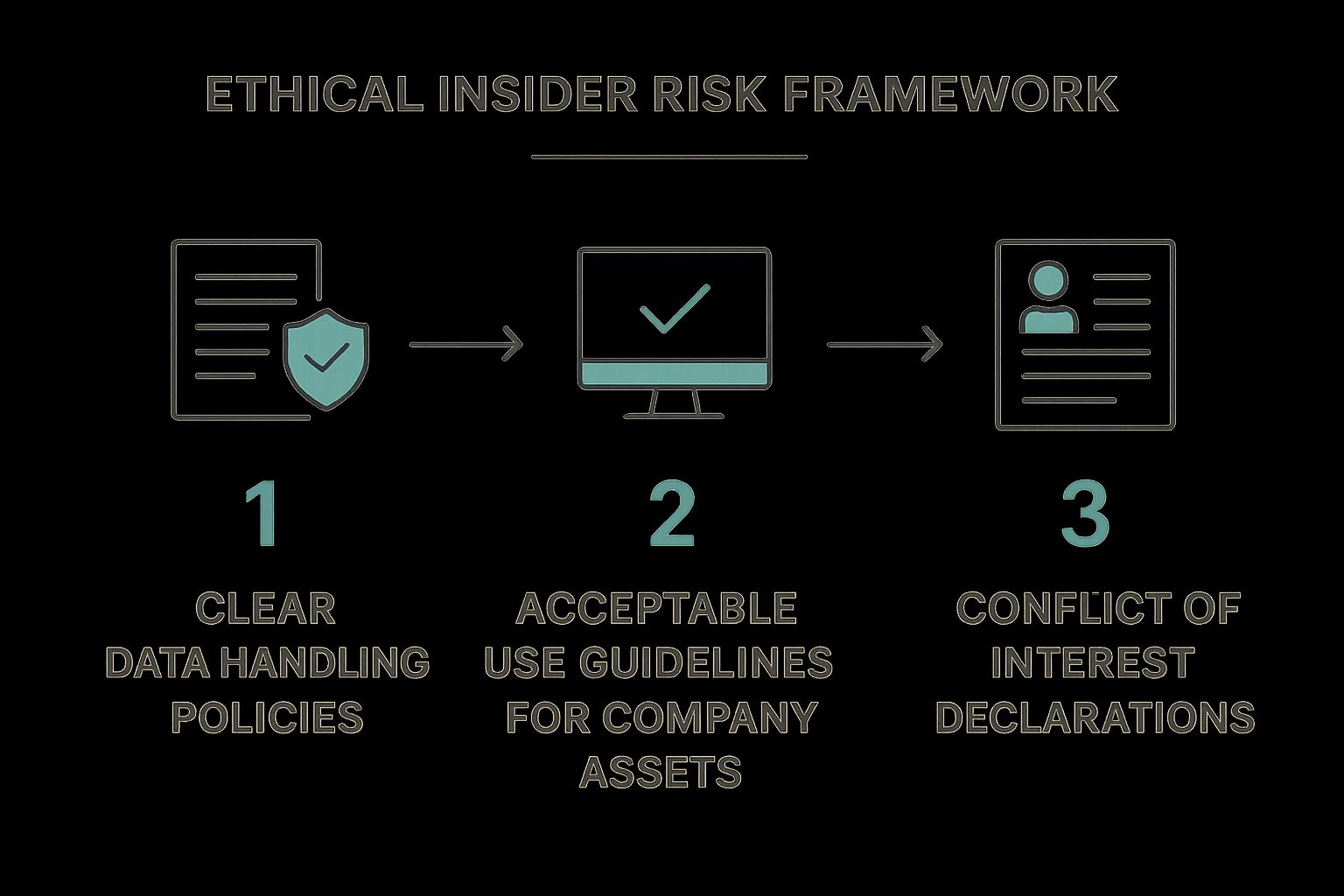
As the infographic illustrates, clear policies for data, assets, and conflicts of interest are foundational, interconnected steps for proactive insider risk mitigation.
Define Acceptable Use of Company Assets
Beyond data, your framework must govern the use of all company assets, from laptops and network access to software and physical facilities. An Acceptable Use Policy (AUP) sets these boundaries, clarifying that company resources are for business purposes and outlining the consequences of misuse.
A strong AUP should explicitly address:
Network Usage: Prohibit access to malicious websites, unauthorized peer-to-peer file sharing, or activities that consume excessive bandwidth.
Software Installation: Restrict employees from installing unapproved software to defend against malware and licensing risks.
Personal Use: Define the limited, acceptable scope of personal use for company equipment to eliminate gray areas.
By clearly defining what is acceptable, you proactively reduce the risk of employees inadvertently creating security vulnerabilities. This transparency is a cornerstone of an ethical internal threat program.
Manage Conflict of Interest Declarations
An undeclared conflict of interest is a potent and often overlooked source of insider risk. An employee with competing loyalties presents a significant human-factor risk. Your framework needs a formal, structured process for declaring and managing these conflicts that goes beyond a simple onboarding checkbox. For a deeper dive, review our complete guide to insider risk management.
A key part of an ethical framework involves assessing core values and alignment. A robust declaration workflow unifies HR, Legal, and Security for a coordinated approach to risk assessment. It helps identify potential issues—like an employee holding a stake in a key vendor—before they can improperly influence business decisions or lead to data exfiltration.
Conduct Meaningful Human-Factor Risk Assessments

An ethical framework sets the rules, but a risk assessment identifies where to focus your defenses. To prevent insider threats, you must understand your specific vulnerabilities by going beyond standard cybersecurity audits. Technical gap analyses are important, but the true drivers of internal risk are human.
A meaningful human-factor risk assessment is a structured, objective process for identifying high-risk roles, critical assets, and potential threat scenarios without resorting to intrusive methods. This provides the clarity needed to apply targeted controls where they will have the greatest business impact.
Identifying High-Risk Roles and Critical Assets
Not all employees and assets carry the same level of risk. The first step is to identify which roles and data sets represent your biggest vulnerabilities.
Your assessment should map out:
Roles with Privileged Access: System administrators, network engineers, and finance managers with access to sensitive systems.
Access to Critical Intellectual Property: Roles in R&D, product development, or corporate strategy handling trade secrets.
Control Over Financial Transactions: Any position with authority to approve payments, manage vendor details, or access company accounts.
Mapping these high-risk roles to the specific critical assets they can access provides a clear picture of your key vulnerabilities, allowing you to prioritize prevention efforts effectively.
Evaluating Risks Across the Employee Lifecycle
Human-factor risk is dynamic and shifts throughout an employee's journey. A proper assessment must evaluate the unique vulnerabilities at each key stage.
For instance, the hiring process is your first line of defense. Knowing how to conduct thorough background checks provides crucial due diligence before a potential risk is introduced.
Other critical points to analyze include:
Onboarding: Are new hires receiving role-specific training on data handling and acceptable use, or just a generic policy document?
Promotions and Role Changes: Are access permissions updated to align with new duties, or does "privilege creep" create unnecessary risk?
Offboarding: Is there an automated process to revoke all access immediately upon an employee's departure to close this common security gap?
A proactive risk assessment treats the employee lifecycle as a series of risk control points. By addressing vulnerabilities at each stage, you systematically reduce your overall exposure to human-factor threats.
Assessing Third-Party and Contractor Vulnerabilities
Your internal risk landscape extends to contractors, consultants, and third-party vendors who often require privileged access. This introduces a significant layer of risk that many organizations fail to manage adequately. These external partners can become an unintentional backdoor for a breach if not governed properly.
Your human-factor risk assessment must extend to this ecosystem. Evaluate the security hygiene of partners, their contractual obligations, and the specific access levels granted. Treating third-party access with the same rigor as you do for internal staff closes a critical gap that adversaries exploit.
Use AI for Non-Intrusive Threat Detection
Traditional security tools are perpetually a step behind insider threats, stuck in a reactive loop of analyzing digital breadcrumbs after the damage is done. To truly prevent incidents, you must identify pre-incident risk indicators long before they escalate. An ethical, AI-driven platform analyzes contextual risk signals from structured, business-related data you already possess, providing a forward-looking view of human risk without crossing ethical or legal lines.
Shifting from Behavior Monitoring to Contextual Risk Analysis
Legacy User Behavior Analytics (UBA) tools monitor logins, file access, and network traffic to spot deviations from normal routines. This method is fundamentally reactive and collects massive amounts of activity data, creating significant privacy concerns.
An ethical, AI-driven approach is different. It works by analyzing structured data that the organization already collects for legitimate business reasons, such as:
Pre-employment screening results: Identifying inconsistencies or risks noted during hiring.
Conflict of interest disclosures: Pinpointing undeclared business activities that could create a conflict.
Access requests and permissions: Spotting unusual patterns, like a request for data access misaligned with an employee’s role.
HR lifecycle data: Correlating risk indicators with events like promotions, transfers, or performance reviews.
By focusing on this business-related data, AI can connect disparate points to identify patterns signaling elevated risk—all without reading emails or monitoring keystrokes. This method is fully aligned with regulations like the EPPA because it avoids surveillance.
The power of AI is its ability to synthesize disparate, structured data points into a cohesive picture of risk. It’s about understanding the business context surrounding roles, not watching people.
How AI Spots Pre-Incident Risk Indicators
An advanced AI platform like Logical Commander’s E-Commander/Risk-HR functions as an early warning system. It is designed to clarify complex human-factor risk by highlighting scenarios that a manual review would almost certainly miss.
For example, an employee in a non-technical role requests access to a sensitive developer database. Weeks later, their conflict of interest disclosure shows an undeclared advisory role at a tech startup. Taken separately, these events may not raise alarms. An AI system, however, instantly connects them, flagging a potential risk of intellectual property theft long before any data exfiltration occurs.
This proactive capability is critical, as it takes an average of 86 days to detect and contain an insider threat. For incidents lasting over 91 days, the cost skyrockets to $18.33 million annually. This lag exists because insiders understand internal systems and can cover their tracks.
Differentiating Ethical AI from Traditional Security Tools
It is crucial to distinguish this ethical, AI-driven approach from older, more invasive technologies. The goal is not to catch employees in the act but to proactively identify and mitigate risks before they can cause business harm.
Here’s how an ethical AI platform is fundamentally different:
No Surveillance: It does not monitor employee communications, web browsing, or application usage. Analysis is strictly confined to structured, business-related information.
EPPA-Aligned: The methodology is designed to respect employee dignity and comply with strict labor laws, avoiding any tool that could be deemed coercive.
Focus on Prevention: The insights are forward-looking, allowing HR, Legal, and Security teams to intervene constructively—with additional training or a review of access rights—rather than launching a punitive investigation.
This non-intrusive method provides the visibility needed to manage human-factor risk effectively and ethically. To learn more, explore our guide on detecting insider threats with ethical AI. Using technology as a preventative tool protects your organization from serious financial and reputational damage while fostering a culture of security.
Build Your Proactive Mitigation Playbook

Identifying a potential human risk is only the first step. The true test of an insider threat prevention program is what you do next. Flagging an issue without a clear, constructive plan is like a smoke detector without a fire extinguisher—it alerts you to danger but does nothing to prevent the damage.
To effectively prevent incidents, you need a playbook of proactive, non-punitive mitigation workflows. These are pre-defined, structured responses designed to address the root cause of a risk without creating an adversarial environment. The focus must be on corrective action, not retribution, bridging the gap between detection and true prevention.
Tailor Workflows to the Real-World Context
Not all risks are equal, so your response cannot be one-size-fits-all. A smart mitigation strategy tailors actions to the specific context of the risk indicator, applying the right level of intervention at the right time.
Consider these tiered responses:
Low-Level Risk (e.g., Inadvertent Policy Violation): The workflow could automatically enroll the employee in a brief, targeted security awareness training module—a supportive, educational fix.
Medium-Level Risk (e.g., Undeclared Conflict of Interest): This might trigger a notification to an HR business partner to prompt a supportive, fact-finding conversation with the employee.
High-Level Risk (e.g., Repeated, Suspicious Access to Sensitive Data): This should initiate a formal review by a cross-functional team from Security, HR, and Legal to assess the situation and determine next steps, such as a temporary suspension of access privileges.
This graduated approach ensures your response is always proportional to the risk.
Effective mitigation isn't about punishment; it's about course correction. A proactive workflow provides a constructive path to address a risk indicator before it can escalate into a damaging incident.
Why a Coordinated Response is Non-Negotiable
Fragmented responses are a primary reason insider risk programs fail. When HR, Security, and Legal operate in silos, critical context is lost, and actions are inconsistent or delayed. This is a widespread problem, with recent data showing that 60% of coordination between HR and security teams is still manual, creating significant gaps.
The scale of the challenge is clear, with 56% of enterprises reporting an insider threat incident in the past year. These incidents stem from malicious insiders, negligent employees, and even compromised job applicants, which is why a unified defense is critical. For more insights, see the 2025 Insider Threat Pulse Report.
Create a Playbook of Constructive Actions
Your mitigation playbook should be a menu of constructive, EPPA-aligned interventions. This is how you shift from a reactive, investigative model to a proactive, supportive one.
Here are examples of reframing your response:
Scenario | Ineffective (Reactive) Action | Effective (Proactive) Workflow |
|---|---|---|
Accidental Data Mishandling | Launching a formal investigation. | Assigning targeted micro-learning on the specific data handling policy violated. |
Privilege Creep | Waiting for an audit to find the issue. | Triggering an automated quarterly access review for high-risk roles. |
Potential Conflict of Interest | Ignoring it until a problem arises. | Initiating a guided check-in from HR to discuss the disclosure and clarify policies. |
By pre-defining these workflows, you ensure every response is consistent, fair, and documented. This mitigates immediate risk and strengthens your overall governance and compliance posture, protecting the organization while reinforcing a positive security culture.
Let's Build Your Proactive Defense
Ready to get ahead of insider threats for good? Logical Commander gives you an ethical, EPPA-compliant platform designed to help you prevent incidents before they ever cause financial or reputational damage. Our AI-driven solution delivers the critical insights you need to manage human-factor risk without resorting to invasive surveillance.
This is a fundamental shift away from outdated, reactive investigations that only clean up the mess after the damage is done. Instead of monitoring employee behavior, our system analyzes structured, business-related data. This allows us to identify pre-incident risk indicators, ensuring your prevention efforts are both incredibly effective and fully compliant.
The new standard for insider risk management isn't about catching people doing wrong; it's about proactively and ethically addressing risk indicators before they escalate into a crisis.
See for yourself how our E-Commander/Risk-HR platform can become the new backbone for your organization's compliance, security, and governance programs. This is how you move from a defensive crouch to a position of proactive control, safeguarding your assets while upholding employee dignity.
Let's start the conversation about your enterprise needs or get you started with platform access today. By adopting a forward-looking strategy, you protect your business, your reputation, and your people from preventable harm.
Your Top Questions About Insider Threat Prevention, Answered
When shifting from a reactive to a proactive defense against insider threats, leaders in security, compliance, and HR want to know how to build a program that’s both effective against risk and fair to employees. Let's tackle the most common questions.
How Can We Prevent Insider Threats Without Making Our Employees Feel Watched?
This is a critical question. The answer lies in shifting focus from monitoring employee communications to analyzing existing business data. An ethical, EPPA-compliant approach uses AI to find risk patterns within structured, operational data—not by reading private communications. Instead of looking over someone's shoulder, you analyze the digital trail their work naturally creates.
This means analyzing sources like:
Access logs: Is an employee attempting to access files unrelated to their job function?
HR records: Do risk indicators correlate with an employee's resignation or a performance review?
Conflict of interest forms: Is an employee involved in an undisclosed external business?
Key Takeaway: This non-intrusive method delivers powerful, forward-looking insights into human risk while respecting employee dignity and privacy. It's about patterns, not prying.
What Is HR’s Real Role in an Insider Threat Program?
HR is an essential partner, not just a participant. An effective insider threat prevention program is impossible without them. They are the custodians of the employee lifecycle data that provides crucial context to risk signals.
HR’s involvement ensures mitigation efforts are fair, compliant, and culturally appropriate. They lead supportive interventions, manage constructive training, and help maintain a non-punitive environment focused on prevention, not punishment.
How Is an AI-Driven Platform Different From the UBA or DLP Tools We Already Have?
The difference is proactive prevention versus reactive detection. Traditional tools like User Behavior Analytics (UBA) and Data Loss Prevention (DLP) are tripwires. They spot suspicious activity as it happens or, more often, after the fact. They are looking for a specific rule violation, like a large file being emailed externally.
In contrast, a proactive AI platform like Logical Commander analyzes the subtle, pre-incident risk indicators that appear long before a policy is broken. It connects seemingly unrelated data points to help you see a threat developing, enabling you to intervene and prevent the activity from ever causing financial or reputational damage.
Article created using Outrank