%20(2)_edited.png)

How to prevent insider threats: A Practical Playbook for Security

To truly get a handle on insider threats, you have to look beyond the usual firewalls and external defenses. It’s about weaving together a smart, multi-layered strategy that combines clear governance, the right technology, and a culture that’s genuinely aware of security. This approach moves you from playing defense to actively building resilience from the inside out.
The Hidden Risk Inside Your Walls

Let’s be honest—the biggest security threats often have a key to the front door. Whether they're malicious or just plain accidental, insiders with legitimate access can cause an incredible amount of damage.
Most traditional security is built to stop attackers from the outside, which means it completely misses the subtle warning signs of risk brewing internally. This creates a massive blind spot, and it’s one that most organizations are dangerously unprepared for.
At its core, preventing insider threats is a people problem, not just a tech problem. Relying only on perimeter defenses is like locking your front door but leaving all the windows wide open. To be effective, you have to shift your focus inward.
Shifting to a People-Centric Model
A successful strategy is built on a deep understanding of human behavior, not just technical vulnerabilities. Instead of treating every employee like a potential suspect, a people-centric model zeros in on identifying risky behaviors and the contextual clues that point to potential harm. This requires a balanced approach that blends smart governance, privacy-respecting technology, and a strong security culture.
This proactive stance is more critical than ever. According to one recent survey, a staggering 93% of cybersecurity professionals find insider threats as difficult or even harder to detect than external attacks. Yet, only 23% feel confident they can spot them before the damage is done.
You can dig into more of these findings in the 2025 Insider Risk Report to see just how wide this capability gap really is. This data screams for a more holistic, preventive approach.
The Four Pillars of a Modern Insider Threat Program
A truly effective insider threat program isn't a single tool or a one-off project. It's a comprehensive system built on four essential pillars that work together to create layers of defense that are both powerful and ethical.
Here’s a quick look at the core components we’ll be breaking down in this guide.
Pillar | Objective | Key Action |
|---|---|---|
Understand Your Risks | Identify your most critical assets and the internal vulnerabilities that expose them. | Map your "crown jewels" and pinpoint which roles have privileged access. |
Use Behavioral Analytics | Detect anomalous activity that signals potential risk, without invasive surveillance. | Deploy smart, privacy-preserving technology to spot unusual patterns of behavior. |
Create Clear Response Plans | Ensure a consistent, timely, and legally sound response to any detected threat. | Develop pre-defined playbooks so your team knows exactly what to do when an alert fires. |
Continuously Improve | Adapt your program to evolving threats and measure its effectiveness over time. | Regularly review metrics, refine your processes, and update your risk assessments. |
By focusing on these four pillars, you can build a program that does more than just protect your organization. You can foster a culture of trust and shared responsibility.
This guide is designed to give you the actionable steps you need to turn these pillars into a powerful, real-world defense against insider threats.
Before you can build a real defense against insider threats, you have to know what you’re protecting and who you’re protecting it from. A smart defense doesn't start with deploying new software; it starts with a deep, honest risk assessment. This is the foundational work that moves you from just reacting to threats to actually anticipating them.
The whole point is to map out your organization's unique vulnerabilities. This isn't just some theoretical exercise. It's a practical deep-dive into your most critical assets and the internal pathways that lead right to them. Without that clarity, any security measures you put in place are pure guesswork, leaving massive gaps for both malicious insiders and accidental slip-ups.
Identifying Your Crown Jewels
Every organization has its “crown jewels”—the critical data, systems, or intellectual property that, if compromised, would cause severe, maybe even catastrophic, damage. The very first thing you need to do is get crystal clear on what these are. Forget generic labels. Get specific.
What does this look like in the real world?
For a healthcare provider: It's undeniably Protected Health Information (PHI). A breach there means massive regulatory fines and a complete loss of patient trust.
For a tech startup: The crown jewel is the proprietary source code for its main product. A leak could literally hand the keys to the kingdom to a competitor.
For a financial services firm: It’s all about customer financial data and sensitive market analysis. A compromise could trigger market chaos or widespread fraud.
Once you’ve identified these assets, you have to map out where they live, who has access, and how they’re used in the day-to-day grind. This process almost always uncovers some surprising—and totally unnecessary—levels of access that you can lock down immediately.
A classic mistake is assuming only a handful of C-suite execs can touch the most sensitive data. The reality is that access is often spread thin across departments and roles, creating a much larger risk surface than anyone realizes.
This is where you establish your foundational defenses. It’s about defining clear roles, tightening access controls, and enforcing comprehensive security protocols that guard against threats from both inside and out. This ensures your most valuable assets are shielded by more than just blind trust.
Pinpointing High-Risk Roles And Scenarios
With your critical assets mapped, it's time to identify the roles that carry the highest risk. This isn't about pointing fingers or labeling employees as untrustworthy. It’s about recognizing that some positions, by their very nature, have the keys to the kingdom and a greater opportunity to cause harm, whether they mean to or not.
Think beyond the usual suspects like system administrators. Consider roles that handle sensitive customer data, manage financial transactions, or have access to strategic plans. A departing salesperson walking out the door with a full client list is a huge data exfiltration risk. Likewise, a finance clerk with the permissions to alter vendor payment details could be a prime target for social engineering or could act maliciously on their own.
Running a Cross-Functional Risk Workshop
To get the full picture of your vulnerabilities, you can't operate in a silo. A truly successful risk assessment is a team sport, bringing together key people from across the business. One of the best ways to make this happen is to run a dedicated workshop.
Your invite list should absolutely include reps from:
IT and Security: These are the folks who understand the technical guts of your infrastructure, access controls, and existing security gaps.
Human Resources: HR brings the human context. They see the entire employee lifecycle—from hiring and onboarding to performance issues and terminations—and are often the first to spot behavioral red flags.
Legal and Compliance: This team is your guardrail. They make sure your assessment and monitoring activities don't cross legal lines or violate privacy laws, preventing your security initiative from turning into a legal nightmare.
Department Leaders: Business unit managers are on the front lines. They know the daily workflows, which data is truly critical to their operations, and which employees actually need access to it.
This collaborative approach transforms your risk assessment from a simple IT checklist into a living, breathing strategy for the entire organization. It creates shared ownership and ensures the controls you design are not only effective but also practical enough to work in the real world.
Using Technology For Smart And Ethical Monitoring

Let's be clear: spotting insider risk isn't about creating a surveillance state inside your company. It's about using smart technology to connect the dots and flag unusual behavior that signals a potential threat—all while respecting employee privacy and maintaining a culture of trust.
The right tools act as your digital sentinels, working quietly in the background. They see patterns a human team could never spot, shifting you from a reactive stance (finding out about a breach after the damage is done) to a proactive one where you can step in at the first sign of trouble.
Focusing On Behavior, Not Identity
Modern insider threat prevention is all about analyzing behavior in context. This is a critical distinction. You aren't spying on individuals; you're monitoring for actions that break from established norms.
Think of it as the difference between reading someone's personal emails and getting an alert because their account is suddenly downloading terabytes of customer data at 2 AM. The first is an invasion of privacy; the second is a clear risk signal.
This approach is both more effective and far more ethical. It slashes false positives and keeps your security team focused on genuine threats instead of chasing down innocent activity. The key is to implement a suite of tools that work together, giving you a complete, contextual picture of what's happening across your network.
True security intelligence comes from understanding the what, when, and where of data access. A focus on behavioral anomalies allows you to detect risk signals without compromising the trust you've built with your team.
For instance, imagine a salesperson who just resigned. If they download a single client file, that's probably normal offboarding activity. But if they try to export the entire CRM database to a personal USB drive? That’s a five-alarm fire. This is the kind of specific, actionable intelligence a well-configured system delivers.
The Core Technology Stack For Insider Threat Prevention
Building a solid technical defense requires layers. No single tool catches everything, but the right combination creates a powerful safety net.
Here are the essential components:
User and Entity Behavior Analytics (UEBA): This is the brain of your monitoring operation. UEBA tools use machine learning to build a baseline of normal activity for each person and then flag significant deviations. It's the key to spotting subtle threats that would otherwise fly completely under the radar.
Data Loss Prevention (DLP): Think of DLP solutions as the gatekeepers for your most sensitive information. They identify, monitor, and protect your "crown jewel" data whether it's being used, sent, or just sitting on a server. You can set up rules to automatically block unauthorized attempts to email, copy, or upload critical files.
Privileged Access Management (PAM): These tools are designed to lock down and monitor the accounts with the highest level of access—your system admins and other power users. PAM solutions enforce the principle of least privilege by vaulting credentials and recording high-risk sessions.
This tech is a critical investment when you look at the numbers. The 2025 Ponemon Institute report shows that companies spend an average of $17.4M annually on insider risks, with the average malicious incident costing over $715,000. It also takes 86 days on average to contain a threat. When that timeline creeps past 91 days, the costs can explode to over $18.33M.
Ethical AI And Privacy By Design
The power of these tools comes with a heavy responsibility to use them ethically. The focus must always be on protecting company assets and identifying risk indicators—not on judging individuals.
This is where the idea of "ethical AI" becomes so important. It's about finding the right balance between security needs and privacy rights. You can dive deeper into this concept in our guide on detecting insider threats with ethical AI.
An ethical rollout comes down to a few core principles:
Transparency: Be open with your team about what you're monitoring and why. Frame it as a necessary step to protect everyone and the company's future.
Proportionality: Make sure the level of monitoring fits the risk. High-risk roles with keys to the kingdom will naturally require more scrutiny than others.
Data Minimization: Only collect the data you absolutely need to identify a threat. Avoid capturing personal information or communications that have nothing to do with security.
By sticking to these principles, you can build a powerful technical defense against insider threats without creating an adversarial "Big Brother" environment. Your team can feel confident that security measures are there to protect them and the business, not to police their every move.
Creating A Human Firewall Through Culture And Training
Technology is a powerful shield, but it's only half the battle. Your most effective defense—or your biggest vulnerability—walks through the door every single morning.
Building a "human firewall" means moving beyond forgettable annual training and creating a security-first culture that genuinely sticks. It’s about empowering your team to become your greatest security asset, not treating them like the weakest link.
Go Beyond "Check-the-Box" Training
This starts by rejecting the one-size-fits-all approach to security education. Generic, check-the-box training rarely prepares employees for the specific threats they'll actually face. A proactive strategy involves creating engaging, continuous education tailored to individual roles.
For example, your finance team operates on the front lines of payment fraud. Their training should immerse them in real-world scenarios involving sophisticated business email compromise (BEC) and invoice manipulation schemes.
Meanwhile, your developers need hands-on workshops focused on securing code repositories and preventing secrets from being leaked in public forums.
Make Security Education Memorable
The key is to make these lessons resonate on a personal level. Dry policy documents and boring slide decks are quickly forgotten. To make security awareness stick, you have to make it engaging and relevant.
Consider these proven techniques:
Gamification: Turn learning into a friendly competition. Use leaderboards, badges, and simulated phishing campaigns where employees can test their skills in a safe environment. This transforms a passive learning experience into an active, memorable one.
Real-World Stories: Share anonymized stories of actual incidents, both from within your industry and your own organization (when appropriate). Explaining how a simple mistake led to a real data breach makes the consequences tangible and the lessons unforgettable.
Developing a human firewall is paramount, and effective strategies for employee awareness and training are key to mitigating human-related risks. The goal is to build muscle memory so that secure behavior becomes an instinct, not an afterthought.
Empower Employees To Speak Up
Even the best-trained employee will hesitate to report a concern if they fear blame or retribution. A cornerstone of preventing insider threats is building clear, no-blame reporting channels. People need to feel psychologically safe to raise their hands when they see something that doesn't feel right.
This means fostering an environment where an employee who clicks on a phishing link feels comfortable reporting it immediately, rather than hiding it out of fear. Quick reporting can be the difference between a minor incident and a full-blown crisis. You can learn more about building this type of environment in our guide to fostering a strong speak-up culture.
A culture of silence is a threat multiplier. When employees are afraid to report mistakes or suspicions, you lose your most valuable source of on-the-ground intelligence. Make it clear that reporting is a sign of strength and responsibility.
The data strongly supports this focus on training and culture. Security awareness training emerges as a critical prevention tactic, with studies showing it can reduce employee-driven cyber incidents by up to 72% and the likelihood of a breach by 65%.
With 55% of incidents in 2025 expected to stem from negligent insiders—costing an average of $8.8M annually—the ROI on effective training is undeniable. You can discover more insights about these security awareness statistics and their impact on modern businesses.
Ultimately, preventing insider threats is a shared responsibility. By investing in tailored, engaging training and building a culture where people feel safe to speak up, you transform your entire workforce into an active, vigilant line of defense.
Your Action Plan For When A Threat Emerges
When an alert fires, chaos is your enemy. A calm, methodical, pre-defined response is what separates a minor incident from a major organizational crisis.
Knowing precisely what to do—and who needs to do it—the moment a potential insider threat is detected isn’t a luxury. It’s the bedrock of effective risk management.
Without a clear action plan, teams scramble, evidence gets mishandled, and critical decisions are made under pressure without proper oversight. This not only magnifies the potential damage but also exposes your company to serious legal and compliance risks. The goal is to move from panicked reaction to disciplined execution.
Assembling Your Cross-Functional Response Team
The first move is to formally establish a cross-functional Insider Threat Incident Response Team. This is not a task for the security team alone. A successful response requires a coordinated effort from key stakeholders across the business, each bringing their unique expertise to the table.
Your core team should absolutely include representatives from:
Security Operations: They're your digital first responders, responsible for the initial triage of the alert, the technical deep-dive, and containing the threat.
Human Resources: HR provides the critical human context—performance history, recent life events, or upcoming changes in employment. They also guide the people-centric aspects of the response, making sure every action is fair and appropriate.
Legal and Compliance: Think of them as your essential guardrail. They ensure every step is legally defensible and compliant with privacy laws and employee rights, preventing a security issue from spiraling into a courtroom battle.
This collaborative structure guarantees that decisions are made with a complete picture, balancing technical findings with human context and legal obligations.
The infographic below illustrates how to engage your workforce as a proactive defense layer, a concept often called the "human firewall."
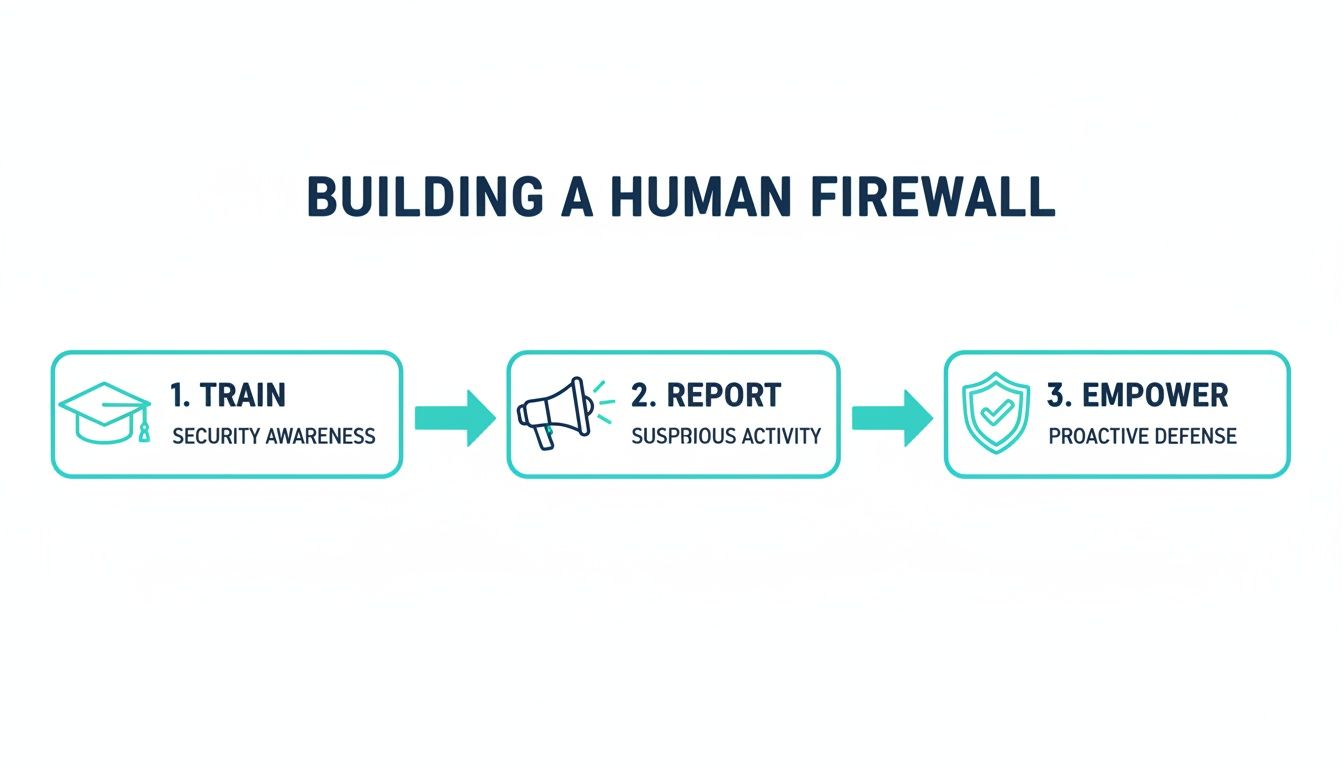
This highlights how a well-prepared workforce, supported by a clear response structure, can become a powerful asset in spotting and reporting threats before they escalate.
Building Your Response Playbooks
Your team needs more than just a contact list; they need practical, step-by-step playbooks for different insider threat scenarios. One size does not fit all.
The way you handle an accidental data leak by a well-meaning employee will be worlds apart from how you respond to deliberate sabotage by a disgruntled administrator.
Start by outlining workflows for your most likely scenarios:
Initial Triage and Verification: The second an alert pops, the first step is to quickly confirm if it’s a true positive or just noise. The security team digs into the technical evidence to validate the activity.
Investigation and Context Gathering: Once verified, the full team is activated. HR provides employee context, Legal advises on evidence collection, and Security deepens the technical investigation, preserving data in a forensically sound manner.
Containment and Mitigation: If the threat is active, the team must act fast. This could mean disabling account access, isolating affected systems, or working with HR to place an employee on administrative leave.
Recovery and Post-Mortem: After the incident is resolved, the focus shifts to recovery and learning. The team analyzes the root cause, identifies gaps in controls or policies, and updates the playbooks so you're stronger next time.
A well-documented response is your best defense, both technically and legally. Every single action—from the initial alert to final resolution—must be logged with timestamps, justifications, and approvals to create a bulletproof, auditable trail.
This structured process is a core component of a mature security posture. If you're looking to formalize this for your organization, our detailed guide on building a security incident response plan offers an excellent framework to get started.
By preparing these playbooks in advance, you equip your team to act decisively and correctly under pressure. This proactive planning is the ultimate tool for preventing a contained security incident from spiraling into a catastrophic business failure.
Keeping Your Insider Threat Program Sharp
An insider threat program isn't a "set it and forget it" project. It’s a living, breathing strategy that has to evolve right alongside your organization and the changing threat landscape. The only way to guarantee its long-term success is to get relentless about measurement and continuous improvement.
This means moving past vanity metrics and tracking the key performance indicators (KPIs) that actually tell you if the program is healthy and effective. A data-driven approach is your best friend here—it’s how you’ll spot gaps, fine-tune your detection rules, and, most importantly, prove the program’s value to leadership.
Measuring What Truly Matters
To keep your program sharp, you have to measure outcomes, not just activity. Forget about counting the number of alerts fired off; that doesn't tell you much. Instead, focus on metrics that show real risk reduction and operational efficiency.
Here are the essential KPIs I always recommend tracking:
Mean Time to Detect (MTTD): This is the average time it takes from when a risky behavior happens to when your team actually detects it. A consistently decreasing MTTD is a great sign that your detection capabilities are getting faster and more accurate.
Mean Time to Respond (MTTR): This tracks the average time from detection to containment. A lower MTTR shows your response playbooks are working and your cross-functional team is a well-oiled machine.
Reduction in Specific Policy Violations: Keep a close eye on trends for high-risk activities. Are people still trying to email sensitive files to personal accounts? Are unauthorized USB drives still popping up? A steady decline here is proof that your training and controls are making a real difference.
The goal isn't just to catch threats; it's to continuously shrink the window of opportunity for them to cause harm. These metrics give you a clear, quantifiable picture of how well you're achieving that goal.
Establishing a Cadence for Review
Data is useless if it just sits on a dashboard. The single most effective way to drive improvement is to set up a formal, recurring review process. I've found a quarterly review is the perfect starting point.
This meeting brings together the core response team—Security, HR, and Legal—to dig into the data and honestly assess how the program is performing.
Your quarterly meeting should have a clear agenda focused on answering a few critical questions:
What did our KPIs tell us this quarter? Analyze the trends in your MTTD, MTTR, and policy violation data. Celebrate the wins, but more importantly, dig into any negative trends to understand the root cause.
Are our detection rules still effective? Go through the alerts from the past quarter. Are you drowning in false positives? Did you miss an incident that was discovered later by other means? Use this direct feedback to fine-tune your monitoring tools.
Have our organizational risks changed? Think about any big business changes, like a merger, a new product launch, or a major shift in remote work policy. These events can introduce entirely new insider risks that your program needs to account for.
This structured review cycle is what turns your insider threat program from a static defense into a dynamic, intelligent system that gets stronger over time. It’s the final, crucial step in learning how to prevent insider threats by ensuring your strategy never goes stale.
Your Questions, Answered
When you're looking at preventing internal threats, you're bound to have some tough questions. Let's dig into some of the most common ones we hear from leaders trying to protect their organization without creating a culture of distrust.
What’s the Single Most Effective First Step I Can Take?
Start with the Principle of Least Privilege (PoLP). It’s the bedrock of any solid internal risk strategy. This means making sure every single employee only has access to the data and systems they absolutely need to do their job—and nothing more.
By strictly limiting who can access what, you dramatically shrink the potential blast radius from both accidental mistakes and malicious actions. It’s a foundational control that makes every other preventive measure you put in place far more effective.
How Can We Monitor for Threats Without Making Employees Feel Spied On?
This is a critical question, and the answer comes down to transparency and focusing on behavior, not personal communications. Be upfront about your security policies. Explain that your goal is to protect company assets and, by extension, everyone who works there—not to snoop.
The key is to use tools that analyze behavioral anomalies, like someone suddenly accessing unusual files or trying to transfer huge amounts of data. This shifts the focus from "who" is doing something to "what" is happening. It makes security feel like an objective, protective function, not a punitive one.
An ethical approach is the only way to prevent insider threats without destroying your culture. Security should be a safeguard for everyone, not a tool for punishment.
Are Small Businesses Really at Risk for This?
Yes, absolutely. In fact, you could argue they're even more vulnerable. Small businesses often don't have the formal security controls of a large corporation, which means a single incident—like a disgruntled employee walking out with your client list—can have a devastating, and sometimes business-ending, impact.
Insider threats aren’t just a big-company problem. They can happen in any organization where people have access to sensitive information. Putting basic, common-sense controls in place is essential for businesses of every size.
At Logical Commander Software Ltd., we help you shift from reacting to fires to preventing them in the first place. Our ethical, AI-driven platform identifies risk signals without resorting to surveillance, protecting your assets while preserving the dignity and trust of your employees.