%20(2)_edited.png)

A Guide to Proactive Insider Threat Management

An insider threat isn't an abstract cybersecurity concept; it's a human-factor risk that originates from within your organization. It comes from the people you’ve already trusted—employees, contractors, or partners with legitimate access to your systems and data. This business risk becomes a crisis when that access, whether by accident or intent, is used to compromise your organization's security, data, or operational stability.
Understanding the Modern Insider Threat
When leaders in Compliance, Risk, and Security hear "insider threat," they often picture a rogue employee stealing company secrets. While that scenario is a real danger, it’s just one piece of a much larger and more complex puzzle of human-factor risk.
The modern insider threat isn't just a security problem—it's a fundamental business liability that stems from the one thing every organization has at its core: people. Unlike cyber threats that can be blocked with firewalls, human risk requires a different, more intelligent approach.
For a deeper dive into this topic, our guide on how to define an insider threat offers additional context.

The Three Faces of Internal Risk
Today’s insider threats are not a single, monolithic problem. They break down into three distinct profiles, each one driven by different motivations and behaviors that legacy systems fail to address.
To better understand how these different threat types impact your bottom line, the table below outlines their primary drivers and the direct business consequences.
Types of Insider Threats and Their Business Impact
Threat Type | Primary Driver | Potential Business Impact |
|---|---|---|
Malicious Insider | Revenge, financial gain, or corporate espionage. The intent is to cause harm. | Intellectual property theft, sabotage of critical systems, fraud, significant financial loss. |
Negligent Insider | Carelessness, convenience, or lack of awareness. No intent to cause harm. | Accidental data breaches, regulatory fines (HIPAA, GDPR), reputational damage from data leaks. |
Exploited Insider | Deception by external attackers (phishing, social engineering). The insider is a pawn. | Ransomware attacks, large-scale data exfiltration, compromise of the entire network. |
This breakdown makes it clear that a strategy focused solely on malicious employees will miss the most common and often most damaging sources of internal risk. Now, let’s dig into each one.
The Malicious Insider
This is the classic villain—the disgruntled or compromised employee who knowingly acts against the company. Their motivation could be anything from financial desperation to revenge or even espionage for a competitor. We've all seen the headlines; for some sobering context, check out these real-world examples of insider profit from collapse.
The Negligent Insider
Often the most common and costly source of incidents, this person causes harm without meaning to. Their actions come from simple carelessness, a lack of training, or trying to find a shortcut around security protocols for the sake of convenience—like emailing a sensitive spreadsheet to a personal account to finish work at home.
The Exploited Insider
This employee becomes an unwitting pawn for an external attacker. Through a clever phishing email or a convincing social engineering scam, their legitimate login credentials are stolen. The attacker then uses that access to waltz right into your network, making their malicious activity look like it’s coming from a trusted employee.
The Escalating Impact on Business
This isn’t some rare, theoretical risk. The prevalence and impact of these threats are growing at an alarming rate, posing a direct threat to corporate stability.
Recent data shows that 76% of organizations report that insider attacks have become more frequent. Even more concerning, insider-led incidents are now responsible for 45% of all data breaches. A staggering 71% of organizations now consider themselves at least moderately vulnerable to an insider threat. This is a clear and present danger to your financial health and operational stability.
An effective strategy must address the full spectrum of human-factor risk—from accidental data exposure to deliberate sabotage. Focusing only on malicious intent leaves the organization exposed to the most common and often most damaging types of incidents.
Ignoring this internal vulnerability is no longer an option. A modern, proactive prevention framework is essential for protecting your organization from the inside out. It's about safeguarding everything from financial assets and intellectual property to your brand's reputation, and it requires leaders in HR, Legal, and Risk Management to shift from reactive forensics to proactive, ethical prevention.
The True Cost of Insider Incidents
When an insider incident hits, the immediate damage—a data breach, sabotaged system, or stolen IP—is just the beginning. The true cost spirals far beyond that initial event, creating a painful ripple effect of financial and operational consequences that drain budgets across the entire organization. This isn't a one-time hit; it's a long, slow bleed on your resources that reactive approaches fail to stop.

This financial burden isn't just a hypothetical problem. The costs are staggering, with organizations now facing an average annual price tag of $17.4 million USD to manage insider risks in 2025. This figure marks a stunning 109.6% increase from 2018, making it one of the most rapidly ballooning expenses for modern businesses. In fact, credential theft has become the priciest category at $779,797 per incident, with the financial services industry feeling the most pain.
Direct Financial Consequences
The most visible costs are the immediate, out-of-pocket expenses required to manage the fallout. These are the bills that land on your desk right after a breach, and they can quickly derail even the most carefully managed budgets.
Key direct costs typically include:
Forensic Investigations: Hiring expensive external experts to determine what happened, who was involved, and the full extent of the damage is a painstaking and costly process.
Legal Fees and Litigation: Lawsuits from customers, partners, or employees can lead to multi-million dollar legal battles that drag on for years, draining resources and focus.
Regulatory Penalties: If you’re found to have failed on compliance, regulators like the SEC or authorities under HIPAA and GDPR can levy crippling fines, often reaching millions for a single incident.
Incident Response: Pulling your best people off their regular duties to contain the damage and restore systems represents a massive, unrecoverable loss in productivity and a significant internal cost.
These expenses are just the opening act. The high price of after-the-fact clean-up shines a harsh light on the fundamental flaws in a reactive security posture. To see why this model is completely unsustainable, check out our analysis on the true cost of reactive investigations.
Hidden and Long-Term Costs
Beyond the immediate invoices and legal bills, an insider incident unleashes a wave of hidden costs that can do even more damage over the long haul. These consequences eat away at the very foundation of your business, from its market standing to its internal culture.
The most significant damage from an insider incident is often not the data that is lost, but the trust that is broken—with customers, partners, and employees. This reputational harm can take years to repair, if ever.
These long-tail costs include:
Reputational Damage: News of a breach can shatter customer trust overnight, leading to churn and making it incredibly difficult to win new business.
Loss of Intellectual Property: Stolen trade secrets, product roadmaps, or client lists can be handed directly to a competitor, wiping out your competitive advantage.
Decreased Employee Morale: The internal suspicion and invasive investigations that follow an incident create a toxic culture of distrust, crushing productivity and driving your best talent away.
Increased Insurance Premiums: Once you're flagged as high-risk after an incident, expect your cybersecurity and liability insurance costs to skyrocket.
When you add it all up, the total financial impact makes one thing painfully clear: reacting to an insider threat is a failing and financially devastating strategy. The only sensible path forward is to invest in proactive prevention—a system designed to spot and neutralize risks before they escalate into a crisis.
Why Traditional Security Methods Fail
For decades, the go-to strategy for managing internal risk was to build taller digital walls and point more cameras at employees. This approach is fundamentally broken. It’s a reactive, expensive, and often counterproductive strategy that completely fails to address the real roots of human-factor risk and creates significant legal liability.
Traditional tools like Data Loss Prevention (DLP) and User Activity Monitoring (UAM) operate like digital security guards looking for specific, pre-defined violations. This method is brittle, easily sidestepped, and—most importantly—reactive. They help you piece together what happened after the damage is already done. This after-the-fact forensic model is incredibly costly, burns through time, and does absolutely nothing to prevent the incident in the first place.
The Pitfalls of Surveillance and Monitoring
Relying on surveillance-based tools creates a cascade of business problems. When employees feel they are being constantly watched, it kills trust and poisons the workplace culture. It frames your workforce as potential suspects instead of partners, crushing morale, stifling innovation, and driving your best people away.
This kind of invasive monitoring also introduces major legal and ethical liabilities. In the United States, the Employee Polygraph Protection Act (EPPA) strictly forbids using methods that resemble lie detection or psychological assessments to judge an employee's integrity. Many surveillance tools on the market today operate in a legal gray area, creating huge risks for any organization that deploys them.
Relying on surveillance to manage an insider threat is like trying to prevent a house fire by installing a smoke detector that only goes off after the building has already burned down. It alerts you to the disaster but does nothing to stop it.
The goal shouldn't be to "catch" employees. It should be to proactively identify and mitigate the underlying risk factors that lead to an incident before it ever happens.
Reactive Investigations: A Model Built for Failure
When a traditional system finally flags an incident, it kicks off a reactive investigation. This process is inherently flawed because it starts far too late. By the time an investigation begins, the sensitive data has already walked out the door, the system has been sabotaged, or the fraudulent transaction is complete. The organization is left to clean up the mess, staring down steep costs from legal fees, regulatory fines, and lasting reputational damage.
This reactive posture keeps your security, HR, and compliance teams in a constant state of firefighting. It eats up valuable resources that could be spent on proactive measures. Instead of preventing risks, teams are stuck trying to assign blame—a practice that further degrades the internal culture.
Comparing Reactive Surveillance vs Proactive Prevention
The difference between outdated surveillance and a modern, ethical approach is night and day. One focuses on policing behavior after the fact, while the other concentrates on managing risk before it ever materializes. This is the new standard of internal risk prevention.
Attribute | Traditional Surveillance (Reactive) | Ethical Prevention (Proactive) |
|---|---|---|
Primary Focus | Catching policy violations and misconduct after they occur. | Identifying and mitigating risk indicators before an incident happens. |
Methodology | Invasive monitoring, content inspection, and secret surveillance. | Non-intrusive analysis of contextual data, respecting employee privacy. |
Employee Perception | Creates a culture of distrust, suspicion, and fear. | Fosters a culture of integrity, transparency, and shared responsibility. |
Legal Risk | High risk of violating EPPA, privacy laws, and labor regulations. | EPPA-compliant by design, avoiding all forms of lie detection or psychological assessment. |
Business Outcome | High costs from investigations, fines, and reputational damage. | Reduced incidents, lower operational costs, and protected brand reputation. |
At the end of the day, traditional methods fail because they are built on a foundation of distrust and reaction. A forward-thinking strategy must shift from policing people to proactively managing human-factor risk in a way that is ethical, compliant, and actually works.
Building an Ethical Prevention Framework
Trying to solve today's insider risk problems with yesterday's reactive security models is a losing game. It’s time for a deliberate shift in both strategy and mindset. Instead of policing employees, the new standard is to build a systematic, ethical framework that manages human-factor risk before it escalates into a damaging insider threat incident. This modern approach isn’t about catching people; it’s about protecting the organization by proactively identifying and neutralizing risks in a way that respects employee dignity and is EPPA-aligned.
The foundation of this new model is a partnership between departments—what we call the Risk-HR model. It demolishes fragmented, siloed operations and replaces them with a unified system where HR, Legal, Compliance, and Security all work from a single source of truth. This collaborative framework ensures that when a potential risk is identified, the response is standardized, consistent, and fully aligned with your policies and legal duties.
This diagram shows the fundamental split between old-school surveillance and a modern, ethical prevention framework.
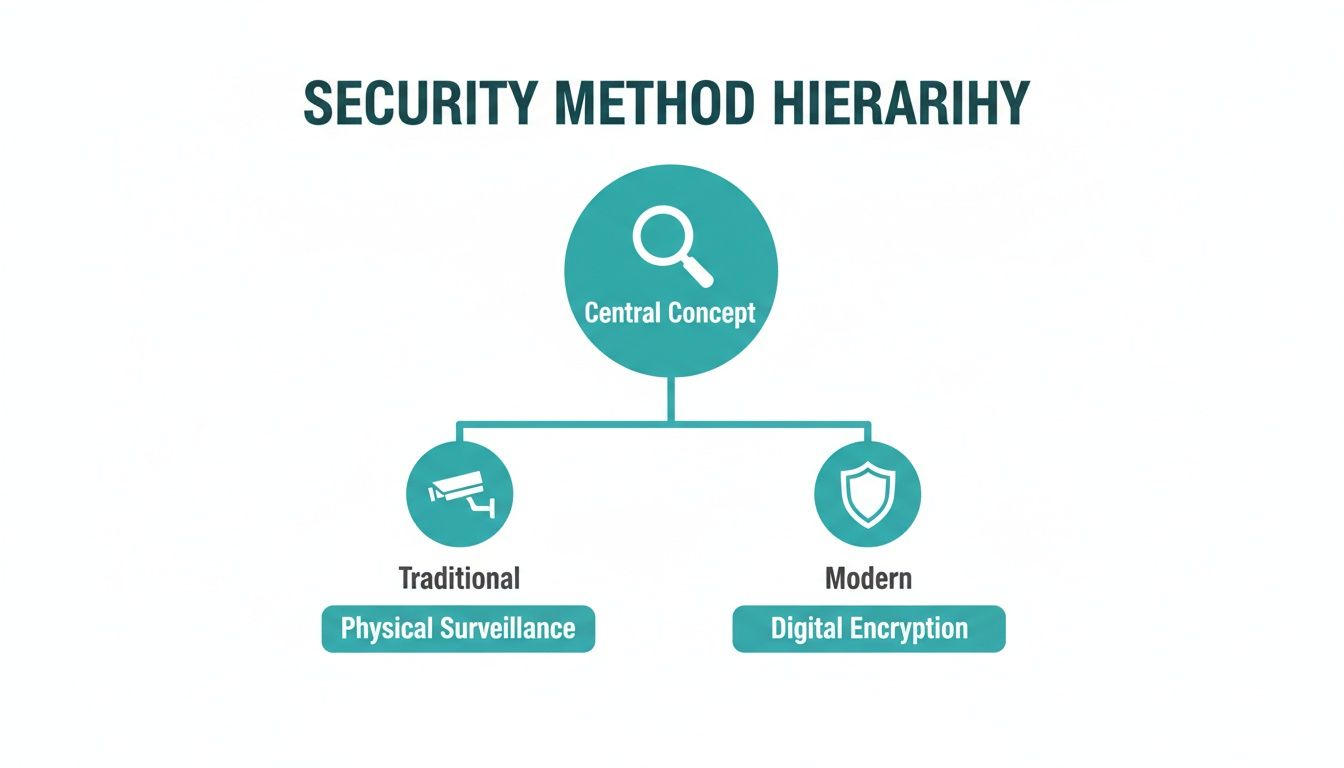
You can see how the modern approach turns away from invasive methods and toward a more strategic, protective stance that’s all about prevention.
The Pillars of an EPPA-Compliant Program
An effective and compliant framework rests on a few key pillars that work together to create a resilient, ethical insider threat prevention program. These principles are what make your risk management efforts both powerful and legally sound, helping you avoid the landmines of traditional surveillance.
The core components are non-negotiable:
Non-Intrusive Risk Identification: The system must analyze contextual and situational data—never personal communications. This means looking at risk indicators tied to conflicts of interest, unusual access patterns, or deviations from normal business processes, not reading emails or chats.
Privacy by Design: Employee privacy has to be baked into the architecture. The platform must be engineered to avoid any form of lie detection, psychological evaluation, or assessment of an employee's personal integrity, keeping it strictly EPPA-compliant.
Standardized Workflows: When a risk is flagged, a clear, predefined workflow engages the right stakeholders immediately. This eliminates guesswork and ensures every case is handled consistently, whether it just needs a simple policy reminder from HR or a formal review by Legal.
This structured approach is what turns insider risk management from a chaotic, reactive scramble into a predictable and governable business function.
From Policing to Proactive Risk Management
The most significant shift here is the move away from a policing mentality. Traditional security often creates an "us vs. them" relationship, breeding a culture of suspicion. In contrast, an ethical prevention model positions risk management as a supportive function designed to protect both the company and its people.
A modern prevention framework doesn't hunt for bad actors. It identifies systemic vulnerabilities and risk scenarios, allowing for early, low-impact interventions that mitigate potential harm before it ever materializes.
For example, instead of catching an employee emailing a sensitive file to a personal account and launching a punitive investigation, a proactive system might identify the root cause—like inadequate remote work tools—and flag it for HR to address. This resolves the source of the risk without creating a high-stakes disciplinary drama. It's about managing risk, not punishing mistakes.
This focus on systemic improvement is a cornerstone of maintaining a healthy and productive work environment. To explore this idea further, you can learn more about fostering integrity in the workplace through proactive and ethical policies.
By implementing a framework built on these principles, organizations can effectively manage the full spectrum of insider threat scenarios. This ethical, AI-driven approach allows leaders in Compliance, HR, and Risk to build a program that is not only highly effective and legally defensible but also preserves the culture of trust that is essential for long-term success.
The Role of AI in Human Risk Mitigation
How do you get ahead of an insider threat without deploying invasive surveillance that destroys trust and creates legal liability? The answer is a smarter, more ethical application of artificial intelligence. Modern AI-driven platforms are completely changing how organizations manage human risk, shifting the focus from watching people to understanding the context of business operations.
This technology doesn't act like a security camera. Think of it more like a sophisticated early warning system for your business processes. It's built to spot risk indicators by analyzing contextual and operational data—not by reading private messages or trying to perform psychological evaluations. That distinction is what makes it so powerful and, just as importantly, EPPA-compliant.

Shifting from Surveillance to Signal Detection
Traditional security tools are notorious for creating thousands of meaningless alerts that bury the real threats. In sharp contrast, an AI-powered human risk platform is designed to find the meaningful signals hidden deep within routine operational data. It excels at identifying the subtle patterns and anomalies that are impossible for human teams to catch at scale.
This is all done by analyzing metadata and situational context, not content. The system doesn't analyze what was said in an email. It identifies if a project manager in finance suddenly starts accessing sensitive engineering blueprints at 3 AM from a new location.
Key advantages of this approach include:
Scalability: AI can process millions of data points in real time to spot tiny deviations from established norms. No human team could ever keep up.
Objectivity: The system operates on objective, verifiable data tied to your organization's policies, stripping human bias out of the initial risk identification process.
Proactivity: It flags risk indicators at their earliest stages, creating a critical window for intervention before a small issue spirals into a major incident.
How Ethical AI Identifies Risk Without Intrusion
An ethical AI platform is engineered from the ground up to respect employee privacy and adhere to strict regulations like the EPPA. It avoids any kind of analysis that could be interpreted as lie detection, psychological profiling, or surveillance.
Instead, it connects the dots between disparate, non-personal data points to flag potential risk scenarios. For a more detailed breakdown, you can explore our complete guide to AI-powered human risk management.
The core principle here is that ethical AI analyzes what is happening inside business operations, not who a person is. It identifies conflicts of interest or policy deviations, enabling low-impact interventions that correct the course and mitigate risk without jumping to punitive measures.
For example, the AI might flag a situation where an employee with access to sensitive M&A data also has a close family connection to a key figure at the target company—a clear conflict of interest. This allows HR or Compliance to have a proactive, non-confrontational conversation to manage the risk, rather than waiting for a leak and launching a costly forensic investigation.
Enabling Early and Low-Impact Interventions
The biggest benefit of AI-driven risk mitigation is that it empowers you to take early, low-impact action. By catching risk indicators before they become malicious acts or serious mistakes, the organization can respond in a way that’s constructive, not punitive.
This preventive posture completely transforms how you manage an insider threat. Instead of a high-stakes investigation after a data breach, the response might be a simple policy clarification, extra training, or a quick review of access controls. This not only protects the company’s assets but also preserves a culture built on trust and integrity.
For a deeper dive into the ethical considerations and practical applications, exploring the impact of AI in corporate environments can provide valuable context. It reinforces that when implemented correctly, AI becomes a partner in governance, not a tool for policing.
It's Time to Get Ahead of Insider Threats
Managing the modern insider threat is no longer a niche security task handled in a silo. It’s a core business function—just as essential as governance, compliance, and protecting your brand. Legacy, reactive methods are not just ineffective but financially unsustainable. The new standard is a proactive, ethical, and AI-driven approach that prioritizes prevention over investigation.
This forward-thinking strategy moves beyond the futile exercise of reacting to damage after it's done. By focusing on prevention, you do more than just protect company assets; you build a more resilient and trustworthy organization. It's time to stop chasing incidents and start systematically managing the human-factor risk that causes them.
The journey from a reactive posture to a proactive one requires a new way of thinking and the right operational tools. Equipping your teams with a platform that supports this ethical framework is the critical next step.
Adopting the New Standard of Risk Management
Making this transition successful isn't about adding another layer of security; it's about building a smarter, more efficient governance model based on a few core principles.
Unify Your Teams: Break down the walls between HR, Legal, Compliance, and Security. A unified platform like E-Commander / Risk-HR provides a single source of truth, ensuring every stakeholder is working from the same data with standardized workflows. This eliminates confusion and creates a consistent, defensible response to any identified risk.
Prioritize Ethical, Non-Intrusive Methods: Your program must be built on a foundation of trust and regulatory compliance. Choose an EPPA-compliant platform that identifies risk without surveillance, lie detection, or psychological assessments. This protects employee dignity and shields your organization from significant legal liability.
Use AI for Early Detection: Deploy AI human risk mitigation to analyze contextual and operational data, spotting risk indicators that human teams would miss. This enables early, low-impact interventions—like a policy clarification or an access review—that neutralize threats before they can escalate into a crisis.
The ultimate goal is to create a resilient organization where risk is managed proactively, ethically, and efficiently. This protects your financial health, safeguards your reputation, and fosters a culture of integrity where employees are seen as partners in protection, not potential suspects.
The path forward is clear. By implementing a proactive, AI-driven framework for managing your insider threat program, you can move beyond the endless cycle of costly investigations. You can start building a stronger, more secure future for your organization, one where risk is anticipated and neutralized before it ever becomes damage.
Frequently Asked Questions
When you start digging into insider risk management, a few critical questions always come up for leaders in Compliance, HR, and Security. Let's tackle some of the most common ones and give you some straight answers that align with an ethical, proactive framework.
How Is an Insider Threat Program Effective Without Monitoring Employees?
This is a huge one, and it gets to the heart of the modern approach. An effective program isn't about invasive employee monitoring at all; it's about identifying contextual risk indicators.
Instead of tracking keystrokes or reading private emails—which is legally and culturally a minefield—an AI-driven platform analyzes metadata and situational factors. Think of it less like surveillance and more like an intelligent safety system. It's designed to spot things like a clear conflict of interest or unusual access requests that just don't fit with normal business operations, all without ever inspecting the content of an employee's work.
This method gives you powerful, early-stage risk signals that are fully aligned with regulations like EPPA. It allows you to step in and fix a problem before it turns into misconduct or a serious error, all while respecting employee privacy.
What Is the Difference Between an Insider Threat and an Insider Risk?
People often use these terms interchangeably, but there’s a crucial difference. Think of it this way: an "insider threat" is the final, damaging event. It’s the active, often malicious, person who is causing or about to cause real harm. It’s the fire that's already burning.
"Insider risk" is a much broader and more strategic concept. It covers the entire spectrum of potential harm that can come from inside your organization, including:
Unintentional mistakes (negligence)
Stolen credentials (exploitation)
Deliberate malicious acts
A mature governance program doesn't just wait for a threat to appear. It focuses on managing the entire landscape of "insider risk." This strategy is about proactively mitigating the conditions that could lead to a threat in the first place. It’s about preventing the fire, not just putting it out.
How Does an AI-Driven Platform Ensure It Is EPPA Compliant?
Simple: compliance with the Employee Polygraph Protection Act (EPPA) is baked into the design from day one, not bolted on as an afterthought. An ethical, AI human risk mitigation platform is built specifically to avoid any form of lie detection, psychological assessment, or coercive analysis that the act strictly prohibits.
The AI doesn't measure honesty, truthfulness, or stress levels. It can't. Instead, it operates on objective, verifiable data tied directly to your business processes and predefined risk scenarios. It identifies risk indicators based on your own organizational policies and contextual analytics, presenting objective findings for a human to review.
By never even attempting to gauge an employee's internal state or veracity, the system stays firmly within the compliant boundaries of risk management, protecting both your organization and your people.
Ready to move beyond reactive investigations and build an ethical, proactive insider threat program? Logical Commander provides the AI-driven, EPPA-compliant platform to help you manage human risk without surveillance.
Get Platform Access: Start your free trial today.
See It in Action: Request a demo tailored to your organization.
Become an Ally: Join our PartnerLC ecosystem and deliver the new standard in risk prevention.
Enterprise Solutions: Contact our team for a consultation on large-scale deployment.