%20(2)_edited.png)

What Is Operational Risk Management in Modern Business?

Updated: Feb 10
At its core, operational risk management is the framework that protects a business from its own internal weak spots. It’s all about getting ahead of potential losses that come from broken internal processes, human mistakes, system meltdowns, or even major external disruptions. In regulated industries, failing to manage these risks proactively isn't just a business problem—it's a direct threat to compliance, liability, and reputation.
For decision-makers in Compliance, Risk, and Legal, this isn't a theoretical exercise. It’s the essential discipline for safeguarding revenue, protecting the company’s good name, and ensuring day-to-day operations are resilient against internal threats.
Understanding Operational Risk Management Today
Modern operational risk management (ORM) has evolved into a strategic necessity. The old model of reactive, siloed teams putting out fires is no longer defensible. It exposes the organization to unacceptable liability. The modern approach demands a proactive, unified strategy that integrates your people, processes, and technology to prevent incidents before they cause business-altering damage.
This modern view of what is operational risk management starts with a simple truth: the most damaging failures often begin with the human factor. While market shifts or external events are significant, the slow burn from flawed procedures, tech failures, and human behavior can inflict more profound, lasting damage.
The Human Factor in Operational Risk
One of the biggest shifts in modern ORM is its intense focus on the human element. For too long, human-related risks were treated as unpredictable, isolated events. This is a dangerous oversight.
Today’s leading organizations understand that the human factor isn’t just another category of risk—it is the root cause that links nearly all other operational failures. Internal threats like fraud, compliance breaches, or data leaks aren't random. They are symptoms of deeper vulnerabilities in your operational controls and governance.
Effective ORM digs into these human-factor risks by asking tough, business-critical questions:
Are our internal controls strong enough to prevent misconduct before it impacts the business?
Do our processes inadvertently create opportunities for insider risk to materialize?
How can we identify behavioral red flags ethically and proactively, without resorting to invasive, EPPA-non-compliant surveillance?
Answering these questions with outdated, reactive methods—which only start after a crisis—is a failed strategy. The entire goal is to build a preventive framework that neutralizes these internal threats before they lead to financial loss and reputational ruin.
From Silos to a Unified Strategy
Traditionally, ORM was stuck in departmental silos. The finance team worried about financial risks, IT handled system risks, and HR dealt with employee conduct. This fragmented approach creates massive blind spots, because real-world risks rarely stay in one lane. An internal threat can easily cross departmental lines.
For example, a weak background check process (HR) could allow an individual to exploit a loophole in financial controls (Finance) using a known system vulnerability (IT). The connection is clear, but siloed teams will miss it every time.
A unified operational risk management strategy breaks down these silos. It integrates intelligence from across the organization to create a holistic view of internal threats and weaknesses, enabling truly informed, proactive prevention.
This integrated approach is the new standard of internal risk prevention. It uses AI-driven technology not to spy on employees, but to understand systemic risk patterns. By centralizing insights, organizations can finally move from a reactive defensive posture to proactively strengthening their operational resilience. This is what separates thriving, compliant companies from those constantly managing crises.
The Essential Pillars of an ORM Framework
An effective operational risk management framework isn't a one-off project; it's a continuous cycle built on four critical pillars. This structure transforms ORM from a theoretical compliance exercise into a practical, value-driven business function that actively protects against liability. It ensures that internal threats aren't just spotted but are managed from discovery through to resolution and ongoing oversight.
These pillars provide a systematic way to understand what is operational risk management in the real world. When they work together, they create a resilient organization that can anticipate and neutralize threats before they ever disrupt the business. The whole process hinges on a seamless flow of information and coordinated action across all four stages.
Risk Identification: The First Step
Risk identification is the foundational pillar—it's your organization’s early warning system for internal threats. In the past, this might have been a simple review of past incidents. But modern ORM demands a far more structured approach to uncover vulnerabilities tied to processes, systems, and most importantly, the human factor.
True identification cannot happen in a silo. Your IT department might flag a system vulnerability, while HR notices a pattern in exit interviews hinting at a cultural problem. Seen separately, these are just isolated data points. But when integrated, they could signal a significant insider risk brewing beneath the surface.
A modern framework requires a unified system to centralize this intelligence. By connecting insights from HR, Compliance, and Security, leaders can finally build a comprehensive, 360-degree view of internal threats and operational weaknesses. This is how you prevent incidents based on a complete picture of risk.
Risk Assessment and Analysis
Once a risk is on the radar, you must assess it to understand its potential business impact and likelihood. This is where raw data is transformed into actionable intelligence. The goal is to prioritize threats so that resources are focused on the vulnerabilities posing the greatest danger to your revenue, reputation, and regulatory standing.
This stage is crucial for avoiding the "boil the ocean" trap where teams are paralyzed by a long list of low-priority risks. A sharp assessment, often powered by a Risk Assessments Software, helps leaders distinguish between minor issues and potential crises that demand immediate attention.
Risk Mitigation and Control
Mitigation is where proactive prevention happens. This pillar involves taking concrete steps to address the identified and assessed risks. The goal is to reduce the likelihood of an incident or minimize its impact. It’s not about eliminating all risk—that’s impossible—but about managing it down to an acceptable level to protect the business.
This simple lifecycle is the core of the ORM process, moving from identification to analysis and finally to mitigation.
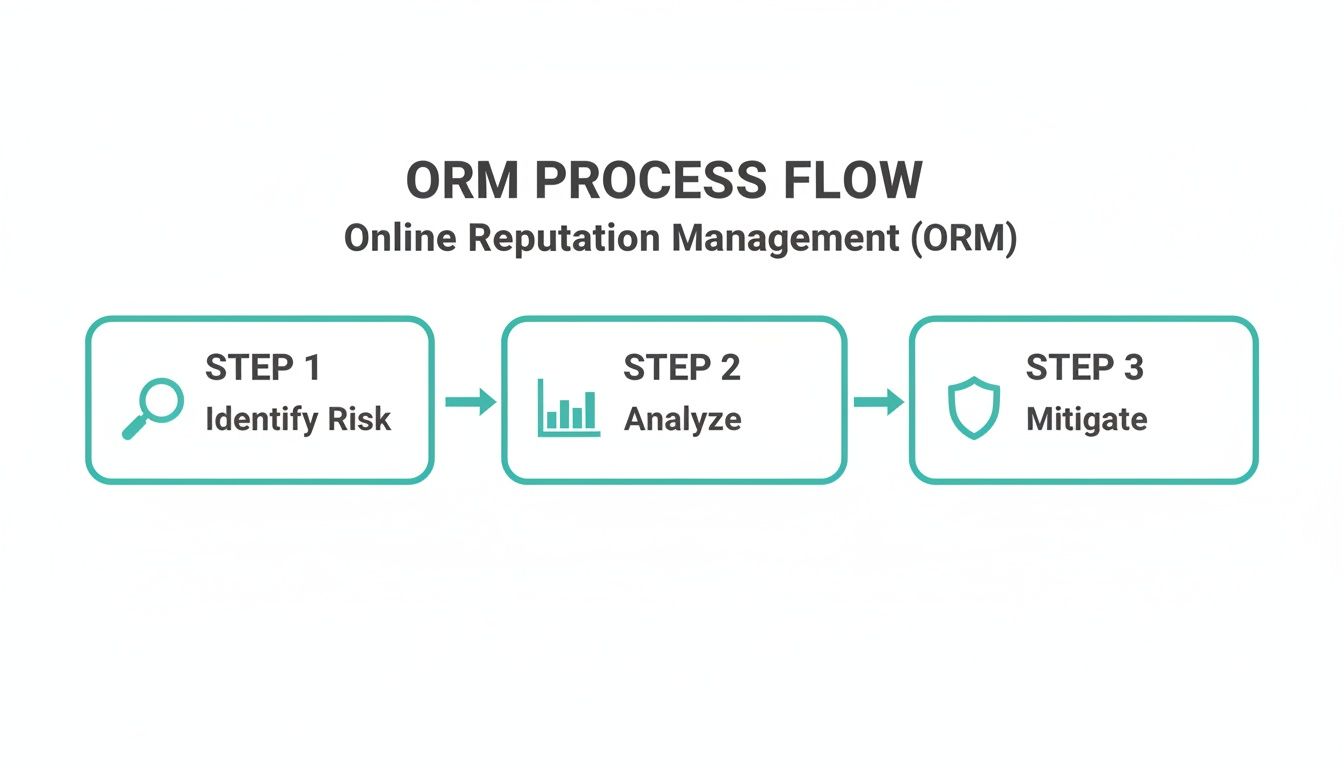
This flow highlights that ORM is a structured, repeatable process designed to systematically shrink an organization's exposure to both internal and external threats, thereby reducing liability.
Monitoring and Reporting
The final pillar, monitoring, makes ORM a living discipline. Continuous monitoring ensures your mitigation strategies are working and that your risk profile adapts to new threats. This involves tracking Key Risk Indicators (KRIs), conducting regular audits, and generating clear reports for leadership and regulators.
The operational risk landscape has changed. A recent study revealed that organizations are now operating in a 'new era of disruption' where technological, geopolitical, and workforce risks are interconnected. This finding makes it clear why traditional, siloed risk management is a failed model. You can explore the full findings of the Aon Global Risk Management Survey to learn more about these interconnected threats.
Effective monitoring and reporting provide the visibility needed to navigate this complex environment, ensuring the ORM framework remains a relevant and effective defense against liability.
Why Proactive Prevention Outperforms Reactive Investigation
In traditional risk management, too many organizations wait for an alarm before acting. This reactive approach, built around post-incident investigations, is fundamentally broken. By the time you act, the damage is already done. You're left managing the fallout of financial loss, a battered reputation, and operational chaos—a position no leader wants to be in.
The problem with a reactive stance is that it only treats symptoms, not the root cause. Most operational failures, especially those involving the human factor, are preceded by a trail of identifiable warning signs. Legacy methods relying on whistleblowers are designed to miss these signals, leaving you perpetually vulnerable to internal threats.
This "wait-and-see" model isn't just inefficient; it's a massive liability. Every day an internal threat goes undetected, the potential for damage grows. The cost and failure of reactive investigations are immense, yet preventable.

The Hidden Costs of Waiting for Failure
Reactive investigations are deceptively expensive. The obvious costs—legal fees, regulatory fines—are just the tip of the iceberg. The hidden costs inflict the real long-term damage on an organization's stability and compliance posture.
Consider the full spectrum of expenses:
Operational Disruption: Investigations pull key people away from their core duties for weeks, grinding productivity to a halt.
Reputational Damage: News of a compliance breach or internal misconduct shatters trust with customers, investors, and partners. Rebuilding it can take years.
Employee Morale: Internal investigations can create a toxic culture of suspicion, tanking engagement and leading to higher turnover.
Legal and Compliance Exposure: Waiting for an incident shows regulators a clear lack of proactive controls, often leading to harsher penalties.
A proactive prevention strategy transforms operational risk management from a costly, reactive exercise into a powerful competitive advantage. It’s about protecting assets, preserving stakeholder confidence, and ensuring business continuity before a crisis strikes.
Making the switch to a proactive model demands a shift in both mindset and technology. Instead of asking, "How do we investigate what went wrong?" the focus becomes, "How do we spot and neutralize risks before they escalate?" This is where modern, ethical risk management platforms become essential. For a deeper analysis, learn more about the true cost of reactive investigations.
Embracing Ethical and Proactive Prevention
The new standard for operational risk management is ethically identifying risk signals without resorting to invasive surveillance. Advanced, AI-driven platforms provide the tools to analyze risk indicators in a way that is fully compliant with regulations like the Employee Polygraph Protection Act (EPPA).
This ethical approach respects employee privacy by focusing on patterns of risk indicators, not personal behaviors. It moves away from legally risky surveillance methods and instead provides a framework for early, ethical intervention. Concepts like data protection by design align perfectly with this forward-thinking ORM strategy, building risk mitigation directly into your processes.
By adopting a proactive stance, organizations can:
Identify vulnerabilities early: Pinpoint weaknesses in processes and controls before they can be exploited by an internal threat.
Mitigate insider risk: Address human-factor risks before they lead to fraud, misconduct, or compliance breaches.
Strengthen governance: Demonstrate a clear commitment to ethical risk management and robust internal controls.
Protect financial health: Prevent the massive losses associated with reactive damage control.
Ultimately, proactive prevention is the only sustainable path forward. It allows leaders in Risk, Compliance, and HR to move beyond crisis management and build a truly resilient, compliant, and reputable organization.
For too long, operational risk management has forced a false choice between security and ethics. Many old-school systems rely on invasive employee surveillance or other techniques that violate regulations like the Employee Polygraph Protection Act (EPPA). This model is ethically broken and ineffective, as it waits for damage to occur.
A modern, ethical approach to managing operational risk—especially the human element—is essential. Logical Commander’s AI-driven platform sets a new standard for preventing internal threats, empowering organizations to be proactive without sacrificing employee privacy or dignity. This is how technology becomes a true partner in strong governance and reputation protection.

The New Standard for Internal Risk Prevention
The future of operational risk management lies in moving from periodic reports toward continuous, real-time risk intelligence. This shift acknowledges a simple truth: risks don't operate on a quarterly schedule; they evolve constantly.
Platforms like Logical Commander's E-Commander and its Risk-HR module embody this new standard. They are the ethical, EPPA-aligned alternative to surveillance. They break down the silos that let threats fester, pulling risk intelligence from HR, Compliance, Legal, and Security into a single, unified system. This creates a cohesive view of human-factor risks without ever resorting to intrusive monitoring.
This ethical framework operates on a powerful principle: analyze risk indicators, not people. By focusing on patterns and anomalies in data already within the organization, these systems flag potential issues tied to misconduct, fraud, or compliance breaches. This allows leaders to mitigate risks before they explode into costly incidents.
How Ethical AI Works in Practice
An EPPA-aligned platform provides a structured, non-intrusive way to manage the human side of operational risk. Instead of surveillance, it focuses on analyzing systemic risk factors.
Here’s how this approach redefines internal threat detection:
It is Non-Intrusive: The system analyzes metadata and process indicators without reading personal emails or tracking keystrokes. This is ethical risk management that respects privacy while identifying concerning patterns.
It is EPPA-Compliant: By design, the platform avoids any form of lie detection, psychological evaluation, or coercive analysis, keeping the organization safely within legal and ethical boundaries.
It is Proactive: The goal is to provide early warnings. For example, the system might flag a pattern of unauthorized access attempts combined with unusual data transfers, prompting a review before a data breach occurs.
This technology empowers organizations to be both proactive and ethical. It allows leaders to uphold their duty of care by protecting the business from harm while treating employees with dignity.
A Clear Break from Legacy Systems
The difference between this new standard and outdated methods is stark. Legacy systems are reactive, legally risky, and create a culture of distrust. The modern, AI-driven approach is preventive, compliant, and helps build a culture of integrity. Surveillance-based tools are not only ethically questionable but also ineffective, as they focus on reaction, not prevention.
Old vs New Standards in Internal Risk Management
Attribute | Reactive Investigations (Old Standard) | Logical Commander (New Standard) |
|---|---|---|
Philosophy | Reacts after an incident causes damage. High cost and liability. | Identifies and mitigates risk indicators proactively. Focus on prevention. |
Methodology | Often relies on invasive surveillance and legally questionable monitoring tools. | Uses non-intrusive, EPPA-compliant AI to analyze systemic risk factors, not people. |
Legal Posture | High risk of violating EPPA, privacy laws, and labor regulations. | Designed for compliance, respecting employee rights and dignity. |
Cultural Impact | Creates a culture of suspicion and fear, harming morale and retention. | Fosters a culture of integrity, transparency, and psychological safety. |
Outcome | Expensive investigations, regulatory fines, and significant reputational damage. | Prevents costly incidents, strengthens governance, and protects organizational assets. |
Adopting an ethical, AI-driven platform for internal threat detection is critical for leaders in regulated industries. It's not just about better risk management; it's about building a resilient and trustworthy organization from the inside out. Exploring an enterprise risk management software solution that aligns with these principles is the clear next step.
Overcoming Common ORM Implementation Challenges
Knowing what operational risk management is represents the starting line. Successfully implementing it is the real challenge. Many organizations stumble over common hurdles that undermine their efforts, leaving them exposed to significant liability. These roadblocks usually stem from outdated thinking, disconnected systems, and a failure to address the human element at the heart of most risks.
To launch an ORM program that actually reduces liability, you must anticipate these obstacles. The usual suspects include stubborn data silos, a weak risk culture, reliance on slow manual processes, and forgetting that the human factor is the root cause of most incidents.
Dismantling Data Silos
One of the biggest barriers to effective ORM is the data silo. When critical risk intelligence is locked away in separate departments—HR, Legal, Compliance, Security—you cannot get a complete picture of internal threats. Each team sees only a piece of the puzzle, creating massive blind spots that bad actors can exploit.
The only way out is to adopt a centralized risk platform. A unified system becomes your single source of truth, pulling intelligence from across the organization to give you a holistic view of operational weaknesses and human-factor risks. This tears down communication walls and empowers proactive, cross-functional risk mitigation.
Fostering a Proactive Risk Culture
An ORM framework is only as good as the culture supporting it. If employees see risk management as a top-down, blame-focused function, they will resist it. A culture built on reactive investigations and punishment kills transparency and encourages people to hide mistakes.
Leadership must champion a shift toward prevention. This means reframing ORM as a protective discipline that safeguards both the organization and its people. It’s about strengthening processes and offering support, not policing behavior. By celebrating early risk identification and focusing on proactive measures, you build a culture of integrity and empower everyone to own risk management. For more, see our guide on internal controls to prevent fraud.
Moving Beyond Manual Processes
Many organizations still rely on spreadsheets and manual follow-ups to manage operational risk. These old-school processes are inefficient, dangerously slow, and riddled with human error. In a dynamic environment where internal threats evolve daily, manual methods cannot keep up, leaving critical vulnerabilities open.
Automating key workflows is no longer optional. Using an AI human risk mitigation platform automates data collection, risk assessments, and monitoring. This frees your risk teams from administrative work to focus on strategic analysis and intervention, directly reducing your organization's liability.
Addressing the Human Element in Cyber Risk
A huge pitfall is misunderstanding the link between cyber threats and the human factor. Cyber incidents consistently rank as a top concern, as noted in the Allianz Risk Barometer. It's a mistake to view this as a purely technical problem. Nearly all cyberattacks are enabled by human action or inaction. We are not a cyber company—our focus starts and ends with humans.
An effective ORM program recognizes that human-factor risk is the root cause of most operational failures, including those in the cyber domain. The focus should be on mitigating the human behaviors that create vulnerabilities, not just on building taller technical walls.
By adopting an ethical, non-intrusive way to understand these behavioral precursors, organizations can finally address the true source of their risk. This human-centric strategy is the key to building an operational risk management framework that is genuinely resilient.
Setting the New Standard for Enterprise Risk Governance
If you’re still managing operational risk with reactive investigations and disconnected processes, you’re not just behind the curve—you're accepting failure and liability as inevitable. The old model of waiting for a crisis is broken. It only addresses problems after the damage is done.
The time for waiting for things to break is over. A smarter, more proactive approach to what is operational risk management isn't just an option; it's the new benchmark for modern governance, compliance, and reputation protection.
This new standard is built on prevention. It recognizes that the most severe risks, especially those tied to the human factor, almost always send out early warning signals. The challenge has always been detecting those signals without resorting to invasive surveillance or legally questionable tactics.
Proactive, Ethical, and Compliant Prevention
The future of risk governance isn't a choice between security and privacy. It's about leveraging intelligent, AI-driven platforms that deliver both. This approach proves you can protect your organization while respecting employee dignity. An EPPA compliant platform provides a clear path forward, allowing you to get ahead of internal threats before they explode into major incidents.
This modern model is defined by key principles:
A Unified View: It smashes data silos across HR, Compliance, Legal, and Security to create a single, holistic picture of human-factor risk.
Non-Intrusive Analysis: It focuses on systemic risk patterns and behavioral indicators—not personal communications—to ensure employee privacy is never compromised.
Proactive Mitigation: It delivers actionable intelligence, empowering leaders to intervene early, shore up internal controls, and prevent misconduct before it takes root.
By shifting from a reactive firefight to a proactive strategy, operational risk management stops being a cost center and becomes a powerful strategic enabler. It's the engine that protects your financial assets, preserves stakeholder trust, and guarantees long-term resilience.
For any leader serious about protecting their organization, adopting this new standard is non-negotiable. To learn more about building a robust framework, explore our comprehensive guide to enterprise risk management. The strategies for building a safer, more resilient organization are here today.
Your Questions About ORM, Answered
Even with a clear game plan, leaders often have questions about putting operational risk management into practice. Let's tackle some of the most common ones to clarify its role and how a modern, proactive approach can be applied effectively and ethically in any organization.
What Is the Difference Between Operational Risk and Financial Risk?
Think of it this way: financial risk is about the money—market volatility, credit defaults, or bad investments. Operational risk, on the other hand, is about the machinery that makes the money. It covers potential losses from failed internal processes, human-factor risk, system failures, and other internal breakdowns.
A market crash is a financial risk. An employee committing fraud that costs millions? Or a critical system outage that halts production? Those are operational risks. Sharp ORM stops the internal failures that almost always lead to severe financial and reputational pain.
How Can We Implement ORM Without Creating a Culture of Distrust?
This is a critical question. The answer is to abandon invasive surveillance. The goal is to shift the focus from punishment to prevention. A modern ORM strategy uses an ethical, EPPA compliant platform that analyzes systemic risk patterns without monitoring individual employees' activities.
This non-intrusive approach lets you spot and fix vulnerabilities before they cause harm. By demonstrating a commitment to protecting both the organization and its people, you build a culture of trust and shared responsibility—not one of suspicion. This is the new standard of internal risk prevention.
Is ORM Only for Large Financial Institutions?
Not at all. While the discipline has deep roots in banking, ORM is essential for any mid-to-large organization, especially in regulated industries. If your business has employees, internal processes, and technology, you face significant operational risks every day.
The internal threat might be supply chain disruption, fraud, or a major compliance breach, but the principles are universal. Identifying, assessing, and mitigating these risks are fundamental to ensuring your business stays resilient, protecting your bottom line, and safeguarding your reputation.
At Logical Commander, we are setting the new standard of internal risk prevention. Our AI-driven, EPPA-compliant platform is the ethical, non-intrusive alternative to surveillance, enabling organizations to manage internal threats proactively. Move beyond reactive investigations and protect your organization from the inside out.
Start a Free Trial: Get access to our platform and see the difference.
Request a Demo: Let our experts show you how to reduce liability and strengthen governance.
Join our Partner Program: Become an ally in our PartnerLC ecosystem and bring proactive risk management to your clients.
Contact Us: For enterprise deployment and tailored solutions.
Request a demo today to see how our non-intrusive technology can transform your operational risk management.