%20(2)_edited.png)

Top 12 Enterprise Risk Management Tools for 2025: A Comprehensive Guide
- Marketing Team
- Dec 7, 2025
- 18 min read
Updated: Dec 11, 2025
In today's landscape of complex regulations, digital threats, and heightened stakeholder expectations, managing enterprise risk is no longer a siloed function; it's a strategic imperative. Spreadsheets and fragmented processes can't keep pace, creating visibility gaps that leave organizations vulnerable. The right enterprise risk management tools centralize data, automate workflows, and provide the clarity needed to transform risk from a threat into a strategic advantage.
This guide cuts through the noise, offering a detailed comparison of the top 12 solutions to help you make an informed decision. We move beyond generic feature lists to provide an in-depth analysis for professionals in Human Resources, Internal Threats, Operational Risk, and Corporate Security roles. Many of these platforms leverage advanced features like workflow automation to streamline processes, such as incident reporting and policy enforcement, ensuring consistent application and auditable trails.
Our curated list examines each tool's core strengths, practical use cases, and potential limitations. You will find a clear breakdown of how each platform addresses key evaluation criteria, from compliance and privacy to integration capabilities and auditability. Throughout this resource, you'll see screenshots and direct links to help you navigate your options efficiently. This article is designed to equip you with the insights needed to select a solution that not only mitigates threats but also aligns with your organization's ethical and strategic goals.
1. Logical Commander Software Ltd.
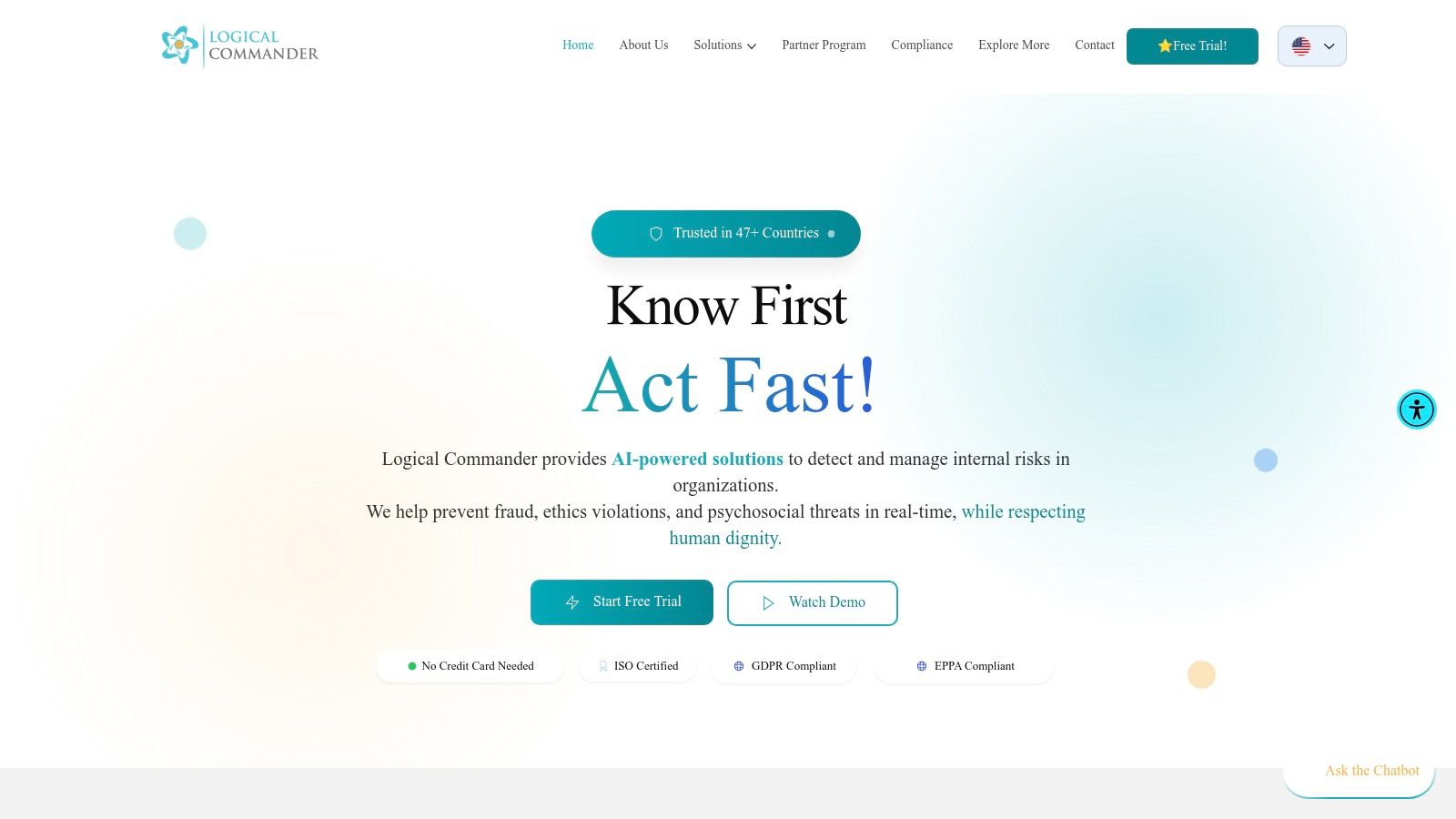
Logical Commander’s E-Commander platform presents a compelling and modern solution in the landscape of enterprise risk management tools, particularly for organizations prioritizing privacy and ethical governance. It operates as a unified operational backbone, designed to detect and prevent internal threats and human-capital risks without resorting to invasive surveillance, psychological profiling, or coercive methods. This approach preserves employee dignity while equipping leadership with actionable intelligence.
The platform centralizes risk data, compliance tracking, and mitigation workflows, enabling collaborative action between HR, Security, Legal, and Compliance teams. Its AI-driven engine focuses on surfacing Preventive and Significant Risk indicators, functioning as a sophisticated decision-support system rather than an automated judge. This "ethical-by-design" framework ensures that human oversight remains central to the investigative and remediation process, a critical factor for maintaining trust and ensuring legal defensibility.
Core Strengths and Use Cases
E-Commander excels in scenarios where fragmented, manual processes (like spreadsheets and inconsistent interviews) create blind spots. Its auditable workflows replace guesswork with traceable, evidence-based documentation, which is crucial for internal audits and regulatory scrutiny.
Proactive Internal Threat Mitigation: Instead of reacting to incidents, the system flags leading indicators of potential misconduct or policy violations, allowing for early, non-confrontational intervention. This is a key tool for mitigating risks related to fraud, data exfiltration, and workplace conflicts. For a deeper dive into this area, you can learn more about its approach to human capital risk management.
Compliance and Governance: The platform is aligned with major international standards like ISO 27001/27701, GDPR, EPPA, and anti-corruption frameworks. This makes it an ideal choice for global enterprises needing to standardize their risk management practices across diverse regulatory environments.
High-Stakes Hiring and Retention: Customer testimonials highlight significant improvements in hiring and retention, with one reporting a 45% reduction in turnover for high-security roles. The system helps ensure that hiring decisions are based on verified, objective risk data.
Implementation and Access
Logical Commander emphasizes rapid, measurable ROI, with a modular architecture that scales from small teams to global enterprises with over a million employees. The company offers a free trial without requiring a credit card, allowing organizations to experience its value proposition firsthand. Insights are generated from the moment the platform is activated. While list pricing is not publicly available, prospective users can request a custom quote tailored to their specific module and integration needs.
Visit the website: https://www.logicalcommander.com
2. IBM OpenPages
IBM OpenPages is a highly modular and AI-powered platform designed for large-scale Governance, Risk, and Compliance (GRC) and Enterprise Risk Management (ERM) programs. It centralizes siloed risk management functions into a single, integrated framework. This tool is particularly well-suited for heavily regulated industries like finance, healthcare, and energy that require comprehensive oversight across multiple risk domains.
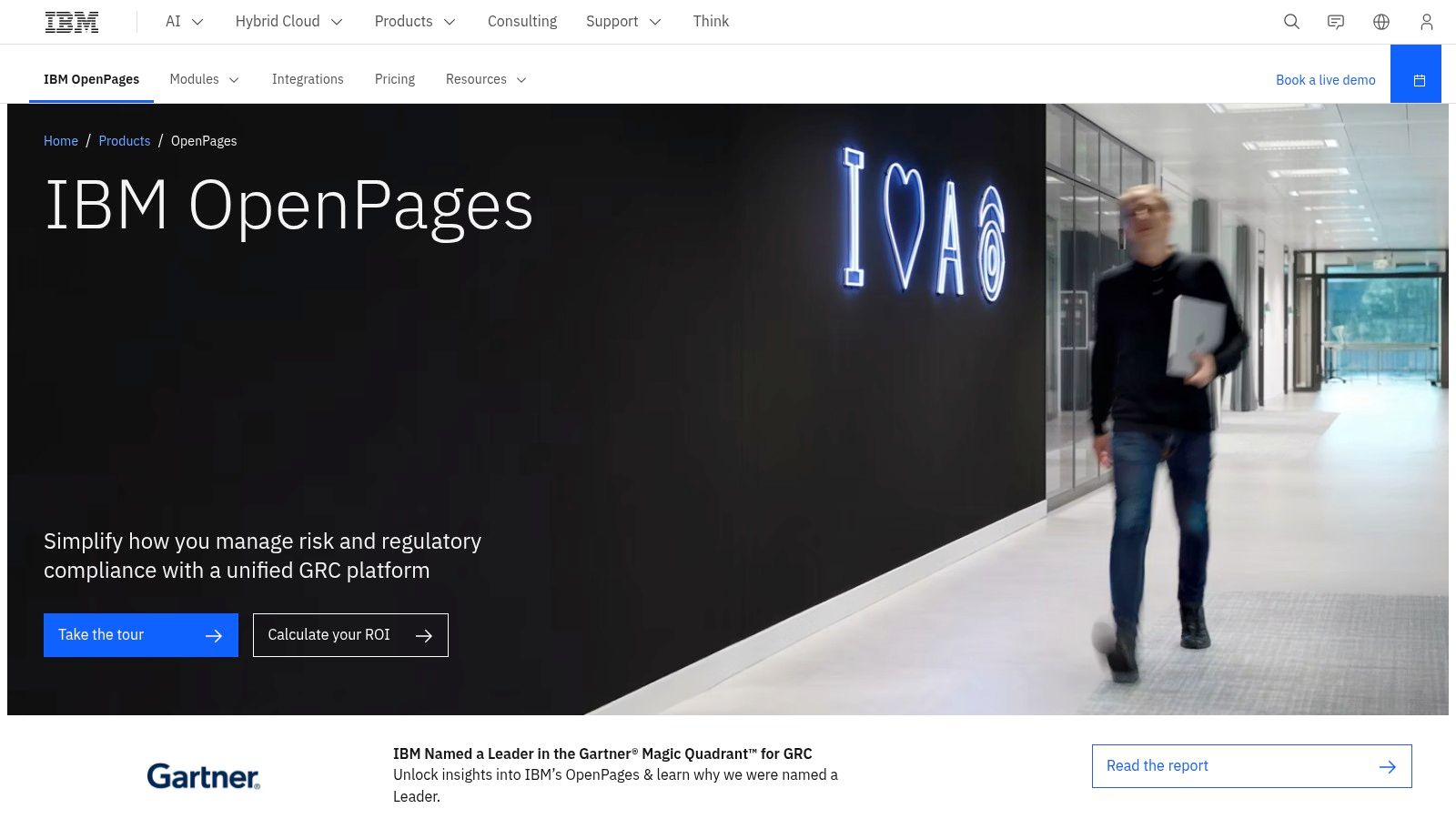
The platform’s strength lies in its purpose-built modules. A financial services firm could implement the Model Risk Governance module to validate and monitor its complex trading algorithms, while a multinational corporation might leverage the Third-Party Risk Management module to track vendor compliance across global supply chains. Its integrated dashboards provide a unified view of Key Risk Indicators (KRIs) and loss events, enabling a more proactive risk posture.
Analysis and Implementation
What makes IBM OpenPages one of the top enterprise risk management tools is its robust analytics engine, powered by IBM Cognos and Watson AI. These AI assistants help classify risks and automate compliance tasks, reducing manual effort for risk and internal audit teams. While the platform is immensely powerful, its enterprise-grade nature means implementation is a significant project. It requires dedicated IT resources and a clear project scope to configure workflows and integrations effectively. Pricing is tailored for large enterprise deployments, so smaller organizations may find it less cost-effective.
Best For: Large, mature enterprises in regulated industries needing a comprehensive, all-in-one GRC/ERM solution.
Key Feature: AI-driven analytics and specialized modules for specific risk areas like model and third-party risk.
Limitation: The implementation complexity and enterprise-level pricing can be a barrier for mid-sized companies.
3. ServiceNow Governance, Risk, and Compliance (GRC)
ServiceNow Governance, Risk, and Compliance (GRC) integrates ERM directly into an organization’s operational fabric by leveraging the native ServiceNow Platform. This suite is uniquely positioned for companies already using ServiceNow for IT Service Management (ITSM) or Security Operations (SecOps), as it unifies risk, compliance, and audit functions with existing IT and operational workflows. It transforms risk management from a siloed activity into a real-time, integrated process.
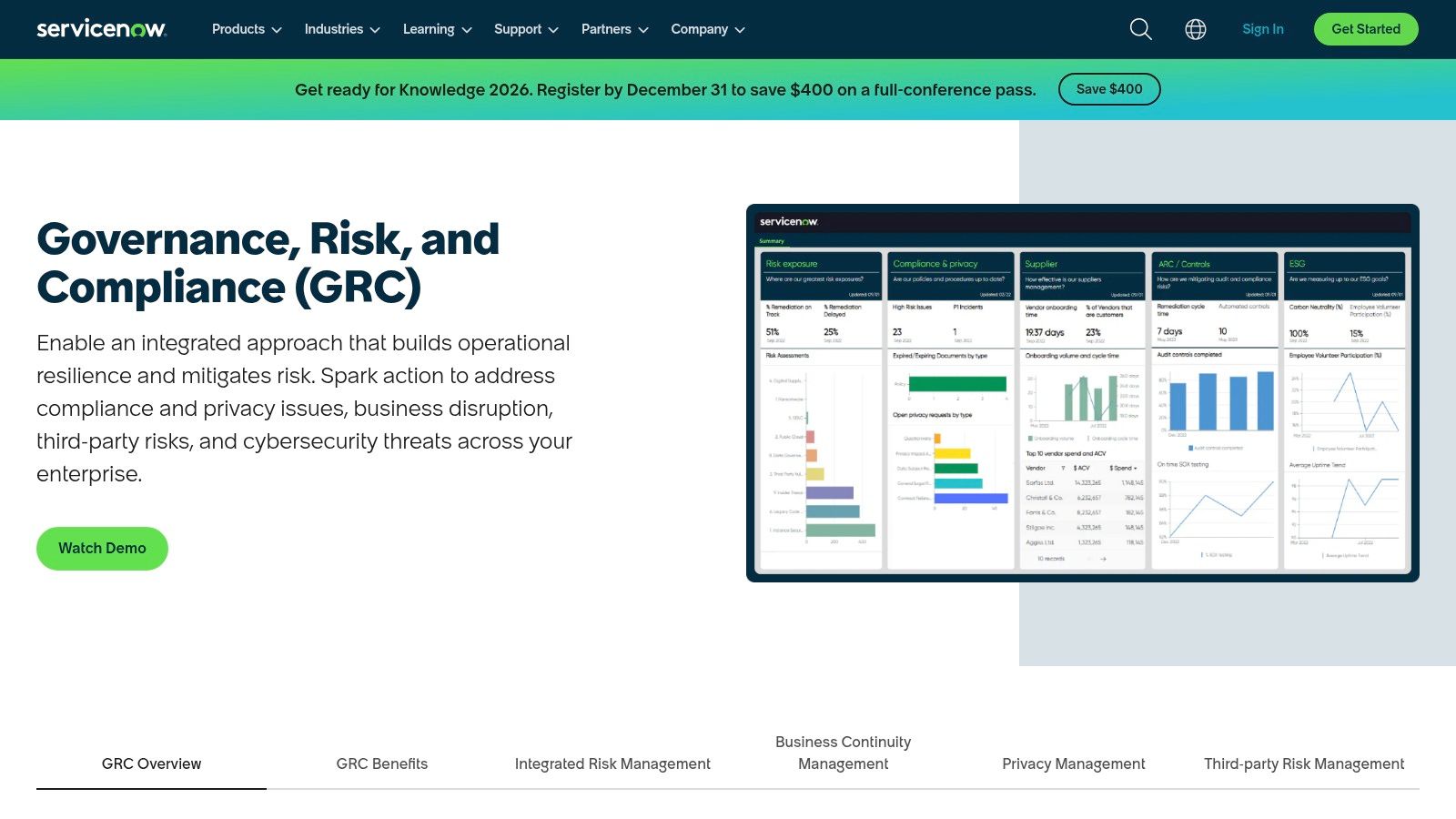
The platform excels at operationalizing risk management through powerful, no-code workflow automation. For example, an IT team can automatically trigger a risk assessment for a new software vendor during the procurement process, linking third-party risk directly to IT asset management. Similarly, a critical data privacy finding can initiate a workflow to ensure old hardware is disposed of properly, ensuring adherence to established guidelines like the NIST SP 800-88 data sanitization standards. You can learn more about how this connects to a broader compliance risk assessment.
Analysis and Implementation
What distinguishes ServiceNow as one of the premier enterprise risk management tools is its single data model and the ability to continuously monitor controls by pulling evidence directly from operational systems. This reduces manual data collection and provides a live view of the organization's risk and compliance posture. However, its greatest strength is also a key consideration; its value is maximized within the ServiceNow ecosystem. Implementation requires a platform subscription and careful planning to configure dashboards and workflows, which can be a complex and resource-intensive project.
Best For: Organizations deeply invested in the ServiceNow platform seeking to embed GRC into their core IT and business operations.
Key Feature: Deep integration with IT and operational workflows, enabling real-time continuous monitoring and automation.
Limitation: The platform-dependent nature and potential complexity of customization can be a hurdle for non-ServiceNow customers.
4. MetricStream Enterprise Risk Management
MetricStream offers a mature and comprehensive ERM product designed to standardize risk management processes across an entire organization. It excels at unifying disparate risk functions through centralized risk registers, sophisticated assessment methodologies, and powerful data visualization tools. This platform is ideal for enterprises seeking to establish a consistent risk language and framework across business units, from finance to operations.
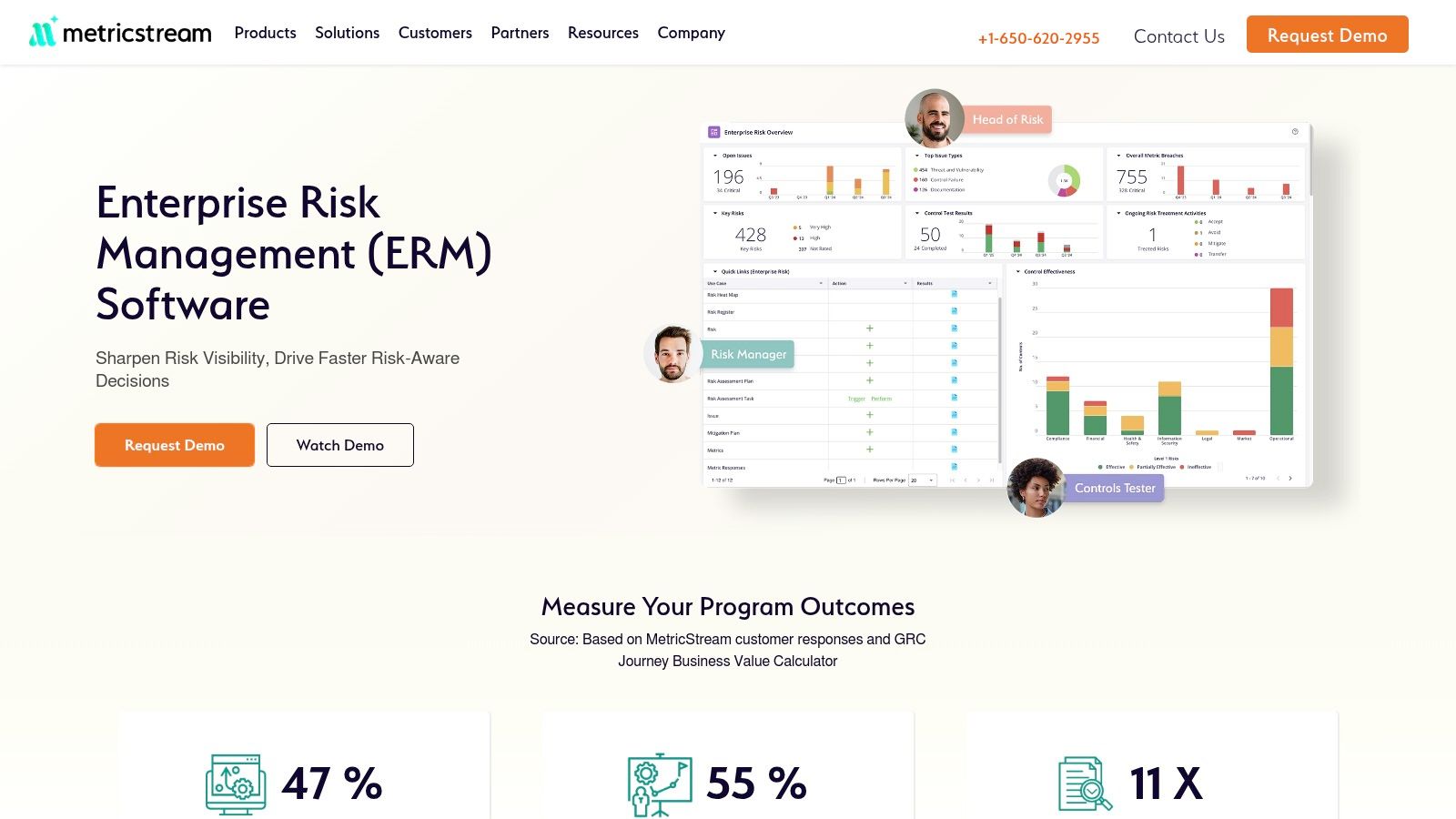
The platform’s federated data model allows for both centralized oversight and decentralized risk ownership, providing role-based landing pages that are relevant to each user. A key strength is its reporting engine, which produces advanced heat maps and predictive metrics. This enables teams to move beyond simple risk identification to proactive risk mitigation, a core component of any robust operational risk management framework.
Analysis and Implementation
What positions MetricStream among the best enterprise risk management tools is its deep library of content and structured assessment templates. This foundation helps organizations accelerate their ERM program deployment. The platform’s advanced analytics and dashboarding capabilities provide executives with clear, real-time insights into the organization's risk profile. However, its enterprise-tier pricing and the need for significant stakeholder alignment during implementation mean it's a strategic investment. Successful deployment requires a clear governance structure and cross-departmental buy-in to fully leverage its capabilities.
Best For: Global enterprises looking for a mature, all-in-one ERM solution with strong reporting and visualization.
Key Feature: Centralized risk registers combined with advanced heat maps and predictive analytics for a holistic risk view.
Limitation: The enterprise-level pricing and implementation complexity can be prohibitive for smaller organizations.
5. Archer (Integrated Risk Management)
Archer, a long-standing leader in the GRC space, offers a highly configurable Integrated Risk Management (IRM) platform designed for complex, multi-domain risk programs. It enables organizations to manage various risk types, from enterprise and operational to third-party and IT risk, within a single, unified environment. Its strength is its extreme flexibility, allowing enterprises to build custom, no-code applications and workflows that align precisely with their unique risk management frameworks and methodologies.
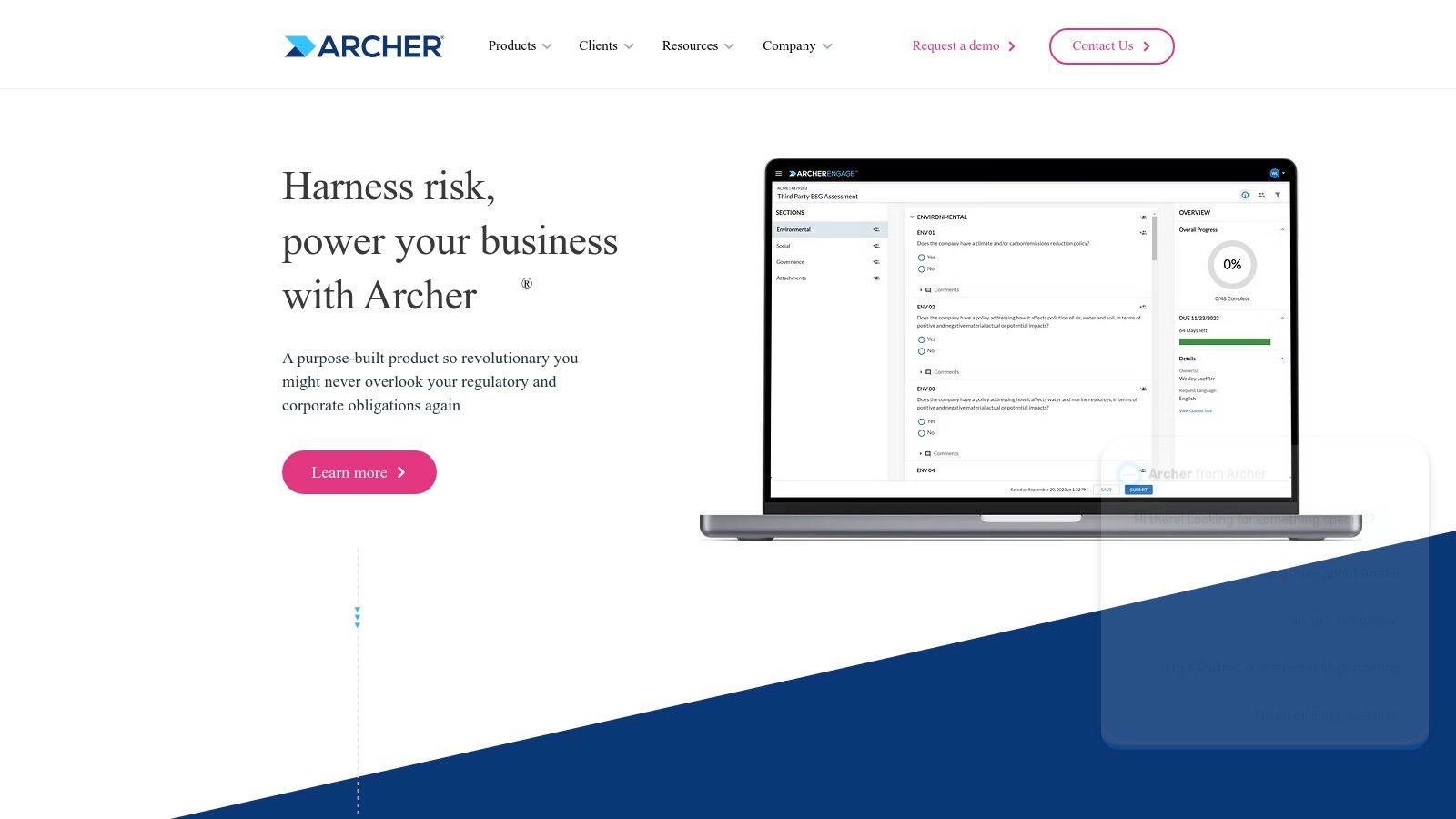
The platform supports qualitative, semi-quantitative, and quantitative risk analysis, catering to varying levels of risk maturity. A key differentiator is its Archer Engage feature, which provides a simplified user interface for first-line-of-defense business users to submit risk data without needing deep system knowledge. This drives better risk ownership and data quality from across the organization. Its customizable dashboards provide tailored views for all three lines of defense, from operational teams to the board.
Analysis and Implementation
What makes Archer one of the most powerful enterprise risk management tools is its unparalleled configurability. However, this flexibility can be a double-edged sword. Without strong governance and a clear implementation strategy, organizations risk creating overly complex solutions that are difficult to maintain and scale. A successful Archer deployment requires a dedicated team to manage solution design and prevent process sprawl. The platform is supported by a mature ecosystem of partners and a large community, offering extensive resources. Pricing is geared toward enterprise-level commitments, reflecting its robust capabilities.
Best For: Large enterprises with unique or complex risk management processes that require a highly tailored and adaptable IRM platform.
Key Feature: Extreme configurability with no-code application building and a mature ecosystem for support and extensions.
Limitation: The high degree of flexibility adds implementation complexity and necessitates strong governance to avoid unmanageable customizations.
Website: https://www.archerirm.com/solutions
6. SAP Risk Management (part of SAP GRC)
SAP Risk Management is an integrated component of the SAP Governance, Risk, and Compliance (GRC) suite, designed to embed risk management directly into core business processes. It offers a powerful solution for organizations heavily invested in the SAP ecosystem, particularly those running on SAP S/4HANA. The platform excels at identifying, analyzing, and monitoring risks across the enterprise, linking them directly to business operations and strategic objectives.
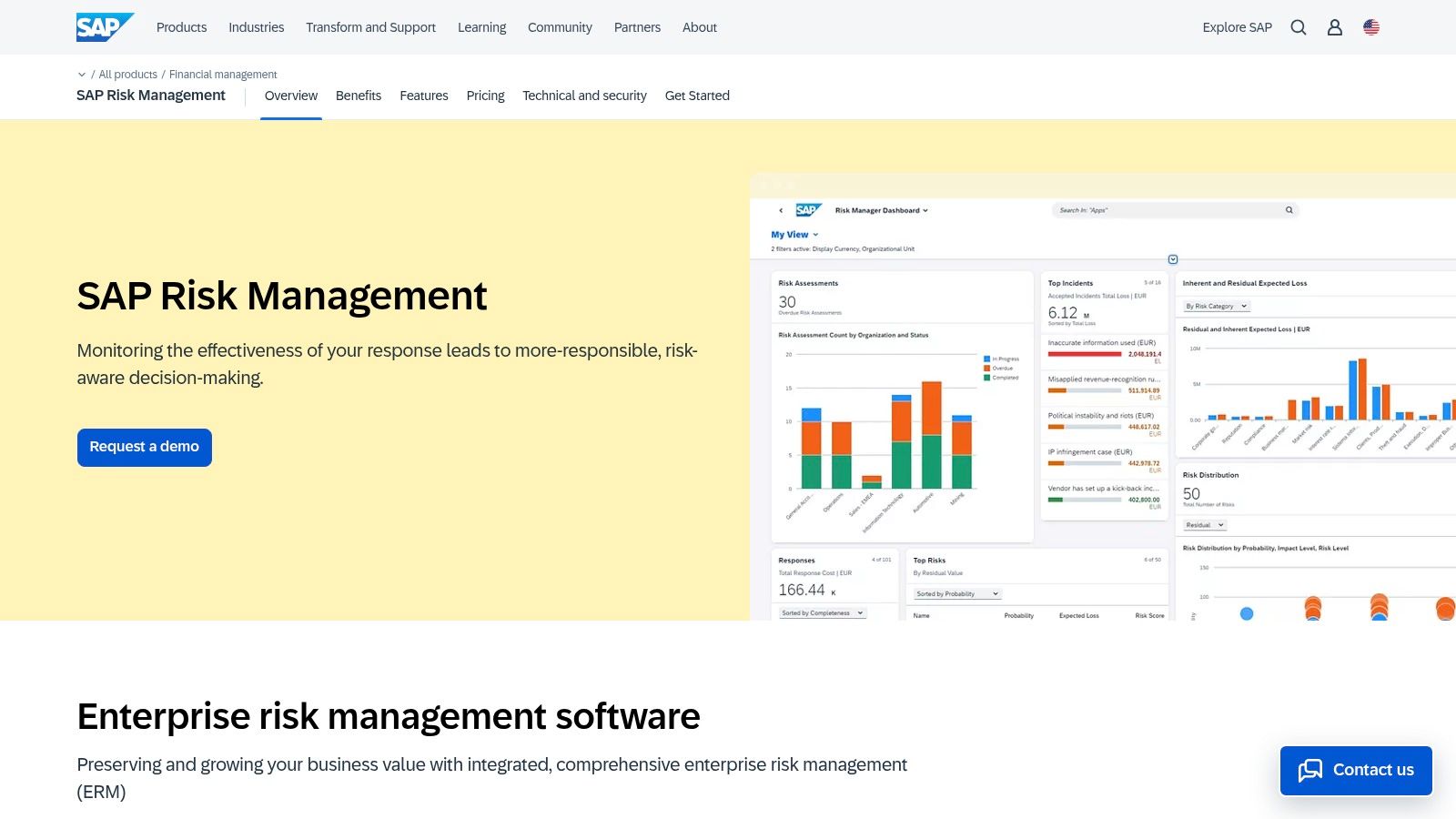
Its primary strength is the native integration with other SAP modules. For example, a manufacturing firm can use it to monitor supply chain disruption risks by pulling real-time data from its SAP S/4HANA system, triggering alerts when Key Risk Indicators (KRIs) like supplier delivery times breach thresholds. The modern SAP Fiori user experience provides graphical dashboards and heat maps, making complex risk data more accessible for decision-makers.
Analysis and Implementation
What solidifies SAP Risk Management's place among top-tier enterprise risk management tools is its ability to connect risk management with control and compliance activities within a single environment. This creates a cohesive GRC framework where identified risks can be directly mapped to internal controls managed in SAP Process Control. Implementation is most seamless for existing SAP customers, leveraging familiar architecture and extensive documentation. However, it requires separate licensing and often involves a dedicated engagement with SAP or a certified partner. The total cost of ownership is best justified when the goal is deep, process-level risk integration within an SAP-centric IT landscape.
Best For: Enterprises already using SAP S/4HANA or other core SAP applications seeking native, process-integrated risk management.
Key Feature: Deep integration with SAP business processes, controls, and compliance modules for a unified GRC approach.
Limitation: The value is maximized within the SAP ecosystem; non-SAP organizations would likely find other tools more suitable and cost-effective.
7. Riskonnect ERM
Riskonnect offers an integrated risk management platform that excels at connecting traditional insurable risk, such as incidents and claims, with broader enterprise risk management (ERM) and GRC functions. This approach provides a holistic view, enabling organizations to see how operational incidents impact strategic objectives. It is particularly valuable for businesses in manufacturing, healthcare, or logistics where physical and operational risks are tightly linked to financial and compliance outcomes.
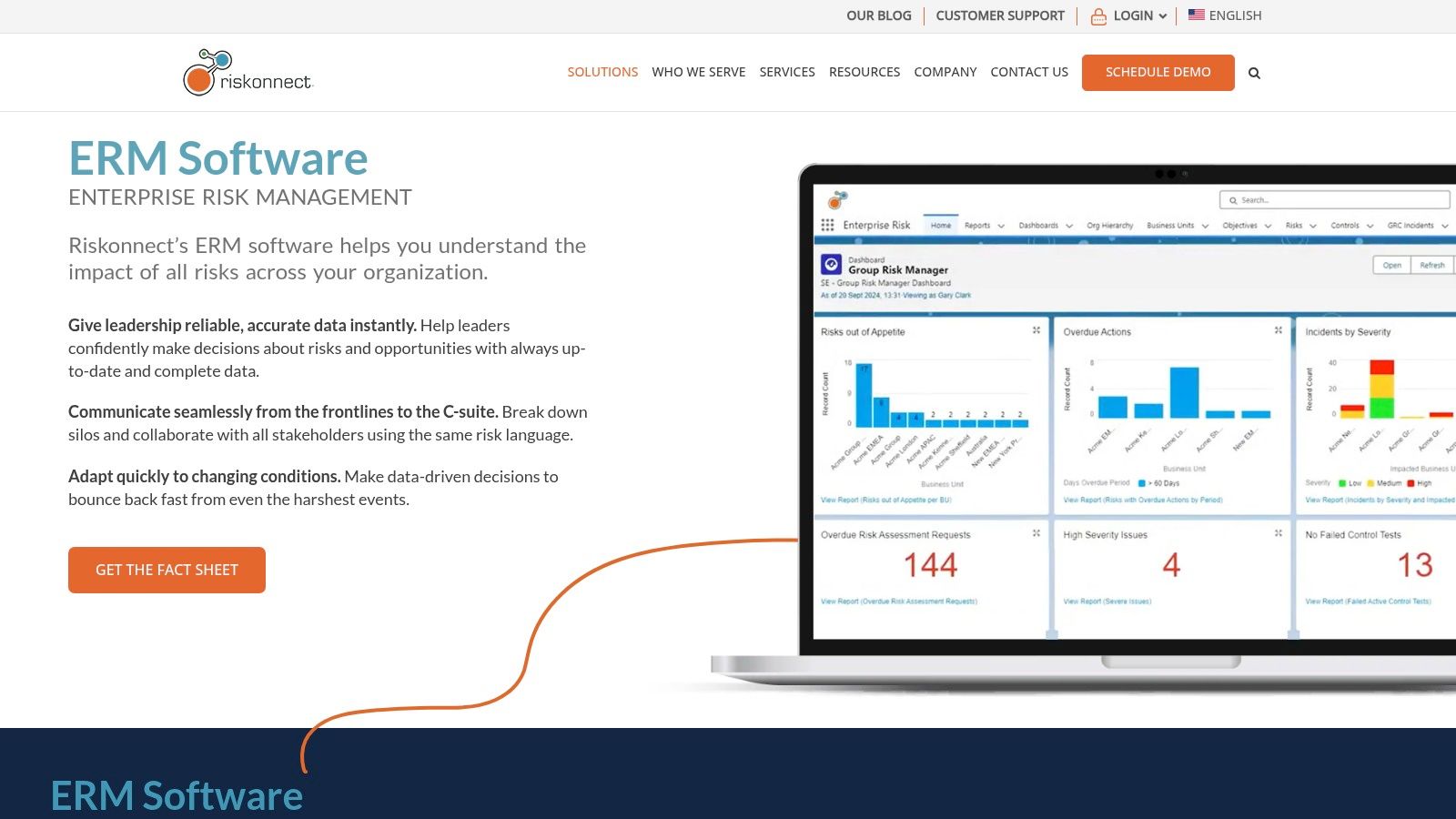
The platform’s strength is its ability to unify disparate risk data. For example, a safety manager can log an incident, which automatically updates relevant Key Risk Indicators (KRIs) on an executive dashboard, while the claims department manages the financial fallout within the same system. This cross-functional visibility breaks down silos and ensures risk data is actionable across departments, from corporate security to loss prevention teams.
Analysis and Implementation
What makes Riskonnect one of the most practical enterprise risk management tools is its focus on unifying insurable and non-insurable risks. While many platforms focus solely on GRC, Riskonnect’s roots in Risk Management Information Systems (RMIS) provide a powerful operational foundation. This makes it ideal for organizations looking to mature from a basic claims and incident management process to a comprehensive ERM program. The platform is highly configurable, which is a significant advantage for tailoring workflows but means implementation can be resource-intensive, often requiring dedicated project management to align the system with specific internal frameworks.
Best For: Organizations aiming to integrate operational/insurable risk (claims, incidents) with their strategic ERM program.
Key Feature: A unified platform that links incident and claims data directly to ERM and GRC activities.
Limitation: The deep configuration required for specific frameworks can make the initial setup and implementation a substantial undertaking.
Website: https://riskonnect.com/erm-software/
8. Diligent ERM (Diligent One Platform)
Diligent ERM, part of the integrated Diligent One GRC platform, is designed for organizations that prioritize a strong connection between risk management and board-level governance. It excels at translating complex risk data into clear, actionable insights for executives and directors. The platform is particularly effective for public sector entities and corporations that require robust reporting and a fast-tracked approach to establishing a formal ERM program.
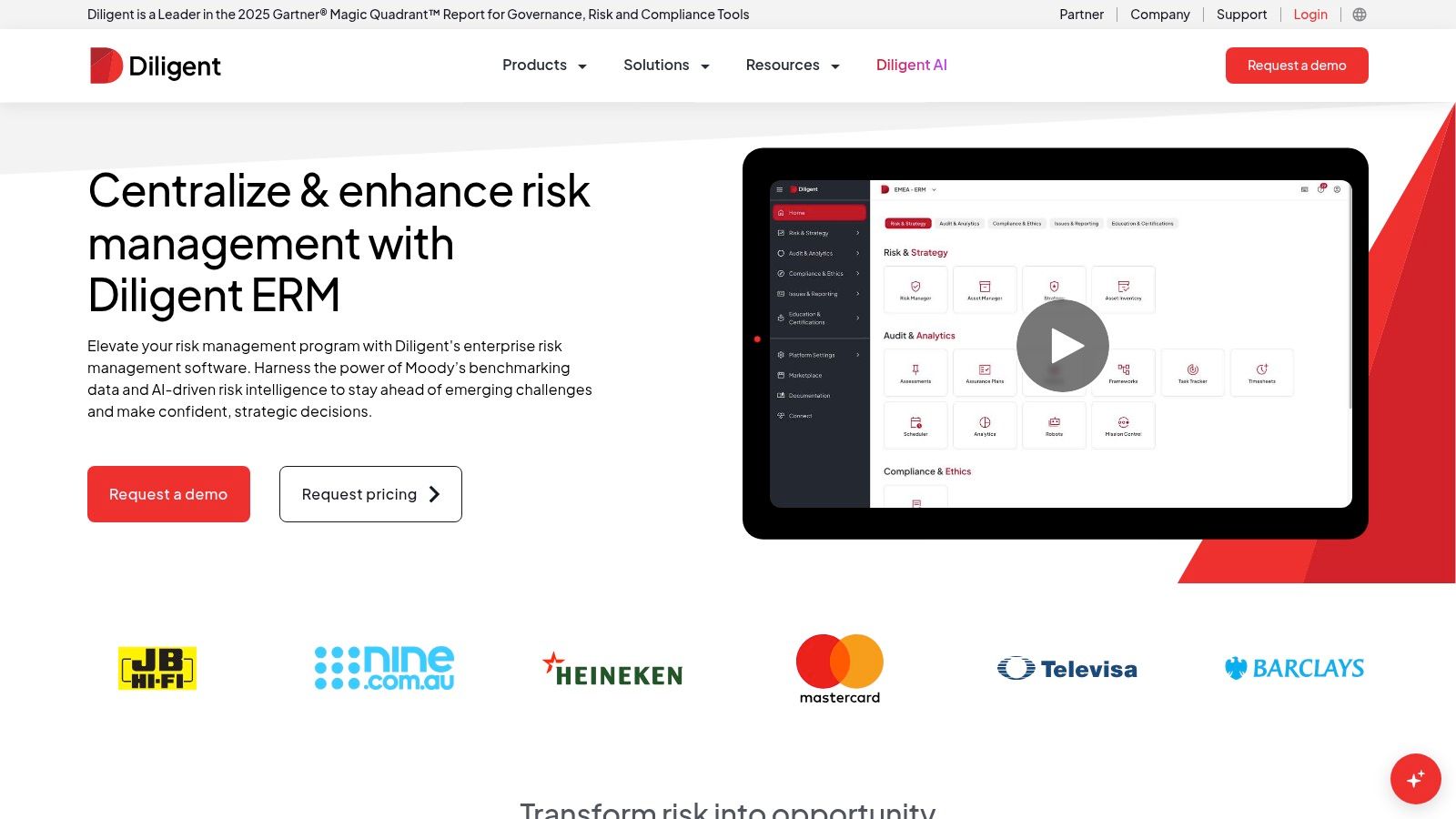
The platform’s standout capability is its emphasis on rapid deployment and high-level reporting. For example, a newly appointed chief risk officer could leverage the AI Risk Essentials package to quickly stand up a foundational ERM framework and generate board-ready reports in weeks, not months. The system also uses AI-powered benchmarking, leveraging data from sources like Moody’s, to help organizations contextualize their risk exposure against industry peers.
Analysis and Implementation
What makes Diligent a notable entry among enterprise risk management tools is its focus on fast time-to-value and governance alignment. Its integrated workflows ensure that identified risks are directly linked to strategic objectives and communicated effectively through its highly-regarded board portal. Implementation is streamlined, especially with the quick-start packages, which lower the barrier to entry for organizations formalizing their ERM processes. However, while the core packages are accessible, advanced features and premium benchmarking data are often add-ons, which can significantly increase the total cost of ownership.
Best For: Organizations needing strong board-level risk reporting and a fast, structured way to launch or mature their ERM program.
Key Feature: Quick-start packages for rapid deployment and AI-powered benchmarking for industry context.
Limitation: The overall cost can escalate as advanced add-ons and premium features are required for a more comprehensive view.
9. LogicGate Risk Cloud — ERM Solution
LogicGate Risk Cloud is a highly flexible, no-code GRC platform that empowers risk teams to build and adapt their own Enterprise Risk Management (ERM) programs. It stands out by replacing rigid, hard-coded software with a user-friendly, drag-and-drop interface. This approach is ideal for growing organizations whose risk landscape and compliance needs are constantly evolving, as it allows them to modify workflows, risk assessments, and reporting dashboards on the fly without developer support.
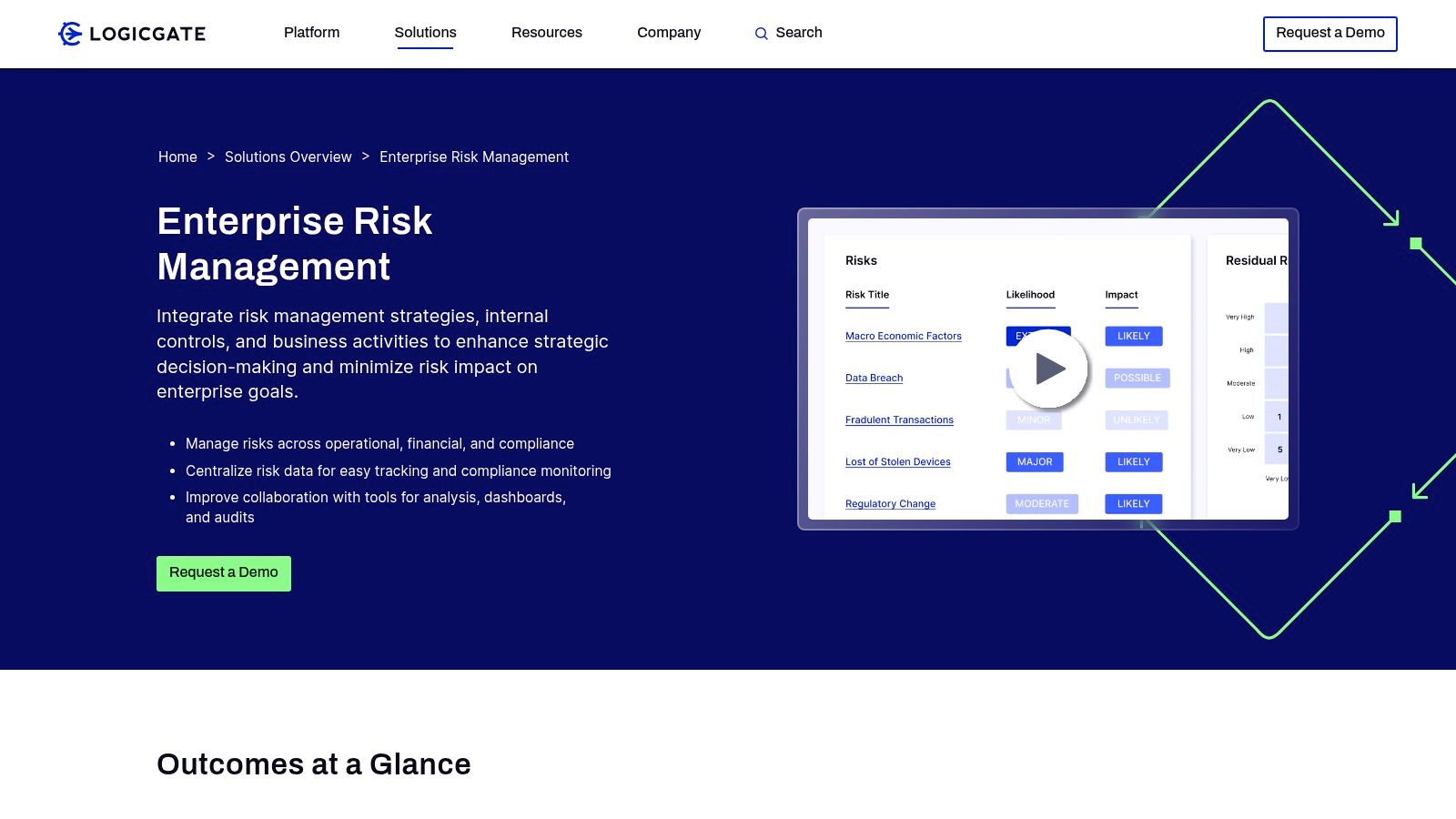
The platform’s strength is its adaptability. For instance, a fintech company could quickly deploy a pre-built template for operational risk and then customize it to include specific controls for cryptocurrency transactions. As regulations change, the risk manager can directly adjust the logic and data fields, ensuring the ERM tool keeps pace with the business. Its role-based dashboards deliver relevant risk data to stakeholders, from operational teams to the board of directors.
Analysis and Implementation
What makes LogicGate one of the most agile enterprise risk management tools is its no-code architecture. This significantly lowers the barrier to entry for creating sophisticated, automated risk and compliance workflows. However, this extreme flexibility is a double-edged sword; it requires a strong internal administrator with a clear governance plan to prevent disorganized or inefficient builds. While teams can iterate rapidly, effective scaling depends on thoughtful initial configuration and ongoing management. Pricing is subscription-based and tailored to the number of applications and users.
Best For: Mid-sized to large enterprises looking for a highly configurable and user-friendly platform that can adapt to evolving risk programs.
Key Feature: A powerful no-code workflow builder that allows for rapid customization of risk assessments, controls, and reports.
Limitation: The platform’s flexibility requires strong internal governance and skilled administrators to maximize its potential and scale effectively.
10. AuditBoard — Risk Management (RiskOversight)
AuditBoard provides an integrated risk management solution, RiskOversight, that excels at connecting enterprise risk management (ERM) with internal audit and SOX compliance activities. It is designed for organizations seeking a unified platform where risk data seamlessly informs audit plans and compliance controls. The tool is praised for its intuitive user interface, which helps drive adoption among first-line business users responsible for managing day-to-day risks.
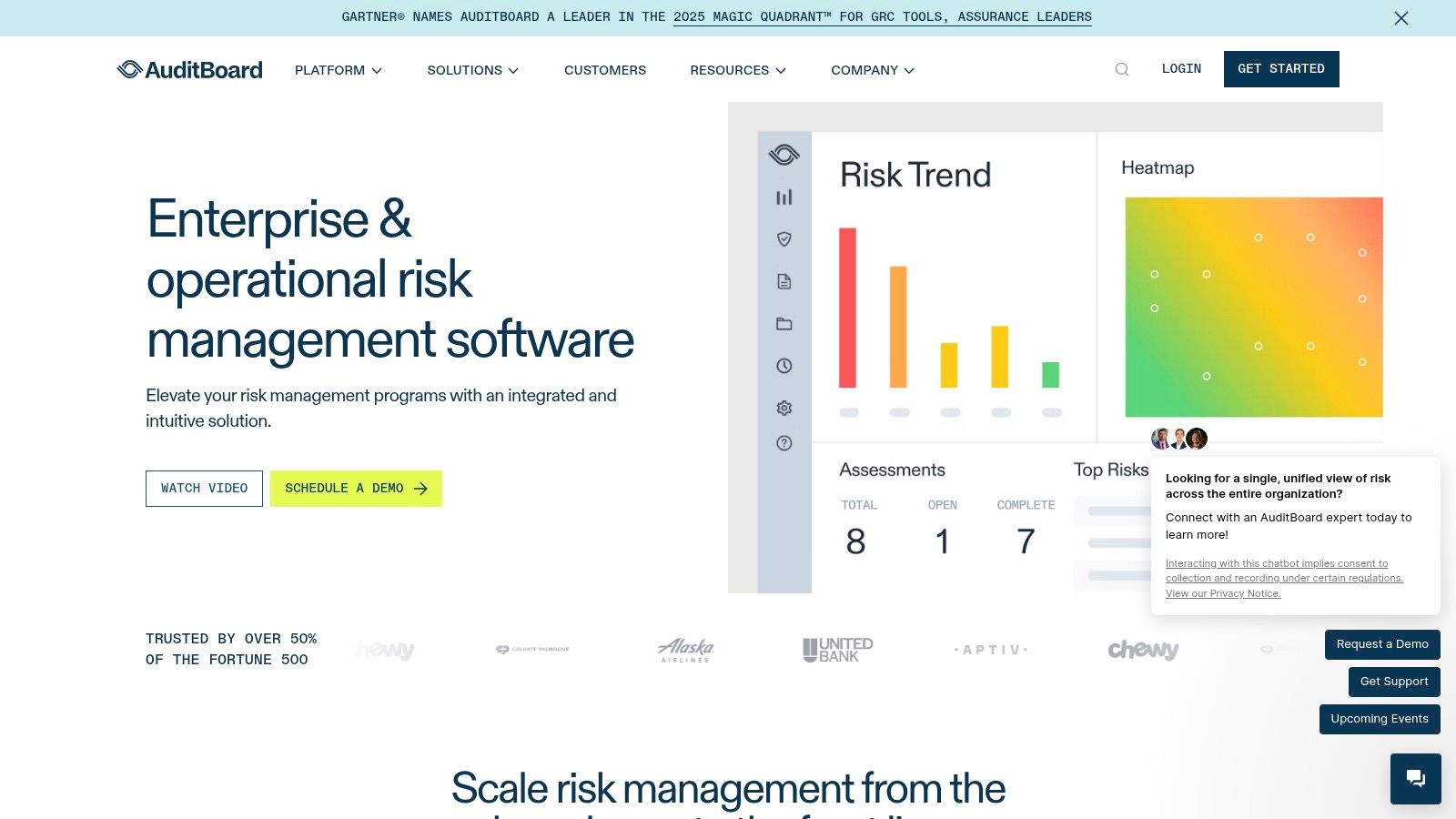
The platform’s power is in its interconnectedness. For instance, a risk team can use the bow-tie analysis feature to visualize the causes and impacts of a critical operational risk. The resulting action plans and controls identified in this exercise can then be directly linked to the internal audit team's workpapers within the same system, ensuring end-to-end visibility. This tight linkage simplifies reporting for audit committees and executive leadership, providing a clear line of sight from risk identification to assurance activities.
Analysis and Implementation
What positions AuditBoard among the leading enterprise risk management tools is its user-centric design combined with robust analytical capabilities like Monte Carlo simulations for scenario planning. This allows teams to quantify potential risk impacts in financial terms, making risk conversations more tangible for stakeholders. While highly effective, the platform delivers maximum value when its risk module is used in conjunction with its audit and SOX modules. Implementation is typically smoother than more complex GRC systems, but pricing is tailored for enterprise use and provided by quote.
Best For: Organizations that need to tightly integrate their ERM, internal audit, and SOX compliance programs.
Key Feature: Strong integration with audit workflows and user-friendly tools like bow-tie analysis and scenario quantification.
Limitation: The solution is most powerful when multiple AuditBoard modules are adopted, potentially making it less ideal for standalone ERM needs.
11. Resolver — Enterprise Risk Management
Resolver is an integrated enterprise resilience platform designed to connect risk, audit, incident management, and threat protection into a cohesive framework. Its core value proposition lies in linking real-time incident data directly to an organization's overall risk posture, providing a clear line of sight from on-the-ground events to strategic risk impact. This makes it a practical choice for teams in corporate security, loss prevention, and operational risk who need to manage the full lifecycle of an incident.
The platform is built to be an actionable system rather than just a repository. For example, a retail company can use the Incident Management module to log a theft event, which automatically triggers a workflow to assess control failures and updates the relevant KRIs on the risk dashboard. This direct incident-to-risk traceability helps teams move beyond reactive responses to proactive risk mitigation and provides executives with clear, quantifiable data.
Analysis and Implementation
What positions Resolver among the leading enterprise risk management tools is its emphasis on practicality and speed-to-value. Its pre-built reporting accelerators and intuitive workflows are designed to reduce the administrative burden on risk and audit teams, allowing them to focus on analysis rather than data entry. Implementation is generally more straightforward than monolithic GRC platforms, but tailoring the system for highly specific or complex use cases may require assistance from their professional services team. Its broad functionality across risk, audit, and security serves a wide audience, though organizations with very deep, niche requirements should validate its capabilities.
Best For: Organizations needing to connect operational incidents and threats directly to their strategic enterprise risk framework.
Key Feature: Strong incident-to-risk traceability that links live events to risk assessments and controls.
Limitation: Advanced or highly customized configurations might require professional services engagement, adding to the total cost.
12. AWS Marketplace — Governance, Risk, and Compliance Listings
AWS Marketplace is not a single tool but a digital procurement platform where organizations can discover, purchase, and deploy a wide range of cloud-based Governance, Risk, and Compliance (GRC) solutions. It streamlines the buying process for companies heavily invested in the AWS ecosystem by offering consolidated billing, flexible pricing models, and faster deployment cycles. This makes it an essential resource for cloud-first enterprises seeking to integrate ERM capabilities directly into their existing cloud infrastructure.
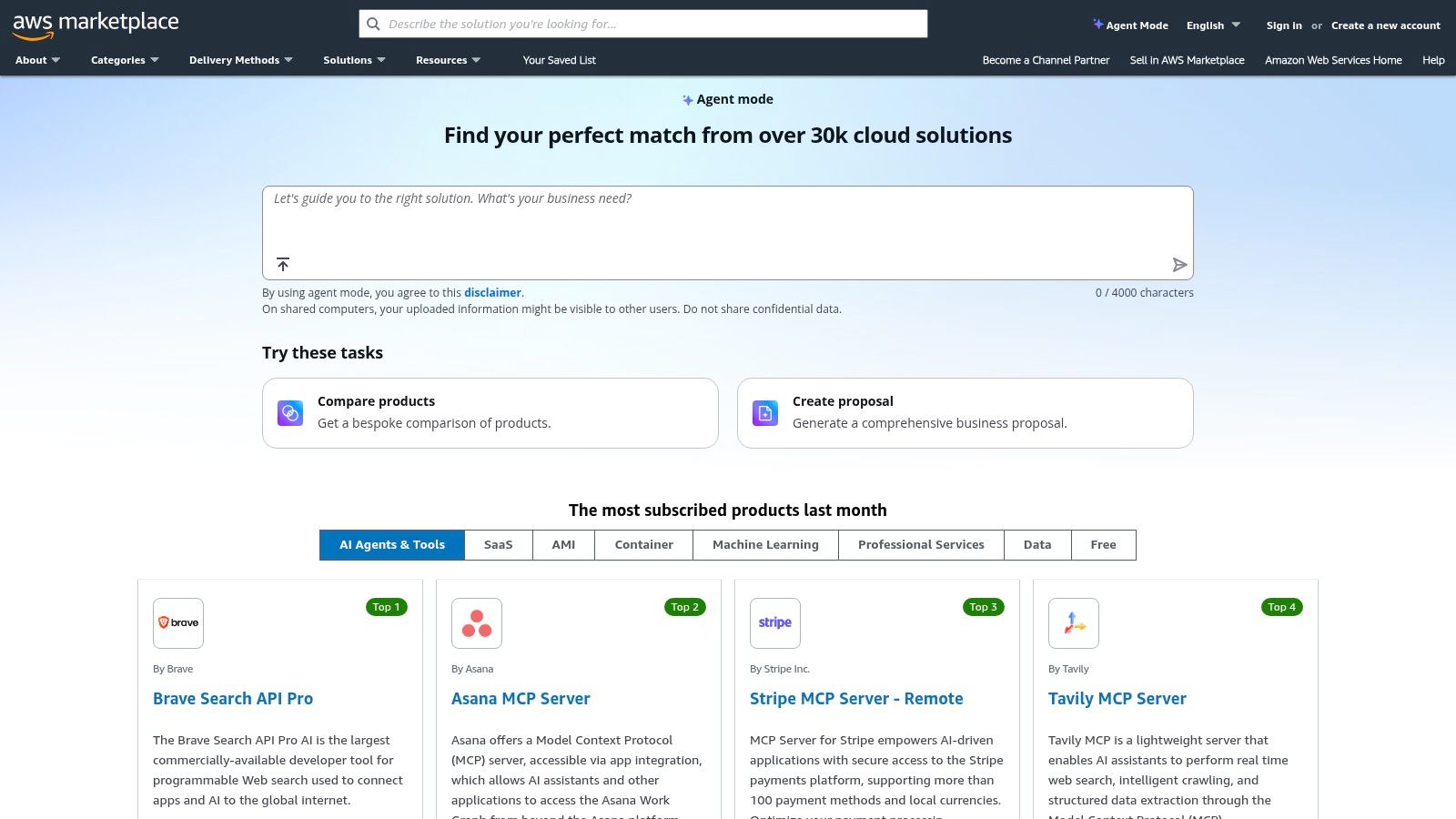
The primary value of the marketplace lies in its efficiency. A technology company can find and trial a new security compliance tool, negotiate a private offer, and have it deployed and billed through their AWS account in a fraction of the time a traditional procurement process would take. This agility allows risk and security teams to respond quickly to emerging threats or regulatory changes by rapidly provisioning pre-vetted enterprise risk management tools.
Analysis and Implementation
What makes AWS Marketplace a unique entry on this list is its role as a procurement accelerator rather than a standalone ERM platform. It simplifies technology acquisition by aligning software purchases with AWS committed spend, which can be a significant financial advantage. However, the onus is on the buyer to perform due diligence. The quality and feature depth of the listed GRC and ERM solutions vary significantly between vendors. Effective use requires a clear understanding of your technical requirements to navigate the listings and select a tool that integrates well with your specific AWS environment.
Best For: Cloud-native organizations and AWS users looking to streamline the procurement and deployment of GRC/ERM software.
Key Feature: Consolidated billing through an existing AWS account and access to private offers for customized pricing.
Limitation: Not all top-tier ERM vendors are available, and the buyer is responsible for vetting the quality of individual listings.
Website: https://aws.amazon.com/marketplace
Top 12 Enterprise Risk Management Tools — Feature Comparison
Product | Core focus & unique features (✨) | UX & effectiveness (★) | Value & pricing (💰) | Target audience (👥) | Notes / Differentiator (🏆) |
|---|---|---|---|---|---|
🏆 Logical Commander Software Ltd. | ✨ Privacy-first AI; Preventive & Significant Risk indicators; regulation-aligned | ★★★★☆ Fast insights (day‑1); decision‑support; traceable workflows | 💰 Free trial (no card); custom quotes; immediate ROI claims | 👥 HR, Compliance, Legal, Risk, Internal Audit; SMB → Enterprise → Govt | 🏆 Recommended — ethical-by-design, non‑invasive, PartnerLC & patent-backed |
IBM OpenPages | ✨ Modular GRC, AI analytics, purpose-built risk modules | ★★★★ Strong analytics & scalability | 💰 Enterprise pricing; best value at large scale | 👥 Large enterprises, regulated industries | Broad module ecosystem; Cognos analytics |
ServiceNow GRC | ✨ No‑code workflows; integrates with ITSM/SecOps | ★★★★ Deep automation; single data model | 💰 Platform subscription; customization costs | 👥 Organizations on ServiceNow; IT/security teams | Excellent workflow automation & operational integration |
MetricStream ERM | ✨ Advanced heat maps, predictive metrics, centralized registers | ★★★★ Mature reporting & visualization | 💰 Enterprise-tier pricing; by quote | 👥 Enterprises needing strong reporting & IR | Strong content libraries & visualization capabilities |
Archer (IRM) | ✨ Configurable no‑code apps; multi-domain risk support | ★★★ Flexible but powerful | 💰 Enterprise pricing; custom implementations | 👥 Regulated industries, complex programs | Highly configurable — requires governance to avoid sprawl |
SAP Risk Management | ✨ Native SAP S/4HANA integration; Fiori UX | ★★★★ Enterprise-grade for SAP environments | 💰 Separate licensing; best value for SAP customers | 👥 SAP customers, finance/control-heavy orgs | Tight integration with SAP controls & compliance |
Riskonnect ERM | ✨ Unifies insurable & non‑insurable risk; claims linkage | ★★★ Operationally focused dashboards | 💰 Quote-based; configuration effort | 👥 Risk/insurance teams, cross-functional RM | Strong RMIS + ERM integration for claims workflows |
Diligent ERM | ✨ AI risk identification; board-ready reporting & benchmarking | ★★★★ Governance-focused, fast time‑to‑value | 💰 Add-ons/benchmarking may add cost | 👥 Boards, governance, public sector | Board reporting & benchmarking (Moody’s data) |
LogicGate Risk Cloud | ✨ No‑code configurability; templates & role dashboards | ★★★★ Very usable; rapid configuration | 💰 Subscription; admin enablement needed | 👥 Mid-market → enterprise seeking agility | Rapid iteration for evolving ERM programs |
AuditBoard RiskOversight | ✨ Scenario planning (Monte Carlo), bow‑tie analysis | ★★★★ Intuitive UI; quick stakeholder adoption | 💰 Enterprise pricing by quote | 👥 Audit/SOX-heavy organizations | Strong audit linkage and scenario quantification |
Resolver ERM | ✨ Incident → risk traceability; executive reporting accelerators | ★★★ Practical with real‑time analytics | 💰 May require professional services | 👥 Risk, incident, threat & brand protection teams | End‑to‑end incident-to-risk linkage |
AWS Marketplace (GRC listings) | ✨ Curated GRC listings; SaaS/container trials & private offers | ★★★ Streamlined procurement; variable feature depth | 💰 Centralized AWS billing; marketplace pricing | 👥 Cloud teams, US buyers, procurement | Fast procurement & private offers; vet listings individually |
Choosing Your Path: From Tool Selection to Strategic Advantage
Navigating the landscape of enterprise risk management tools can feel overwhelming. We've explored a wide array of solutions, from comprehensive GRC platforms like ServiceNow and Archer to specialized applications found on the AWS Marketplace. The journey from evaluating features to successful implementation is a critical one, and the choice you make will profoundly impact your organization's ability to anticipate, manage, and mitigate risk effectively. This selection process is not merely a technical procurement; it's a foundational decision that reflects your company's strategic priorities, operational maturity, and ethical commitments.
The key takeaway is that there is no single "best" tool for every organization. The ideal solution is the one that aligns seamlessly with your specific risk profile, existing technology ecosystem, and long-term strategic goals. A large, highly regulated financial institution might find the extensive, audit-ready frameworks of IBM OpenPages or SAP Risk Management indispensable. In contrast, a fast-growing tech company may prioritize the agility and cloud-native integration capabilities of platforms like LogicGate Risk Cloud or AuditBoard.
Synthesizing Your Evaluation Criteria
As you move forward, revisit the core evaluation criteria we discussed. Don't let a long list of features distract you from what truly matters. Your decision should be a balanced consideration of several key factors that will determine the long-term success of your ERM program.
Scope vs. Specialization: Do you need an all-in-one GRC suite that covers every facet of risk and compliance, or a specialized tool that excels in a specific area, such as managing human capital or third-party risk? Platforms like MetricStream offer breadth, while solutions like Logical Commander provide focused depth on ethical, non-surveillance-based insider risk management.
Ethical Posture: The distinction between detection and surveillance is a critical one. Consider whether a proposed tool respects employee privacy and fosters a culture of trust. An ethical-by-design approach, which avoids invasive monitoring, can be a powerful asset in building psychological safety and encouraging proactive reporting.
Integration and Scalability: How well will the new tool integrate with your existing systems, such as your HRIS, ERP, or security information and event management (SIEM) platforms? The right enterprise risk management tools should act as a central hub, not another data silo. Ensure the solution can grow with your organization as your risk landscape evolves.
From Selection to Strategic Implementation
Once you've selected a tool, the real work begins. Successful implementation is less about technology and more about people and processes. A phased rollout, starting with a specific department or risk area, can help you build momentum and gather valuable feedback.
Secure executive buy-in from the outset by framing the investment not as a cost center, but as a strategic enabler. Communicate the "why" behind the new system to all stakeholders, emphasizing how it will simplify their workflows, provide clearer insights, and ultimately protect the organization. Develop a robust training program to ensure users are not just technically proficient but also understand how the tool supports the broader risk management strategy. This approach transforms the implementation from a software deployment into a catalyst for cultural change, embedding risk awareness into the fabric of your daily operations.
Ultimately, the goal of adopting any of these powerful enterprise risk management tools is to move from a reactive, check-the-box compliance mindset to a proactive, risk-intelligent culture. The right partner will empower your teams with the visibility and data needed to make smarter, faster decisions. By carefully evaluating your options and committing to a thoughtful implementation, you can turn risk management from a defensive necessity into a distinct competitive advantage, building a more resilient, ethical, and successful organization for the future.
Ready to address human capital risk with an ethical, non-surveillance approach? See how Logical Commander Software Ltd. helps organizations proactively manage insider risks while building trust and respecting privacy. Visit our website to learn how our unique, ethical-by-design framework can strengthen your enterprise risk management strategy at Logical Commander Software Ltd..