%20(2)_edited.png)

What Is Compliance Training: A Practical Guide to Building an Effective Program
- Marketing Team

- 9 hours ago
- 17 min read
Compliance training is the formal process of teaching your employees about the laws, regulations, and internal policies that apply to their jobs. At its core, its purpose is to cut down on risk, keep the workplace safe, and protect the company's legal and ethical standing. This training is mandatory and acts as a critical line of defense against steep legal penalties and a damaged reputation.
Understanding Compliance Training Beyond the Basics

Think of compliance training as preventative maintenance for your business. It’s not something you do after a problem explodes; it's a proactive system designed to keep the entire organization running smoothly, ethically, and legally. It’s the framework that ensures everyone—from new hires to the C-suite—knows the rules of the road, including both government laws and your own internal code of conduct.
The mission here is twofold. First, compliance training acts as a shield, protecting the company from serious legal and financial blowback. Second, it lays the groundwork for a strong culture of integrity, where making the right call becomes second nature for everyone on the team.
The Dual Mission of Compliance Programs
The best programs go way beyond dry, check-the-box exercises. They become strategic assets that connect how employees act with what the company values and what the law demands. This dual focus makes sure the company is protected and its people are empowered.
Protecting the Organization: This means training on specific laws and regulations to head off violations that could lead to fines, lawsuits, or even a shutdown. It's about knowing the absolute "must-dos."
Building a Culture of Integrity: This is about creating an environment where employees want to do the right thing. It covers ethics, company values, and building a workplace where people feel safe speaking up.
A strong compliance program isn't just a legal chore; it's a competitive advantage. It builds trust with customers, helps you attract top talent, and creates a stable foundation for growth by proving your commitment to operating with integrity.
To really get your arms around what is compliance training, it helps to look at the pillars that hold it all up. These components form the structure that supports a legally sound and ethically strong organization.
The table below breaks down these core areas, explaining what they aim to achieve and the kinds of topics they usually cover. It's a clear roadmap for what an effective compliance program looks like.
Core Components of a Compliance Program
Component Area | Core Purpose | Common Training Topics |
|---|---|---|
Regulatory Adherence | To ensure the company follows all applicable external laws and industry-specific regulations. | Anti-money laundering (AML), data privacy (GDPR, CCPA), anti-bribery laws, workplace safety (OSHA). |
Internal Policies | To educate employees on the company's own rules, values, and code of conduct. | Conflict of interest policies, acceptable use of company assets, information security protocols. |
Ethical Conduct | To promote a culture of integrity and ethical decision-making beyond strict legal rules. | Anti-harassment and diversity training, business ethics, creating a respectful workplace. |
Together, these pillars ensure that compliance training is more than just a list of rules. It becomes a living part of the company culture that guides behavior and protects the organization from the inside out.
Why Every Organization Needs a Strong Compliance Program
Viewing compliance training as just another business expense is a dangerous mistake. In reality, it’s a strategic necessity for survival and growth. A strong program isn’t about checking a box—it’s about building a resilient, trustworthy organization from the inside out.
Without one, a company is basically flying blind through a storm of legal and financial risks. The kind of risks that can ground a business for good, sometimes overnight.
History is littered with cautionary tales, but the Enron scandal of 2001 is the textbook case of what happens when compliance fails. Widespread accounting fraud, greenlit from the very top, led to the company’s spectacular implosion, wiping out thousands of jobs and billions in shareholder value. The fallout was so massive it gave us the Sarbanes-Oxley Act, fundamentally rewriting the rules of corporate governance for an entire generation.
That story isn't just a footnote. It’s a harsh reminder of how a breakdown in ethics can trigger financial ruin, reputational collapse, and industry-wide regulation. The abstract idea of "risk" gets very real when you think about the lives it impacts—employees, investors, and the public.
The True Cost of Non-Compliance
Ignoring compliance isn’t a way to save money; it’s an incredibly expensive gamble. The fallout from a single failure goes way beyond one fine from a regulator. The damage ripples through the entire organization and can be crippling.
Financial Penalties: These are the most obvious costs. Fines from regulatory bodies can easily hit millions or even billions of dollars for serious violations.
Legal Expenses: Defending against lawsuits and government probes drains money that should be going into growing the business.
Reputational Damage: Trust is hard to build and easy to shatter. A major compliance breach can wreck a brand’s reputation, leading to lost customers, broken partnerships, and a tough time hiring good people.
Operational Disruption: Investigations and audits can bring business to a screeching halt. New sanctions can block access to markets, making it difficult for the company to even operate.
These stakes have pushed companies worldwide to get proactive. Structured programs designed to teach employees about laws and ethical standards are no longer optional. The global Corporate Compliance Training market was valued at US$6.4 billion and is projected to skyrocket to US$12.0 billion by 2030. You can get more details in this in-depth market research analysis on marketresearch.com.
That growth isn’t just a trend; it's a global admission that the cost of getting it wrong is just too high to ignore.
Beyond Risk Mitigation: The Competitive Advantage
But thinking about compliance as just a defensive shield misses the bigger picture. When done right, it flips from a burdensome obligation into a powerful driver of competitive advantage. Good ethics is, without a doubt, good business.
An organization that embeds compliance into its cultural DNA doesn't just avoid trouble; it builds a foundation for sustainable success. It signals to the market, its customers, and its employees that it is a trustworthy and reliable partner.
This commitment creates real business benefits that show up directly on the bottom line. Companies with a strong ethical backbone don't just survive; they often outperform their peers by creating a more stable and attractive environment for everyone.
Strategic Benefits of a Strong Compliance Culture
A culture of compliance delivers a serious return on investment that you can see in key business metrics.
Enhanced Brand Trust: Customers want to do business with companies they see as ethical and dependable. A public commitment to doing things the right way builds a powerful brand reputation that wins and keeps loyal customers.
Improved Employee Morale and Retention: People want to work for a company that operates with integrity. A safe, respectful, and ethical workplace is a huge draw for attracting and keeping top talent, leading to higher engagement and productivity.
Greater Operational Efficiency: Clear rules and procedures cut down on confusion and costly mistakes. When employees are well-trained, they make fewer errors, which means smoother workflows, less waste, and better quality across the board.
What Kinds of Compliance Training Are There, Really?
Compliance training isn’t a monolith. It’s not some one-size-fits-all product you just plug in and forget. Instead, think of it as a specialized toolkit, with each tool designed for a very specific job. The training a nurse needs to protect patient privacy is worlds apart from what an accountant needs to spot money laundering.
Getting these distinctions right is the first step toward building a program that actually works. When you tailor the training, you move away from generic, check-the-box exercises and toward education that resonates with employees because it speaks to the real-world challenges they face every single day.
Universal Compliance Mandates
Some rules apply to pretty much everyone, no matter what industry you're in. These topics form the bedrock of any solid compliance program because they address the legal and ethical standards that govern how we all work together. They’re the "must-haves" because the risks they cover are present in almost any professional setting.
Anti-Harassment and Diversity Training: This is non-negotiable for building a respectful and inclusive workplace. It’s all about teaching employees how to recognize, report, and prevent harassment and discrimination, keeping the company in line with laws like Title VII of the Civil Rights Act.
Data Privacy and Security Training: In a world run on data, protecting sensitive information is everything. This training covers major regulations like the General Data Protection Regulation (GDPR) in Europe and the California Consumer Privacy Act (CCPA). More importantly, it teaches employees practical skills, like how to spot a phishing email that could compromise thousands of customer records.
Workplace Safety (OSHA): For any business with physical operations, Occupational Safety and Health Administration (OSHA) training is a must. It covers everything from emergency plans to the right way to use equipment, all with the goal of preventing accidents and injuries on the job.
The sheer number of these universal regulations has fueled a massive global market for compliance training. North America is the leader here, thanks to a tough regulatory environment and a high number of multinational corporations. The U.S. alone makes up roughly 40% of global compliance training revenue. To put that in perspective, the North American online corporate compliance training market hit USD 1,486.24 million and is still growing. You can dig into more global compliance training market projections on marketreportanalytics.com.
Industry-Specific Compliance Requirements
Once you’ve got that universal foundation sorted, you need to layer on training that’s specific to your industry. These programs tackle the unique laws and ethical codes that govern highly regulated sectors. The risks in finance just aren’t the same as the risks in healthcare, and your training has to reflect that reality.
An industry-specific approach shows your employees you get it. You understand the world they operate in. It makes compliance feel less like a top-down corporate mandate and more like a practical guide for navigating their daily professional lives.
Here’s how this specialization looks in a few different fields:
Healthcare (HIPAA): The Health Insurance Portability and Accountability Act (HIPAA) has incredibly strict rules for protecting patient health information. Training makes sure everyone, from doctors to the front desk staff, understands their legal duty to keep patient data confidential.
Finance (AML & FINRA): Financial institutions are on the front lines in the fight against financial crime. Anti-Money Laundering (AML) training teaches employees to spot and report suspicious transactions, while FINRA rules set the standard for ethical conduct among securities professionals.
Government Contractors (FAR): If you work with the federal government, you have to play by their rules. That means complying with the Federal Acquisition Regulation (FAR). This training covers complex guidelines on everything from bidding on contracts to ethical behavior when dealing with government officials.
Comparing Compliance Training Delivery Methods
Choosing the right topics is only half the battle. How you deliver the training is just as important for making it stick. The best programs usually blend a few different methods, matching the approach to the subject matter and the audience. A quick, engaging e-learning module might be perfect for an annual data privacy refresher, but a sensitive topic like anti-harassment is often better handled in an immersive, facilitator-led workshop where people can ask questions and have real discussions.
The table below breaks down the pros and cons of the most common delivery methods to help you figure out what makes sense for your organization.
Method | Key Advantages | Best For | Potential Drawbacks |
|---|---|---|---|
E-Learning Modules | Scalable, consistent, and easy to track. Offers flexibility for remote teams. | Foundational knowledge, annual refreshers, and topics like data privacy or cybersecurity. | Can lack engagement if poorly designed; not ideal for complex, nuanced discussions. |
Instructor-Led Workshops | Highly interactive, allows for real-time Q&A, and fosters group discussion. | Sensitive topics like anti-harassment, ethics, or complex role-specific training. | More expensive to scale, scheduling can be difficult, and consistency depends on the instructor. |
Microlearning | Delivers short, focused content bursts that improve knowledge retention. | Reinforcing key concepts, providing just-in-time refreshers, and continuous learning. | Not suitable for introducing complex topics from scratch; works best as a supplement. |
Simulations & Scenarios | Provides realistic, hands-on practice in a safe environment. | High-stakes decision-making, such as responding to a data breach or an ethical dilemma. | Can be complex and costly to develop and implement effectively. |
Ultimately, there’s no single "best" method. The key is to build a flexible program that uses the right tool for the right job, ensuring the training isn't just completed, but actually understood and applied.
How to Build an Effective Compliance Training Program
Moving from theory to practice is where a compliance program really comes to life. Building effective training isn’t about checking a box or finding a one-size-fits-all template. It’s about creating a custom framework that reflects your company’s specific risks, culture, and day-to-day realities.
The goal is to design something that does more than just inform—it has to inspire real, lasting changes in behavior. A great program starts not with content, but with questions. What are our biggest vulnerabilities? What do our employees actually need to know to do their jobs correctly and ethically? Answering those questions lays the foundation for training that feels relevant, necessary, and genuinely helpful.
Start with a Comprehensive Risk Assessment
Before you can build effective training, you have to understand your unique risk landscape. A risk assessment is the diagnostic tool that pinpoints your organization's most significant weak spots. This isn't just a legal exercise; it's a strategic analysis of where things are most likely to go wrong.
This process means identifying potential legal, financial, and reputational threats that are specific to your industry and how you operate. For a financial firm, the top risk might be money laundering. For a tech startup, it could be data privacy breaches. The assessment should give you a clear, prioritized list of risks your training absolutely must address.
Once you know your risks, you can set clear and measurable learning objectives. Instead of a vague goal like "improve data security," a strong objective sounds like this: "After completing this module, employees will be able to identify and report a phishing email with 95% accuracy." That kind of clarity guides content creation and makes success easy to measure.
Design Content That Engages and Sticks
With clear objectives in hand, the next step is to create content that people will actually remember. Let’s be honest, the days of clicking through dense, hour-long slideshows are over. Modern learners expect material that is engaging, relevant, and easy to access.
Knowing how to create training materials that work is a huge piece of the puzzle. It’s all about using a mix of formats to keep the learning experience fresh and impactful.
Microlearning: Deliver key information in short, digestible bursts. A five-minute video on proper data handling is far more likely to stick than a 40-page document.
Scenario-Based Simulations: Put employees in realistic ethical dilemmas. Let them practice making tough decisions in a safe space, like figuring out how to respond when a client offers an inappropriate gift.
Gamification: Add elements like points, badges, and leaderboards to make learning more interactive and competitive. This can turn a mandatory task into a genuinely engaging challenge.
The most effective compliance training feels less like a lecture and more like a practical guide for navigating real-world job challenges. It should empower employees with the confidence to act correctly when faced with a difficult situation.
Tailor Training to Specific Roles and Responsibilities
One of the biggest mistakes you can make in compliance training is delivering the same generic content to everyone. A universal, one-size-fits-all approach just dilutes the message and makes it feel irrelevant to most people. The best training recognizes that different roles face entirely different risks.
This infographic breaks down the layered approach to tailoring compliance content.
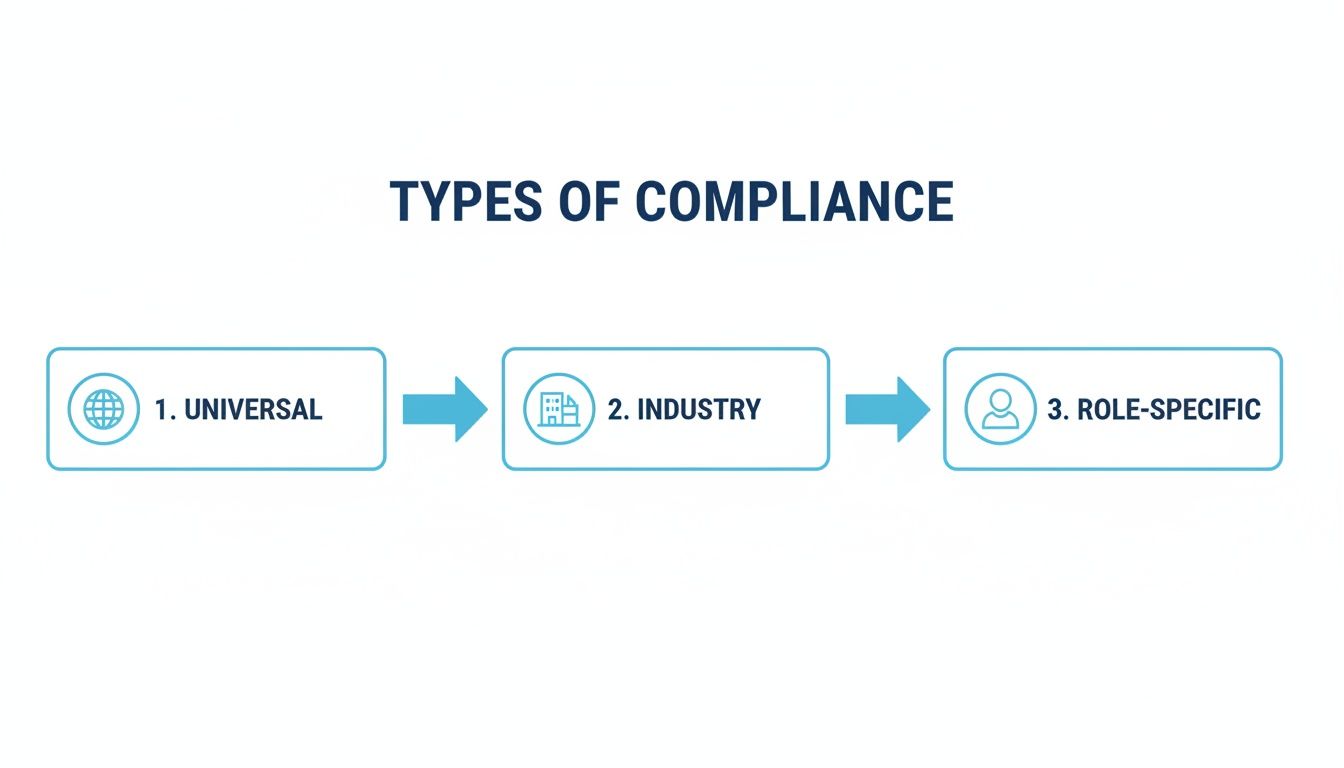
As you can see, compliance obligations are tiered—from universal rules that apply to all employees, to highly specific requirements for certain industries and individual job functions.
For example, your sales team needs deep-dive training on anti-bribery laws and gift policies. Your IT administrators, on the other hand, require advanced cybersecurity and data handling protocols. By segmenting your audience and tailoring the content, you make sure every employee gets information that is directly useful for their daily work.
Foster a Culture of Continuous Improvement
Finally, a compliance program isn’t a one-and-done project. It’s a living system that needs continuous maintenance and improvement. Technology changes, and regulations are always evolving. Your program has to be agile enough to keep up.
This involves a few key activities:
Regularly Update Content: Review and refresh all training materials at least once a year, or whenever a major regulatory change happens.
Gather Employee Feedback: Actively ask employees for their thoughts on the training's relevance, clarity, and engagement. Use surveys and focus groups to find out what’s working and what isn’t.
Promote Open Communication: An effective program is built on a strong speak-up culture, where employees feel safe reporting concerns without fear of retaliation. You can learn more about building this kind of environment here: https://www.logicalcommander.com/post/speak-up-culture. This cultural foundation is essential for any compliance program to truly succeed.
Leadership Buy-In: Make sure leaders at all levels are championing the importance of compliance. When employees see their managers taking training seriously, they are far more likely to do the same. This top-down reinforcement turns compliance from a requirement into a shared value.
How to Measure the Success of Your Compliance Efforts
So, how do you know if your compliance training is actually working? Just tracking completion rates is like judging a chef by how many ingredients they bought—it tells you nothing about the quality of the meal. To really understand the impact of your program, you have to measure behavioral change and risk reduction, not just who showed up.
This means ditching the superficial metrics and adopting Key Performance Indicators (KPIs) that prove genuine understanding and application. The goal isn't just to check a box; it's to prove that your training is a strategic investment that strengthens the organization from the inside out.
Moving Beyond Simple Completion Rates
Tracking who finished a course is a start, but it’s the bare minimum. True measurement looks at what happens after the training ends. The best programs use a mix of qualitative and quantitative data to build a complete picture of their impact.
Some meaningful KPIs to use include:
Knowledge Retention Quizzes: Test employees weeks or months after the initial training to see what information actually stuck.
Observed Behavioral Changes: Use data from internal audits, performance reviews, and direct observations to see if employees are applying what they learned on the job.
Reduction in Policy Violations: Track the number and severity of reported incidents over time. A downward trend is a powerful indicator that the message is getting through.
Your Learning Management System (LMS) can be a goldmine for this data. It can track assessment scores, identify knowledge gaps across departments, and shine a light on where your training content might need a redesign for better clarity.
The ultimate measure of a compliance program isn't what employees know, but what they do. Success is demonstrated through consistent, ethical actions, not just high quiz scores. It’s about building muscle memory for making the right choice.
Leading vs. Lagging Indicators
A critical part of any compliance program is being able to objectively determine its impact and find areas for improvement, which requires understanding how to measure training effectiveness. A more sophisticated approach means distinguishing between two types of metrics: leading and lagging indicators.
Think of it like managing your health. A lagging indicator is the number on the scale—it tells you the result of past actions. A leading indicator is your daily step count—it predicts future results.
Lagging Indicators are backward-looking metrics that show the outcomes of past events. They are easy to measure but hard to influence directly. * The number of regulatory fines or penalties received. * The quantity of substantiated ethics hotline reports. * Costs associated with compliance-related lawsuits.
Leading Indicators are forward-looking metrics that can predict future outcomes and signal emerging risks. They are proactive and help you course-correct before a major issue occurs. * An increase in questions to the ethics hotline (this shows engagement, not just problems). * Faster completion times for mandatory training modules. * Positive feedback scores on the relevance of training content.
By focusing on leading indicators, you shift from a reactive to a proactive compliance posture. You can spot potential issues early, adjust your training strategy, and prevent problems before they escalate into costly lagging indicators.
This data-driven approach does more than just improve your program; it allows you to demonstrate a clear return on investment to leadership. When you can connect training efforts to a measurable reduction in risk and a stronger ethical culture, you prove that compliance is a core driver of business value. To explore this further, you might be interested in our guide on measuring compliance program effectiveness and improving your outcomes.
The Future of Compliance Training with AI and Technology

The days of the dreaded, one-size-fits-all annual compliance module are numbered. Technology, especially Artificial Intelligence (AI), is transforming a once-static chore into a dynamic, data-driven process that runs intelligently in the background.
This isn't just about making things digital; it's about making them personal. Instead of marching everyone through the same generic course, AI-powered platforms can now deliver training that adapts to an employee’s specific role, past performance, and unique risk profile.
Personalization at Scale Through Adaptive Learning
Imagine a system smart enough to know your sales executive needs a deep dive on anti-bribery laws, while your lead developer just needs a quick refresher on secure coding. That’s the power of adaptive learning. AI algorithms analyze employee data to spot knowledge gaps and then push targeted micro-learning modules at the precise moment they’re needed.
This makes training far more efficient. Employees spend their time on material directly relevant to their jobs, which sends knowledge retention and application through the roof. It turns the experience from a disruptive yearly event into an organic part of their professional growth.
The future of compliance isn't about more training; it's about smarter training. AI allows organizations to deliver the right lesson to the right person at the right moment, turning compliance education into a proactive and personalized safeguard.
Using Data Analytics to Predict and Prevent Risk
Beyond just delivering content, modern platforms are giving us powerful new ways to spot risks before they blow up. By analyzing anonymized data from different internal systems, AI can identify patterns that might signal a potential compliance issue long before it becomes a full-blown crisis.
For example, data analytics might flag an unusual pattern of expense claims in a specific department. This could trigger a targeted training intervention on the company’s travel and expense policies for that team. This proactive stance is a core part of modern risk management, and as organizations look to get ahead of internal threats, many are adopting solutions found in this guide to AI-powered human risk management.
The Rise of Continuous and Integrated Compliance
Ultimately, technology is weaving compliance into the daily workflow instead of keeping it as a separate, isolated task. This creates a culture where ethical and compliant behavior gets reinforced continuously, not just once a year.
Intelligent Documentation: Modern platforms automate the record-keeping process, creating a clean, auditable trail of all training activities. This makes reporting a breeze and proves due diligence to regulators.
Proactive Risk Identification: AI tools help organizations shift from a reactive posture—punishing violations after they happen—to a preventive one that addresses risks before they cause harm.
Enhanced Engagement: By using formats like simulations and gamified quizzes, technology makes learning more interactive and less of a chore, which naturally leads to better outcomes.
This forward-looking approach makes compliance an intelligent, ongoing, and seamless part of how a modern organization operates, protecting both the company and its people more effectively than ever before.
Your Compliance Training Questions, Answered
Even with the best strategy in place, you’re bound to have questions when it comes to the nuts and bolts of compliance training. Let's dig into some of the most common ones we hear from managers trying to get this right.
How Often Should We Conduct Compliance Training?
This is a big one, and the honest answer is: it depends on the risk. Annual training is a pretty standard baseline for universal topics like data privacy or anti-harassment. It's enough to keep the core principles fresh for most of your team.
But for high-risk roles—think finance teams handling sensitive transactions or procurement specialists managing big contracts—you'll want more frequent touchpoints. Quarterly refreshers or targeted workshops can keep their skills sharp and their knowledge current. A great approach is to supplement your big annual courses with ongoing microlearning to keep critical concepts top-of-mind all year long.
Is Online Compliance Training Effective?
Absolutely, as long as it’s not treated like a box-checking exercise. Online training is fantastic for scalability and consistency, making it a powerful tool for getting foundational knowledge out to a large, distributed workforce. You get consistent messaging and great tracking capabilities.
The biggest mistake is treating compliance training as a 'check-the-box' task. This mindset leads to generic, uninspired content that employees quickly forget. Effective training must feel relevant to an employee's daily job and be championed by leadership.
However, for really nuanced or sensitive topics like ethical decision-making, a blended approach is usually best. Combine the efficiency of self-paced online modules with live, interactive sessions—either virtual or in-person. This lets you cover the basics online and save the valuable face-to-face time for deep, meaningful discussions.
What Is the Biggest Mistake to Avoid?
The single biggest pitfall is creating a training program that feels completely disconnected from an employee's actual job. When the content is all theory and generic examples, people tune out. It fails to stick because it doesn't resonate with their daily challenges and decisions.
The other half of this mistake is a lack of genuine leadership buy-in. If your leaders aren’t visibly championing a culture of integrity, even the slickest training program will fall flat. You need that top-down reinforcement to show that compliance isn’t just a mandate—it’s how you do business.
At Logical Commander Software Ltd., we believe in proactive, ethical risk management. Our AI-driven E-Commander platform helps you identify early signals of internal threats and misconduct without invasive surveillance, preserving employee dignity while ensuring compliance. Instead of reacting to damage, our system empowers you to act first with intelligence and integrity. Discover how Logical Commander can strengthen your governance and protect your organization.