%20(2)_edited.png)

What Is Insider Threats and How to Proactively Prevent Them

Updated: Feb 14
When business leaders hear the term "what is insider threats," their minds often jump straight to a disgruntled employee deliberately stealing company secrets. And while that scenario is a very real danger, it's only one piece of a much larger, more complicated business problem. The conversation must shift from cybersecurity to human-factor risk.
The reality is, the most common and costly internal risks aren't driven by malice at all. They're fueled by simple human error and vulnerability. To truly get a handle on insider threats, you have to look at the entire spectrum of human-factor risk—a challenge that starts and ends with people, not technology. This is why reactive forensic investigations and employee surveillance not only fail to prevent the damage but also create a culture of distrust and open the door to huge legal liabilities, especially around regulations like the Employee Polygraph Protection Act (EPPA).
An effective risk management strategy must be proactive and ethical. It starts by acknowledging that these threats are fundamentally a human challenge, demanding a non-intrusive alternative to the invasive, outdated methods that undermine trust and violate regulations.
The Three Faces of Internal Risk
To build a resilient defense, you have to understand the different motivations and behaviors behind each type of threat. Let's break them down.
The Malicious Insider (The Saboteur): This is the person who acts with the clear intent to harm the organization. Think of a disgruntled engineer who deletes critical project files on their way out the door or sells proprietary code to a competitor. Their goal is direct damage, driven by revenge, financial gain, or ideology.
The Negligent Insider (The Accidental Accomplice): This individual causes harm completely unintentionally, usually through carelessness or a lack of awareness. A classic example is a well-meaning HR manager who clicks on a sophisticated phishing email, unknowingly handing attackers the keys to the entire employee database. They aren't an enemy, but their actions can be just as destructive.
The Compromised Insider (The Unwitting Puppet): This threat happens when an external actor steals an employee's legitimate credentials. Imagine a senior executive's laptop being stolen, giving a criminal direct access to sensitive financial systems. The employee is a victim, but their stolen identity becomes a weapon pointed right back at the company.
You can learn more about how to spot the warning signs by reading our guide on key insider threat indicators.
The following table breaks down these three core types of insider threats, their drivers, and some common examples to help clarify the distinctions.
The Three Core Types of Insider Threats Explained
Threat Type | Primary Driver | Common Examples |
|---|---|---|
Malicious Insider | Intentional Harm (Revenge, financial gain, ideology) | Stealing intellectual property, sabotaging systems, committing fraud. |
Negligent Insider | Unintentional Error (Carelessness, lack of training) | Falling for a phishing scam, misconfiguring a cloud server, mishandling sensitive data. |
Compromised Insider | Credential Theft (External attack) | Stolen passwords, lost company devices, social engineering attacks. |
Thinking about these threats in distinct categories helps organizations build smarter, more targeted defenses instead of relying on a one-size-fits-all approach.
The critical takeaway here is that two out of the three insider threat types are not malicious. A strategy focused solely on "catching bad employees" is guaranteed to fail because it completely misses the far more frequent risks of everyday human error and credential theft.
A modern approach has to be proactive, ethical, and non-intrusive. It must focus on identifying risk indicators before they escalate into costly incidents. This means moving away from reactive surveillance and toward AI-driven preventive risk management that respects employee dignity while protecting the organization.
The Escalating Financial Impact of Internal Risk
Knowing what an insider threat is just the first step. Understanding the staggering financial and operational consequences is what forces decision-makers to act.
Internal risks aren't some minor cost of doing business—they're a massive and fast-growing liability that hits your bottom line, erodes shareholder trust, and tarnishes your brand. For leaders in Risk, Compliance, and Security, the conversation has to shift from if an incident will happen to when, focusing on proactive prevention instead of expensive, reactive clean-ups.
The financial damage from these incidents has hit alarming levels. Recent data shows that organizations are now spending an average of $17.4 million a year to deal with the fallout. That figure marks a staggering 109.6% jump between 2018 and 2025, a trend that’s impossible for any board to ignore.
Credential theft costs businesses an average of $779,797 per incident, while malicious insider acts average $715,366. Even simple negligence comes with a hefty price tag of $676,517 per event.
Breaking Down the High Costs of Inaction
The direct financial hit from theft, fraud, or sabotage is often just the tip of the iceberg. The real cost is a cascade of consequences that can cripple an organization long after the breach is contained.
These business-crippling expenses pile up across several key areas:
Containment and Remediation: The immediate cost of stopping the bleed, repairing systems, and restoring data is immense. It’s a huge drain on your IT, security, and operational resources.
Investigation and Legal Fees: Post-incident forensic investigations are notoriously expensive and disruptive. Add in legal consultations, potential lawsuits, and regulatory fines, and the bill just keeps climbing.
Reputational Damage: The loss of customer trust can tank your revenue for years. A damaged brand makes it harder to attract new clients, keep the ones you have, and hire top talent.
Operational Disruption: Business can grind to a halt during and after an incident, leading to lost productivity, missed deadlines, and strained relationships with partners.
This infographic breaks down the different types of insider threats by how often they occur, helping to visualize where these risks really come from.
As you can see, the non-malicious threats—simple negligence and compromised accounts—make up the biggest slice of the pie. This drives home the need for a strategy that addresses human factors, not just bad intentions.
Why Certain Industries Are More Vulnerable
While every organization faces internal risk, some sectors are prime targets because of the incredibly valuable data they handle. Industries like finance, healthcare, technology, and government are particularly in the crosshairs.
In these highly regulated environments, the cost of a single incident gets amplified by the threat of severe regulatory penalties and the complete collapse of public trust. The stakes are simply too high to rely on outdated, reactive measures.
For leaders in these fields, it’s not just about preventing a financial loss—it’s about ensuring the survival of the institution and maintaining their license to operate. Failing to address the human factor proactively is a direct threat to business continuity.
Reactive forensics not only arrive too late but also create their own set of liabilities. To see just how deep that rabbit hole goes, take a look at our deep dive on the true cost of reactive investigations. Ultimately, investing in proactive, non-intrusive prevention is no longer an option; it’s a strategic imperative for modern governance and risk management.
Why Traditional Detection Methods Create More Liability
When you ask most leaders about what is insider threats, their minds often jump to a familiar, but deeply flawed, playbook: deploy surveillance tools and launch a forensic investigation after something goes wrong. This "detect and respond" model seems logical on the surface, but it's an outdated strategy that creates far more problems than it solves, exposing your business to a cascade of legal, financial, and cultural liabilities.
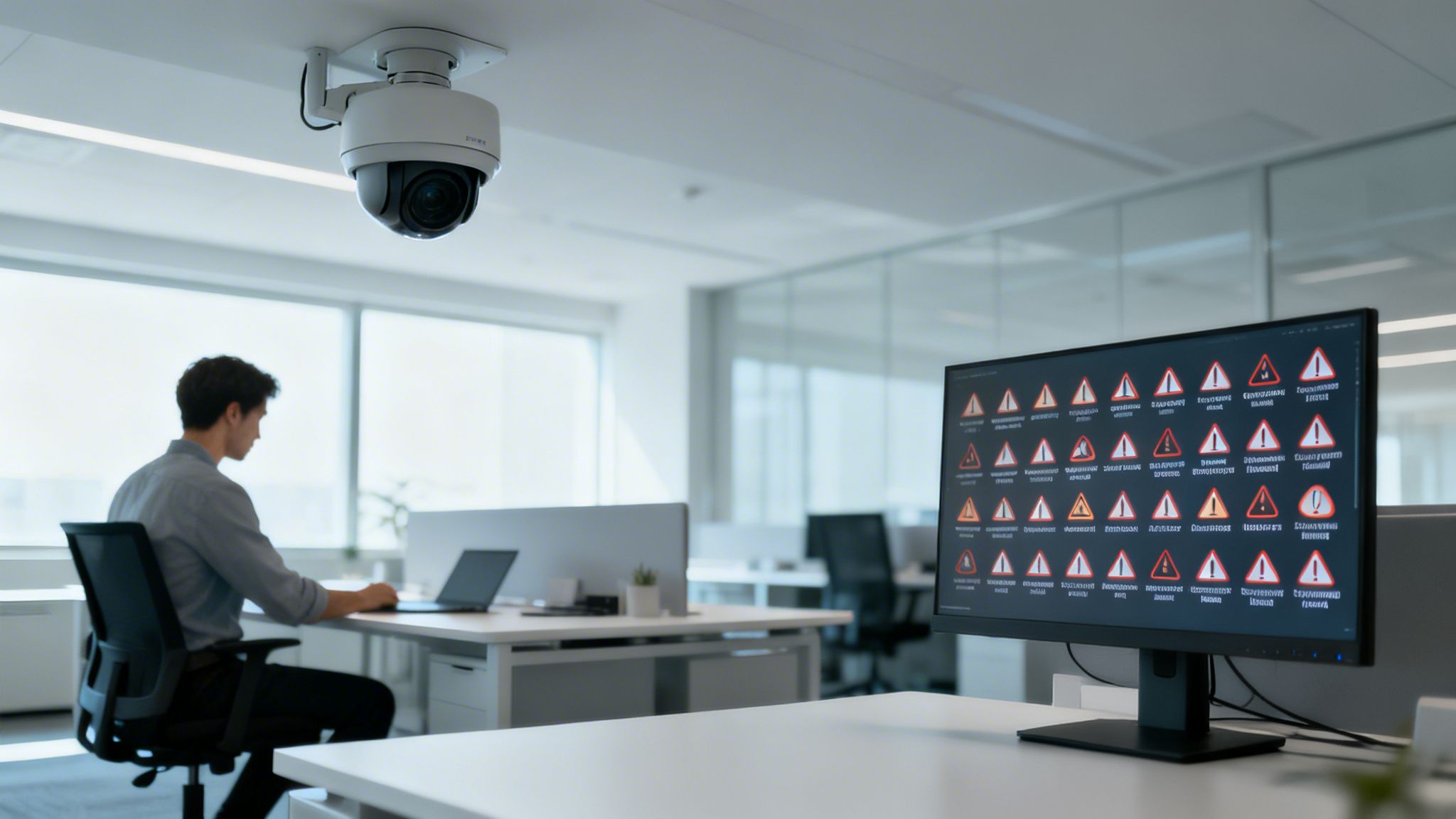
Traditional employee monitoring and surveillance systems are built on a foundation of distrust. They operate by treating every single employee as a potential suspect, which poisons workplace culture and erodes morale. This approach doesn't just damage the relationship between you and your team; it can easily step over critical legal and ethical lines, especially concerning regulations like the Employee Polygraph Protection Act (EPPA).
Relying on these invasive methods puts your organization on shaky legal ground, turning a security initiative into a compliance nightmare. They are simply not the new standard for internal risk prevention.
The Operational Failures of Surveillance
Beyond the cultural and legal risks, surveillance-based tools are just plain inefficient. They're notorious for generating a constant stream of alerts, and the vast majority of them are false positives. This noise creates a massive burden for already stretched security and IT teams, forcing them to waste countless hours chasing down harmless activities instead of focusing on genuine risks.
This constant alert fatigue leads to a dangerous outcome: real threats get lost in the noise. By the time a legitimate incident is finally identified, the damage—whether it's data theft, financial fraud, or a shattered reputation—is already done.
The fundamental flaw of the old standard is that it is inherently reactive. It catches threats in the rearview mirror, leaving you to manage the costly and disruptive aftermath of a crisis that could have been prevented.
The Hidden Costs of Post-Incident Investigations
When surveillance inevitably fails to prevent an incident, the next step is a forensic investigation. These investigations are far from a simple fix; they are a massive drain on your organization's resources.
Financial Drain: The costs escalate fast, piling up with specialized forensic consultants, legal fees, and potential regulatory fines.
Operational Disruption: Investigations grind normal business operations to a halt, pulling key personnel away from their primary duties and often stalling critical projects.
Reputational Damage: A public investigation can permanently tarnish your company's brand, shaking the confidence of customers, partners, and investors.
This reactive cycle places the organization in a perpetual state of defense, always one step behind the next internal risk. It’s an expensive, unsustainable model that fails to address the root cause of the problem—the human factor. You can explore more about the various approaches in our review of modern insider threat detection tools.
The modern risk landscape demands a new standard—one that is proactive, ethical, and non-intrusive. Moving away from invasive surveillance and costly investigations toward a prevention-focused model is no longer just a best practice; it's a strategic necessity for protecting your organization's assets, reputation, and most importantly, its people.
A New Standard: Shifting From Reaction to Prevention
For years, the playbook for managing internal risk has been fundamentally broken. It was built on a reactive foundation of surveillance and investigation—a model that only kicks in after the damage is done. This approach doesn't just fail to stop threats; it creates a culture of suspicion, poisons employee morale, and opens the door to huge legal liabilities.
The future of managing insider risk isn't about invasive methods. It's about ethically and proactively identifying the human-factor risks that lead to a crisis in the first place. This is a fundamental shift away from policing your staff and toward a modern, human-centric model built on prevention, dignity, and rock-solid compliance. Logical Commander is this new standard.
Leading organizations now get it. True security comes from understanding and neutralizing risk at its source: the human level. This demands a non-intrusive, EPPA-aligned methodology that protects the company's most critical assets without treating employees like suspects.

Introducing E-Commander: The AI-Driven Prevention Platform
Logical Commander’s E-Commander platform was built from the ground up to embody this new standard. It's an AI-driven system designed for ethical risk management—fully non-intrusive and aligned with the Employee Polygraph Protection Act (EPPA). Our approach intentionally avoids surveillance, employee monitoring, or any method that even hints at lie detection or psychological evaluation.
Instead of policing behavior, we provide a sophisticated tool for preventive risk management.
The platform’s core Risk-HR module analyzes human-factor risk indicators to deliver actionable intelligence. It gives HR, Compliance, and Security teams the insights they need to make smart decisions and intervene constructively before a small problem becomes a full-blown incident. This is about identifying risk, not judging people.
This shift represents a move from a culture of distrust to one of proactive diligence. By focusing on prevention, organizations can protect their assets and reputation without compromising employee privacy or creating a toxic work environment.
How Non-Intrusive Technology Works
Our proprietary technology identifies patterns and connections tied to human-factor risks without ever monitoring employee communications or day-to-day activities. It operates on a foundation of respect for individual dignity, ensuring every assessment is conducted ethically and transparently.
The whole process is designed to be seamless and fair, providing objective risk indicators that help leaders manage potential vulnerabilities responsibly. A critical piece of this is having robust data governance in place. For instance, organizations can learn about establishing effective SharePoint data governance to minimize the internal risks tied to data handling. This focus on structured data control is a perfect complement to a human-centric risk strategy.
The Benefits of a Proactive and Ethical Approach
Adopting this new standard gives you a massive advantage over outdated, reactive methods. It allows your organization to finally get ahead of threats instead of constantly cleaning up after them.
The key business benefits are clear:
Prevention Over Reaction: It empowers your teams to address risks before they cause financial or reputational harm, breaking the expensive cycle of post-incident investigations.
EPPA and Legal Compliance: By design, our EPPA compliant platform operates well within legal boundaries, significantly reducing your legal liability compared to surveillance tools.
Enhanced Organizational Culture: Moving away from surveillance fosters a more positive and collaborative workplace where employees feel respected, not monitored.
Actionable Intelligence for Leaders: E-Commander provides clear, concise risk indicators, enabling HR and security leaders to take targeted, appropriate actions.
This modern approach to internal risk isn't just about better technology; it's about a better philosophy. It recognizes that the goal is to manage risk with precision and integrity. Logical Commander’s E-Commander and Risk-HR module provide the tools to do just that, setting a new benchmark for AI human risk mitigation that is both effective and ethical.
Implementing a Modern Insider Risk Program
Building a modern insider risk program means throwing out the old, reactive playbook. The outdated approach—wait for the damage, then launch a costly investigation—is a guaranteed way to lose. A forward-thinking strategy is about prevention. It focuses on establishing clear, fair policies and integrating ethical, non-intrusive technology to get ahead of human-factor risks before they blow up.
This is all about building a sustainable, defensible framework that protects your organization without creating a culture of suspicion.
The heart of this modern approach is weaving an AI-driven platform like Logical Commander’s Risk-HR module directly into your existing HR, security, and compliance workflows. Think of it as the central nervous system for your internal risk intelligence. It finally provides a unified view, breaking down the departmental silos that let major threats fester and enabling coordinated, proactive action.
From Policy to Proactive Prevention
The very first step is building a clear governance structure. This isn't about writing policies that just sit on a shelf. It’s about creating a living framework that defines roles, responsibilities, and the exact protocols for addressing potential risks when they appear. A strong program is built on a foundation of transparency and fairness, ensuring every action is consistent, defensible, and respectful.
Once that framework is solid, technology becomes the engine that drives it. Logical Commander’s platform supports this entire structure by providing objective, AI-driven Risk Assessments Software that is fully EPPA compliant. This lets you:
Establish a baseline for risk: Get a clear picture of your current risk posture across different roles and departments.
Integrate risk assessment into the employee lifecycle: Use it from pre-employment screening all the way to continuous evaluation for employees in sensitive roles.
Create unified workflows: Make sure HR, Legal, and Security are all working from the same playbook the moment a risk indicator is flagged.
This proactive stance is no longer a "nice-to-have." The data shows that insider threat incidents have become increasingly frequent across global enterprises. In fact, a staggering 76% of organizations reported that insider attacks became more frequent over the last year. The absolute number of documented incidents has roughly doubled in just seven years, jumping from 3,269 confirmed incidents in 2018 to a projected 7,868 in 2025. You can explore more of the startling numbers in these insider threat statistics.
Real-World Use Cases and ROI
A modern insider risk program delivers tangible, measurable value right across the organization. By shifting from a reactive model to a preventive one, you don’t just mitigate potential harm—you generate a significant return on investment by sidestepping the immense costs of forensic investigations, legal fees, and operational chaos.
Consider these practical applications:
Pre-Employment Screening: For roles with access to sensitive data or finances, our platform provides an initial risk assessment that goes far beyond a traditional background check. It offers ethical insights into a candidate's potential for human-factor risk, all without invasive methods.
Continuous Risk Evaluation: For employees in high-stakes positions, periodic and non-intrusive assessments help ensure their risk profile stays within acceptable limits. It’s an early warning system that spots potential issues before they escalate.
The goal is not to police employees but to manage risk with precision. By identifying potential vulnerabilities before they are exploited, organizations can intervene constructively—perhaps through additional training, a change in responsibilities, or enhanced support—to prevent an incident from ever occurring.
This table really drives home the difference between the old, reactive model and the new, proactive standard. The business advantages of prevention become crystal clear.
Comparing Reactive Forensics Versus Proactive Prevention
Aspect | Reactive Investigations (Old Standard) | Proactive Prevention (Logical Commander) |
|---|---|---|
Timing | After the damage has already occurred | Before an incident can escalate |
Cost | Extremely high (legal, forensics, remediation) | Predictable, subscription-based cost |
Employee Impact | Creates distrust, damages morale, high stress | Fosters a culture of integrity and respect |
Legal Risk | High potential for EPPA violations and lawsuits | Low risk, designed for EPPA compliance |
Outcome | Assigns blame, documents losses | Prevents damage, protects assets and reputation |
By implementing a modern program centered on prevention, you create a unified, defensible risk management framework that empowers your legal and compliance teams while protecting your most valuable assets. You can read more about what constitutes an insider threat in our foundational guide on understanding insider threats.
The old way of managing internal risk is broken. If you're still relying on reactive, after-the-fact investigations to deal with internal threats, you're not just falling behind—you're leaving your organization exposed to massive financial loss, legal liability, and reputational damage.
Logical Commander represents a fundamental shift in thinking. We offer a new standard in ethical, AI-driven internal threat prevention. Our EPPA-aligned platform helps you get ahead of human-factor risks before they cause real harm, all without resorting to invasive employee surveillance or other legally toxic methods. It's time to move from reaction to prevention and build a culture of proactive integrity.
Don't wait for the next crisis to force your hand. See the future of risk management for yourself and break the failed cycle of costly forensic investigations.
Adopting a modern, ethical approach to what is insider threats isn't just a compliance task—it's a strategic imperative for any organization serious about governance, reputation protection, and business continuity.
Ready to see how our ethical, non-intrusive platform works? Contact our team today to request a demo of our E-Commander platform. You can also explore joining our PartnerLC program to bring this powerful solution for ethical risk management to your own clients and partners. Your journey toward proactive prevention starts now.
Your Questions About Modern Insider Risk, Answered
When leaders start exploring a modern approach to managing internal risk, a few critical questions always come up. It's a big shift, moving from a reactive stance to a proactive one, and navigating the nuances of compliance, employee perception, and new technology requires real clarity.
Let's tackle some of the most common queries we hear.
Is This Kind of Risk Assessment Even Legal Under EPPA?
Absolutely, and this is a critical distinction that separates the new standard from outdated, risky methods. There's a common misconception that any tool touching on internal risk is legally radioactive. The reality is, it all comes down to the methodology.
Logical Commander was built from the ground up to be fully EPPA-aligned. Our platform does not involve lie detection, psychological evaluations, or any form of coercive analysis that would ever violate labor regulations.
Unlike old-school methods like surveillance or polygraph-like systems that can easily stray into legally dangerous territory, our approach is non-intrusive. We focus on objective risk indicators without any form of monitoring. This design ensures you can get ahead of risk while staying squarely within legal and ethical lines, protecting your organization from liability.
How Is This Different From Employee Surveillance?
The difference is night and day. Surveillance tools operate on a principle of constant monitoring—tracking employee activity, reading communications, and logging behavior. This approach immediately creates a culture of distrust and, just as importantly, buries security teams in a mountain of false positives. They are reactive and invasive.
Our platform is the complete opposite. We are not a surveillance system. Logical Commander’s Risk Assessments Software provides periodic and non-intrusive insights, giving you a clear snapshot of human-factor risk at a specific point in time. We never track individuals or monitor their day-to-day work, which means employee dignity and privacy are always respected.
The core distinction is prevention versus policing. Surveillance reacts to behavior, often long after the damage is done. Our ethical AI platform identifies potential risk indicators before they can escalate, enabling proactive intervention rather than a reactive, costly cleanup.
How Do Employees Actually Perceive This Approach?
Employee perception is everything, and this is where an ethical, non-intrusive model truly shines. Because our system completely avoids surveillance and other invasive techniques, it’s received far more positively. The process is transparent and built on a foundation of respect, which is essential for maintaining a healthy and productive workplace culture.
When your team understands that the goal is to protect the organization and its people—not to police their behavior—it reinforces a shared sense of responsibility. This approach builds a culture of integrity, not one of suspicion. It’s a massive advantage over old-school monitoring tactics that are notorious for destroying morale.
Ultimately, implementing a transparent, fair, and respectful program is the key to earning employee trust and cooperation.
At Logical Commander, we believe proactive prevention is the only viable path forward for modern risk management. Relying on outdated methods that damage morale and create legal liabilities is a strategy destined to fail. Our AI-driven, EPPA-compliant platform empowers you to get ahead of human-factor risks without invasive surveillance.
Ready to see the new standard in ethical risk management?