%20(2)_edited.png)

What is Integrated Risk Management? A Guide to Proactive Prevention

Updated: Jan 13
Integrated Risk Management, or IRM, is a strategic framework that connects every risk management activity across your entire business. Instead of letting different teams work in isolation, it creates a single, unified view of your organization's risk landscape, with a special focus on the human element. This shift from a siloed, reactive approach to a connected, proactive one is what builds a truly resilient company. It's how leaders make smarter, risk-aware decisions that both protect the business from liability and drive performance.
Seeing The Whole Picture With Integrated Risk Management
Imagine you're trying to solve a massive puzzle, but each department—Compliance, HR, Security, and Legal—only has a handful of pieces. No single team can see the full image, leaving the organization exposed to dangerous blind spots. One department might spot a minor compliance issue, while another notices a troubling pattern of employee misconduct. On their own, these might seem like small, manageable problems. But together? They could be the first signs of a major internal threat.
This fragmented, piece-by-piece approach just doesn't work anymore. Integrated Risk Management (IRM) is the command center that brings all those scattered puzzle pieces to the same table. It’s what reveals how a risk in one area, like a human-factor risk bubbling up in HR, could explode into a crisis that impacts legal compliance, operational stability, and even your brand's reputation.
The End of Siloed Thinking
For decades, risk management was a completely decentralized function. Security worried about external threats, HR handled employee conduct, and Compliance stayed laser-focused on regulations. This created dangerous information silos where critical connections were constantly missed. As a result, reactive investigations—launched only after the damage was done—became the norm. That outdated model isn't just inefficient; it exposes organizations to staggering liability and reputational damage.
IRM demolishes these walls by establishing a common framework and language for discussing risk. It’s a deliberate move away from departmental defensiveness and toward enterprise-wide resilience. If you want to dig deeper into these foundational concepts, our detailed guide on Enterprise Risk Management provides great context on how these frameworks evolve.
To really understand the shift, it helps to see the two approaches side-by-side.
Siloed vs. Integrated Risk Management: A Quick Comparison
The difference between the old, reactive way and the new, preventive standard is stark. Traditional methods keep information locked away, while an integrated model ensures risk intelligence flows freely, allowing leaders to connect dots they never knew existed, particularly with internal threats.
Aspect | Siloed Risk Management (Traditional) | Integrated Risk Management (Modern) |
|---|---|---|
Perspective | Department-specific, narrow focus. | Enterprise-wide, holistic view. |
Communication | Fragmented; critical info stays within teams. | Collaborative; shared language and data. |
Decision-Making | Reactive, tactical, and often disconnected. | Proactive, strategic, and risk-informed. |
Technology | Disparate systems and spreadsheets. | A unified platform with a single source of truth. |
Goal | Mitigate known risks within a single function. | Create value, prevent liability, and build resilience. |
Ultimately, IRM provides the clarity needed to identify and address interconnected threats—especially complex internal threats stemming from human factors—before they escalate into costly crises.
A Board-Level Imperative for Modern Business
IRM has grown from a set of disconnected, department-level controls into a board-level discipline for one simple reason: today's biggest risks cut across the entire organization. Top concerns like human capital risks, internal threats, and regulatory changes don't live in neat little boxes.
A recent Aon Global Risk Management Survey, which polled nearly 3,000 leaders, confirmed that major risks are now converging. This makes integrated strategies absolutely essential, rendering reactive, point-solution fixes obsolete. For leadership teams, IRM provides a single operating model to connect internal threat indicators, misconduct red flags, and regulatory exposures into one cohesive, understandable picture. You can explore more insights from the Aon Global Risk Management Survey to understand this critical trend.
An integrated approach means that risk management is no longer just about preventing losses; it’s about creating value and preventing liability. When you understand the complete risk landscape, you can make bolder, more informed strategic decisions that drive growth while protecting the organization's integrity and reputation.
By unifying risk intelligence, IRM empowers organizations to finally break free from a constant state of reaction and move to a position of proactive prevention. This strategic alignment isn't just a best practice—it's the cornerstone of a modern, defensible, and high-performing business.
The Building Blocks Of A Strong IRM Framework
An effective Integrated Risk Management (IRM) program is far more than a dusty policy document sitting on a shelf; it's a dynamic, living system. Building a strong IRM framework requires several interconnected components that work in unison, completely transforming how your organization sees and acts on risk.
Moving from scattered, manual processes to a structured, sustainable solution depends on getting these foundational pillars right. The whole point is to build a culture of risk awareness where every part of the business understands its role in protecting the whole from liability. Let's break down the essential building blocks.
Strategy and Governance
The first and most critical component is a clear strategy that ties risk management directly to core business objectives. This isn’t about creating rules for the sake of rules. It’s about defining your organization's risk appetite and tolerance in a way that actually supports growth while protecting its integrity.
Effective governance makes sure there are clear lines of ownership and accountability. Who is responsible for identifying human-factor risks? Who oversees compliance reporting? Without this clarity, critical risks inevitably fall through the cracks between departments. A strong governance structure makes risk a strategic conversation in the boardroom, not just another departmental function.
Assessment and Response
Once the strategy is set, the next building block is a robust process for risk assessment. This means systematically identifying, evaluating, and prioritizing risks from across the entire organization—not just the obvious ones. A key part of modern assessment is looking beyond traditional financial or operational threats to include complex internal threat detection, especially those tied to human behavior.
Of course, identifying a risk is only half the battle. You need an agile response and mitigation plan that outlines exactly how the organization will address each identified threat. The response might involve implementing new controls, changing processes, or investing in new technology. A strong framework ensures these actions are timely, appropriate, and assigned to the right teams, turning insight into meaningful action.
The real power of an IRM framework lies in its ability to connect disparate risk signals. An HR issue, a compliance gap, and a security alert are no longer separate problems but interconnected data points that reveal a bigger picture of organizational health and liability.
Monitoring Technology and Data
Continuous monitoring and reporting are what make an IRM framework truly proactive. Instead of waiting for annual audits, IRM uses technology to provide a real-time, unified view of the risk landscape. This is how leaders track the effectiveness of their mitigation efforts and spot emerging threats before they have a chance to escalate.
This diagram shows how an IRM hub acts as a central brain, pulling in intelligence from departments like HR, Legal, and Security.
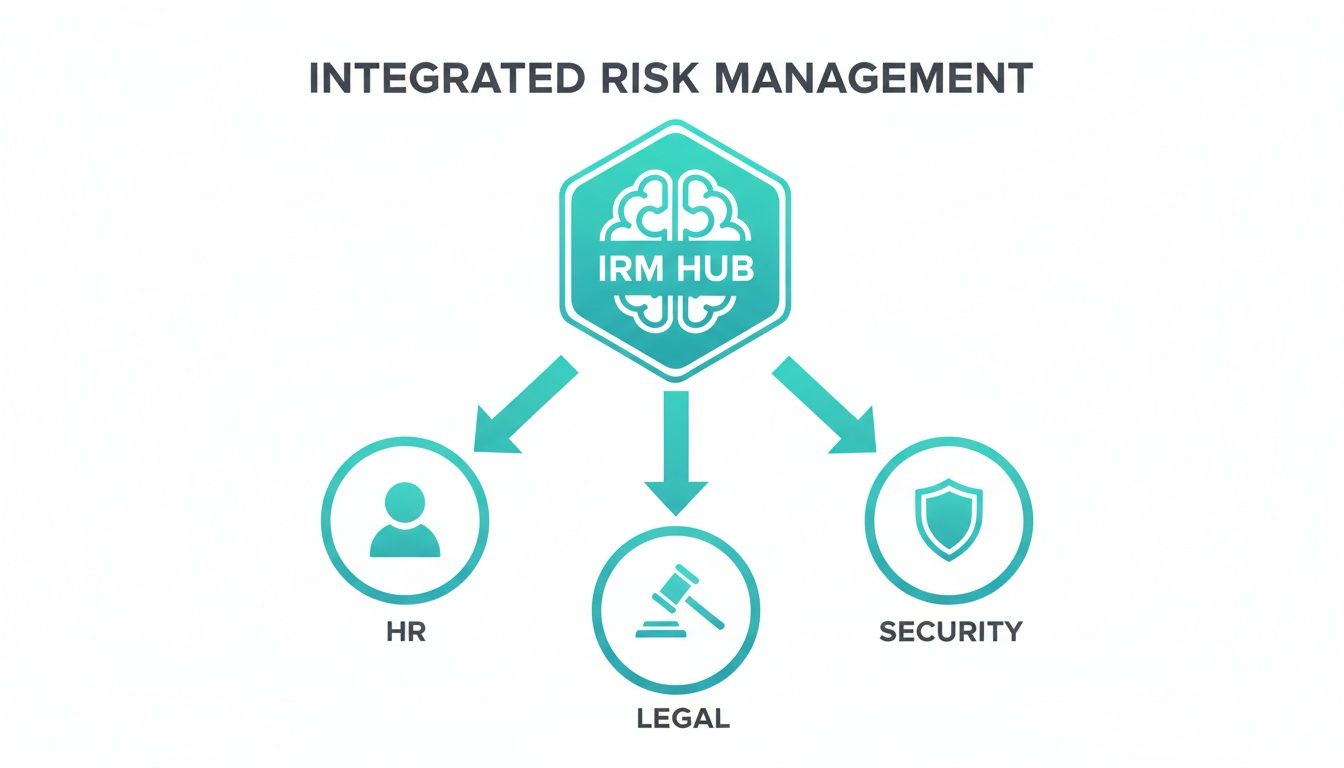
This setup prevents critical information from getting trapped in departmental silos, enabling a holistic, coordinated response. Technology and data are the engines that power this entire process. An EPPA compliant platform centralizes risk intelligence, automating the tedious work of data collection and correlation. This frees up your teams to focus on strategic analysis and prevention rather than chasing down information in spreadsheets. A robust framework is built upon identifying and managing diverse risk categories, including critical areas like managing compliance and employment law risks.
By implementing these foundational components, organizations can build a resilient and defensible system. For a deeper look into the specifics of structuring these elements, our guide on creating a compliance risk management framework provides actionable insights.
GRC vs. ERM vs. IRM: Untangling the Acronyms
The world of risk management is a confusing sea of acronyms. To make smart, defensible decisions, leaders have to cut through the noise and understand the real differences between Integrated Risk Management (IRM), Governance, Risk, and Compliance (GRC), and Enterprise Risk Management (ERM).
These aren't just interchangeable buzzwords. Each represents a different philosophy and shows a clear evolution in how we think about business threats and liability. Knowing which approach actually puts you ahead of problems is key to prevention.
GRC: The Compliance-Driven Foundation
Governance, Risk, and Compliance (GRC) was the original framework designed to get an organization's IT and security operations in line with its business goals. Over time, GRC became almost entirely focused on satisfying external regulations.
This history has made GRC an inherently reactive practice. It's often driven by audit findings and the need to prove that you're following a specific set of rules. While necessary, a compliance-first mindset can easily lead to a "check-the-box" culture. Teams end up working to keep auditors happy instead of building an organization that can actually see the next human-factor threat coming.
ERM: The Top-Down Strategic View
Enterprise Risk Management (ERM) was the next step up, designed to take a broader, more strategic view than GRC. ERM is typically a top-down approach, zeroing in on major threats that could derail the entire company's strategic goals—think large-scale financial, operational, and market risks.
The problem is, ERM can sometimes stay too high-level. It’s great for seeing the forest, but it often misses the individual trees—those granular, interconnected risks bubbling up from deep within the organization. This is especially true for complex human-factor risks, where small issues in different departments can quietly combine into a major internal threat.
IRM: The Modern, Proactive Standard
Integrated Risk Management (IRM) is the modern answer to the shortcomings of both GRC and ERM. It’s a holistic, tech-powered approach that weaves risk awareness directly into the fabric of everyday business decisions. IRM is all about breaking down the silos that prevent leaders from seeing the full picture of liability.
IRM connects the dots between a compliance gap found by legal, a misconduct issue flagged by HR, and a security alert from IT. It understands these aren't three separate problems—they're symptoms of a single, bigger risk that needs a unified, preventive response.
This shift from siloed reactions to integrated prevention is absolutely crucial. Unfortunately, most companies are still stuck in the old way of thinking. PwC’s Global Risk Survey 2023 found that a staggering 71% of executives admit that regulatory adherence still dominates their risk posture—a classic GRC mindset.
This highlights the urgent need to move beyond traditional frameworks. For more on this, you can explore the full study on why risk management needs to evolve.
So, what is integrated risk management? It's the new standard that finally enables organizations to get ahead of challenges instead of just reacting to them, creating a defensible and high-performing business by preventing human-factor risk.
The Real Business Value Of Adopting IRM
Let's move past the theory. What does an Integrated Risk Management (IRM) strategy actually do for your business? This isn't just another compliance checkbox; it's a strategic move that delivers real, measurable value. It’s about transforming risk management from a necessary cost into a function that actively drives performance, protects your bottom line from liability, and builds a far more resilient organization.
For leaders, the value is crystal clear. IRM delivers the clarity needed to make smarter, faster decisions. Instead of seeing risks as isolated fires popping up in different departments, you get a single, interconnected view of your organization’s health. That unified perspective is essential for navigating today's complex, intertwined threats.
Enhanced Decision Making And Strategic Advantage
When risk data is trapped in departmental silos, executives are forced to fly blind, making critical decisions with an incomplete picture. Your compliance team might be flagging a regulatory gap, while HR is tracking a spike in internal complaints. Without IRM, those are just two separate data points. With it, they combine into a single, actionable insight: you have a potential culture and liability bomb on your hands.
This integrated intelligence allows leadership to get ahead of problems instead of constantly reacting to them. By understanding how different risks—from human-factor issues to operational weak points—influence each other, you can channel resources where they’ll have the greatest impact and prioritize the threats that pose a genuine danger to your strategic goals.
This unlocks a few key advantages:
Smarter Capital Allocation: Funneling money and people toward the highest-priority risks, stopping the resource drain from low-impact issues.
True Strategic Agility: Spotting emerging internal threats long before your competitors do, giving you the room to pivot and adapt.
Defensible Governance: Building a clear, auditable trail of risk-aware decisions that will hold up under the scrutiny of regulators and stakeholders.
Strengthening Operational Resilience
Operational disruptions can come from anywhere—supply chain failures, tech outages, or internal misconduct. An IRM framework helps you anticipate these shocks by pinpointing weak points and dependencies across the entire business. It fundamentally shifts the organization from a reactive, "break-fix" model to a proactive one focused on prevention of human-factor risk.
By connecting the dots between different functions, you can finally see how a seemingly small issue in one corner of the business could cascade into a major operational failure. This holistic view is the bedrock of genuine business resilience, ensuring you can absorb shocks and keep things running, even when the unexpected hits.
The ultimate goal of IRM is to embed risk awareness into the organization's DNA. It's not about trying to eliminate risk entirely—that’s impossible. It's about understanding it so thoroughly that you can take calculated risks with confidence, turning potential threats into opportunities for growth and improvement.
The impact of this integrated approach is felt across the entire organization, breaking down the silos that typically hinder effective risk management.
Impact of IRM on Key Business Functions
Department | Challenge Without IRM | Benefit With IRM |
|---|---|---|
Finance & Accounting | Blind spots in financial controls, making it hard to spot fraud indicators until after the fact. | A unified view of financial and operational risks helps identify anomalies that signal potential misconduct or fraud early. |
Human Resources (HR) | Disconnected data on employee complaints, turnover, and policy violations, masking systemic cultural issues. | Connects HR metrics with compliance and security data, revealing the human-factor risks behind operational failures. |
IT & Security | Focuses on technical threats, missing the human element behind breaches (e.g., social engineering, insider risk). | Integrates human-factor risk data with other alerts, creating a more complete picture of insider threat vulnerabilities. |
Legal & Compliance | A constant, reactive scramble to respond to regulatory changes and internal incidents. | Proactively maps risks to controls, automates compliance monitoring, and provides a clear audit trail for regulators. |
Operations | Supply chain or process disruptions appear as sudden, unexpected crises with no clear root cause. | Identifies hidden dependencies and single points of failure, allowing for proactive contingency planning. |
This table illustrates how IRM moves risk management from a siloed, departmental task to a strategic, cross-functional capability that protects and strengthens the entire business.
Reducing Costs and Protecting Reputation
Perhaps the most powerful business case for IRM is its direct impact on the bottom line. Reactive investigations, regulatory fines, and legal battles are incredibly expensive, not just in dollars but in reputational damage. IRM gets ahead of these costs by identifying and neutralizing risks before they blow up into damaging incidents.
This proactive stance is quickly becoming an economic necessity. The global IRM market is projected to grow significantly as regulatory complexity makes ad-hoc, reactive models completely unsustainable. Companies that fail to adopt a preventive posture will be left behind, facing mounting costs and liabilities.
Ultimately, IRM is one of the most effective tools for protecting your most valuable—and fragile—asset: your reputation. By demonstrating a mature, proactive approach to managing risks, especially sensitive internal threats and human-factor risks, you build deep-seated trust with customers, investors, and regulators. That trust is the foundation for any long-term success.
Advancing IRM With Proactive, Ethical AI
Even the most buttoned-up IRM framework has a massive blind spot: the unpredictable human element. Traditional approaches are great at mapping out risks in processes and technology, but they fall apart when trying to get ahead of the complex, nuanced threats that come from within. This is where the whole concept of integrated risk management has to evolve.
The new standard for managing this human-factor risk means moving beyond damage control and embracing ethical, non-intrusive AI. It’s about shifting IRM from a discipline that just responds to incidents to one that is genuinely preventive.
This approach tackles a hard truth: the costliest risks, from misconduct and conflicts of interest to internal fraud, start with people. Instead of waiting for a whistleblower report or kicking off a painful investigation after the fact, a modern IRM strategy needs a real-time intelligence layer dedicated to these human-capital risks.

Shifting From Reactive Forensics to Proactive Prevention
The old model of managing internal risk is fundamentally broken. It’s built on expensive, reputation-damaging forensic investigations that only start after the damage is done. This reactive posture leaves organizations perpetually on the defensive, cleaning up messes instead of preventing them in the first place. Modern IRM demands a smarter way forward.
Ethical AI-driven platforms like Logical Commander provide the missing piece of the puzzle. They offer a way to continuously assess human-factor risks without resorting to invasive methods that create a legal and cultural nightmare.
Unlike outdated surveillance tools that monitor employee activity and trigger massive privacy concerns, a modern EPPA compliant platform identifies risk indicators through structured, respectful interactions. This preserves employee dignity and protects the organization from legal blowback.
This proactive capability finally allows HR, Compliance, and Security teams to get ahead of potential issues. It empowers them to address concerns before they escalate into costly incidents, protecting both the organization and its people.
The New Standard: E-Commander And Risk-HR
To effectively fold human-factor risk into your IRM, you need specialized tools built for the job. Solutions like E-Commander and Risk-HR represent the new standard in ethical risk management. They are designed from the ground up to provide early warnings on a range of internal threats without crossing legal or ethical lines.
This technology helps operationalize a proactive IRM strategy in a few critical ways:
Continuous Risk Intelligence: It offers an ongoing view of human-related risks, replacing the periodic, manual assessments that are outdated the moment they’re finished.
Early Warning System: The platform flags potential conflicts of interest, misconduct, or other integrity risks long before they can cause financial or reputational harm.
Ethical and Compliant Framework: It operates within strict legal guidelines like EPPA, ensuring your risk management process is defensible and respects employee rights.
Why Traditional Tools Fail at Human Risk
Many organizations try to manage human risk with tools that were never designed for it. Cybersecurity platforms, for example, are focused on technical threats; they completely lack the nuance to understand human behavior and intent. They are simply not equipped for AI human risk mitigation.
Here’s a quick comparison of the old, invasive methods versus the new, ethical standard:
Aspect | Outdated Surveillance Approach | Ethical AI Prevention (Logical Commander) |
|---|---|---|
Methodology | Secretly monitors employee communications and activities. | Engages employees through structured, non-intrusive assessments. |
Legal Risk | High risk of violating privacy laws and EPPA regulations. | Fully EPPA-aligned, preserving employee rights and dignity. |
Focus | Reactive; identifies individuals after an incident has occurred. | Proactive; identifies risk indicators to prevent incidents. |
Employee Impact | Creates a culture of distrust and fear. | Fosters a culture of integrity and transparency. |
Outcome | Leads to costly investigations and legal battles. | Enables early intervention and proactive risk mitigation. |
By adopting a proactive, ethical AI platform, organizations can finally address their most complex and dynamic risk area. This approach plugs seamlessly into a modern IRM framework, providing the critical intelligence needed to protect the business from the inside out and build a true culture of prevention.
How To Implement IRM And Avoid Common Pitfalls
Moving to an Integrated Risk Management (IRM) framework is a strategic leap, not just a technical upgrade. It's an achievable goal, but one that demands a clear roadmap. Getting it right requires careful planning to sidestep the common hurdles that can derail even the best-laid plans.
The biggest obstacles you'll face are almost always cultural, not technological. Deeply entrenched data silos, resistance to change, and a lack of executive buy-in can stop an IRM initiative cold before it ever gets off the ground. Breaking down these barriers is the first and most critical step toward building a truly unified view of risk.

Overcoming Key Implementation Challenges
If you tackle the most common pitfalls head-on, you'll dramatically improve your chances of a smooth transition. The game plan is simple: secure support from the top, prove value quickly, and pick the right technology from day one.
Here are the key hurdles and how to clear them:
Securing Executive Buy-In: Leadership support is non-negotiable. Don't frame IRM as just another cost center; position it as a strategic enabler that protects the company's reputation and reduces liability. Use hard data from past costly, reactive investigations to build a powerful business case for proactive prevention.
Breaking Down Data Silos: Departments often guard their data fiercely. To show the immediate value of a unified view, launch a pilot project focused on a high-impact area. For example, connecting HR misconduct data with compliance flags can reveal patterns that were previously invisible.
Navigating Cultural Resistance: Employees might worry that new systems are just for policing their behavior. It's crucial to emphasize that modern ethical risk management tools are built for prevention and support, not punishment. Build trust from the outset by choosing EPPA compliant platforms that respect employee dignity and privacy.
Selecting The Right Technology Partner
Your choice of technology is a pivotal decision. The right platform should dismantle silos, not just create new digital ones. It needs to be capable of pulling together wildly diverse data streams—from compliance and security reports to the subtle signals of human-factor risk—and weaving them into a single, coherent picture.
The goal is to select a system that provides a unified intelligence layer, enabling proactive decision-making rather than just aggregating data after the fact. The technology should empower your teams to see connections between risks before they escalate into incidents.
When you're evaluating potential platforms, prioritize solutions that are non-intrusive and align with a culture of prevention. Steer clear of surveillance-based tools that create a legal minefield and poison employee trust. Instead, look for modern Risk Assessments Software like Logical Commander, which is designed for ethical, proactive management of human-factor risk.
Finally, don't underestimate the value of having a strategic partner to guide you through this shift. Programs like our PartnerLC initiative provide expert support to make sure your implementation is a success and delivers a strong return on investment, solidifying your move to a more resilient, proactive risk posture.
Your Questions on Integrated Risk Management, Answered
Even with the best strategy in hand, questions always pop up when you're about to implement a new risk framework. Getting clear on the practical details of integrated risk management is what gives leaders the confidence to move forward and build a program that's both proactive and defensible against liability.
Here are a few of the most common questions we hear from decision-makers.
What Is The Difference Between GRC And IRM?
It's easy to get these two mixed up, but the distinction is critical. Think of GRC (Governance, Risk, and Compliance) as the high-level blueprint for the entire organization. It sets the rules of the road for how the business is governed, how it approaches risk in general, and how it meets its compliance obligations.
IRM, on the other hand, is the engine that actually makes the "R" in GRC work effectively. It’s the hands-on methodology for connecting all the different risk functions—like internal audit, HR, and security—so they operate as one cohesive system instead of isolated silos. In short, IRM is the modern, integrated execution of your risk strategy.
How Long Does IRM Implementation Take?
The timeline really depends on your company's size and complexity, but you will see progress in stages. Most organizations start seeing real value within the first six months, such as running risk assessments faster and generating clearer, more actionable reports.
The initial technical setup and getting your team trained on a new platform typically takes about 3-6 months. From there, weaving the IRM processes deeper into each department's day-to-day work might take another 6-12 months.
The ultimate goal—getting to a point where risk-aware thinking is just part of your company’s DNA—can take anywhere from 12 to 24 months. We always recommend starting with a few high-impact pilot projects to score some quick wins and build momentum for the preventive strategy.
What Are The Biggest Hurdles To Implementing IRM?
The biggest obstacles are almost always about people, not technology. The most common challenges we see are cultural: resistance to change, teams worried about losing autonomy, and data silos that have been entrenched for years. This is why having unwavering executive sponsorship from day one is absolutely non-negotiable.
On the technical side, getting legacy systems to talk to each other can be a headache, especially when they all use different data formats. This is a huge reason why choosing an ethical risk management platform designed with strong integration capabilities is so critical to your success.
The single biggest mistake you can make is underestimating the change management involved. IRM isn't just a software install; it's a mindset shift from defending your department to building enterprise-wide resilience. To get everyone on board, you have to be crystal clear about the benefits: reducing liability, protecting the entire organization, and shifting from costly reaction to proactive prevention.
This kind of proactive thinking ensures you can manage all kinds of risks, including sensitive internal threats, without creating a culture of fear and suspicion.
Elevate Your Risk Strategy with Logical Commander
Ready to move beyond reactive investigations and build a truly resilient organization? Logical Commander’s ethical, AI-driven platform provides the proactive intelligence you need to get ahead of human-factor risk and protect your business from the inside out.
Get Platform Access: Start your free trial and experience the new standard in risk prevention.
Request a Demo: Schedule a personalized demo to see how our EPPA-aligned technology can fit your IRM framework.
Join Our Partner Ecosystem: Become an ally in our mission. Join our PartnerLC program and bring next-generation risk solutions to your clients.
Contact Our Team: Have questions about enterprise deployment? Contact us today to speak with a risk management expert.