%20(2)_edited.png)

Your Guide to the Enterprise Risk Management Manager Role
- Marketing Team

- Jan 19
- 17 min read
Updated: Jan 21
An enterprise risk management manager is the strategic architect of a company's resilience, tasked with identifying, assessing, and neutralizing risks across the entire organization. They go far beyond simple compliance, building a robust framework that shields the business from financial, operational, and reputational threats.
What Does an Enterprise Risk Management Manager Really Do
Think of an enterprise risk management (ERM) manager as a ship's navigator, but for a modern business. A navigator does more than just steer the vessel; they are constantly scanning the horizon, interpreting weather patterns, and consulting complex charts to plot the safest, most efficient course. They anticipate turbulence long before the crew feels the first jolt.
This role operates with the same forward-thinking mindset. Instead of just reacting to problems after they hit—like a data breach or a supply chain failure—this manager builds the systems to see them coming. They work across every department, from finance and HR to operations and IT, to understand the unique vulnerabilities each one faces.
Shifting from Reaction to Proactive Resilience
The core mission of an ERM manager is to shift the entire organization's mindset from reactive to proactive. A reactive company waits for a crisis and then scrambles to contain the damage. A proactive one, guided by its ERM leader, has already built the necessary safeguards.
This involves a few key activities:
Identifying Potential Threats: They hunt for everything from cybersecurity vulnerabilities and regulatory changes to internal fraud risks and geopolitical instability.
Assessing Impact and Likelihood: Not all risks are created equal. The manager analyzes which threats pose the greatest danger and are most likely to happen, allowing the business to prioritize its resources intelligently.
Developing Mitigation Strategies: Once risks are prioritized, they design and implement plans to reduce their impact. This could mean improving security protocols, diversifying suppliers, or updating internal policies.
To give you a clearer picture, here's a quick breakdown of their most critical responsibilities and the direct impact on the business.
The Enterprise Risk Management Manager's Core Functions at a Glance
This table summarizes the essential responsibilities of an ERM Manager, providing a quick overview of their strategic importance.
Core Function | What It Looks Like in Practice | Impact on the Business |
|---|---|---|
Risk Identification & Assessment | Running workshops with department heads to map out potential operational, financial, and strategic risks. | Prevents blind spots and ensures leadership has a complete view of potential threats. |
Framework Development | Designing and implementing a unified ERM framework that standardizes how risks are measured and reported company-wide. | Creates a consistent "language of risk," making it easier to compare and prioritize issues across different business units. |
Mitigation & Control | Working with IT to strengthen cybersecurity controls or with legal to update compliance policies based on new regulations. | Reduces the likelihood and impact of negative events, protecting assets and profitability. |
Reporting & Communication | Creating clear, concise risk dashboards for the board of directors and executive leadership. | Enables informed, strategic decision-making by translating complex risk data into actionable business intelligence. |
Cultivating a Risk-Aware Culture | Leading training sessions to ensure employees at all levels understand their role in managing risk. | Embeds resilience into the company’s DNA, making risk management a shared responsibility, not just a departmental function. |
As you can see, the ERM manager is a central figure who connects dots across the entire organization to build a stronger, more adaptable enterprise.
An effective enterprise risk management manager doesn't just create a list of potential problems. They build a living, breathing program that integrates risk awareness into the company's DNA, making resilience a shared responsibility.
The Strategic Value of Foresight
Ultimately, the goal is to build organizational resilience. In a world defined by constant change and unpredictability, the ability to absorb shocks and adapt is a powerful competitive advantage. The ERM manager is the central figure in developing this capability.
They provide leadership with the critical foresight needed to make informed decisions, protect assets, and confidently pursue strategic goals. By understanding the complete landscape of potential disruptions, organizations can navigate uncertainty with greater stability and purpose. For a deeper dive into the foundational concepts, our guide on enterprise risk management provides extensive details.
A Day in the Life of a Risk Manager
Forget the image of a quiet, predictable nine-to-five job. The role of an enterprise risk management manager is anything but. It’s a fast-paced blend of high-level strategy, on-the-ground collaboration, and sharp data analysis. Their day is less about ticking boxes and more about connecting dots that no one else sees, all to keep the organization steady in a world that’s constantly changing.
A risk manager’s morning might not even start with emails. Instead, they’re likely diving straight into the company’s risk register. This isn’t some dusty, forgotten document; it’s a living dashboard tracking every potential threat, from a new cybersecurity weakness to a looming regulatory hurdle. They’re assessing what’s changed overnight—did a geopolitical flare-up just threaten a key supplier? Does a new piece of legislation need the legal team’s eyes on it, right now?
From Frameworks to Facilitation
A huge part of the job is turning abstract strategy into concrete action. This often means leading workshops with department heads. Picture them in a room with the leaders of Operations, Finance, and Marketing, all focused on a new product launch. The risk manager is there to ask the hard questions: What happens to our financials if we miss our sales projections? What’s the reputational fallout if this product has a flaw?
By steering that conversation, they help each department see beyond its own silo and recognize how its decisions impact the company's total risk profile. They aren’t there to kill ideas. They’re there to build the guardrails that allow innovation to happen safely. The growing demand for this critical function is clear in market trends. The global enterprise risk management market was valued at a huge USD 5.83 billion in 2024, showing just how much companies are investing in these specialized skills. For a deeper dive into this growth, you can explore the full market research report.
After these workshops, the manager’s job is to synthesize all that information. They take complex technical data and candid feedback and distill it into clear, actionable intelligence for the C-suite and the board of directors, who depend on it to make sound strategic bets.
The true art of an enterprise risk management manager is transforming abstract concerns into a concrete action plan. They must be part storyteller and part data scientist, weaving a narrative that makes risk understandable and manageable for everyone, from the front lines to the boardroom.
Central Command in a Crisis
Now, let's throw a wrench in the works. Imagine a critical supplier’s factory is suddenly shut down by a natural disaster. This is where the risk manager pivots instantly from strategist to crisis coordinator. Their phone lights up, and the day’s priorities are completely reshuffled.
Their first move is to activate the business continuity plan they helped create. They immediately assemble a cross-functional response team, pulling in the right people from:
Operations: To get an instant read on inventory and start vetting alternative suppliers.
Finance: To model the financial fallout and green-light any emergency spending.
Legal: To pull up supplier contracts and check for force majeure clauses or other liabilities.
Communications: To craft statements for customers and stakeholders, getting ahead of any reputational damage.
In this chaos, the ERM manager is the central command. They don't make every single decision, but they ensure every decision is coordinated and aimed at a single goal: minimizing the damage. They track progress, keep the lines of communication open between frantic departments, and deliver clear updates to leadership. It’s in moments like these that their proactive planning pays off, turning a potential catastrophe into a challenge the business can actually manage.
The Skills That Define a Great ERM Manager
Being a successful enterprise risk management manager is a balancing act, a unique mix of hard technical expertise and subtle interpersonal finesse. While the technical skills get you in the door, it’s the soft skills that truly separate a great manager from a merely good one. They have to be part data analyst, part diplomat, and part strategist to navigate the complex currents of a large organization.
This blended skill set is what allows them to build bridges between departments. They can take dense, intimidating risk data and turn it into a compelling business case that actually gets people to act. Without that blend, even the most perfectly designed risk framework will just sit on a shelf, failing to deliver any real value.
Technical Proficiency and Hard Skills
There are a few non-negotiable hard skills that form the bedrock of an ERM manager’s credibility. These are the technical chops that prove they can accurately identify, measure, and manage risk with a steady hand, all while sticking to established best practices.
Quantitative and Analytical Skills: An ERM manager has to be comfortable in a world of data. This means being able to run statistical analyses, build financial models, and use quantitative methods to put real numbers on the likelihood and potential impact of different risks.
GRC Platform Expertise: You can't run a modern ERM program without a solid grasp of Governance, Risk, and Compliance (GRC) software. These platforms are the central nervous system of the whole operation, used to manage risk registers, track mitigation efforts, and create the reports that leadership depends on.
Knowledge of Standards and Frameworks: A deep, practical understanding of globally recognized frameworks like ISO 31000 or the COSO ERM Framework is absolutely essential. These standards aren't just academic—they are the blueprints for building a structured, defensible, and effective risk management program.
This flowchart shows how these skills come together in the ERM manager's day-to-day responsibilities, moving from the initial framework design to delivering real, actionable intelligence.
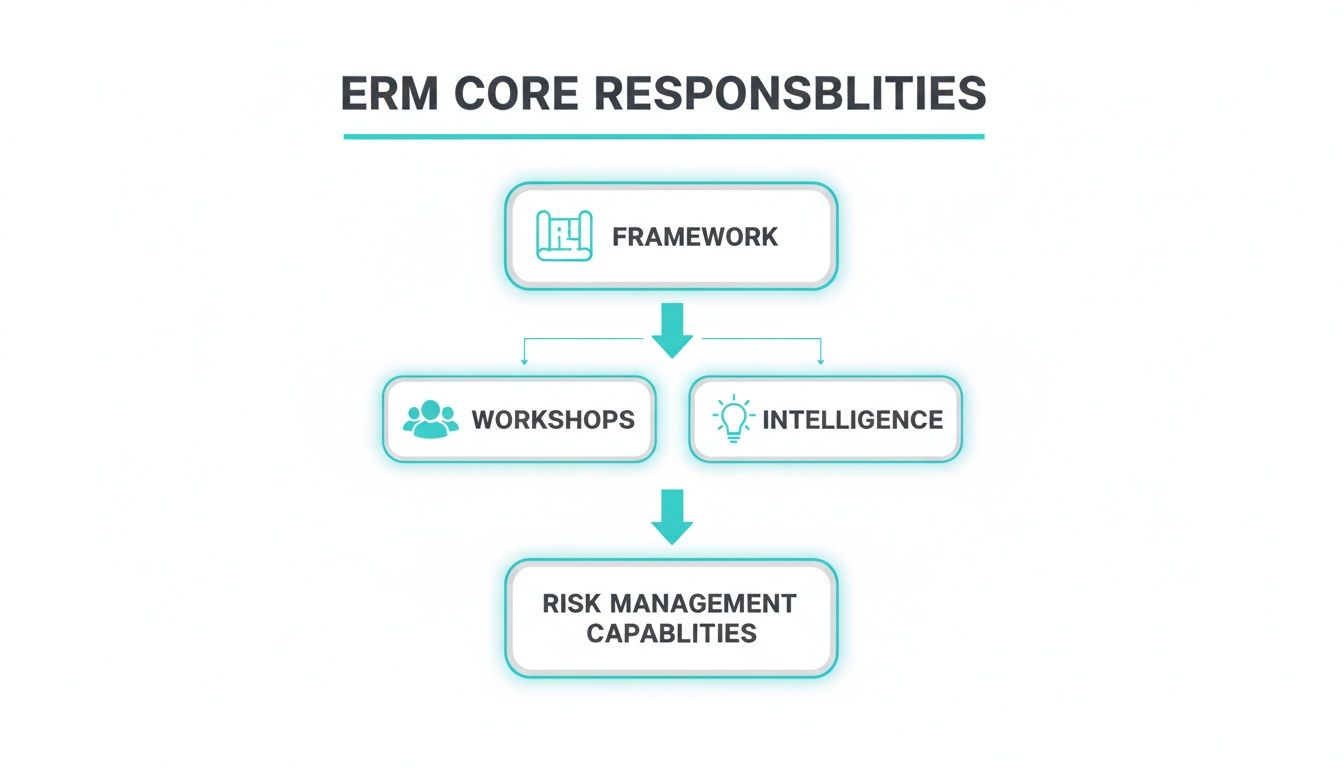
You can see a clear, logical progression here. A solid framework makes collaborative workshops possible, and those workshops produce the critical intelligence that leadership needs to make smart decisions.
The Soft Skills That Drive Influence
While technical skills are the price of entry, it's the soft skills that determine an ERM manager’s real-world impact. They often have to influence major outcomes without any direct authority, which makes these interpersonal abilities absolutely critical.
An enterprise risk management manager's greatest challenge isn't identifying the risk; it's convincing a dozen different stakeholders why they should care and what they need to do about it. This requires persuasion, not just process.
Key soft skills include:
Strategic Communication: The ability to translate complex risk information for different audiences is huge. A presentation to the board of directors is going to look and sound very different from a workshop with an engineering team, but both have to be clear, concise, and persuasive.
Building Consensus: Risk management is a team sport, not a solo act. The manager has to be a master facilitator, skilled at navigating departmental politics and bringing diverse groups to the table to agree on a unified path forward for mitigation.
Influencing Without Authority: ERM managers rarely have direct control over other departments. Their success hinges entirely on their ability to build relationships, establish credibility, and use data-driven arguments to persuade colleagues to adopt new processes or controls.
Improving these skills is directly tied to getting better results. For more on this, you can explore our guide on how decision intelligence and human risk management intersect to create a more resilient organization.
Organizational Placement and Impact
Where an ERM manager sits within a company’s structure has a huge effect on their influence. Most commonly, they report up to a senior executive like the Chief Risk Officer (CRO), Chief Financial Officer (CFO), or General Counsel.
This high-level reporting line is completely intentional. It gives the ERM function the visibility and authority it needs to operate effectively across the entire organization. This placement ensures that risk management is treated like a strategic priority, not just a compliance checkbox buried deep within a single department.
Navigating the Toughest Challenges in Risk Management
Even the sharpest enterprise risk management manager is up against some serious headwinds. The job often feels less like a technical function and more like a diplomatic mission. It demands persistence, strategic savvy, and the ability to tell a compelling story. The real struggle isn't spotting the risks; it's getting the rest of the organization to see them with the same urgency.
Three massive obstacles show up time and again: getting genuine buy-in from the top, demolishing stubborn departmental silos, and the classic problem of proving the value of a disaster that never happened. To win these battles, you have to evolve from a risk administrator into a strategic influencer.
Securing Genuine Executive Buy-in
Getting leadership to sign off on a risk program is easy. Getting them to truly champion it is a different beast entirely.
Real buy-in means executives see risk management not as a compliance checkbox or a cost center, but as a critical part of making smart business decisions. The challenge is that risk management lives in the world of hypotheticals and what-ifs, which can feel a lot less urgent than hitting this quarter’s revenue targets.
To close that gap, a smart manager has to learn to speak the language of the C-suite. Ditch the long laundry list of potential disasters. Instead, frame the conversation around what they really care about: business objectives. Show them exactly how an unmanaged risk threatens a strategic goal, whether it’s a new market launch, a product rollout, or the company’s profitability. Use data to model the financial impact of doing nothing, turning abstract threats into cold, hard numbers that hit home with bottom-line-focused leaders.
This is a place where many organizations fall short. In fact, a huge capability gap exists right now, with only 18% of enterprise risk management leaders feeling highly confident in their ability to spot emerging risks. That statistic is a glaring vulnerability and it highlights why strong, leadership-backed programs are so essential. For a deeper dive into these trends, you can read the full research about ERM capabilities.
Breaking Down Departmental Silos
Risk doesn’t care about your org chart. A financial risk spills over into operations, and an IT vulnerability can cripple the entire company. An ERM manager's job is to be the bridge-builder between these isolated functions, creating a shared sense of ownership for the organization's overall health. This is almost always easier said than done, since every department has its own priorities, budgets, and culture.
Imagine a manager trying to convince a top-performing sales team to adopt a stricter client vetting process. To the sales team, it looks like nothing more than bureaucratic red tape designed to slow down deals and shrink their commissions. A top-down mandate would be met with eye-rolls and quiet defiance.
So, the manager comes at it with data. They present a scenario showing how just one bad client—one who defaults on a major contract—could not only create a massive financial loss but also trigger commission clawbacks for the entire team. All of a sudden, the risk isn’t some abstract compliance issue; it’s a direct threat to their wallets. By reframing the new process as a way to protect their own earnings, the manager turns resistant employees into engaged partners.
The most effective enterprise risk management manager doesn't force collaboration; they create a compelling, data-driven case that makes collaboration the only logical choice for every department.
Avoiding Risk Fatigue and Proving ROI
Finally, you have to battle "risk fatigue." When people are constantly hit with warnings, new procedures, and what-if scenarios, they can start to tune it all out. The ERM program becomes background noise instead of an urgent priority. This is especially true when the program is actually working, because the absence of a crisis makes the need for vigilance feel less real.
To fight this, the manager has to constantly and creatively demonstrate value. This means:
Celebrating the near-misses: When a risk is successfully shut down, tell that story. Show everyone how the framework you built prevented a real-world disaster.
Tracking the right metrics: Don't just track risks; track wins. Showcase things like lower insurance premiums, fewer compliance fines, or better operational uptime as direct results of the ERM program.
Weaving risk into strategy: Make sure risk conversations are a standard, required part of strategic planning meetings. This keeps the topic relevant and top-of-mind for leadership.
By actively communicating successes and tying the program to tangible business outcomes, the enterprise risk management manager can keep the organization engaged and prove that the quiet, thankless work of prevention delivers one of the most powerful returns on investment there is.
Charting Your Career Path in Enterprise Risk Management
The journey to becoming an enterprise risk management manager is rarely a straight line. Think of it less as a ladder and more as a strategic climb, built on a solid foundation of experience and a serious commitment to learning. This isn't an entry-level gig; most professionals build their expertise in related fields first, bringing a rich, multi-disciplinary view to the ERM role when they arrive.
The path often kicks off in roles that sharpen your analytical and procedural instincts. Many of today's sharpest ERM leaders started their careers as Risk Analysts, Internal Auditors, or Compliance Specialists. These jobs are the perfect training ground for understanding how a business really works, where its weak spots are, and how to tell if a control is actually doing its job. This is where you master the "how" of risk—how to test controls, document findings, and hunt for anomalies in the data.
From Analyst to Manager
As you rack up experience, the trajectory naturally moves from analyst to more senior positions. A Senior Risk Analyst or an ERM Specialist starts tackling more complex projects, begins to lead risk assessments, and facilitates workshops with department heads. This is that crucial transition phase where your technical skills start to blend with the softer, but equally critical, skills of influence and communication.
Making the leap to enterprise risk management manager is a significant shift in perspective. At this level, your focus explodes from just executing tasks to designing and owning the entire ERM framework. You're no longer just identifying individual risks; you're shaping the organization’s entire risk culture, strategy, and appetite, and you’re the one presenting those insights directly to senior leadership.
Advancing to Executive Leadership
The ERM manager role is a powerful launchpad for a seat at the executive table. Once you’ve proven you can successfully manage risk across the entire enterprise, the next logical steps often lead to more senior, strategic positions.
Director of ERM: This role dials up the strategic responsibility, often involving managing a team of risk managers and overseeing the ERM program for a whole business unit or region.
Chief Risk Officer (CRO): As a C-suite executive, the CRO is the ultimate owner of the organization's risk landscape. They report directly to the CEO and the board, making sure risk management is woven into the very fabric of top-level corporate strategy.
Anonymous Case Study: A CRO at a Fortune 500 financial services firm I know started her career in internal audit. She stood out by not just flagging issues, but by digging into the business reasons behind them. That curiosity pushed her into a risk specialist role, where she focused on building relationships and showing how proactive risk management could actually enable growth, not just block it. Her knack for turning dry risk data into a compelling business story was the key to her climb to the C-suite.
Accelerating Your Growth
Certain professional certifications can put a serious accelerator on your career progression, validating your expertise and showing you're committed to the field. The RIMS-Certified Risk Management Professional (RIMS-CRMP) is a globally recognized credential that signals a high level of competence in ERM principles and practices.
For anyone looking to be the architect of their own career, understanding how to build a meaningful development plan is invaluable. A well-structured approach helps you map out the specific skills and experiences you need at each stage. Investing in credentials like the RIMS-CRMP and creating a robust career development plan are practical, powerful steps toward landing those senior leadership roles in the risk management world.
How Technology Is Reshaping Internal Risk Management
The job of an enterprise risk management manager is undergoing a massive shift, moving from a reactive, clean-up role to a predictive, preventive one. This change is being driven by new technologies designed to spot internal threats before they ever detonate.
Think of traditional systems as a smoke detector. They only sound the alarm after a fire has already started, leaving managers to deal with the damage. Modern platforms, on the other hand, are more like an advanced early-warning system. They’re built to spot the subtle, preliminary signals of risk—like integrity gaps or potential fraud—without resorting to invasive surveillance. This flips the script from reaction to prevention, changing how companies protect themselves from the inside out.
From Silos to a Single Source of Truth
For years, managing internal risk has been a messy, fragmented effort. HR, Compliance, Security, and Legal teams each had a piece of the puzzle, but they were often working from separate spreadsheets and siloed databases. This approach created dangerous blind spots where critical information could easily be lost or misinterpreted between departments.
An ERM manager armed with modern tools can finally tear down those walls. A unified operational platform creates a single source of truth, connecting all relevant departments and centralizing risk intelligence into one place. This integration brings a few huge advantages:
Complete Visibility: Every stakeholder sees the same up-to-date information. No more conflicting data or guessing games—everyone is on the same page.
Streamlined Collaboration: When a potential issue pops up, teams can coordinate their response through a shared system, making the process faster and more accountable.
Consistent Governance: A unified platform ensures that all risk management activities follow the organization’s established policies and regulatory standards, every time.
This centralized approach means that when an early warning sign appears, it's seen by the right people at the right time. It replaces guesswork with a structured, coordinated process for getting ahead of internal threats.
The Ethical Shift to Proactive Prevention
The biggest change technology brings is the power to be proactive without being invasive. Older approaches to internal risk often leaned on monitoring tools that felt a lot like Big Brother, creating a culture of distrust and raising serious privacy red flags. Employees felt watched, and managers were drowning in ambiguous data.
Newer, ethically designed platforms work on a completely different principle. Instead of monitoring employee communications or behavior, they focus on identifying structured, objective risk indicators. For instance, a system might flag a potential conflict of interest based on procedural data, not by snooping through private messages.
Today's most effective enterprise risk management tools are not about catching people doing wrong; they are about identifying systemic vulnerabilities before anyone has the chance to exploit them. This is the core of ethical, proactive risk management.
This method protects employee dignity and privacy while still giving the ERM manager the insights needed to act. It shifts the focus from judging individuals to strengthening organizational processes. By spotting early signals of procedural weaknesses or governance gaps, the manager can step in to fix the underlying issue, stopping misconduct before it ever happens.
This approach is not only more effective but also builds a healthier, more trusting corporate culture. You can find more information about these specialized platforms by exploring our guide on modern enterprise risk management tools.
The Power of AI in Identifying Hidden Patterns
Artificial intelligence is what makes this proactive shift possible. AI can analyze massive amounts of operational data to find subtle patterns and anomalies that a human analyst would almost certainly miss. This capability takes risk detection far beyond simple, rule-based alerts.
For example, an AI-powered system can cross-reference information from different departments to uncover complex risks that would otherwise stay buried in the data. For a broader look at current AI technologies that could shape risk management, you might explore companies like Parakeet-AI.
This analytical power allows the enterprise risk management manager to evolve from a data collector into a strategic advisor. With AI handling the heavy lifting of pattern recognition, the manager can focus on higher-value work:
Interpreting Insights: Understanding the business context behind the data and figuring out the right response.
Strategic Mitigation: Designing and implementing controls that address the root causes of the risks identified.
Advising Leadership: Giving clear, data-driven recommendations to the C-suite on emerging internal threats.
By embracing these technological advances, the modern enterprise risk management manager is better equipped than ever to protect their organization. They can anticipate threats, act decisively, and foster a resilient culture—all while holding up the highest ethical standards.
Common Questions About the ERM Manager Role
As the enterprise risk management manager role becomes a staple in modern companies, a few key questions always come up. Getting the answers right is crucial for understanding just how strategic and forward-looking this position really is.
These aren't just academic distinctions. The answers show exactly where the ERM manager fits into the bigger picture of corporate governance and why their work is so vital for building a truly resilient business.
What Is the Difference Between an ERM Manager and an Internal Auditor?
While both roles are absolutely essential for good governance, they look in completely different directions. Think of an internal auditor as a historian. They look backward, carefully examining past transactions and events to make sure everything was done by the book and that existing controls held up. Their world is about accuracy and compliance with established policies.
An enterprise risk management manager, on the other hand, is a futurist. They’re constantly scanning the horizon, looking ahead to spot and prepare for potential storms before they ever hit. One verifies what already happened; the other readies the organization for what could happen next.
An internal auditor asks, "Did we follow the rules correctly?" An ERM manager asks, "What future event could break our rules, and how do we prepare for it now?" This fundamental difference separates historical review from strategic foresight.
How Can an ERM Manager Demonstrate the Value of Their Program?
This is one of the toughest parts of the job. How do you prove the financial value of a disaster that didn't happen? Success is often invisible. The key is to tell a complete story using a mix of hard numbers and qualitative wins.
Quantitatively: You can point to real dollars saved. This includes reduced financial losses from incidents that did occur (but were minimized), lower insurance premiums thanks to a stronger risk posture, and documented cost savings from process improvements found during risk assessments.
Qualitatively: Success is also obvious in the company's smarter, more risk-aware strategic decisions. It’s seen in the increased confidence from investors and the board, and in the organization’s ability to navigate market disruptions far more smoothly than its competitors.
How Is AI Changing the Job of an ERM Manager?
Artificial intelligence is taking the ERM manager out of the weeds and into the boardroom. AI-powered tools are incredible at chewing through massive, complex datasets to find the subtle risk patterns and emerging threats a human analyst could easily miss. It automates much of the tedious, routine monitoring work.
This frees up the ERM manager to focus on what humans do best: high-level strategy, creative problem-solving, and advising leadership on complex threats. AI allows them to act faster and with much greater precision, turning risk management from a defensive function into a real source of competitive advantage.
Ready to shift your organization from reactive fire-fighting to proactive risk management? Logical Commander Software Ltd. offers E-Commander, an AI-driven platform that ethically identifies internal threats before they cause damage—without invasive surveillance. It centralizes risk intelligence, unites departments like HR and Compliance, and empowers your team to protect your organization's integrity and reputation. Discover how Logical Commander helps you Know First and Act Fast.