%20(2)_edited.png)

A Modern Risk Based Approach to Internal Threats
- Marketing Team

- Oct 23
- 15 min read
At its core, a risk based approach is a strategic mandate: focus your resources where the greatest liability exists. It’s a strategic shift that channels your time, budget, and talent directly toward the human-factor risks with the highest potential for business impact.
This means breaking free from the outdated one-size-fits-all compliance model. Instead, you can zero in on the specific internal risks that pose the biggest threat to your organization's financial stability, regulatory standing, and hard-earned reputation.
Why a Risk Based Approach is the New Standard
For too long, internal threat management has been a reactive, high-stakes game of damage control. It’s a world of expensive investigations and deep-dive forensics that only kick off after a data breach, fraud, or misconduct has already occurred. This leaves your compliance, HR, and legal teams scrambling to manage the fallout.
Frankly, that outdated model isn't just inefficient—it's a massive liability.
The move to a proactive, risk based approach is a fundamental change in mindset. Instead of waiting for an incident, this strategy is about understanding and neutralizing the human-factor risks that precede these events. It’s about prevention, not reaction.
This infographic perfectly captures that essential pivot from a reactive posture to a proactive, preventive framework.
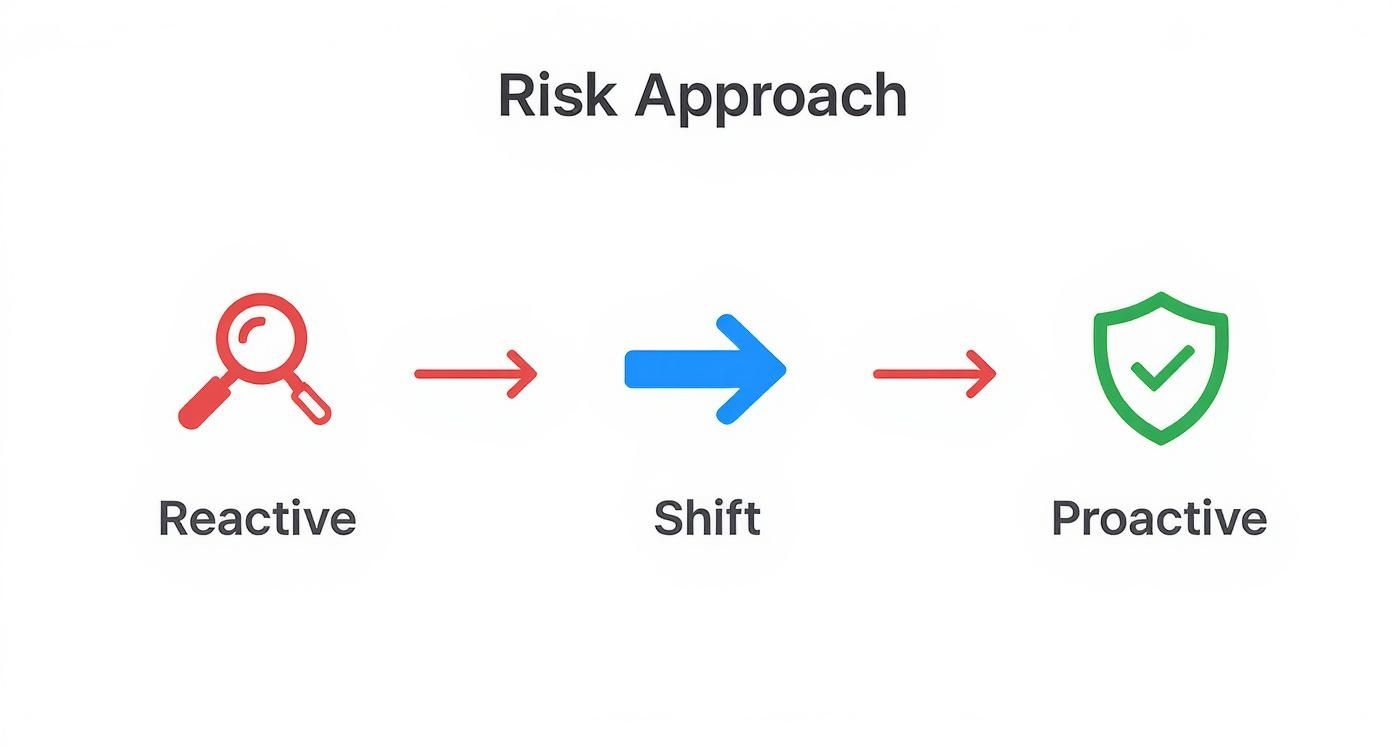
This shift is more than just a new process; it's about moving away from the costly cycle of reactive investigations and toward a modern strategy that safeguards your assets and reputation from the start.
The Evolution of Strategic Risk Management
This is not a theoretical concept. The risk based approach has been battle-tested for years in highly regulated fields, most notably in the fight against money laundering (AML).
Initially, AML rules were rigid and uniform, creating massive inefficiencies. Recognizing this, regulators pushed for a more proportional system. By 2007, the Financial Action Task Force (FATF) had formalized the risk-based framework we know today.
This change required institutions to actively identify, assess, and mitigate their unique risks rather than just blindly applying the same rules to everyone. It was a game-changer and is now the bedrock of global AML compliance.
Applying the Approach to Internal Threats
Applying this same proven logic to internal, human-factor risks is the obvious next step for any forward-thinking organization. It's about empowering your teams to allocate compliance and security resources with surgical precision, targeting the highest-risk areas before they can escalate into major incidents.
A quick comparison shows just how different these two mindsets really are.
Comparing Reactive Investigations vs Proactive Risk Based Approach
Aspect | Reactive Investigations | Proactive Risk Based Approach |
|---|---|---|
Timing | Post-incident (after the damage is done) | Pre-incident (preventive) |
Focus | Damage control & evidence gathering | Prevention & risk mitigation |
Goal | Assign blame & manage fallout | Reduce the likelihood and impact of incidents |
Cost | Extremely high (legal, forensics, fines) | Controlled & predictable operational expense |
Team Burden | Overwhelms legal, HR, and security teams | Empowers teams to be strategic and proactive |
Outcome | Financial loss, reputational damage, operational disruption | Enhanced resilience & operational stability |
The difference is night and day. One approach keeps you stuck in a costly cycle of cleanup, while the other builds a resilient, forward-looking defense.
A proactive risk management framework is no longer a competitive advantage—it is a core component of organizational resilience and responsible governance. It's about protecting the business and its people from preventable harm.
To truly eliminate data breach risks, this strategic focus is non-negotiable. By making this shift, you dramatically reduce the financial and reputational bleeding that plagues reactive organizations. It empowers your leaders to build a more secure and ethical environment, finally breaking free from the endless cycle of damage control.
You can learn more about the true cost of reactive investigations and see why this evolution is so essential for modern business survival.
Building a Human-Centric Risk Mitigation Strategy
Adopting a true risk-based approach isn't about plugging in a new piece of software. It’s a fundamental shift in how your organization thinks about risk—placing the human factor squarely at the center of your defense strategy. After all, internal risk almost always starts with people.
This human-centric view moves us away from cold, mechanical processes and toward a framework that's more intelligent, dynamic, and ethical. A core principle here is proportionality. You must tailor your controls to match the specific level of risk you’ve identified. A one-size-fits-all approach is a recipe for failure; you'll either overspend on minor issues or leave gaping holes in your most critical areas.

Think of it like preventive healthcare for your business. Instead of waiting for a full-blown crisis—the organizational equivalent of a heart attack—you proactively screen for indicators that point to a higher potential for risk. This allows for early, supportive intervention before a small problem spirals into a major incident.
The Power of Dynamic Assessment
Let's be honest: those static, once-a-year risk assessments are obsolete. An effective risk-based approach has to be dynamic, constantly updating and refining risk profiles as new information becomes available. Your business, your teams, and the human factors at play are always changing, and your risk posture needs to adapt in real time.
This continuous loop of assessment and reassessment is what turns a risk framework from a document that gathers dust into a living, breathing part of your operational DNA. It’s what keeps you a step ahead of emerging internal threats.
A dynamic assessment model doesn't just identify risk; it anticipates it. It's about seeing the patterns and connections that signal potential trouble long before an incident occurs, giving leaders the foresight needed to act decisively.
This requires a system that can make sense of vast amounts of data without ever crossing into invasive surveillance. The goal is to get a clear view of systemic vulnerabilities, not to scrutinize individual employees.
Ensuring an Ethical and EPPA-Aligned Framework
Here’s the most critical piece of the puzzle: an unwavering commitment to ethics. Any action you take must respect employee dignity, preserve a culture of collaboration, and strictly adhere to regulations like the Employee Polygraph Protection Act (EPPA).
This is a non-negotiable line in the sand. An effective internal risk program cannot and should not rely on methods that are legally or ethically questionable. That means absolutely no surveillance, no secret monitoring, and no tools that function like lie detectors or conduct psychological evaluations. The purpose is to protect the organization, not to police its people.
A proper risk-based approach gets the job done through supportive and transparent measures. It helps build a resilient culture where potential risks are addressed constructively, which reduces liability for the business while upholding a positive, respectful work environment.
When you put ethical risk management first, you build a stronger, more stable organization from the inside out. For a deeper look into implementing these principles, exploring comprehensive guides on human capital risk detection can provide valuable, practical insights. This approach ensures your efforts are both compliant and culturally sound, ultimately protecting everyone involved.
The Role of Leadership and Technology in Implementation
A risk-based approach is more than just a policy on a shelf; it's a deep operational shift. For it to actually work, it needs two powerful engines firing at once: committed leadership and modern technology. If you're missing either one, even the most brilliant framework will stall out, leaving your organization just as exposed as when you started.
Executive sponsorship is the absolute, non-negotiable starting point. A successful program needs a clear, top-down mandate to break down the departmental silos that so often kill effective risk management. When Compliance, HR, Security, and Legal are all running in separate lanes, you get a fractured, inconsistent picture of risk—and that's a massive liability.
Leadership as the Unifying Force
Strong leadership gives the entire effort a sense of direction and the authority needed to create a unified culture of proactive defense. This commitment has to be visible and consistent. It sends a powerful message to every single department that managing risk with integrity is a core business priority, not just another compliance box to tick. Without that buy-in from the top, any attempt to build a cohesive strategy will hit a wall of resistance and inertia.
In fact, there's a direct line between executive involvement and actually getting a risk-based approach off the ground.
According to one analysis, only 36% of businesses report having active senior executive leadership dedicated to risk management. That gap is a huge reason why efforts stay fragmented and companies remain stuck with outdated, ineffective systems. You can read more about overcoming these RBA deployment challenges at amlwatcher.com.
This really drives the point home: leadership doesn't just sign off on the budget. It must champion the cultural shift that allows a risk-based approach to truly take root.
Why Legacy Technology Fails
While leaders set the course, it's technology that gives you the horsepower to get there. Unfortunately, this is where legacy systems become a serious roadblock. Most older platforms were built for a reactive world of siloed data and painful manual reviews. They are fundamentally incapable of supporting a dynamic, forward-looking risk strategy.
These old-school tools just can't keep up. They typically fall short on:
Real-time analysis: They can't process and connect different data points fast enough to spot emerging patterns of human-factor risk.
Scalability: Manual processes are a nightmare to scale across a large, complex organization, which leads to inconsistent and patchy application.
Integration: They keep crucial information locked away in departmental databases, failing to create that single, unified view of risk you desperately need.
This technological lag severely limits an organization’s ability to perform the kind of nimble and effective mitigation a modern risk-based approach demands.
The Power of Ethical AI Platforms
This is exactly where ethical, AI-driven platforms come into play. Modern systems are designed from the ground up to blow past the limitations of legacy tech. They act as the central nervous system for your entire risk framework, analyzing complex data to identify the subtle signals of potential insider risk long before they escalate into a full-blown crisis.
Crucially, this is all done without resorting to prohibited surveillance, employee monitoring, or any other methods that violate EPPA standards. AI's job isn't to pass judgment on people. Its purpose is to provide objective, data-driven insights into systemic vulnerabilities—connecting the dots that human teams, swamped with manual work, could never see on their own.
By pairing strong leadership with advanced, ethical technology, organizations can finally bring their preventive vision to life. This synergy creates the targeted, effective, and compliant risk mitigation needed to protect the business and its people. For a deeper dive into this technology, check out our guide to AI-powered human risk management.
Overcoming Common Implementation Challenges
The theory behind a risk-based approach is solid. But translating that theory into a real-world strategy that actually works? That’s where things get messy, and it’s where most organizations stumble.
A great framework means very little if your teams don't understand it, apply it inconsistently, or just treat it like another bureaucratic hoop to jump through. This gap between good intentions and real business impact is exactly where your biggest liabilities live.
One of the most common hurdles is simply a lack of real risk comprehension. Teams might follow a procedure perfectly, ticking all the right boxes on a checklist without ever grasping the strategic ‘why’ behind their actions. This creates a dangerous illusion of security. When your people don’t understand the specific human-factor risks they’re supposed to be preventing, the entire framework becomes a hollow, check-the-box exercise instead of a living, breathing defense.
This isn’t just a theoretical problem; it has massive, measurable consequences, especially in highly regulated fields.
The Global Reality of Implementation Gaps
Data from global oversight bodies paints a stark picture of this divide. Despite the widespread adoption of a Risk-Based Approach (RBA) for anti-money laundering, its effectiveness is shockingly low. A major report from the Financial Action Task Force (FATF) found that while roughly 75% of jurisdictions have the right legal frameworks in place, the practical application is lagging dangerously behind.
Consider this: only 17% of financial institution supervisors and a dismal 3% in non-financial businesses are effectively implementing these RBA measures. This disconnect is a key reason why a staggering 97% of assessed countries score low on their ability to prevent financial crime in the private sector. You can discover more insights about these FATF findings on napier.ai.
The data tells a clear story: having a policy on the shelf is not the same as having a functional, effective strategy. The very same gaps plague internal risk programs focused on human factors, where inconsistent application can leave an organization just as exposed as having no policy at all.
Inconsistent Application Across Business Units
Another major pitfall is applying the risk-based approach unevenly across the company. It’s a classic mistake. You’ll see a robust, well-managed framework in highly regulated departments like finance or compliance, while other units—think sales, procurement, or operations—are left with minimal oversight.
This is a critical error. Some of the most significant human-factor risks, like conflicts of interest or intellectual property theft, often start in these very departments.
When you have a siloed approach, you’re creating dangerous blind spots by design. For a risk framework to be truly effective, it has to be applied uniformly across the entire enterprise, with the controls and mitigation efforts tailored to each department's unique threat landscape.
A risk framework is only as strong as its weakest link. If one department operates outside the established protocols, it undermines the integrity and protective value of the entire system, creating an open door for preventable incidents.
Closing the Gaps for a Resilient Framework
So, how do you turn that paper policy into a powerful, living strategy? It comes down to tackling these common challenges head-on. Success really hinges on a few core actions:
Targeted Education: Ditch generic, one-size-fits-all training. Educate teams on the specific human-factor risks relevant to their roles and the direct business impact of those risks. When people finally understand the ‘why,’ they move from simple compliance to genuine commitment.
Cross-Departmental Collaboration: Break down the silos. Establish a cross-functional oversight committee with leaders from HR, Legal, Compliance, and key business units to ensure everyone is on the same page and applying the framework consistently.
Robust Oversight and Communication: Leadership has to champion this. They need to continuously reinforce the importance of the risk-based approach. Regular communication, clear metrics, and consistent oversight ensure the framework stays a top priority and doesn’t just fade into a forgotten initiative.
By actively closing these common implementation gaps, you can transform your risk-based approach from a theoretical document into a dynamic and effective shield that genuinely protects your organization from the inside out.
How AI Platforms Power a Modern Risk-Based Approach
A risk-based approach sounds great in a boardroom, but putting it into practice across a large, complex organization is a different beast. The sheer volume of communication and operational data makes any kind of manual analysis a non-starter. This is where modern, ethical AI platforms come in, acting as the engine for a truly dynamic and preventive strategy.
Think of these platforms as the central nervous system for your risk framework. They're built to sift through massive datasets and spot the subtle, systemic patterns of human-factor risk that are completely invisible to the human eye. This capability is what turns a static policy document into a living, breathing defense mechanism.
The goal here isn't to create a digital watchdog. Far from it. The AI's job is to be a powerful analytical tool that quantifies risk potential ethically and objectively, connecting disparate dots to flag vulnerabilities long before they can be exploited.

From Manual Reviews to Automated Intelligence
Imagine tasking your team with manually reviewing communications to find hints of a conflict of interest or a potential plan to leak data. It’s a monumental task, riddled with human error and unconscious bias. An AI-driven platform automates this heavy lifting, giving you consistent, scalable analysis 24/7.
This frees up your compliance, HR, and security teams to stop drowning in tedious manual work and start focusing on high-value strategic intervention. They get precise, actionable insights that point them directly to the areas of greatest concern, making the entire risk-based approach smarter and more effective.
The purpose of AI is not to find "bad actors" but to identify high-risk systemic patterns and vulnerabilities that human teams cannot see. It’s about understanding the environment, not policing the people within it.
This distinction is absolutely critical for maintaining an ethical framework that aligns with regulations like EPPA. The tech spots the risk indicators; your human experts decide on the right, supportive course of action.
The Ethical Core of AI-Powered Risk Management
The most advanced platforms, like E-Commander, are built from the ground up on a foundation of ethical principles. This is non-negotiable for any modern risk-based approach. The analysis is done without any kind of invasive surveillance, psychological profiling, or lie detection.
This commitment to ethical AI ensures your risk management efforts don't backfire and create new legal or reputational problems. It protects employee dignity while still delivering the critical insights needed to safeguard the organization. To get the most out of these platforms, it's useful to have a baseline understanding what AI detectors look for and how they can process information without using invasive methods.
Here’s how ethical AI creates a robust and compliant framework:
Focus on Systemic Risk: The analysis targets vulnerabilities in processes and communication patterns, not the personal behavior of any one individual.
Anonymized Pattern Recognition: It identifies high-risk trends without attributing them to specific people until a clear threshold of concern is met and human oversight is absolutely necessary.
EPPA-Alignment: The entire process is designed to be non-intrusive and respectful of employee rights, steering clear of any methods that feel coercive or invasive.
This ethical alignment is what makes AI-driven platforms a truly sustainable solution for long-term risk management.
Making Proactive Prevention a Scalable Reality
Ultimately, the greatest benefit of using AI is that it makes proactive prevention a scalable reality. It gives organizations the power to finally break free from the costly and disruptive cycle of reactive forensics. Instead of waiting for an incident to happen, you can identify and shut down the precursors.
For example, an AI can detect subtle linguistic patterns across multiple communication channels that indicate a growing conflict of interest or a coordinated plan to exfiltrate sensitive data. These are signals a human team would almost certainly miss in real time.
This capability empowers leadership to direct resources with surgical precision, applying controls and interventions exactly where they are needed most. This is the essence of a modern risk-based approach—intelligent, targeted, and always one step ahead. To see how this works in practice, our guide on detecting insider threats with ethical AI offers a detailed look at applying these advanced, non-intrusive methods. By integrating ethical AI, organizations can build a truly resilient and forward-thinking defense against internal threats.
It’s Time for a Proactive and Ethical Future in Risk Management
The era of expensive, after-the-fact internal investigations is over. The modern business landscape demands a smarter, more effective defense—one built on a proactive and ethical risk-based approach. This isn’t just a procedural tweak; it's a fundamental shift in mindset from damage control to genuine prevention.
Waiting for an incident to happen before you act is a surefire way to rack up massive financial losses, regulatory penalties, and reputational damage that can last for years. The old model of forensics and internal probes only cleans up the mess. A preventive framework, on the other hand, is all about identifying and neutralizing human-factor risks before they can ever blow up into a full-blown crisis, protecting both the organization and its people.
The New Standard for Governance and Compliance
An ethical, AI-driven risk-based approach is fast becoming the new standard for corporate governance. It moves companies away from invasive, legally questionable methods toward a model that respects employee dignity and aligns with strict regulations like the EPPA. The goal is to build resilience, not a culture of suspicion.
Platforms like E-Commander are built specifically to power this forward-thinking strategy. By using ethical AI to analyze systemic vulnerabilities, they deliver the insights needed for targeted, preventive action—all without resorting to any form of surveillance or lie detection. This ensures your risk management efforts are not just effective, but also fully compliant and culturally sound.
Adopting a preventive, risk-based approach is a decisive move toward stronger governance, enhanced reputational defense, and lasting organizational resilience. It replaces outdated, reactive tactics with an intelligent, ethical, and effective strategy for managing human-factor risk.
By finally leaving the failed methods of the past behind, leaders in compliance, risk, and legal can get ahead of internal threats for the first time. This approach empowers your organization to build a more secure and ethical foundation, ensuring stability and integrity from the inside out.
Common Questions Answered
When leaders start exploring a modern risk-based approach to internal threats, a few key questions always come up. Here’s a straightforward look at the most common ones.
Is This Just Something for Banks and Financial Compliance?
Not at all. While the financial world certainly perfected the risk-based approach for anti-money laundering (AML), its core idea is universal.
It's a strategic framework for putting your resources where they can do the most good—the areas with the greatest potential for business impact. That makes it incredibly effective for managing human-factor risks like fraud, IP theft, or misconduct, no matter what industry you're in.
How Is This Different From Old-School Employee Monitoring?
The difference is night and day, and it all comes down to intent and ethics. Traditional monitoring relies on invasive surveillance, which erodes a collaborative culture and opens up huge legal risks under regulations like the EPPA.
A modern, ethical risk-based approach does the complete opposite. It focuses on spotting systemic vulnerabilities and high-risk patterns without intrusive observation of individuals. It’s about identifying where your organizational processes are weak, not policing your staff.
Does This Mean We Have to Hire a Ton of New Analysts?
Actually, no. A huge benefit of using an AI-powered platform for this is that it automates the heavy lifting of data analysis. Instead of adding headcount, you make your existing teams more powerful.
This approach frees your compliance, HR, and security pros from the soul-crushing work of manual reviews. You empower your current experts to focus on strategic, high-value work based on the sharp insights the system delivers, making your entire team more efficient.
What’s the Very First Step to Get Started?
It all starts with commitment from leadership and a clear-eyed look at your organization's unique human-factor risks. You have to map out where your biggest vulnerabilities are, whether that's in procurement, R&D, or sales.
Once you know where the real risks lie, you can start applying resources proportionally. Focus your first efforts on the highest-priority areas. This ensures you get the biggest impact right from the start and build a strong foundation for a more resilient and ethical way of managing internal risk.
Ready to stop reacting to incidents and start building a proactive, ethical defense against internal threats? Logical Commander gives you the AI-driven platform to make it happen. Our E-Commander and Risk-HR solutions empower you to implement a true risk-based approach without surveillance or legal headaches.
Request a demo today and see the future of internal risk management for yourself.