%20(2)_edited.png)

Anti-Bribery and Anti-Corruption Compliance Guide
- Marketing Team
- 9 hours ago
- 16 min read
Anti-bribery and anti-corruption (ABAC) programs are how businesses prevent, spot, and shut down illegal payments and unethical influence. Think of it as a corporate immune system, built to protect the organization from the twin threats of bribery—offering something of value to improperly sway a decision—and the broader danger of corruption, which is any abuse of power for private gain.
In today's global market, a strong ABAC program isn't just good practice. It's a non-negotiable requirement for doing business.
Why Anti-Bribery and Anti-Corruption Is Your Strongest Asset

Imagine your company’s integrity as its foundation. While customers and investors admire the impressive structure built on top, its stability rests entirely on the unseen principles holding it all together. An anti-bribery and anti-corruption framework is that foundation. It provides the strength needed for sustainable growth and protects against a catastrophic collapse.
Without it, the entire enterprise is at risk from staggering regulatory fines, shattered reputations, and a total loss of trust.
This guide cuts through the dense legal jargon to offer a practical roadmap. We’ll break down the core concepts in simple terms, showing how a robust ABAC program is far more than a defensive compliance measure—it’s a powerful competitive advantage.
Understanding the Core Concepts
Before diving deep, it's helpful to get clear on the key terms. These concepts form the bedrock of any effective ABAC strategy. We've put together a quick table to define these ideas and show how they directly impact your business operations.
Core ABAC Concepts at a Glance
Concept | Simple Definition | Business Impact |
|---|---|---|
Bribery | Offering, giving, or receiving anything of value to improperly influence an action or decision. | Poses direct legal risk, can lead to massive fines, and invalidates contracts. |
Corruption | The broader abuse of entrusted power or position for personal or corporate gain. | Erodes market trust, creates unfair competition, and damages brand reputation. |
Facilitation Payments | Small payments made to secure or speed up a routine government action (e.g., processing a permit). | Illegal under many international laws (like the UK Bribery Act) and create significant compliance risk. |
Third-Party Risk | The risk that agents, consultants, or partners acting on your behalf will engage in bribery. | Your company can be held liable for their actions, making due diligence non-negotiable. |
Understanding these distinctions is the first step. It allows you to see how different forms of misconduct can quietly take root in your operations if you're not actively working to prevent them. A solid ABAC program addresses all these vulnerabilities head-on.
The Real Cost of Neglecting Compliance
The fallout from a bribery or corruption scandal goes far beyond the initial legal penalties. The damage seeps into every corner of the business, leaving scars that can take years, or even decades, to heal.
Organizations that turn a blind eye to this area face a handful of predictable—and devastating—threats:
Crippling Financial Penalties: Fines can easily run into the hundreds of millions of dollars, gutting a company's financial health and shareholder value.
Lasting Reputational Harm: News of a bribery scandal can instantly vaporize decades of brand trust, making it nearly impossible to attract customers, partners, and investors.
Operational Disruption: Lengthy and invasive government investigations divert critical resources, paralyze leadership, and grind business objectives to a halt.
Loss of Business Opportunities: Many government and corporate contracts are completely off-limits to companies with a history of corruption, effectively walling them off from entire markets.
At the end of the day, building a culture of integrity is fundamental to long-term success. For a deeper dive into the practical steps involved, you can explore our complete guide on creating a high-integrity workplace framework. A strong ABAC program is the absolute cornerstone of that effort.
Navigating the Global Regulatory Maze
Taking your business global is like setting sail on international waters. The opportunities are vast, but so are the different sets of maritime laws you have to follow in every port. Think of your anti-bribery and anti-corruption compliance program as your navigational chart—it’s what helps you steer clear of treacherous legal shoals in every new jurisdiction you enter.
Ignoring these rules simply isn’t an option. The world’s leading economies have passed powerful laws with what’s known as "long-arm jurisdiction," meaning they can hold your company accountable for its actions anywhere on the globe. Getting a handle on this regulatory maze is the first step toward building a business that can actually withstand the pressures of global expansion.
The Pillars of Global Anti-Bribery Law
Two pieces of legislation really form the bedrock of modern international anti-corruption enforcement. They’ve set the standard for how nations fight bribery beyond their own borders, and their influence is felt in boardrooms and sales offices everywhere.
The U.S. Foreign Corrupt Practices Act (FCPA): Passed way back in 1977, the FCPA is one of the most powerful and far-reaching anti-corruption laws on the books. It makes it illegal for U.S. individuals and companies—as well as any foreign firms listed on U.S. stock exchanges—to bribe foreign officials to win or keep business. Its scope is incredibly broad, covering not just cash payments but basically anything of value offered with corrupt intent.
The UK Bribery Act 2010: Often seen as even stricter than the FCPA, this law cracks down on the bribery of both public officials and private individuals. One of its most potent features is the "failure to prevent bribery" offense. This holds a company strictly liable if an employee or an agent pays a bribe on its behalf, leaving only one defense: proving the company had "adequate procedures" in place to stop it.
These two laws fundamentally changed the risk calculation for international business. A violation is no longer a local headache; it’s a global crisis with severe consequences.
Understanding Your Obligations Across Borders
The core idea behind these laws is brutally simple: you are responsible for the actions taken in your name, no matter where they happen. This responsibility goes far beyond your direct employees to include a wide network of agents, consultants, and partners.
A common and costly mistake is assuming that distance creates a buffer from liability. Under laws like the FCPA and the UK Bribery Act, a company can be prosecuted for what a third-party agent does in another country, even if headquarters had no direct knowledge of the bribe. Ignorance is not a defense.
This concept, known as "vicarious liability," is precisely why tough due diligence on third parties is a non-negotiable part of any serious anti-bribery and anti-corruption program. Your company is judged by the company it keeps.
The Evolving Enforcement Landscape
The global fight against corruption isn't standing still. Regulatory agencies are working together more than ever, sharing information across borders to build bigger, stronger cases. At the same time, governments are constantly sharpening their legal tools to close loopholes and tackle new forms of corruption.
For instance, the game is changing again with new laws like the U.S. Foreign Extortion Prevention Act (FEPA), which now criminalizes foreign officials for demanding or accepting bribes. Over in the UK, the new 'Failure to Prevent Fraud' offense puts even more pressure on large organizations to have strong compliance programs in place. You can get a deeper analysis of how these changes are shaping enforcement trends and what it means for your business.
This trend toward tougher laws and greater international cooperation sends a clear message. Proactive compliance isn't just a best practice anymore; it's an essential survival strategy for any company operating on the world stage. Failing to adapt to this new reality means leaving your organization exposed to unprecedented legal, financial, and reputational risks.
Building Your Anti-Corruption Compliance Program
Moving from legal theory to the real world requires a solid blueprint. An effective anti-bribery and anti-corruption program isn’t some static document living on a server—it’s a living, breathing defense system designed to shield your entire organization. It’s the fusion of smart policies, practical controls, and clear oversight that creates a genuine defense against misconduct.
Think of it like building a fortress. You need strong walls (your policies), vigilant guards (your internal controls), and a clear chain of command (your governance). Each piece is absolutely critical. If one fails, the whole structure becomes vulnerable. Let's break down the core elements you need to construct a compliance program that's both tough and practical.
The Foundation: Leadership and Tone at the Top
Every single successful compliance program starts with an unwavering commitment from the top. When senior executives and the board of directors truly champion integrity, that attitude cascades down through the entire company, setting a powerful, unmistakable precedent. This is what we call the "tone at the top."
And this can't just be lip service in an annual report. It has to be visible in day-to-day business decisions, in how resources are allocated to compliance functions, and in a genuine zero-tolerance stance toward violations. Without that authentic buy-in from leadership, even the most brilliantly written policies will fall flat with employees.
The image below shows the key global regulations that are the driving force behind the design of these programs.
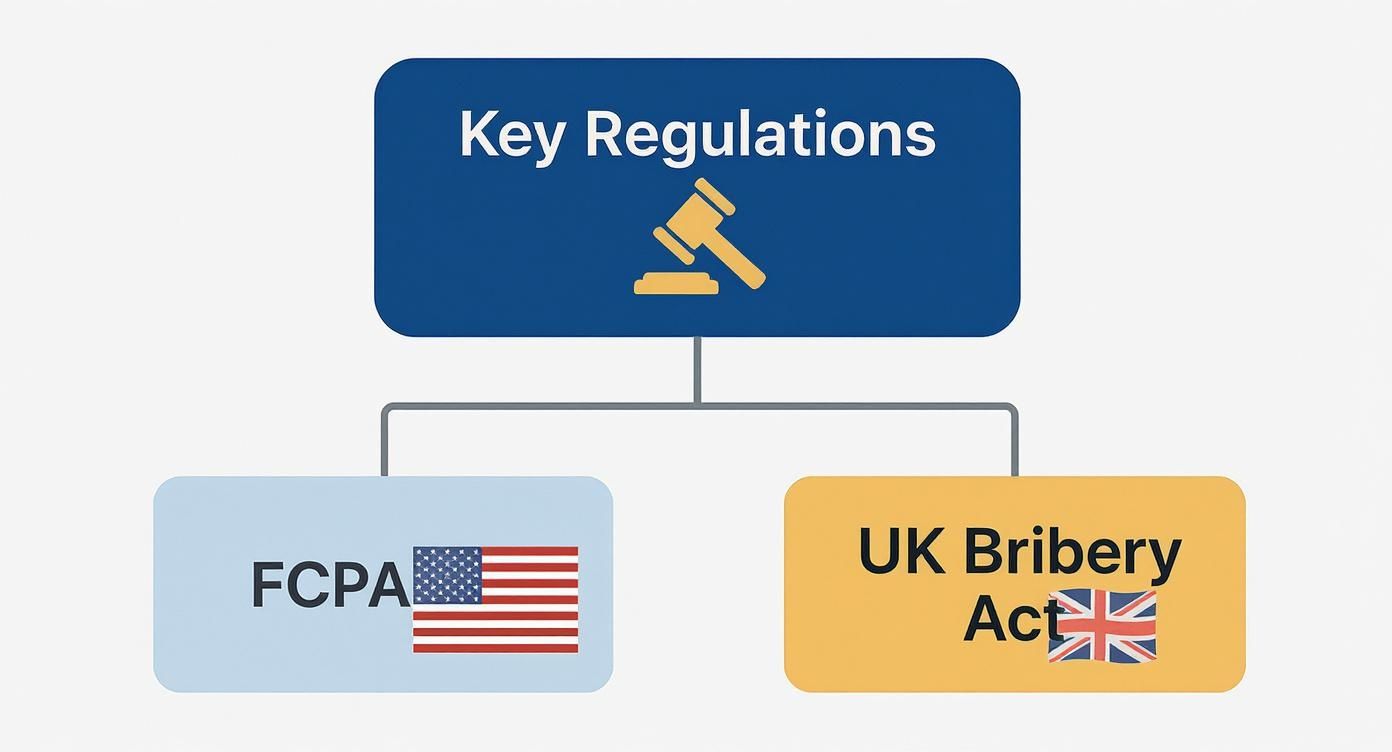
As the diagram makes clear, foundational laws like the FCPA and the UK Bribery Act set the global standard, making a robust compliance framework an absolute necessity for any company operating internationally.
Conducting a Thorough Risk Assessment
Before you can build your defenses, you have to know where the attacks are likely to come from. A risk assessment is the diagnostic phase—it’s how you identify where your company is most exposed to bribery and corruption. This is not a one-size-fits-all exercise; it must be tailored specifically to your operations, your industry, and where you do business.
Key areas to put under the microscope include:
Geographic Risk: Where are you operating? Some countries have a much higher perceived level of public sector corruption, which automatically dials up your risk.
Sector Risk: Certain industries, like energy, defense, and construction, have historically been hotbeds for corruption. If you're in one of them, your guard needs to be up.
Business Partner Risk: Your single greatest exposure often comes from third parties acting on your behalf—agents, distributors, consultants, you name it.
Transactional Risk: Scrutinize any area that involves government interactions, like customs, licensing, and permits, as well as high-value contracts.
An effective anti-corruption program is often defined by how well it manages the risks that come with external partners. You can learn more about building out a strong third-party risk management framework to shore up this critical part of your strategy.
Designing Effective Policies and Controls
Once you have a clear map of your risks, you can develop targeted policies and internal controls to counter them. Your anti-bribery and anti-corruption policy should be a clear, practical document that any employee can easily understand and apply to their daily work. Steer clear of dense, impenetrable legalese.
These controls are the specific procedures that actually enforce your policy. Think of them as the checkpoints that prevent or detect potential misconduct before it gets out of hand.
Examples of Essential Internal Controls:
Due Diligence Procedures: You need a standardized process for vetting every third-party partner before you sign a contract. This process should be risk-based, meaning higher-risk partners get a much more intense level of scrutiny.
Gift and Hospitality Registry: Maintain a crystal-clear policy with specific monetary limits for giving and receiving gifts. A central registry ensures total transparency and allows for easy oversight.
Segregation of Duties: Make sure no single individual has control over every step of a financial transaction. For instance, the person who approves a payment should never be the same person who initiates it.
Clear Reporting Channels: Establish confidential and easily accessible channels for employees to report concerns without any fear of retaliation. This could include a hotline managed by an independent third party.
By embedding these controls directly into your business processes, you move from just having a policy to actively managing your corruption risks. To learn more about the structure and implementation of these programs, explore our guide on creating an https://www.logicalcommander.com/post/effective-compliance-program. This integrated approach is the key to building a resilient and defensible compliance posture.
Spotting Red Flags and Internal Risk Signals
The best anti-bribery and anti-corruption programs aren’t just defensive—they’re proactive. Instead of waiting for a full-blown crisis to erupt, they empower everyone in the organization to recognize the subtle warning signs of misconduct. These signals, or "red flags," are the early indicators that something isn’t right, giving you a chance to step in before a small problem becomes a catastrophe.
Think of these red flags as smoke detectors for your business. A single beep might not mean there's a fire, but it’s a clear signal to investigate immediately. Ignoring these warnings can lead to devastating outcomes, from massive fines to reputational damage that takes years to repair. Learning to spot them is a critical skill for every single employee, from the sales team on the front lines to the finance department processing payments.
Common Financial and Transactional Red Flags
Corruption almost always leaves a financial trail, but the clues can be buried deep in routine transactions. It’s absolutely essential to scrutinize payment requests and expense reports that stray from the norm, as these are classic hiding places for improper payments.
Keep an eye out for these specific warning signs:
Unusual Payment Structures: Any request for payment in cash, to an offshore bank account, or to a company completely unrelated to the transaction should set off alarm bells. This is a common tactic used to hide where the money is really going.
Vague or Incomplete Invoicing: Invoices that lack detail, use generic descriptions like "consulting fees," or are sequentially numbered from a third-party agent are a huge red flag. This often suggests the paperwork was fabricated to disguise a bribe.
Excessive or Poorly Documented Expenses: Lavish gift-giving, over-the-top travel expenses without a clear business purpose, or expense reports with a suspicious number of missing receipts demand immediate scrutiny.
Pressure to Expedite Payments: An unusual sense of urgency to push a payment through, especially right before a fiscal deadline, could be an attempt to bypass the standard financial controls that would otherwise catch it.
These financial signals are often the most concrete evidence of potential wrongdoing and give you a clear place to start any internal review.
Behavioral and Third-Party Warning Signs
Beyond the balance sheet, behavioral signals can be just as telling. How your partners and even your own employees conduct themselves can reveal underlying risks that a financial audit would never catch. This is especially true when dealing with third-party agents, consultants, and distributors, who consistently represent a company's biggest area of corruption risk.
The most significant enforcement actions frequently involve misconduct by third parties acting on a company's behalf. Rigorous and ongoing due diligence is not just a best practice; it is an essential defense against being held liable for the actions of your partners.
Stay alert for these behavioral and relationship-based indicators:
Reluctance to Certify Compliance: If a potential partner pushes back on signing standard anti-corruption certifications or refuses to provide detailed information about their ownership, it’s a major risk.
Insistence on a Specific Partner: When a foreign official or client insists that you must use a particular local agent or consultant, it may be a sign that this third party is really just a channel for funneling illicit payments.
Claims of "Special Relationships": Be wary of agents who brag about their close ties to government officials and suggest they can "make things happen." Their value should come from legitimate expertise, not from their ability to wield improper influence.
By teaching your people to spot these signals, you empower them to become the first line of defense in your anti-bribery and anti-corruption strategy. Fostering this kind of awareness turns every employee into a vigilant guardian of the company’s integrity.
Using Technology for Modern Compliance

Manual compliance processes just can't keep up anymore. Trying to manage today’s complex business risks with periodic audits is like checking the locks on a fortress just once a day—it leaves you wide open to threats that are far more creative and persistent.
Technology, especially artificial intelligence (AI) and data analytics, is completely changing the game. These tools give compliance teams a massive advantage by shifting the focus from reactive damage control to proactive prevention.
Modern systems can sift through enormous volumes of data—from expense reports to third-party communications—at a speed no human team could ever match. They spot the subtle red flags and suspicious patterns that would otherwise fly under the radar.
This isn't just a trend; it's the new standard. The OECD Global Anti-Corruption & Integrity Forum, for example, has pointed to AI as an essential tool in the fight to detect and prevent corruption. As global enforcement gets tougher, companies need smarter frameworks to stay ahead. You can learn more about how new regulations are shaping the future of enforcement.
From Reactive to Predictive Compliance
The real power of technology in anti-bribery and anti-corruption is the move from a reactive to a predictive stance. Instead of discovering a violation months after the fact, you can spot the warning signs as they happen.
Think of it this way: traditional compliance is like a smoke detector. It only blares an alarm after a fire has already started. An AI-powered system is more like a sophisticated sensor that detects a gas leak before there's a spark, giving you a chance to prevent the disaster.
This predictive capability is built on a few key functions:
Continuous Transaction Monitoring: AI algorithms can scan every single transaction in real time, flagging payments that don’t fit the norm—like those made at odd hours, to unusual locations, or just below approval thresholds.
Network Analysis: These systems map out the web of relationships between employees, vendors, and third parties, instantly highlighting hidden connections or potential conflicts of interest that could open the door to corruption.
Behavioral Analytics: By learning what "normal" activity looks like, the technology can flag odd behaviors, such as an employee suddenly accessing high-risk client files or communicating excessively with a vendor during a sensitive bidding process.
Enabling Ethical and Efficient Investigations
When a potential issue does surface, technology makes the investigation process faster, more focused, and more respectful of employee privacy. Instead of launching broad, disruptive inquiries that poison morale, teams can use data-driven insights to target their efforts with surgical precision.
A common challenge in internal investigations is balancing the need for thoroughness with the duty to protect employee dignity and privacy. Modern platforms solve this by surfacing structured risk signals, not accusations, allowing for targeted verification without resorting to invasive surveillance.
This approach grounds every investigation in objective data, preserving due process and creating a clear, auditable trail of every action taken.
For businesses looking to bring these capabilities together, a unified operational platform is the key. Systems that integrate data from different sources create a single source of truth, replacing the mess of fragmented spreadsheets and siloed information. You can read more about how specialized compliance risk management software gets this done.
Effective compliance also means using every tool at your disposal to shut down threats before they start, including those designed to reduce fraud risk with biometric technology. By connecting the dots between departments like HR, Legal, and Security, organizations can finally build a coordinated and highly effective defense against internal threats.
Your Top Anti-Bribery Questions, Answered
As you work to build and maintain a strong ethical culture, the real-world questions always start to surface. Navigating the nuances of an anti-bribery and anti-corruption program isn’t about abstract policies; it’s about having clear answers for your teams on the ground. This is where we tackle the most common questions that compliance, HR, and legal teams face every day.
Getting these answers right is non-negotiable. Ambiguity is the enemy of compliance—it creates the gray areas where misconduct takes root. When you provide clear, straightforward guidance, you empower your people to make the right decisions with confidence.
What Is the Real Difference Between a Bribe and a Business Gift?
This is, without a doubt, the most frequent and critical question in day-to-day business. The line between a legitimate business gift and an illegal bribe all comes down to one thing: intent.
Think of a legitimate gift or hospitality as a reasonable courtesy meant to build general goodwill and strengthen a professional relationship. The key is that there’s no expectation of getting anything specific in return.
A bribe, on the other hand, is anything of value given with the corrupt intent to gain an improper business advantage. It’s a direct or indirect attempt to influence a specific decision, action, or outcome.
To tell the difference, ask yourself these questions:
Value: Is the gift over the top? A company-branded pen is one thing; a luxury watch is something else entirely.
Timing: Is the gift being offered during a sensitive period, like a competitive bidding process or a contract negotiation?
Transparency: Is the gift being offered openly and logged in a registry, or is it being handed over in secret?
The most effective anti-bribery programs remove the guesswork completely. They set clear monetary limits for gifts, require pre-approvals for any hospitality, and keep transparent registries. This protects both the company and its employees from accidental violations or false accusations.
Does Our Small Business Really Need a Formal ABAC Program?
Yes, but it has to be tailored to your specific risk profile. Global laws like the U.S. FCPA and the UK Bribery Act apply to businesses of all sizes, and regulators have shown very little patience for companies that plead ignorance.
That said, a small domestic business doesn't need the same complex system as a multinational corporation. The key is proportionality. Your compliance efforts should be a direct response to your actual risks.
If your company operates only within one country and rarely interacts with government officials, your risk is much lower than a business that uses international agents to get permits abroad. A proportionate program shows a genuine commitment to ethical conduct that matches your operational reality.
At a minimum, even a small business should have these basics in place:
A Clear Written Policy: A simple, easy-to-understand document that explicitly prohibits bribery.
Basic Employee Training: Make sure everyone understands the policy and knows how to report a concern.
Third-Party Due Diligence: Have a straightforward process to vet any agents or partners who act on your behalf.
What Are the First Steps to Improve Our ABAC Compliance?
Strengthening your anti-bribery and anti-corruption framework doesn’t have to be some massive, overwhelming project. A few foundational steps can build serious momentum and create a solid base for a more mature program down the road.
First, get genuine, visible commitment from senior leadership. This "tone at the top" is everything. Without it, any compliance initiative is dead on arrival.
Next, conduct a formal risk assessment. This is your roadmap—it helps you identify your company's greatest vulnerabilities. Focus your analysis on high-risk areas like certain geographic locations, business sectors, or critical third-party relationships.
From there, use what you’ve learned to develop a clear and accessible ABAC policy that is tailored to your specific risks. Finally, roll out practical training for all employees and set up clear, confidential channels for them to report any concerns. These foundational steps create the structure for a truly resilient program.
How Can Technology Help Manage Our Third-Party Risk?
Technology is an indispensable ally here, especially since third-party risk is so often cited as an organization's single greatest ABAC weakness. Manual vetting and monitoring are slow, prone to human error, and simply can't scale.
Automated platforms can instantly screen potential partners against thousands of global sanctions lists, watchlists, and adverse media sources. This gives you a level of immediate, deep insight that would be impossible to get manually.
Beyond that, technology can help you manage the entire third-party lifecycle. It can automate the distribution of compliance questionnaires, track certifications, and provide ongoing monitoring for any changes in a partner's risk profile. AI-powered analytics can also flag high-risk transactions or unusual invoicing patterns in real time, alerting your team to potential issues before they escalate. This automation not only creates a robust audit trail but also frees up your compliance team to focus their expertise on the highest-risk relationships.
At Logical Commander Software Ltd., we believe in turning risk into strategic information. Our E-Commander platform provides a unified operational backbone for HR, Compliance, Legal, and Security teams to manage internal threats proactively and ethically. By identifying early indicators without invasive surveillance, we help you protect your organization and its people. Know First, Act Fast with Logical Commander.