%20(2)_edited.png)

The Modern Playbook for Enterprise and Risk Management

Updated: Feb 11
Enterprise and Risk Management (ERM) is the holistic strategy a business uses to spot, size up, and get ready for any potential threat to its operations, reputation, and bottom line. Think of it as your company's central nervous system—it senses risks across every department, processes that information, and coordinates a single, unified response.
Why Enterprise and Risk Management Is Now a Strategic Necessity
In the past, risk management was a fractured affair. The finance team worried about market swings, IT handled cyber threats, and HR dealt with employee conduct—but these teams rarely talked to each other in a meaningful way. This siloed approach left dangerous blind spots, allowing interconnected risks to slip right through the cracks.
Modern enterprise and risk management tears down those walls. It creates a single, top-down view of every potential threat, weaving risk awareness directly into core strategic planning. This ensures that every major business decision is made with eyes wide open to its potential impact. The whole function shifts from a reactive, box-checking chore into a proactive driver of resilience and a real competitive advantage.
The Forces Driving Modern ERM Adoption
A few powerful trends have pushed ERM out of the back office and into the boardroom. The breakneck pace of digitalization is constantly introducing new vulnerabilities, while a tangled web of global regulations demands a much more coordinated approach to compliance.
Here are the key drivers:
Regulatory Complexity: Mandates like the General Data Protection Regulation (GDPR) and the Sarbanes-Oxley Act (SOX) demand that organizations prove they have robust internal controls. A unified ERM framework is no longer optional; it's essential for staying compliant.
Digital Transformation: As businesses become more dependent on interconnected digital systems, a single cyber incident can set off a disastrous chain reaction of operational, financial, and reputational damage. This highlights the urgent need for an integrated defense.
Stakeholder Expectations: Investors, customers, and employees are paying closer attention to Environmental, Social, and Governance (ESG) factors. They demand transparency and accountability in how companies manage ethical and reputational risks.
The demand for comprehensive solutions is undeniable. The global risk management market was valued at USD 15.40 billion in 2024 and is projected to rocket to USD 51.97 billion by 2033, growing at a compound annual rate of 14.6%. This explosive growth shows just how urgently businesses need tools that can handle today’s complex threats.
From Siloed Reactions to Unified Strategy
The journey from outdated, siloed risk management to a modern ERM framework is a fundamental shift in perspective. It moves the entire organization from playing defense to playing smart offense. The table below breaks down this evolution.
Traditional Risk Management vs Modern ERM
Aspect | Traditional Risk Management | Modern Enterprise Risk Management |
|---|---|---|
Scope | Departmental silos (Finance, IT, HR) | Holistic, enterprise-wide view |
Approach | Reactive and compliance-focused | Proactive and strategy-driven |
Ownership | Mid-level managers in separate functions | C-suite and Board of Directors |
Goal | Minimize losses and check boxes | Create and protect business value |
Perspective | Tactical and isolated problem-solving | Strategic and interconnected decision-making |
The difference is stark. The old way asks, "How does this department handle its specific risks?" In contrast, a modern ERM strategy asks, "How does this risk impact the entire enterprise, and how can we coordinate our response to protect our overall strategy?"
An effective ERM program provides a panoramic view of the organization’s entire risk landscape. It enables leadership to make informed, risk-conscious decisions that protect and create value, rather than just plugging leaks as they appear.
This unified approach builds true organizational resilience, ensuring the business can not only weather unexpected storms but also confidently seize new opportunities. By understanding the full spectrum of threats, from internal misconduct to external market shifts, companies can put their resources where they matter most and protect what's truly valuable. You might be interested in a deeper exploration of risk management in enterprise settings.
Understanding Core ERM Frameworks and Standards
For enterprise and risk management to be more than just a buzzword, it needs a solid structure—a blueprint that guides consistent, effective action across the entire business. This is where ERM frameworks and standards come in. Forget rigid, bureaucratic rulebooks; think of them as proven, practical toolkits designed to help you build a resilient risk management culture.
It’s a lot like building a house. You wouldn’t just start laying bricks without an architectural plan. Frameworks like COSO and ISO 31000 are those essential blueprints, making sure every part of your risk management structure is sound, aligned with your business strategy, and built to withstand real pressure.
These established models give everyone a common language and a systematic approach, transforming risk management from a series of disconnected activities into a unified, strategic function. They are the scaffolding that supports a strong defense against uncertainty.
The COSO Framework: A Strategic Blueprint
The COSO ERM framework is one of the most widely adopted models out there, particularly in the United States. Its real power is how it directly connects risk management to strategy and business performance. It helps leaders answer the most critical question of all: "How do our risks impact our ability to hit our core objectives?"
The COSO framework is built around five interconnected components, each one supported by clear principles:
Governance and Culture: This sets the tone from the top, reinforces ethical values, and clarifies who is responsible for oversight.
Strategy and Objective-Setting: This is all about aligning your risk appetite with your strategy, ensuring business goals are set with a clear-eyed view of the risks involved.
Performance: This involves the hands-on work of identifying, assessing, and responding to risks that could get in the way of achieving strategic goals.
Review and Revision: This component focuses on monitoring how your risk management is performing over time and pushing for continuous improvement.
Information, Communication, and Reporting: This emphasizes the need to share risk intelligence across the organization to support sharp, timely decisions.
By weaving these components together, COSO helps organizations bake risk awareness directly into the fabric of their strategic planning and daily operations. It’s a powerful tool for both protecting and creating value.
ISO 31000: The Universal Language of Risk
While COSO offers a deep strategic blueprint, ISO 31000 provides a more universal set of principles and guidelines. It’s designed to be flexible enough for any organization, no matter its size, industry, or sector. Think of it as a universal translator for risk management, providing a clear, adaptable approach you can customize to fit your specific world.
ISO 31000 isn’t a standard you get certified against. Instead, it provides a set of best-practice principles to guide the creation of a tailored risk management process. It emphasizes integration, a structured approach, and continuous improvement.
Its core principles are all about creating a framework that is integrated, structured, customized, inclusive, and dynamic. This adaptability makes it a fantastic choice for global companies or any organization looking for a versatile foundation to build upon. To see how these principles can be applied, you can explore this detailed operational risk management framework.
Connecting Frameworks to Regulatory Demands
ERM frameworks aren't just about internal best practices; they are absolutely essential for navigating the complex web of modern regulations. Building your system "Under Regulation" isn't a limitation—it’s a strategic advantage that fosters a more effective, ethical, and legally defensible operation.
For example, adhering to a framework like COSO can directly support compliance with mandates like the Sarbanes-Oxley Act (SOX) by demonstrating robust internal controls. In the same way, the principles of ISO 31000 can guide an organization in managing data privacy risks in line with GDPR.
Newer standards, like ISO 37003 for managing internal investigations, also fit neatly within these broader ERM structures. They provide specific guidance on handling sensitive issues like misconduct and corruption, ensuring that your processes are fair, transparent, and compliant.
Ultimately, these frameworks and standards work together to ensure your organization is not just managing risk, but is also building a foundation of trust and integrity from the inside out.
Weaving Resilience into Your ERM Governance and Culture
An effective enterprise and risk management strategy is built on people and processes, not just software. Frameworks give you the blueprint, but a strong governance structure and a risk-aware culture are what bring that blueprint to life. Without them, even the most sophisticated ERM plan is just a document collecting dust, with zero influence on real-world decisions.
Think of it like an orchestra. You can have the best instruments and a brilliant musical score, but without a conductor to lead and musicians who are in sync, all you get is noise. A solid ERM governance model is the conductor, making sure every part of the organization plays its role in harmony.
The Three Lines of Defense Model Explained
To get everyone synchronized, many organizations use the "Three Lines of Defense" model. This isn't a rigid hierarchy but a dynamic, layered system that clarifies who does what, creating a powerful shield against internal and external threats. Each line has a distinct but complementary job.
First Line: Operational Management This is your front line. Department heads and operational managers own and manage the risks baked into their daily work. They’re responsible for putting controls in place and ensuring their teams stick to the rules, making them the first and most immediate defense against problems.
Second Line: Risk and Compliance Functions This line provides oversight and specialized knowledge. Teams like risk management, compliance, and legal are the ones who write the policies and build the frameworks the first line follows. They keep an eye on how well the controls are working and offer guidance, making sure the company’s risk efforts are consistent and tied to the overall strategy.
Third Line: Internal Audit This is your independent assurance layer. The internal audit team gives an objective, unbiased evaluation of the first two lines. They assess the overall effectiveness of the ERM framework and report their findings straight to senior leadership and the board. This independent review drives accountability and keeps everyone honest.
When these three lines work together seamlessly, they create a robust system of checks and balances that is far more effective than any single department could ever be on its own.
Breaking Down Silos for Unified Action
The real power of this model kicks in when it smashes through departmental silos. Threats, especially the internal ones, rarely stay neatly within one team's boundaries. A potential conflict of interest might show up in HR records, have financial red flags tracked by the finance team, and involve digital activity monitored by IT security.
A siloed approach would completely miss the connections, but an integrated governance model ensures these teams are all working from the same playbook. HR, Legal, Security, and Compliance must collaborate, sharing insights to manage internal threats as a whole. This cross-functional teamwork is absolutely essential for connecting the dots before a small issue explodes into a major incident.
A strong risk culture starts at the top with clear leadership commitment but must be embedded at every level of the organization. It’s about creating a shared understanding where every employee feels accountable for managing risk.
This infographic shows how various frameworks and regulations are structured to support overarching business goals.
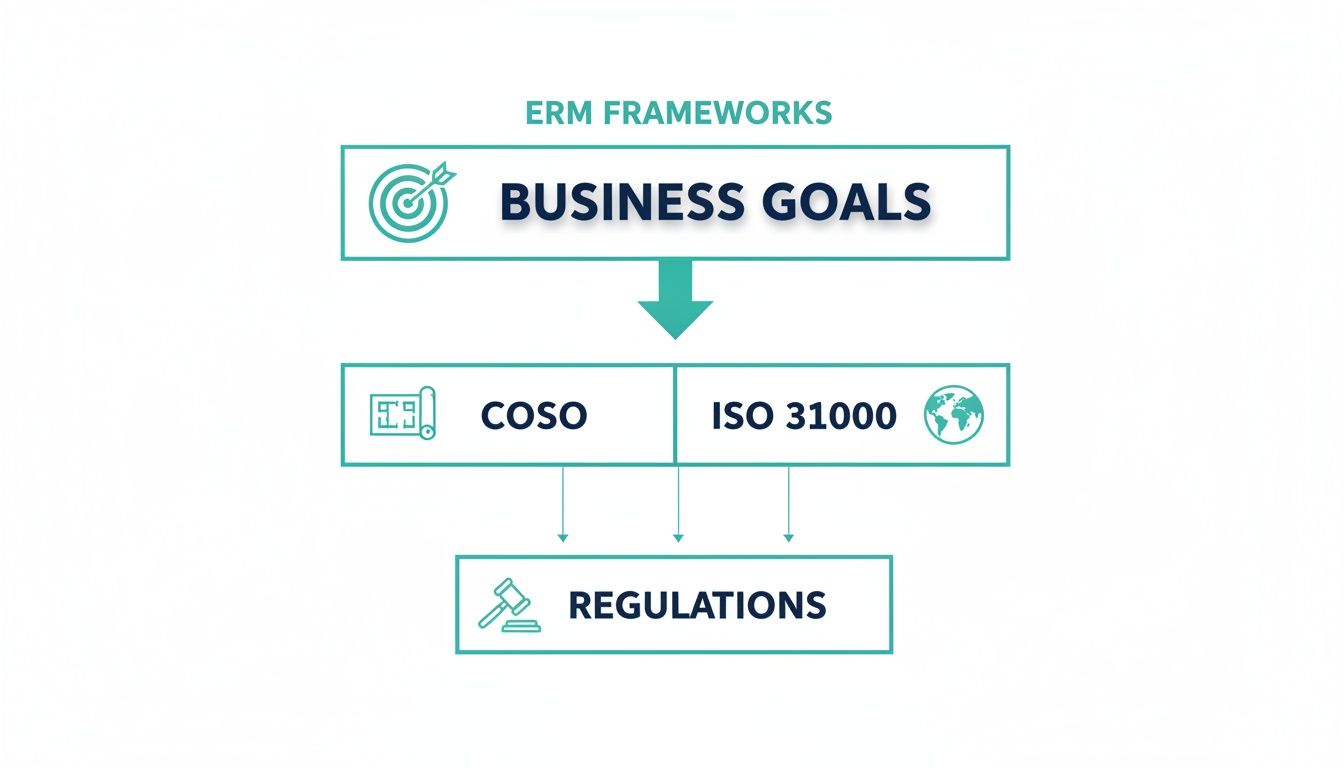
The diagram makes it clear that standards like COSO and ISO 31000 aren't just for checking a compliance box; they are strategic tools designed to help you hit your core business objectives within a regulated world.
The Role of a Unified Platform
Embedding this culture and making cross-functional collaboration happen is nearly impossible with fragmented tools. When HR uses one system, Legal another, and Security is stuck with manual spreadsheets, crucial information gets lost in the cracks. This is where a unified operational platform becomes the linchpin of modern enterprise and risk management.
By creating a single source of truth, a platform like E-Commander establishes a common operational language across all departments. It centralizes risk intelligence, standardizes workflows, and creates a clear, auditable trail of every action taken. This replaces guesswork and scattered data with clear, actionable insight, empowering every line of defense to do its job effectively and cohesively.
How AI Is Redefining Proactive Risk Management
For years, enterprise risk management has been a reactive discipline—a constant scramble to clean up the mess after an incident. That approach is no longer cutting it. Today, the goal is to flip the script entirely, moving from reactive damage control to proactive prevention. And the engine driving that shift is Artificial Intelligence.
AI gives us the ability to spot the faint signals and hidden patterns that point to potential misconduct or fraud, long before they erupt into a full-blown crisis. It's the difference between hearing the smoke alarm and seeing the tiny spark that could start the fire. By analyzing huge sets of operational data, AI can flag anomalies that human teams would almost certainly miss.
But let's be clear: this isn't about invasive surveillance or trying to predict guilt. It's about using technology as a sophisticated decision-support tool. A truly ethical AI approach focuses on structured, objective risk indicators, empowering the human experts in HR, compliance, and risk to act early and with precision.
From Reactive Audits to Predictive Insights
The traditional playbook for risk detection relies on audits, whistleblowing, and manual reviews—all of which happen after a potential problem has already taken root. This backward-looking view leaves organizations perpetually one step behind, always reacting to yesterday's news.
AI enables a forward-looking, predictive posture. It connects the dots across various business systems to identify statistical outliers and correlations that signal a heightened risk.
For instance, an AI system might flag a series of actions that seem harmless on their own but, when viewed together, point to a potential conflict of interest or a procedural weak spot. This isn't an accusation; it's a data-driven prompt for human experts to conduct a timely, focused verification. This transforms enterprise and risk management from a historical review into a live, preventive function.
The real power of AI in risk management is its ability to weave disparate data points into a coherent picture of emerging risk. It empowers organizations to “Know First, Act Fast,” handling issues when they are small and manageable.
Ethical AI Versus Invasive Surveillance
A common fear when discussing AI is that it will become a "Big Brother" tool for employee surveillance, breeding a culture of distrust. It’s a valid concern, and it’s exactly why modern, ethical AI platforms are designed with strict guardrails. The distinction is critical.
Invasive Surveillance: This is about monitoring personal communications, tracking movements, or using algorithms to make judgments about an individual's character or intent. This approach is ethically toxic and often legally prohibited.
Ethical AI: This focuses exclusively on structured, work-related data and objective risk indicators. It never profiles individuals or judges their intentions. Its job is to flag operational anomalies, not to monitor people.
Platforms like E-Commander are built "Under Regulation," adhering to standards like GDPR that strictly forbid methods like lie detection, psychological profiling, or covert monitoring. The AI serves as a guide, providing objective signals that require human verification. This approach preserves both employee dignity and organizational security, proving an AI-driven enterprise risk management platform can strengthen governance without sacrificing trust.
The Accelerating Adoption of AI in Risk
The move toward AI-powered risk management isn't some far-off trend; it's happening right now. Artificial intelligence is turning enterprise risk management from a reactive chore into a predictive powerhouse, and the staggering adoption rates signal a major change in mindset.
Research shows that by 2025, 70% of risk managers will place AI at the center of their strategies. Other reports point to a 35% year-over-year growth in AI integration within risk frameworks. This trend is speeding up as executives prioritize AI to navigate technological disruption. You can discover more insights about these critical risk management trends on nssg.global.
This rapid adoption highlights a core truth: in today’s complex business world, human-only capabilities are no longer enough to manage the scale and speed of emerging threats. AI provides the analytical horsepower needed to make proactive risk management a practical reality. It helps organizations protect themselves effectively while upholding the highest ethical standards, proving that technology can be both humane and highly effective when designed with clear boundaries.
Navigating Critical Cyber and Insider Threats
Of all the areas that demand a piece of a leader's attention, few cause as much anxiety as cyber and insider threats. For far too long, cybersecurity was treated as a technical problem you could just wall off inside the IT department.
That perspective is dangerously outdated. Today, a single breach can set off a catastrophic chain reaction, grinding operations to a halt, wrecking financials, and permanently staining a brand's reputation.
Modern ERM correctly reframes cybersecurity as a fundamental business risk. This requires a coordinated defense involving not just IT, but legal, finance, and the C-suite. Every part of the organization has to understand its role in protecting digital assets, because the attack surface is no longer just the network—it’s the entire business.
The Rise of Cyber Risk as a Primary Concern
Cyber risks have decisively jumped from a side issue to the top of the corporate threat list. Global surveys confirm it: leaders across every industry now see cyber attacks as a primary danger demanding an integrated ERM strategy.
Pivoting to the Internal Threat Landscape
Just as critical are the challenges lurking within an organization’s own walls. Internal risks—fraud, conflicts of interest, and other forms of employee misconduct—are often harder to spot and can be every bit as destructive as an external attack. These are not just HR issues; they are serious operational and financial vulnerabilities.
An employee with legitimate access who acts maliciously, or even just carelessly, can walk right past many traditional security controls. This is why a holistic approach to enterprise and risk management has to deeply integrate the management of both external cyber threats and internal integrity risks.
The greatest vulnerability lies in the gaps between siloed departments. A unified strategy is the only way to connect the dots between an external cyber event and a potential internal catalyst, turning scattered data into a clear operational picture.
A Unified Strategy for Interconnected Threats
Cyber and insider risks aren't separate problems; they are deeply interconnected. An external phishing attack might get through because of an internal training gap. A disgruntled employee could become the perfect target for a social engineering scheme. Without a unified view, these connections are completely invisible.
This is where a holistic platform becomes essential. It provides the central nervous system needed to connect scattered data points into actionable insight.
Coordinated Action: It gets Security, HR, and Legal on the same page, ensuring everyone is working from a single source of truth.
Early Detection: By analyzing operational data, the platform can flag early indicators of vulnerabilities, like potential conflicts of interest, before they blow up.
Comprehensive Visibility: It breaks down silos, giving leadership a complete picture of both internal and external threat landscapes.
Understanding how other sectors tackle these challenges, such as through robust Cybersecurity in Health IT, can offer valuable lessons for protecting sensitive data in any industry. By adopting a unified management strategy, organizations can finally move from a reactive, fragmented defense to a proactive, coordinated posture that protects against the full spectrum of modern threats.
The Future of ERM Is Ethical and Proactive
The world of enterprise and risk management is in the middle of a massive shift. What was once a reactive, compliance-driven function stuck in the world of checklists and audits is finally becoming what it was always meant to be: a strategic enabler of resilience, growth, and organizational integrity.
Best-in-class ERM programs have stopped trying to solve yesterday's problems. The new standard is proactive prevention, fueled by a deep understanding of how risks are connected and a firm commitment to ethical governance. This isn't just a minor tweak; it's a fundamental change in mindset across the entire business.
A New Paradigm for Protection
This transformation is really about three key upgrades to how we think about risk:
From Reaction to Anticipation: The focus has moved from damage control after an incident to spotting and neutralizing faint risk signals long before they can escalate into a full-blown crisis.
From Surveillance to Dignity: Modern tools respect employee privacy and dignity. They zero in on objective operational indicators rather than using invasive monitoring or profiling that creates legal liabilities and destroys trust.
From Siloed Data to Coordinated Action: The days of fragmented spreadsheets are over. They're being replaced by unified platforms that give HR, Legal, Security, and Compliance a single source of truth, finally allowing them to work together effectively.
This new model gets one thing right: protecting the institution and protecting the individual aren't competing goals. They're two sides of the same coin. An organization that respects the dignity of its people builds a stronger, more resilient culture from the inside out.
The future of enterprise risk management is built on the idea that the best way to safeguard an organization is to create an environment of trust, transparency, and shared accountability. This is where ethical design meets operational excellence.
Platforms like E-Commander are the engine for this evolution. By providing an AI-driven, unified operational backbone, they give leaders the tools to manage internal risks with both precision and integrity. The entire system is designed "Under Regulation," making sure every action aligns with legal frameworks and ethical lines you can't cross.
This is a powerful call to action for every leader. To survive in an unpredictable world, organizations have to adopt modern ERM technologies that allow them to Know First, Act Fast. By doing so, they don’t just manage risk—they set a new standard of excellence where protecting both the business and its people becomes their ultimate competitive advantage.
Your ERM Questions, Answered
When you’re trying to get a handle on enterprise risk, a lot of questions come up. It's a complex field, and the goalposts are always moving. Let's break down some of the most common ones we hear from leaders building out their ERM strategies.
What’s the Real Difference Between ERM and Traditional Risk Management?
Think of traditional risk management as a set of separate alarm systems. The finance team has one for financial risks, IT has another for cyber threats, and legal watches for compliance issues. They all work, but they don't talk to each other. You only see one piece of the puzzle at a time.
ERM rips out those separate systems and installs a single, integrated command center. It’s a top-down, holistic view that connects every type of risk across the entire organization. This way, you’re not just managing individual threats; you’re aligning your entire risk strategy with your core business goals.
What Are the Core Pieces of an ERM Program?
While every program is a bit different, the effective ones are always built on the same solid foundation. You can’t skip any of these core components if you want a system that actually works.
Governance and Culture: It all starts at the top. This is about setting a risk-aware tone and making sure everyone knows who is responsible for what.
Strategy and Objective-Setting: This is where you decide how much risk you’re willing to take on to hit your strategic goals. It’s about defining your risk appetite.
Risk Identification and Assessment: You can't manage what you don't see. This is the ongoing work of spotting, analyzing, and prioritizing potential threats.
Risk Response: Once you’ve identified a risk, what are you going to do about it? You have to develop clear plans to mitigate, transfer, accept, or avoid it.
Monitoring and Reporting: This is the feedback loop. You need to constantly track how well your ERM program is working and get the right insights to the right people.
How Does a Company Figure Out Its Risk Appetite?
Defining your risk appetite isn't a simple calculation; it’s a strategic conversation led by the board and senior leadership. It’s about deciding exactly how much—and what kind—of risk the organization is willing to stomach to achieve its objectives.
This isn’t a set-it-and-forget-it decision. Your risk appetite has to be reviewed and adjusted regularly as your business changes. Factors like your industry, financial health, and strategic ambitions all play a huge role. A tech startup chasing aggressive growth will have a much higher tolerance for market risks than a stable, established utility company focused on reliability.
Which ERM Framework Is the Best?
There’s no magic bullet here. The "best" framework is the one that fits your company’s size, industry, and unique risk profile. The three most common ones offer different strengths, and many organizations end up blending them.
COSO ERM Integrated Framework: Widely used in the U.S., this one is fantastic for tying your risk management directly to business strategy and performance. ISO 31000: This is a more universal and flexible set of principles that can be adapted to just about any organization, making it popular worldwide. NIST RMF: If your world revolves around tech and data, this is your go-to. It’s laser-focused on cybersecurity and privacy risks.
Most mature organizations don’t just pick one off the shelf. They take the best elements from multiple frameworks to build a hybrid model that’s perfectly tailored to their own reality.
A modern, proactive approach to internal threats is essential for a complete enterprise and risk management strategy. Logical Commander Software Ltd. provides an AI-driven platform to help your organization Know First and Act Fast, ethically managing internal risks without invasive surveillance. Discover how E-Commander can unify your HR, Legal, and Security teams by visiting https://www.logicalcommander.com.