%20(2)_edited.png)

How to Build a High-Impact B2B Software Referral Program
- Marketing Team

- Jan 25
- 16 min read
Updated: Jan 26
A software referral program is a structured way to get third parties—think consultants, industry experts, or other tech vendors—to recommend your software to their networks. But let's be clear: this isn't about simple customer-to-customer discounts. B2B software referral programs are built on a foundation of professional trust, turning trusted advisors into your most powerful growth channel.
Why Your Next Big Growth Channel Is a Referral Program

In high-stakes B2B software, especially within compliance, HR tech, and internal risk, trust isn’t just a nice-to-have. It’s the entire conversation.
Decisions to procure complex platforms like Logical Commander are never made lightly. They almost always hinge on a single, trusted peer recommendation that cuts through the marketing noise and validates a solution’s credibility on the spot.
This is exactly where a software referral program stops being just another marketing channel and becomes a core growth engine. It’s less about commissions and more about building a powerful ecosystem of advocates who can genuinely vouch for your platform.
Trust as a Strategic Asset
Put yourself in the shoes of a Chief Compliance Officer. They’re tasked with finding a new solution for managing internal integrity risks and are staring down dozens of options, each one promising the world.
Overwhelmed and terrified of making a costly mistake, who do they call? Not a salesperson. They call the consultant who has guided them through regulatory minefields before.
That consultant's recommendation carries more weight than any demo or whitepaper ever could. Why? Because that referral isn't just a lead; it's a validation. It says your software is a proven tool that reduces risk, not adds to it. A well-designed program is all about formalizing and scaling that exact dynamic.
The software industry is a leader in this area, with an average 4.75% referral rate—way higher than other sectors. This just goes to show how much weight professionals put on peer recommendations when making critical tech decisions.
Building an Ecosystem of Authentic Advocates
A strong B2B software referral program isn’t a numbers game of chasing low-quality leads. It's about methodically recruiting and enabling partners who already have rock-solid credibility in your target market.
These partners become a natural extension of your team. They’re equipped to talk about your value in a way that truly connects with potential buyers.
This approach creates a powerful flywheel effect:
Consultants and Advisors: They recommend your platform because it solves a real pain point for their clients, which in turn reinforces their own status as a trusted expert.
Industry Experts: They talk about your solution at conferences or in articles because it aligns with their own thought leadership on best practices.
Complementary Tech Vendors: They refer customers because your tool integrates with theirs, creating a stickier, more valuable solution for everyone.
When you frame your program as a genuine partnership, you get way beyond transactional rewards. You start building a loyal network that truly understands the complex challenges your software solves.
Ultimately, this turns your program into a sustainable, defensible growth channel rooted in the single most powerful currency in B2B sales: trust. You can find more strategies for SaaS growth by exploring our related guides on building effective software referral programs.
Designing a Program That Partners Actually Love

The best B2B software referral program frameworks aren't pulled from a template. They’re carefully designed to feel like a genuine partnership, motivating people with clear incentives, fair rules, and real value. This is where you build the foundation for a program that partners are actually excited to join and promote.
Forget the one-size-fits-all model. The real magic is in creating distinct partner tiers that recognize different levels of commitment and capability. This approach gives partners a clear path to grow and makes sure you're rewarding the right activities.
Creating Clear and Motivating Partner Tiers
A tiered structure lets you engage a wide range of partners, from a consultant who occasionally sends a lead your way to a dedicated reseller building their business around your software. Each tier needs transparent, achievable criteria for entry and advancement.
Think about starting with a three-tiered model:
Referral Partner: This is your entry point. These partners are often industry consultants, individual experts, or even other tech vendors who spot opportunities for your solution. Their main job is to make a warm introduction and register the lead. The requirements are minimal—usually just a signed agreement and a solid grasp of your ideal customer profile.
Solution Advisor: These partners are much more involved. They don't just hand off a name; they actively nurture the lead, run initial discovery calls, and might even help with demos. They need deeper product knowledge and are invested in moving the deal forward. To get here, they might need to pass product training and have a history of successful referrals.
Reseller/Certified Partner: This is the top tier. Resellers own the entire sales cycle, from prospecting and closing to implementation and ongoing support. This level of partnership demands extensive training, certification, and a formal business plan.
When you structure your program this way, you create an aspirational ladder. A great Referral Partner can see exactly how to become a Solution Advisor, unlocking higher commissions and a deeper working relationship.
Structuring Commission Logic That Rewards Real Value
Your commission structure is the engine of your program. It has to be dead simple to understand and directly tied to the value each partner delivers. A clunky system that only pays out on a closed deal will quickly demotivate partners who do critical work in the early stages.
The solution is to think beyond a single reward. Consider multi-stage incentives that align with key milestones in the sales process. This keeps partners motivated and engaged throughout what can be a very long B2B sales cycle.
A well-structured program doesn’t just pay for a name; it invests in the actions that drive revenue. Think about rewarding partners for a successful demo, a completed Proof-of-Concept (POC), or other critical pipeline advancements.
For instance, a Solution Advisor might earn a flat fee when a qualified lead completes a demo with your sales team, plus a percentage of the contract value when the deal closes. This dual incentive rewards them for both generating pipeline and contributing to revenue.
The software industry is living proof that this works, boasting a 4.75% referral rate that leaves other sectors in the dust. This success comes from understanding that trust is everything in B2B, especially for complex solutions. It's why 72% of SaaS companies now have referral incentives—they know referred customers are simply better leads. This is particularly true for Millennial and Gen X decision-makers, who convert from referrals at rates of 45% and 46%, respectively. You can dig into more referral marketing statistics that back this up and explore key findings from recent industry analyses.
Sidestepping Common Program Pitfalls
Building a fair and ethical program means getting ahead of potential conflicts before they ever happen. The two biggest headaches you need to solve for are channel conflict and low-quality leads.
Preventing Channel Conflict: You need clear "rules of engagement" from day one. Your lead registration process, tied directly into your CRM, is your single best defense. When a partner registers a lead, that lead should be exclusively theirs for a set period, like 90 days. If your direct sales team happens to engage the same account, the system must honor the partner's original registration. No exceptions.
Ensuring Lead Quality: Your partner agreement must spell out exactly what a "qualified" lead is. This is more than just a name and an email address. It should include firm criteria like company size, industry, and—most importantly—confirmation that the prospect has actually agreed to be contacted. This stops partners from dumping unqualified lists on you and ensures your sales team's time is respected.
By thoughtfully designing your tiers, commission logic, and rules, you create a software referral program that partners view as a credible, lucrative, and fair business opportunity—turning them into your most powerful advocates.
Choosing the Right Tech to Run Your Program
An ambitious program design is only as good as the technology powering it. Without a solid operational backbone, even the most brilliant partner tiers and commission structures will crumble under the weight of manual tracking, payment disputes, and frustrated partners.
The right tech stack is what transforms your strategy from a plan on a slide deck into a scalable, automated growth engine.
At the core of any successful B2B software referral program is a seamless, non-negotiable integration between a dedicated partner management platform and your CRM, like Salesforce or HubSpot.
When these two systems talk to each other, you create a single source of truth. A lead registered by a partner in their portal instantly appears in your CRM, tagged with their information. This wipes out disputes over lead ownership and gives both your team and your partners a real-time view of the pipeline.
The Foundation: Your CRM and Partner Platform
The goal is to build a system that empowers your partners, not one that buries them in administrative work.
Imagine a partner logging into their dedicated portal. They can register a new lead in seconds, grab pre-approved marketing materials like battle cards and one-pagers, and see the exact status of every single deal they've referred.
This transparency builds immense trust. When a partner sees a lead they submitted has moved to the "Demo Completed" stage, they know their efforts are being recognized. That real-time feedback loop is a powerful motivator.
A partner portal isn’t just a feature; it's the digital handshake of your program. It's the central hub where partners engage, find resources, and track their success, making it one of the most critical components of your tech stack.
The demand for this kind of automation is exploding. The referral marketing software market is projected to hit $2.5 billion by 2025 and is growing at a 15% compound annual growth rate through 2033. Yet, only 18% of B2B companies have fully automated their referral processes, creating a massive opportunity to gain an edge. You can read the full research on referral software trends to see the data for yourself.
Your Checklist for Evaluating Referral Software
When you're ready to evaluate platforms, the sheer number of options can be overwhelming. To cut through the noise, you need to focus on the core functionalities that a B2B software referral program truly needs to thrive. Don't get distracted by flashy features you'll never use.
This table breaks down the must-have features to guide your evaluation and ensure you pick a platform that actually delivers.
Essential Features for B2B Referral Program Software
Feature | Why It's Critical for B2B | Example Use Case |
|---|---|---|
Seamless CRM Integration | This is your single source of truth. It eliminates manual data entry, prevents lead disputes, and keeps sales and partner teams aligned. | A partner registers a lead in the portal, and it instantly creates a new Lead record in Salesforce, automatically attributed to them. |
Customizable Partner Portal | Your portal is your program's front door. A branded, easy-to-use interface makes a professional impression and encourages engagement. | You customize the portal with your company's logo, colors, and messaging to create a seamless brand experience for partners. |
Flexible Commission Logic | B2B sales cycles are complex. You need a system that can handle multi-tier rewards for milestones beyond just a closed deal. | The system automatically calculates a $250 payout for a qualified demo and a 15% recurring commission once the deal is won. |
Automated Payouts | Manual commission payouts are a nightmare for finance and a source of frustration for partners. Automation builds trust and saves time. | At the end of the month, the platform automatically pays out all earned commissions via integrated systems like PayPal or Stripe. |
Centralized Asset Library | Your partners need easy access to the right sales and marketing tools to represent your brand effectively. | A partner downloads a co-brandable case study and a pre-approved email template directly from the portal to send to a prospect. |
Real-Time Analytics | Transparency is key. Both you and your partners need to see what's working and what isn't, right now. | A partner logs in and sees their conversion rate is 20% for the quarter, motivating them to submit more high-quality leads. |
Choosing your tech is a foundational decision that will shape the entire partner experience. For a deeper dive, check out our guide on choosing the right referral marketing software for your business.
By investing in a robust, integrated, and user-friendly platform, you create an environment where partners feel valued, informed, and motivated to win alongside you.
Activating and Enabling Your Partners for Success
Launching your software referral program is just the starting line. The real work—and the real success—comes from treating your partners like a strategic extension of your own team. This means actively finding the right people, onboarding them with a clear process, and truly enabling them with the tools they need to win.
A well-executed activation plan is the difference between a program that just exists on paper and one that consistently drives high-quality, partner-sourced revenue. It’s all about building momentum from day one.
The process of setting up the technology to support your program involves a few key stages, from initial evaluation to final launch.
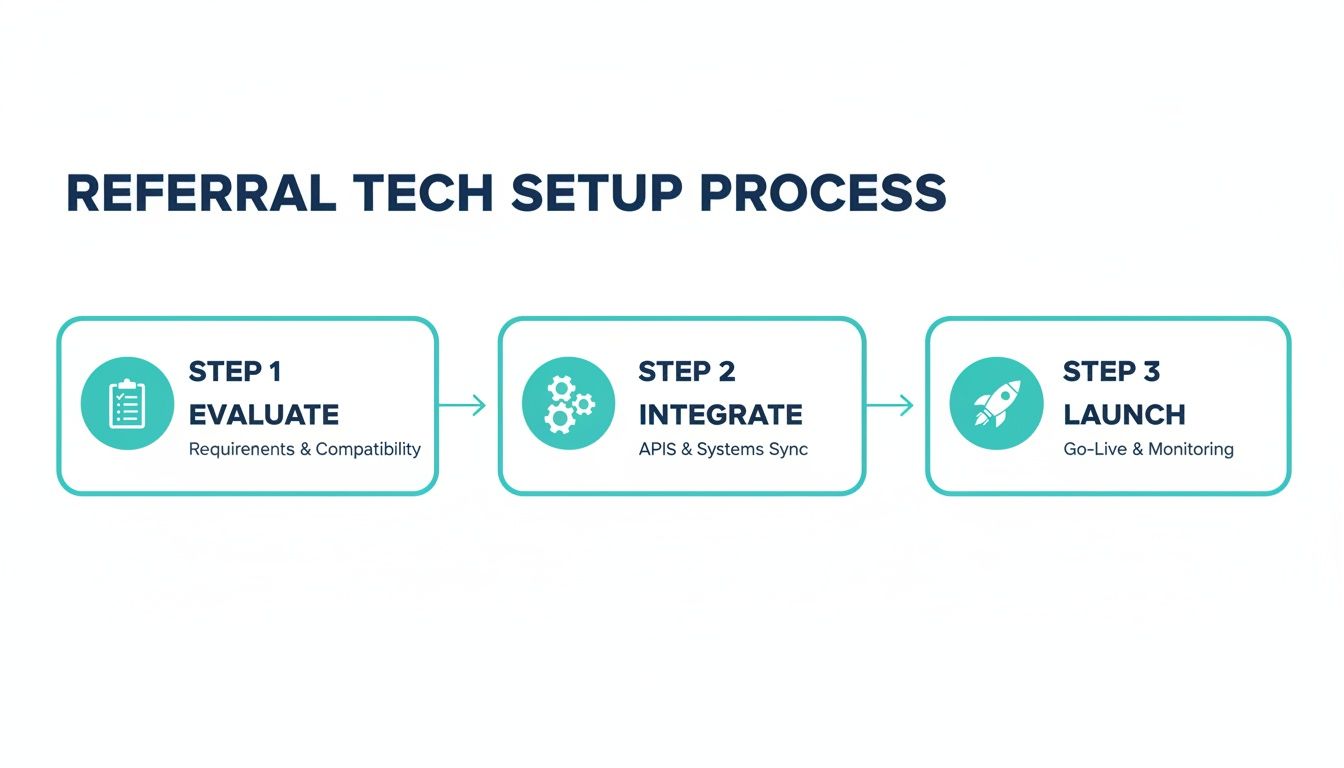
This visual flow underscores that a successful launch is the result of careful planning and integration, making sure the tech actually serves the strategic goals of your partner program.
Building Your Partner Recruitment Engine
You can't just build a program and hope partners find you. You need a multi-channel recruitment strategy to identify and attract the right fits, from boutique consultants to larger system integrators.
Start by looking internally. Your own sales and customer success teams are sitting on a goldmine of potential partners. They regularly talk with consultants, agencies, and vendors who already trust your product and work with your ideal customers.
Internal Nominations: Create a simple process for your team to nominate potential partners they meet in the field.
Customer-Partners: Your happiest customers are often your best future partners. They already know your product’s value inside and out.
Industry Events: Actively network at conferences and trade shows where your ideal partners gather. Focus on building relationships, not just pitching your program.
The key is to be proactive and targeted. Instead of a broad, passive approach, focus your efforts on recruiting partners who have a natural, strategic alignment with your software and target market.
The Partner Onboarding Experience
Once you've recruited a new partner, their first 30 days are critical. A confusing or disorganized onboarding process is the fastest way to kill a partner's enthusiasm. Your goal should be to make them feel confident, equipped, and ready to refer their first lead as quickly as possible.
A structured onboarding isn't just a welcome email; it's a guided journey.
Welcome & Kick-Off: Schedule a dedicated kick-off call to walk them through the partner portal, explain the commission structure, and introduce them to their main point of contact.
Product & ICP Training: Provide concise, on-demand training that covers your product’s core value proposition and exactly who your ideal customer is. Don't drown them in technical details.
First Lead Simulation: Guide them through registering their first lead in the portal, even if it's just a test. This removes any technical friction and builds immediate confidence.
This initial experience sets the tone for the entire partnership. A smooth, professional onboarding shows partners that you're invested in their success right from the start. You can learn more about the different types of referral program software that can help automate this process.
Crafting an Essential Partner Enablement Kit
Effective enablement means giving partners the same quality of tools you give your own sales team, tailored for their use. A comprehensive enablement kit should be easy to find in your partner portal and designed to make selling your software as simple as possible.
This isn't just a folder of random PDFs. It’s a curated library of strategic assets.
Your enablement kit should answer a partner's questions before they even have to ask. The goal is self-sufficiency and confidence, empowering them to represent your brand accurately and persuasively.
Here’s what your kit must include:
Product One-Pagers: Clear, jargon-free summaries of your software's features and, more importantly, its benefits for specific customer personas.
Competitor Battle Cards: Honest, straightforward comparisons that highlight your unique strengths without trashing competitors. Equip partners to handle tough questions about the market.
Co-Brandable Marketing Materials: Ready-to-use email templates, social media posts, and slide decks that partners can easily add their own logo to. This makes it a no-brainer for them to promote your solution to their network.
Case Studies & Testimonials: Powerful social proof that partners can use to validate your software’s real-world impact with their prospects.
By investing in high-quality recruitment, onboarding, and enablement, you transform your partners from passive participants into active, motivated advocates for your brand.
Measuring What Matters to Optimize and Grow
Getting your software referral program live is a huge step, but it’s definitely not the finish line. A program without clear, consistent measurement is like flying blind—you're moving, but you have no idea if you're headed in the right direction. To really optimize and grow, you need to get past the vanity metrics and focus on the key performance indicators (KPIs) that prove you're making a real impact on the business.
Let’s be honest: if you can't measure your program, you can't improve it, and you certainly can't defend its budget to the C-suite. The right data tells a powerful story about your program's health, its return on investment, and its potential to become a primary revenue engine.
Defining Your Core Program KPIs
Don't fall into the trap of tracking every possible data point. A cluttered dashboard is just as useless as no dashboard at all. For a B2B software referral program, your focus should be on a handful of crucial metrics that connect partner activity directly to pipeline and revenue.
Start with these foundational KPIs:
Partner Activation Rate: This tells you the percentage of signed-up partners who have actually taken a meaningful first step, like registering their first lead. A high number of sign-ups means nothing if those partners are dormant.
Lead-to-Deal Conversion Rate: What percentage of the leads your partners bring in ultimately become paying customers? This is a critical indicator of the quality of leads your program is generating.
Partner-Sourced Revenue: This is the bottom-line number your leadership team will care about most. It’s the total contract value from deals that came from your referral partners.
Tracking these numbers in your CRM and partner platform gives you a clear, quantitative picture of your program's performance. It lets you spot which partners are your top performers and which ones might need a little more help.
A program that can't prove its ROI is a program that's at risk of being cut. Focusing on metrics like Partner-Sourced Revenue is non-negotiable for securing long-term executive buy-in and investment.
The financial upside here is enormous. Referral marketing has fundamentally reshaped customer acquisition, delivering an extraordinary average return on investment of 3,000%. This isn't just a theoretical number; it translates to real growth, with referred B2B customers showing 38% higher retention rates.
Here's a quick rundown of the essential KPIs you should be watching.
Key KPIs for Your B2B Software Referral Program
This table summarizes the most important metrics for measuring the health, growth, and ROI of your partner program.
KPI | What It Measures | How to Calculate It | Why It Matters |
|---|---|---|---|
Partner Activation Rate | The percentage of signed partners who have completed a key action (e.g., registered a lead). | (Number of Activated Partners / Total Signed Partners) x 100 | Identifies partner engagement and highlights potential onboarding friction. |
Lead-to-Deal Conversion | The percentage of partner-submitted leads that become paying customers. | (Number of Closed-Won Deals / Total Partner Leads) x 100 | Measures the quality of leads your partners are sending. |
Partner-Sourced Revenue | The total revenue generated from deals originating from partners. | Sum of Contract Value from all Partner-Sourced Deals | The ultimate measure of your program's financial impact and ROI. |
Average Deal Size | The average contract value of deals brought in by partners. | Total Partner-Sourced Revenue / Number of Partner-Sourced Deals | Helps you understand the value of partner deals compared to other channels. |
Time to Close | The average time it takes for a partner-sourced lead to become a customer. | Average(Date Closed - Date Lead Created) | Indicates the efficiency of your sales cycle for partner leads. |
Keeping a close eye on these numbers will give you the hard data you need to make smart decisions and prove your program's value.
Beyond the Numbers: Gathering Qualitative Feedback
While data tells you what is happening, talking to your partners tells you why. Numbers alone can't explain why a top-performing partner suddenly went quiet or why a promising new recruit never sent a single lead. You need both data and dialogue.
Make regular, structured partner check-ins a core part of how you manage the program. These aren't sales calls; they are strategic conversations focused on their experience.
Ask open-ended questions like:
What’s one thing we could do to make referring leads easier for you?
Are the enablement materials in the portal actually helping you have better conversations?
Have you run into any friction with the lead registration or commission process?
This direct feedback is gold. It helps you spot problems—like a confusing partner portal or outdated battle cards—long before they show up as a dip in your KPIs. It also makes your partners feel heard and valued, strengthening the relationship far more than a commission check ever could.
To effectively measure success, it's vital to understand the return on investment, as detailed in this Ultimate Guide to Partnership ROI for Startups.
Using Data to Refine and Prove Value
Your ultimate goal is to combine the quantitative "what" with the qualitative "why" to create an unstoppable feedback loop. When you merge hard data with partner insights, you can make smarter, more strategic decisions to improve your program.
For example, if your data shows that leads from a certain partner tier have a low conversion rate, and your check-ins reveal they feel under-equipped to discuss your software, you have a clear action plan: deliver targeted training and better sales assets to that specific partner segment.
By consistently tracking the right KPIs and actively listening to your partners, you build a resilient, adaptable program that not only drives revenue but also proves its immense value to the entire organization.
Your B2B Referral Program Questions, Answered
Even the most buttoned-up referral strategy will run into real-world questions once you're in the trenches. Getting ahead of these common hurdles and having clear, direct answers ready is the key to managing the day-to-day reality of a thriving partner ecosystem. Let’s tackle a few of the big ones we see all the time.
How Do We Keep Our Sales Team and Partners From Clashing?
This is probably the most critical question you need to get right. Preventing channel conflict between your direct sales team and your referral partners comes down to one thing: crystal-clear rules of engagement from day one. There can be zero gray area here.
Your best weapon is a rock-solid lead registration system built right into your CRM. When a partner registers a new lead, that submission needs to be time-stamped and assigned to them for a set period—think 90 to 180 days.
If one of your direct reps later engages that same company, the system has to instantly flag the existing registration. This is non-negotiable. It guarantees the partner gets credit if the deal closes within their active window. It's just as important to define which accounts are off-limits, like existing customers or named enterprise accounts, and spell this out plainly in your partner agreement.
What’s a Realistic Commission Structure?
There's no magic number that works for everyone, but a proven model for B2B SaaS is paying a percentage of the First Year's Annual Contract Value (ACV). This sweet spot is usually between 10% and 25%, and it should scale based on how involved the partner is.
Simple Referral (10-15%): This is for a partner who makes a warm introduction and registers the lead. They open the door, and your team takes it from there.
Active Involvement (20-25%): This higher tier is for a partner who’s in the trenches with you, maybe co-hosting a demo or helping navigate a Proof of Concept (POC).
Some programs also toss in a one-time flat fee for hitting key milestones, like a qualified meeting or a successful POC. The main thing is to make sure the reward matches the value delivered and doesn't blow up your Customer Acquisition Cost (CAC).
This tiered approach incentivizes partners to do more than just throw a name over the fence. It keeps them engaged and motivated, which is huge for longer, more complex sales cycles.
How Long Until We Actually See an ROI?
Patience is a virtue here. For a B2B software company with a typical 3 to 9-month sales cycle, you should realistically plan for a 9 to 18-month timeframe to see a significant, measurable return on your investment. Momentum builds over time as you recruit more partners and they get better at spotting truly qualified prospects.
Your first 3 to 6 months will be all about the foundational work—program setup, partner recruitment, and initial enablement. You might see the first few leads trickle in during this phase, but it takes time for those opportunities to move through the pipeline and turn into closed-won deals.
Because of this natural delay, you absolutely have to track leading indicators to gauge early progress. Keep a close eye on metrics like the number of active partners and qualified leads registered each month. These early signals are your proof that the program is gaining traction long before the first commission checks go out.
At Logical Commander Software Ltd., our PartnerLC program is built on these exact principles of clarity, fairness, and shared success. We give our partners the tools, technology, and transparent rules of engagement they need to thrive. Learn more about joining our ecosystem and driving growth with a truly ethical, compliant, and partner-first program.