%20(2)_edited.png)

Growth with software referral programs

Software referral programs are one of the smartest ways to grow. They're strategic systems designed to turn your happiest, most loyal customers into your most powerful advocates.
Instead of pouring money into traditional ads that everyone's trained to ignore, these programs tap into the power of trusted, personal recommendations to drive real growth. Think about it: when a colleague you respect suggests a tool that solved a huge problem for them, you listen. That recommendation cuts through all the marketing noise instantly.
Understanding the Foundation of Referral Marketing
At its core, a software referral program is simply a structured engine for word-of-mouth marketing. It takes the natural, organic process of people sharing good experiences and puts a formal system around it, offering incentives to existing customers who recommend your product to their professional network.
This approach is especially powerful for B2B and SaaS companies. Why? Because in these worlds, peer validation and professional reputation aren't just nice-to-haves; they are critical parts of the buying decision.
Unlike broad-stroke advertising that shouts at everyone, these programs leverage a pre-existing layer of trust. A recommendation from a respected peer lands with immediate credibility, creating a powerful, self-sustaining growth loop where your satisfied users become one of your best customer acquisition channels.
The Power of Trusted Recommendations
The whole principle is incredibly simple: we trust people we know. A recommendation from a friend or colleague will always carry more weight than any flashy advertisement ever could. Software referral programs are built on this fundamental human behavior.
This is especially true in specialized industries where software solutions are complex, and the cost of making the wrong choice is high. For a platform like Logical Commander, which operates in sensitive areas like internal risk and compliance, a referral from a trusted source is pure gold.
The diagram below shows exactly where referral programs fit within the broader partnership ecosystem. They typically serve as the foundational, most relationship-driven tier.
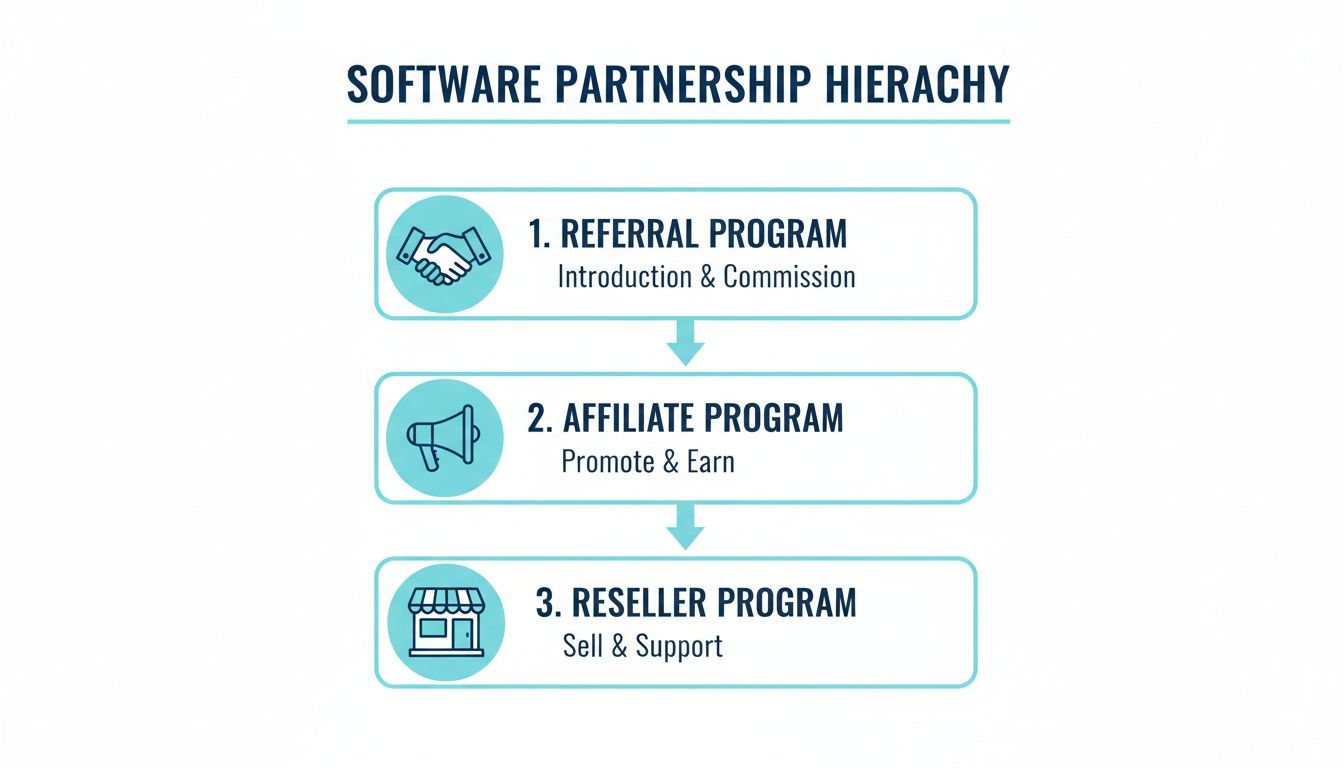
As you can see, referral programs are the most direct form of advocacy, followed by more structured affiliate and reseller partnerships that build upon that foundation.
Why Referrals Outperform Traditional Marketing
The data doesn't lie. Referrals aren't just another marketing channel; they are consistently one of the most effective.
In the software industry, referral programs are a proven powerhouse for growth. They boast an average referral rate of 4.75%, which blows away the 2.35% average across all industries as of 2025. But it gets better. Referred customers don't just convert; they also spend 200% more over their lifetime and have 27% higher retention rates. For any platform focused on long-term enterprise relationships, that's a goldmine. You can explore more key referral program metrics to see the full picture.
A successful software referral program does more than just generate leads; it builds a community of advocates who are invested in your success. It transforms your customer base from passive users into active partners in growth.
Ultimately, these programs work because they create perfect alignment between three key groups:
The Company: Acquires a high-quality, low-cost customer.
The Referrer: Gets rewarded for sharing a solution they genuinely believe in.
The New Customer: Discovers a trusted tool that solves a real problem for them.
This creates a win-win-win scenario that fuels sustainable growth and reinforces your brand's reputation with every single successful introduction.
The True Business Impact of Referral Marketing
Word-of-mouth has always felt a little soft, right? It's one of those things everyone says is important, but it's hard to nail down on a spreadsheet. A well-built software referral program changes all that. It takes the power of genuine trust and turns it directly into hard business results. This isn't about buzzwords; it's about building a powerful engine for sustainable growth that touches everything from your acquisition costs to customer loyalty.
The idea is simple. A referred customer doesn't show up cold. They arrive with a baseline of trust already baked in because the introduction came from a source they already respect. That completely changes the dynamic of the sales process from the very first conversation.

This pre-established trust naturally shortens sales cycles, helps build stronger initial relationships, and reinforces your brand’s reputation with every single successful referral.
Driving Down Customer Acquisition Costs
One of the first and most dramatic wins you'll see from a software referral program is how it slashes your Customer Acquisition Cost (CAC). Think about the budget you pour into traditional marketing channels—paid ads, content syndication, industry events. It all adds up, and it's all expensive.
Referrals flip that model on its head. Your existing customers effectively become your best marketing team, tapping into their own networks to bring in highly qualified people who are already primed to listen. It’s an organic, incredibly cost-effective approach.
Referred customers aren't just cheaper to bring on board; they are fundamentally more valuable from day one. Their journey with you starts with confidence, leading to faster adoption and a deeper commitment right out of the gate.
The latest benchmarks paint a pretty stunning picture of this impact. SaaS referral programs can cut CAC by 25% and boost revenue by 20-30% in the first year alone. Even better, referred customers tend to generate 35% more lifetime revenue and have 37% higher retention after a year. For B2B specifically, referrals deliver 38% better retention. In a competitive market, those aren't just numbers—they're a massive advantage.
Boosting Customer Lifetime Value and Retention
The financial perks don't stop once a new customer signs up. Time and time again, we see that referred customers are more loyal and more profitable over the long haul, which directly pumps up your Customer Lifetime Value (LTV).
It makes sense when you think about it. They were recommended by someone who actually understands their needs, so they're usually a much better fit for your product. This means they run into fewer problems, find value faster, and have a positive initial experience that sets the tone for a long-lasting relationship.
A few key things drive this higher LTV:
Higher Initial Trust: They onboard with confidence, which dramatically cuts down on that early-stage churn we all dread.
Better Product Fit: Your current customers are great at naturally qualifying leads, making sure the new person’s needs line up with what your software actually does.
Stronger Loyalty: That personal connection from the referral often creates a stronger, more emotional bond with your brand.
This powerful combination of a lower CAC and a higher LTV is the secret sauce to an efficient growth model. The entire SaaS B2B business model is built on getting this balance right, and referrals are one of the best levers you can pull to make it happen.
Creating a Virtuous Cycle of Growth
Here’s where it gets really exciting. A great referral program creates a growth loop that feeds itself. Every happy new customer you acquire through a referral is another potential advocate waiting to happen. This flywheel effect can kick your growth into a higher gear, often without you needing to spend a single extra dollar on marketing.
This approach is easily one of the most effective ways to fill your pipeline with high-quality prospects. In fact, if you look at a list of 12 powerful B2B lead generation strategies, you'll see that programs like these are essential for modern B2B growth. By turning your customers into advocates, you’re not just finding new leads—you’re building a sustainable, scalable acquisition channel rooted in trust and real value.
Designing a High-Performance Referral Program
Building a referral program that actually works isn't about luck; it's about smart design. A high-performance program starts with a solid blueprint that thinks about your goals, what motivates your users, and the entire experience you create for them. Think of it like building a bridge—it needs a clear destination, strong supports, and a smooth path for people to cross.
The very first step is to get crystal clear on what success looks like for you. Are you hunting for highly qualified leads for your sales team to nurture, or are you aiming for direct, hands-off sign-ups? These are two completely different goals that demand different program structures and incentives.
A program geared toward qualified leads might reward referrers as soon as their contact agrees to a demo. On the other hand, a program focused on direct sign-ups will only pay out after the new user becomes a paying customer. Nailing this distinction is the foundation of your entire strategy.
The Psychology of Incentives
Once your goal is set, the next piece of the puzzle is the reward. The right incentive is the fuel that powers your referral engine, but it's not just about throwing money at people. The most effective rewards tap into user psychology and feel connected to your product's value.
The big question is usually whether to go with single-sided or dual-sided rewards.
Single-Sided Rewards: Only the referrer gets a reward. This really only works when your brand has fanatical loyalty, and advocates are happy to share without needing to offer their friends a deal.
Dual-Sided Rewards: Both the referrer and the new customer get something. This model is overwhelmingly more popular—over 90% of programs are dual-sided—because it turns the referral into a generous act. The referrer feels good about giving a friend a discount, which completely removes that icky feeling of just "selling" for a commission.
The type of reward matters just as much as who gets it. While cash is a universal motivator, it isn’t always the best choice for B2B software referral programs.
For B2B software, incentives that enhance the user's professional life often deliver better results than cash. Think about rewards that add value directly within your ecosystem, like subscription credits, access to premium features, or exclusive content.
This approach keeps the value locked inside your platform and reinforces the benefits of being a loyal customer. To help spark some ideas, check out these top customer referral program ideas to find inspiration that fits your audience.
Creating a Frictionless User Experience
Even the most amazing rewards will fall flat if the process of referring someone is a pain. The user experience has to be absolutely seamless. If a user has to hunt for their referral link or jump through a bunch of hoops to share it, they just won't bother.
Your program needs to feel intuitive, accessible, and transparent. Users must be able to find their unique link easily, share it in a few clicks, and track the status of their referrals in real-time. A dedicated dashboard where they can see pending referrals, successful conversions, and earned rewards is essential for keeping them engaged and building trust.
Make sure you nail these key elements for a smooth experience:
Easy-to-Find Link: Put the referral link somewhere obvious inside the user's account dashboard. Don't make them search for it.
Simple Sharing Options: Give them pre-written messages and one-click sharing buttons for email and the major social platforms.
Clear Communication: Use automated emails to let referrers know when a friend signs up and when their reward has been issued.
Transparent Tracking: A simple dashboard showing the status of each referral proves the program is fair and that you're holding up your end of the deal.
Ultimately, the goal is to make sharing feel like a natural, easy, and rewarding part of using your software. The tools you use can make a huge difference here. For a deeper dive, our guide on the best referral marketing tools can help you find the right software to automate and manage this entire process effectively. A great program design, combined with a frictionless experience, is the formula for turning satisfied customers into your most powerful growth channel.
Getting Your Program Off the Ground
Alright, you've got a solid plan. Now comes the fun part: turning that blueprint into a real, working growth engine. This is where we move from strategy to execution, making the critical technical choices and promotional pushes that bring your software referral program to life.
Build vs. Buy: The First Big Decision
One of the first hurdles is deciding whether to build a custom referral system in-house or go with a specialized software platform. Building your own gives you total control, which sounds great in theory. The reality? It’s a massive drain on engineering resources, a constant headache for maintenance, and a security minefield. It can easily distract your team from what they should be doing: improving your core product.
The alternative is to use a dedicated referral platform. These tools are built for this one job and do it incredibly well. They handle everything from generating unique links to paying out rewards, freeing up your team to focus on promoting the program and building relationships. For most SaaS companies, this is the faster, smarter, and more reliable way to get started. If you're weighing the options, check out our deep dive into the best referral program software on the market.

If Nobody Knows, It Doesn't Exist: Promoting Your Program
Even the world's most generous referral program will fall flat if your customers don't know about it. Promotion isn't a one-and-done launch email; it's an ongoing effort to keep the program top-of-mind. The key is to weave it into the customer journey so it feels natural, not forced.
You'll need to hit them from a few different angles. Start by placing clear calls-to-action inside your app, especially right after a user has a "win" or accomplishes something important.
Here are a few channels that work wonders:
In-App Notifications: A simple, non-pushy pop-up after a user completes a key task can be incredibly effective. Timing is everything.
Email Campaigns: Kick things off with a big announcement, but follow up with periodic reminders or share success stories to keep the momentum going.
Customer Success Teams: Your support and success reps are on the front lines. Train them to mention the program during positive conversations with happy, engaged customers.
Referrals are most powerful when they feel like a genuine extension of a great experience. By placing these reminders strategically, you make it easy for customers to act when they're feeling good about your product.
The Bedrock of Success: Accurate Tracking and Attribution
Let's be blunt: the absolute cornerstone of any referral program is trust. And that trust is built on one thing—flawless tracking. Every single click, signup, and conversion has to be attributed correctly. If someone sends you a new customer and doesn't get credit for it, you haven't just lost a promoter; you've likely created an active detractor.
Accurate attribution isn't a feature; it's a promise. It's the operational proof that you'll honor your end of the deal. Any failure here shatters the trust that makes the whole system work.
This is another area where specialized software is a game-changer. These platforms are engineered to nail attribution, using referral links, cookies, and other methods to ensure credit always goes where it's due. They give referrers a transparent dashboard to see the status of their invites in real-time, which reinforces fairness and keeps them motivated.
Getting this right is vital. In the B2B SaaS world, sales reps who actively ask for referrals can close 35% more deals, and a well-managed program can boost user engagement by a staggering 48%. But those numbers are only possible when everyone involved has total confidence that the system is fair and accurate.
Measuring Performance and Optimizing for Growth
Launching your referral program is just the starting line, not the finish. Think of it as a living system, like a garden that needs constant attention to flourish. To turn a good program into a great one, you have to ditch the “set it and forget it” mindset and embrace one of continuous measurement and optimization.
This is where data becomes your most valuable tool.
By tracking the right metrics, you can understand exactly how your program is performing, pinpoint the friction points in the user journey, and uncover hidden opportunities for growth. Without this data-driven feedback loop, you’re essentially flying blind, unable to tell what’s working from what’s falling flat.
Identifying Your Core Program KPIs
To get a clear picture of your program's health, you need to focus on a handful of key performance indicators (KPIs). These numbers tell the real story of how users are interacting with your program at every stage, from initial awareness to the final conversion. Don't get lost in vanity metrics; concentrate on the data points that directly impact your goals.
Your essential KPI dashboard should include:
Participation Rate: What percentage of your total user base has actually joined the referral program? A low rate here often signals an awareness problem—your customers simply don't know the program exists or don’t understand what’s in it for them.
Share Rate (or Referral Rate): Of those who have joined, what percentage are actively sharing their referral links? This metric reveals just how motivated your participants are. If participation is high but sharing is low, your incentives might not be compelling enough.
Conversion Rate: This is the ultimate measure of success—the percentage of referred leads who become paying customers. A low conversion rate could point to issues with your landing page, a disconnect in messaging, or a poor product fit for the referred audience.
By keeping a close eye on these three KPIs, you can quickly diagnose where your program is strong and where it needs work, letting you focus your optimization efforts where they'll have the biggest impact.
A Culture of Continuous Improvement
Once you have a baseline understanding of your program's performance, the real work begins. Optimization is an ongoing process of testing, learning, and refining. The goal is to systematically remove friction and enhance motivation for both the referrer and their network.
A small improvement in your conversion rate can have a massive impact on your ROI over time.
A software referral program isn't a static campaign; it's a dynamic growth engine. Every data point is an opportunity to fine-tune its performance, turning incremental gains into significant, long-term revenue.
Start by forming hypotheses based on your data. For example, if your share rate is low, your hypothesis might be: "Offering a dual-sided reward will make referrers feel more generous and increase sharing." From there, you can run targeted A/B tests to validate your assumptions.
Here are a few key areas to focus your testing efforts on:
Incentives: Test cash versus product credits, or single-sided versus dual-sided rewards.
Messaging: Experiment with different headlines, calls-to-action, and email copy.
Landing Pages: Optimize your referral landing page for clarity, trust signals, and a dead-simple sign-up process.
By embracing a cycle of measuring, testing, and iterating, you transform your referral program from a simple marketing tactic into a powerful, scalable, and predictable channel for acquiring high-value customers. This methodical approach ensures your program evolves and continues to deliver maximum impact.
Navigating Compliance and Ethical Considerations
Trust is the currency of any successful software referral program. Plain and simple. Without it, the whole system just falls apart. While the growth potential is exciting, launching a program without a solid legal and ethical framework is like building a skyscraper on a foundation of sand. It’s not a matter of if it will fall, but when.
This is especially true in B2B and enterprise spaces, where reputation and sticking to regulations are everything. A poorly run program can quickly spiral into brand damage, legal penalties, and a total loss of customer confidence. The goal is to build something founded on absolute transparency and fairness from the very beginning.

This isn't just about protecting yourself from risk. It’s about actively building deeper, more resilient relationships with your customers. That’s how you ensure your program drives sustainable and ethical growth for the long haul.
Establishing Clear Terms and Conditions
Think of your program's terms and conditions (T&C) as your most important line of defense. It’s not just legal boilerplate; it's the official rulebook that sets clear expectations for everyone involved. A vague or incomplete T&C is basically an open invitation for disputes and headaches down the road.
Your T&C should be easy to find, simple to understand, and spell out the key operational details with zero ambiguity.
Eligibility Requirements: Who gets to play? Define clearly if the program is open to all users or only paying customers on specific plans.
Definition of a "Successful" Referral: State exactly what action triggers a reward. Is it when someone requests a demo, signs up for a trial, or only after they become a paying subscriber?
Reward Payouts and Conditions: Detail the reward amount, format (cash, service credit, etc.), and the exact timeline for payouts. You’ll also want to include any conditions, like the new customer needing to remain active for 30 days.
Program Abuse Policies: Outline what you consider fraudulent activity (like self-referrals or spamming links) and what happens when someone breaks those rules.
A well-written terms and conditions document prevents confusion and protects your business. It ensures that both you and your referrers are aligned on the rules of engagement from day one.
Upholding Disclosure and Data Privacy
Transparency isn't just good ethics—it's often a legal requirement. In the United States, for instance, the Federal Trade Commission (FTC) has crystal-clear guidelines on endorsements. If a referrer gets any kind of compensation, they must disclose that relationship to their audience. This makes sure the person receiving the recommendation understands the full context.
On top of that, data privacy is completely non-negotiable. Regulations like GDPR in Europe and CCPA in California have strict rules on how you collect, process, and store personal data. Your referral program has to be compliant. That means getting explicit consent to contact people who are referred and managing all user data securely. The fines for failing to comply can far outweigh any benefits you’d get from the program.
Got Questions About Software Referral Programs? We've Got Answers
Even the best-laid plans come with questions. When you're diving into the world of software referral programs, a few common ones always seem to pop up. Getting clear, straightforward answers is the key to building your program on a solid foundation and launching with confidence.
Let's tackle the most frequent questions we hear from businesses, so you can sidestep the common hurdles and make smart decisions from the very start.
Referral vs. Affiliate Programs: What’s the Real Difference?
This is easily the most common point of confusion. While both referral and affiliate programs rely on other people to spread the word, the core relationship and who you're targeting couldn't be more different.
Referral Programs are all about personal trust. You’re tapping into your existing base of happy customers and encouraging them to recommend your software to their professional network—people they actually know. The motivation here is genuine satisfaction, not just a paycheck.
Affiliate Programs are performance-based marketing partnerships. These are open to a much wider audience, like professional marketers, bloggers, and influencers who promote your software to their followers for a commission. It’s a commercial relationship, plain and simple.
Think of it this way: a referral is like a trusted colleague telling you about a tool they genuinely love and use every day. An affiliate is like a skilled marketer running a paid campaign for a product they believe in.
When Is the Right Time to Launch a Program?
Timing is everything. Jump the gun and launch a referral program too early—before your product is truly dialed in—and you could do more harm than good. The sweet spot for launching is after you've nailed product-market fit and have a solid base of customers who are genuinely thrilled with what you offer.
Look for these signs that you're ready:
High Net Promoter Scores (NPS): Your customers are already telling you they’d recommend you.
Glowing Customer Reviews: You're getting unsolicited praise and clear social proof that people are happy.
Strong User Retention: People are sticking around month after month because they can't imagine working without your software.
The rule is simple: wait until you have a product people genuinely love before you ask them to share it. A referral program just amplifies what your customers are already feeling—so make sure that feeling is overwhelmingly positive.
What Incentives Actually Work for B2B Referrals?
In the B2B world, you need to think beyond just throwing cash at people. While money is always a decent motivator, rewards that offer real professional value can be far more powerful and do a better job of aligning with your brand.
For software referral programs, these high-impact options are proven winners:
Subscription Credits: Offering a discount or a free month of service is a no-brainer. It directly ties the reward back to the value of your product and keeps them sticky.
Access to Premium Features: Unlock advanced functionality for successful referrers. This makes them feel like valued insiders and power users, which is a reward in itself.
Dual-Sided Incentives: This is the gold standard. Rewarding both the person referring and the new customer they bring in is a powerful combination. It makes the referrer feel generous for sharing a great deal, completely removing any feeling that they're just "selling" for a commission.
At Logical Commander Software Ltd., we know that the strongest growth comes from trusted partnerships. Our PartnerLC program is built to create powerful, mutually beneficial relationships that drive ethical growth. Find out how we can succeed together by visiting https://www.logicalcommander.com.