%20(2)_edited.png)

A Modern Guide to Enterprise Risk Management

Updated: Dec 29, 2025
Let's be clear: enterprise risk management is not a static compliance checklist you dust off once a year. It's the central nervous system of a modern business, designed to identify internal threats and neutralize them before they inflict serious liability. This is a holistic discipline, pulling together Legal, HR, and Compliance to shield the organization from a full spectrum of human-factor risks that traditional methods miss.
What Is Enterprise Risk Management Really
Forget the dry, textbook definitions. Traditional risk management has a fatal flaw: it operates in silos. Different departments chase their own concerns, completely independent of one another. This fragmented approach creates massive blind spots, especially for internal threats that cut across departmental lines—the very risks that originate with people.
Modern enterprise risk management (ERM) tears down those walls. It builds a unified, top-down strategy that ties risk oversight directly to your core business goals, focusing on the human factor where most significant risks begin and end.
Think of the difference between reactive forensics and proactive prevention. A reactive approach waits for an incident—like internal fraud or a major compliance breach—and then kicks off a costly, disruptive investigation. A proactive ERM strategy, powered by ethical AI, is about spotting the leading indicators of human-factor risk and neutralizing them before they cause financial or reputational damage.
The Shift from Reactive to Proactive Prevention
The real evolution in ERM is this fundamental change in mindset. Old-school methods are inherently backward-looking. They lean on historical data and audits to address problems that have already happened, leaving you perpetually one step behind the next internal threat. The cost and failure of reactive investigations are a drain on resources and morale.
A truly effective enterprise risk management program is forward-looking. It weaves risk awareness directly into your strategic planning, ensuring every major business decision is weighed against its potential impact. This is where ethical risk management becomes non-negotiable.
The goal isn't just to document risks anymore; it's to build a resilient organization that can anticipate and adapt. That demands a cultural shift where risk awareness is part of every team's DNA, backed by technology that delivers preventive intelligence, not just post-mortem reports.
Unifying Your Defense Against Human-Factor Risk
While most companies focus on external threats, many ERM programs stumble when it comes to the most unpredictable variable: the human factor. Issues like employee misconduct, conflicts of interest, and internal fraud are not just HR problems. They are enterprise-level threats with the power to cause severe financial and reputational harm.
Effective ERM gets the right stakeholders—Compliance, HR, Legal, and Security—in the same room to build a complete picture of this complex risk landscape. It ensures that:
HR can identify behavioral risks without resorting to invasive surveillance.
Legal and Compliance have a clear line of sight into potential policy violations before they become liabilities.
Security can focus on internal threat detection based on objective, AI-driven intelligence, not just gut feelings.
By creating this unified front, you turn risk management from a defensive chore into a powerful competitive advantage. You're not just protecting assets; you're protecting your people with a framework that is both effective and EPPA compliant. This is the new standard of internal risk prevention.
Navigating Key ERM Frameworks
When you start digging into enterprise risk management, you'll encounter two major acronyms: COSO and ISO 31000. These are the dominant frameworks organizations lean on, but they were designed for a different era. For decision-makers in Compliance, Legal, or HR, it’s critical to understand not just what they do, but more importantly, their glaring blind spots.
COSO vs. ISO 31000: Blueprints and Philosophies
Think of the COSO framework as a detailed architectural blueprint. It’s a formal, top-down model emphasizing internal controls and strict governance. Its prescriptive nature makes it a go-to for proving compliance with regulations like the Sarbanes-Oxley Act (SOX). It tells you exactly where the walls and support beams need to go.
ISO 31000, on the other hand, is less of a rigid blueprint and more of a guiding philosophy. It’s a flexible set of principles designed to be woven into a company’s culture and decision-making. The focus isn't on specific controls but on cultivating a continuous, risk-aware mindset. It’s about teaching everyone how to think about risk, not just follow a checklist.
Modern ERM has to be proactive, holistic, and unified to have any real impact on business liability.
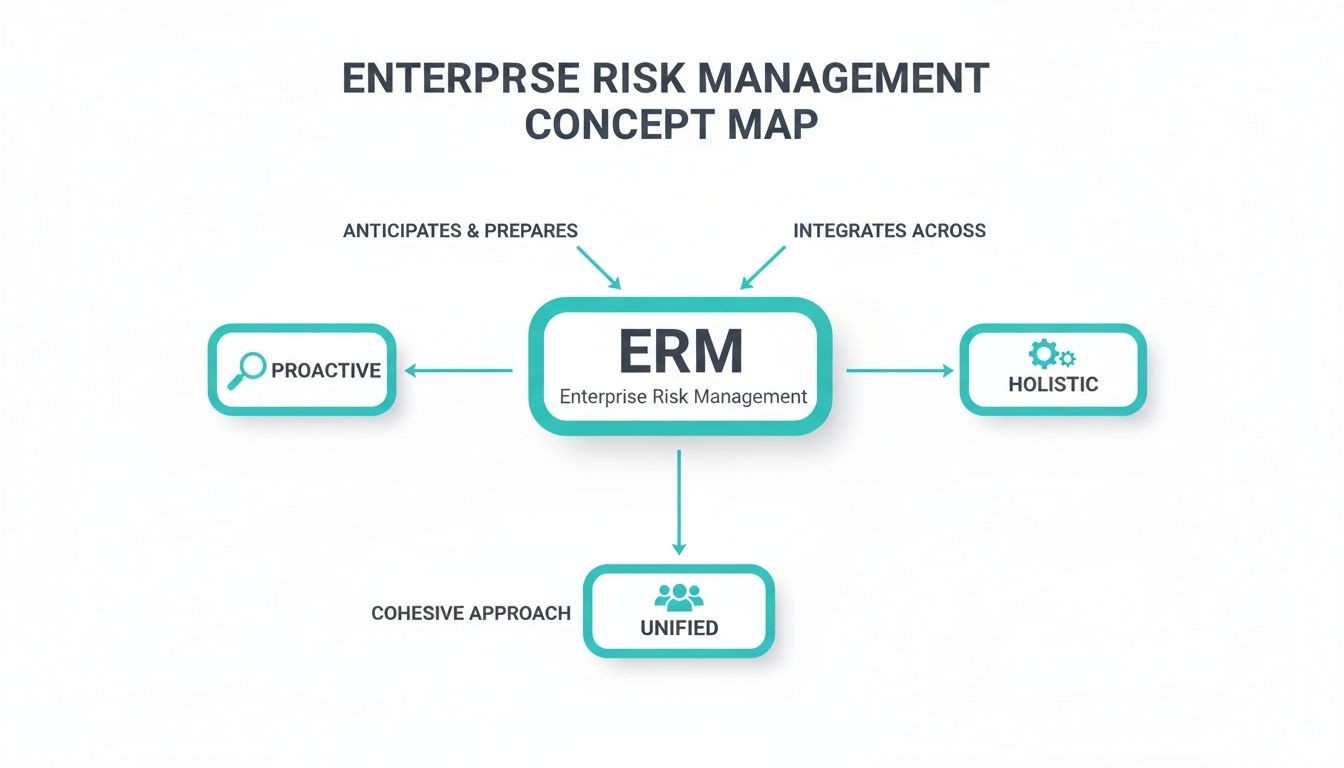
The key takeaway here is that these pillars are completely interdependent. You can’t be proactive if your view of risk is fragmented and siloed.
A side-by-side comparison makes the differences even clearer.
Comparing COSO and ISO 31000 ERM Frameworks
Aspect | COSO ERM Framework | ISO 31000 Framework |
|---|---|---|
Core Philosophy | Prescriptive & Control-Based. Focuses on internal controls, governance, and achieving specific objectives. It's a structured, top-down model. | Principles-Based & Flexible. A set of guidelines designed to be integrated into existing processes. Focuses on creating a risk-aware culture. |
Structure | Rigid Five-Component Model. Built on Governance & Culture; Strategy & Objective-Setting; Performance; Review & Revision; and Information, Communication, & Reporting. | Iterative Three-Part Model. Based on Principles, a Framework, and a Process (the classic "Plan-Do-Check-Act" cycle). |
Application | Compliance-Oriented. Excellent for organizations in highly regulated industries (like finance or healthcare) needing to demonstrate strong internal controls for audits. | Strategy-Oriented. Best suited for organizations wanting to embed risk management into all strategic and operational decision-making, adapting it to their unique culture. |
While both provide a foundation, their primary goal is documenting known risks, not preventing unknown ones.
The Shared Blind Spot in Both Frameworks
For all their strengths, both COSO and ISO 31000 share a massive blind spot: the messy, unpredictable, and deeply nuanced world of human-factor risk. These traditional models are great at categorizing known quantities—financial risks, operational hiccups—but they fall short when it comes to the leading indicators of internal threats like misconduct, fraud, or conflicts of interest.
They were designed in an era before advanced, ethical AI could non-intrusively spot the subtle behavioral patterns that almost always precede a major internal incident. As a result, organizations relying solely on these frameworks are stuck in a reactive loop, waiting for something to break before they can act. This is the costly failure of legacy systems.
The real challenge for modern enterprise risk management isn't just documenting known risks. It's about proactively identifying the unknown risks that are rooted in human behavior. Traditional frameworks tell you what to look for, but they lack the how for preventing these threats before the damage is done.
This gap creates a critical vulnerability. Even the most perfectly documented ERM program can be completely undermined by a single internal event that a conventional risk assessment would never have seen coming.
Evolving Beyond Traditional Frameworks
This doesn't mean you should throw these frameworks out. Instead, see them as the foundation upon which you must build a more advanced, AI-driven layer. The future of effective enterprise risk management hinges on augmenting these models with tools that directly address their inherent weaknesses in preventing human-factor risk. Digging into a modern operational risk management framework can show you exactly how to bridge these gaps.
A modern ERM program integrates the structure of COSO and the principles of ISO 31000 with AI-driven, preventive capabilities. This new standard, E-Commander / Risk-HR, allows you to:
Proactive Prevention: Move beyond reactive investigations by identifying risk indicators before an incident causes liability.
Ethical Insight: Gain visibility into human-factor risks without resorting to legally toxic surveillance or invasive monitoring.
Unified Intelligence: Break down the walls between HR, Legal, and Security to create a single, coherent view of internal risk.
Platforms that provide AI human risk mitigation are designed to be this essential top layer. Built to be fully EPPA compliant, they ensure your prevention efforts protect not only the company's assets but also its employees' dignity and privacy, transforming ERM from a compliance exercise into a strategic advantage.
Why Human-Factor Risk Is Your Biggest Blind Spot
While headlines scream about cyberattacks, organizations are discovering that their biggest vulnerabilities walk through the front door every morning. A solid enterprise risk management strategy cannot afford to ignore its most unpredictable and impactful variable: its people. Human-factor risk is where minor issues become major liabilities.
Issues once buried in HR—like misconduct, conflicts of interest, and internal fraud—are now rightly understood as enterprise-level threats. The potential for financial and reputational damage is devastating, far exceeding the impact of many external events.
Many ERM programs are heavily weighted toward external cyber risks. Recent surveys show it as the top concern, with nearly 75% of enterprises hit by at least one critical risk event last year. Yet this intense focus creates a dangerous blind spot, as internal actions are frequently the key that unlocks the door for those external breaches. For a closer look at these interconnected threats, you can explore these detailed risk management statistics.

This oversight reveals the fundamental failure of traditional, reactive approaches to internal risk. An investigation that begins after the damage is done is already a business failure.
The High Cost of Reactive Investigations
Reactive investigations are broken by design. They are, by definition, backward-looking. Kicked off by a negative event, they launch a costly and disruptive scramble to piece together what went wrong. This model fails the business in critical ways:
Financial Drain: Investigations burn through resources—legal fees, forensic accounting costs, and crippling operational downtime. The initial loss from the incident is often just the beginning.
Reputational Damage: By the time an internal problem goes public, the harm to brand trust and stakeholder confidence is irreversible. Rebuilding that trust is a long, expensive road.
Cultural Corrosion: Internal investigations breed a climate of suspicion and fear, poisoning morale and productivity. They signal that the system failed to prevent the problem in the first place.
This reactive posture is a massive liability in most ERM strategies. It treats human-factor risk as an unfortunate event to be cleaned up, not a preventable threat to be neutralized. To learn more about this specific area, you might be interested in our guide on human capital risk management.
The Urgent Need for a Proactive, Ethical Approach
The new standard for enterprise risk management demands a complete shift from reaction to prevention. Addressing the human element requires gaining insight without resorting to invasive employee surveillance.
Legally risky methods that monitor employee activity or create a "big brother" atmosphere are not just unethical; they violate regulations like the EPPA and destroy corporate culture. The old way of surveillance is not only wrong, it’s a liability.
The goal is not to police employees but to understand the leading indicators of risk within the organization's processes and culture. True prevention identifies patterns and anomalies that signal potential misconduct or conflicts of interest before they escalate into a full-blown crisis.
This is where modern AI human risk mitigation platforms provide a clear advantage. By using ethical, non-intrusive technology, organizations can identify these red flags in a privacy-first way. An EPPA compliant platform delivers preventive intelligence, empowering Compliance, HR, and Legal teams to act proactively and protect the business from liability.
This approach strengthens governance and protects the bottom line by getting to the root causes of internal risk. It’s about building a resilient organization that identifies and mitigates threats from the inside out, turning its biggest blind spot into a core strategic strength.
Using Ethical AI for Proactive Risk Mitigation
How do you get ahead of a risk before it impacts your bottom line? Traditional enterprise risk management frameworks give you a structure for documentation, but they leave you cleaning up messes that have already happened. The strategic shift comes from integrating advanced, ethical AI into your ERM program, moving your focus from reactive forensics to proactive prevention.

This isn't a future concept; it’s a strategic imperative. Research shows that by 2025, a stunning 70% of risk managers expect to put AI at the core of their strategies. This signals a huge pivot from reactive to predictive risk handling, with AI adoption in ERM climbing by 35% year-over-year as companies grapple with massive volumes of data they can’t analyze manually.
A New Standard in Risk Intelligence
AI-powered platforms like E-Commander and Risk-HR are setting a completely new standard for preventing internal risk. Instead of resorting to invasive employee monitoring, this technology analyzes disconnected, non-personal data points to find the leading indicators of human-factor risk. It connects the dots that are invisible to the human eye, predicting where the next liability will emerge.
A traditional investigation is like sifting through wreckage after a car crash. An ethical AI system is the advanced collision-avoidance technology that spots hazardous conditions and warns you to act before an incident occurs.
It does this by flagging anomalies and patterns tied to:
Conflicts of Interest: Spotting situations that could compromise an employee's objectivity or create business liability.
Misconduct Risks: Identifying behavioral patterns that are often precursors to policy violations or fraud.
Insider Threats: Pinpointing the early warning signs of data exfiltration or internal fraud without accessing private communications.
This approach gives HR, Legal, and Compliance teams actionable, preventive intelligence, empowering them to intervene early and defuse risks before they become a crisis. You can learn more in our guide on detecting insider threats with ethical AI.
The Critical Difference Between Ethical AI and Surveillance
It is absolutely essential to separate this new standard from outdated, legally dangerous alternatives. Many legacy tools are built on intrusive surveillance—monitoring emails, tracking keystrokes, or analyzing employee sentiment. These methods are not just unethical; they create huge legal exposure under regulations like the Employee Polygraph Protection Act (EPPA) and are fundamentally misaligned with modern governance.
An EPPA compliant platform operates on a totally different principle. It’s designed to be non-intrusive and privacy-first, analyzing systemic patterns instead of policing individual employees. The goal is to build a system of ethical governance that strengthens integrity, not a culture of suspicion.
By focusing on process integrity and behavioral indicators without personal intrusion, an ethical AI system protects both the organization's reputation and its people. For companies using AI, it's also critical to get a handle on new risks, like mitigating AI-generated code issues, which introduces a whole new class of operational vulnerability.
Empowering Teams with Actionable Insights
Ultimately, the power of ethical AI in enterprise risk management lies in its ability to deliver targeted, high-fidelity alerts. Instead of drowning your teams in false positives, the system pinpoints specific, validated risks that require attention.
This allows decision-makers to shift from a state of constant reaction to one of strategic prevention. HR can address a potential conflict of interest before it becomes a crisis. Legal can reinforce compliance policies in areas showing elevated risk. Security can harden controls based on predictive intelligence.
This is the future of ERM—a unified, intelligent, and ethical framework that turns risk management from a cost center into a strategic enabler that protects your people, reputation, and bottom line.
Building Your Future-Ready ERM Program
Knowing the theory of enterprise risk management is one thing; putting it into action to protect your business is another. Implementing a modern ERM program isn’t just about swapping frameworks; it’s a fundamental shift in how your company prevents risk—especially the human element.

This change demands a clear roadmap. First, secure executive buy-in by framing ERM not as a cost center, but as a strategic enabler that protects revenue and safeguards reputation from internal threats. Next, form a cross-functional risk committee with leaders from HR, Legal, Security, and Compliance. This is how you finally break down the departmental silos where liabilities hide.
Starting with a Modern Risk Assessment
A future-ready ERM program kicks off with an enterprise-wide risk assessment that gives human-factor vulnerabilities the attention they deserve. Traditional assessments get stuck on external or financial risks, leaving a massive blind spot for internal problems like misconduct or conflicts of interest. A modern Risk Assessments Software must change this.
A modern assessment includes:
Human-Factor Scenarios: Go beyond financial models to map out potential integrity, misconduct, and fraud risks.
Process Vulnerability Analysis: Pinpoint the weak spots in your internal processes that could be exploited.
Data Silo Identification: Discover where critical risk information gets trapped within different departments.
This process lays the groundwork for defining your organization's risk appetite—the level of risk you’re willing to accept to achieve strategic goals. A well-defined risk appetite ensures your mitigation efforts are aligned with business objectives, avoiding the classic mistake of overspending on low-impact risks while bigger threats fly under the radar.
Choosing the Right Technology Partner
Technology is the engine of a proactive ERM program, but picking the right partner is a make-or-break decision. Too many solutions are stuck in the past, relying on outdated surveillance methods that create massive legal exposure and cultural damage. To build a future-ready program, organizations must get proactive about fixing internal alignment and leadership clarity in a VUCA environment.
Your evaluation checklist for any technology partner should place ethical design and preventive capabilities at the top.
The goal is to find a solution that offers proactive intelligence, not one that simply automates reactive investigations. The technology should empower your teams to prevent damage, reinforcing a culture of integrity rather than one of suspicion.
The market for these solutions is growing fast. The global enterprise risk management market is projected to more than double, from US$10.5 billion to US$23.7 billion by 2028. Yet, even with 76% of companies implementing ERM programs, maturity remains low—only 32% feel their oversight is truly mature. This gap screams for integrated platforms that can unify workflows and tackle top human-factor risks head-on.
Your Checklist for an Ethical ERM Platform
When vetting potential enterprise risk management software solutions, use this checklist to ensure you’re adopting the new standard of ethical prevention.
Is the platform fully EPPA compliant? It absolutely must operate without any form of lie detection, psychological pressure, or surveillance.
Is it non-intrusive? The technology should analyze systemic patterns, not monitor individual employee activities.
Does it deliver preventive alerts? The system must identify the leading indicators of risk, giving you the chance for early intervention to prevent liability.
Can it unify disparate data? Look for a platform that breaks down silos between HR, Legal, and Security to create a single, coherent view of internal risk.
Does it protect employee dignity? The methodology must be designed to build integrity and preserve a positive, healthy workplace culture.
If you can get confident answers, you’re on the right track to lead your organization’s evolution from a reactive, fragmented approach to a proactive and unified risk management culture that provides a true strategic advantage.
Setting a New Standard in Enterprise Risk
The future of enterprise risk management is here. It’s proactive, unified, and fundamentally ethical. For too long, organizations have been trapped in a reactive cycle—treating the immense costs of investigations, legal fees, and reputational damage as an unavoidable part of business.
That backward-looking approach only addresses threats after the damage is done. The old standard of reactive forensics is no longer acceptable. Proactive prevention offers far greater strategic value, protecting both the bottom line and your organization's integrity by ensuring disasters never happen in the first place.
Beyond Outdated and Intrusive Practices
A modern approach to enterprise risk moves beyond invasive, legally questionable practices. Many traditional monitoring tools create more problems than they solve, exposing companies to significant liability under regulations like the EPPA and eroding employee trust. Surveillance-based systems that track employee activity are not just ethically dubious; they are a massive strategic liability.
In stark contrast, a new standard has emerged. Logical Commander provides a non-intrusive, EPPA-aligned alternative that delivers critical risk intelligence without surveillance. Our AI-driven platform focuses on identifying the systemic indicators of human-factor risk—like misconduct and conflicts of interest—empowering you to act before a situation spirals out of control. It’s an ethical framework designed to protect both the organization and the dignity of its people.
The new benchmark for effective enterprise risk management is not how well you investigate failures, but how effectively you prevent them. This requires a commitment to ethical technology that provides foresight, not just hindsight.
Join the New Ecosystem of Proactive Prevention
Embracing this modern approach is a call to action for every leader in Risk, Compliance, HR, and Legal. It’s time to move beyond the failed reactive model and adopt a system of proactive, ethical governance. We invite consultants, advisors, and B2B SaaS providers to join us in leading this change.
Our PartnerLC program is built for firms committed to bringing this new standard of ethical risk prevention to their clients. By joining our partner ecosystem, you can equip organizations with the tools they need to build resilient, high-integrity cultures. Together, we can redefine what’s possible in enterprise risk management and build safer, more ethical organizations from the inside out.
Your Questions on Modern ERM, Answered
Modernizing your enterprise risk management is a significant strategic move. It touches on technology, culture, and business liability. Let’s tackle the most common questions we hear from decision-makers, focusing on real-world business impact and the ethical principles that must guide your choice.
How Do We Implement ERM Without Creating a Culture of Distrust?
This is the most important question. The answer gets to the heart of what separates a modern ERM platform from an outdated surveillance tool. The key is to build your program on an ethical, non-intrusive foundation from day one.
Modern ERM platforms, like those from Logical Commander, are engineered specifically to avoid employee surveillance. They do not monitor individuals or their personal activities. Instead, they use privacy-first AI to spot systemic risk indicators within your existing processes.
When you transparently communicate that the goal is to protect the organization from liability—and you back that up by using only EPPA-compliant tools—you build a culture centered on integrity and shared responsibility, not suspicion. The focus shifts from policing people to strengthening processes to prevent business harm.
Is an AI-Driven ERM Platform Difficult to Integrate?
No, it should be the opposite. Leading platforms like E-Commander are designed for seamless, plug-and-play integration with your current technology stack. They act as a unified intelligence layer on top of your existing HRIS, compliance, and security systems, pulling data together without disruption.
The goal is to finally break down the information silos that let major risks go unnoticed, creating a single, authoritative source for preventing internal risk. It is not about ripping and replacing the infrastructure you already rely on. A good implementation should be streamlined to deliver a quick and tangible return on investment, providing powerful insights with minimal disruption.
How Does a Preventive ERM System Address Internal Fraud?
A preventive system completely changes the game. It shifts the focus from trying to "catch" a bad actor after the damage is done to identifying risk patterns long before they escalate into a crisis. An ethical AI can detect the leading indicators of potential fraud, such as clear conflicts of interest or major deviations from established financial controls.
Instead of waiting for a whistleblower report after money is gone, the system flags a risky pattern and sends a preventive alert to a designated team like Compliance or Internal Audit. This allows them to step in early—perhaps by clarifying a policy, strengthening a control, or conducting a quiet review. The risk is neutralized long before it causes any real financial or reputational damage.
This proactive stance is what modern enterprise risk management is all about. It transforms ERM from a reactive, backward-looking chore into a genuine strategic advantage that protects your organization from the inside out.
Ready to set a new standard for ethical and proactive internal risk management? Logical Commander provides the EPPA-aligned, non-intrusive AI platform that protects your organization and its people. Request a demo to see how our E-Commander and Risk-HR modules can prevent internal threats before they cause damage.
Or, if you are a consultant or technology provider, learn how you can deliver this new standard to your clients by joining our PartnerLC program. Contact us today to start a free trial or discuss an enterprise deployment.