%20(2)_edited.png)

A Guide to Enterprise Risk Management Compliance

When decision-makers hear enterprise risk management compliance, they often think of rigid rules and auditors with clipboards. But that’s an outdated picture. Today, it’s a strategic framework that weaves regulatory, legal, and ethical duties directly into the fabric of an organization's operations, focusing on preventing the human-factor risks that lead to major liability.
This isn’t about just ticking boxes on a checklist. It's about building a proactive, AI-driven system that spots and manages internal threats before they can cause real financial or reputational harm.
What Is Enterprise Risk Management Compliance?

Think of modern ERM compliance less like a stuffy rulebook and more like the central computer in a modern car. This system does far more than just confirm the seatbelts are buckled—that’s old-school, reactive compliance. Instead, it’s constantly processing signals on engine performance (operational risk), road conditions (regulatory shifts), and driver inputs (the human factor) to prevent an accident.
This integrated, preventive approach is the key difference between a passive, 'check-the-box' mentality and a forward-thinking strategy that builds a truly resilient business. It’s a fundamental shift in focus from costly, reactive investigations to proactive prevention of internal threats.
Beyond The Checklist Mentality
Traditional compliance often lives in silos. The legal team manages its risks, HR handles theirs, and Security focuses on its own narrow slice of the pie. This fragmented model creates massive blind spots, especially when it comes to risks that stem from the human factor—the primary source of internal threats like fraud, misconduct, or conflicts of interest.
These are the threats that fly completely under the radar of conventional systems, which are built for reactive forensics, not prevention. By the time they are discovered, the damage is already done.
A modern enterprise risk management compliance program shatters those silos. It creates a single, unified view of human-factor risk across the entire organization, connecting seemingly random data points to reveal patterns and potential threats that would otherwise stay hidden. This holistic perspective is the only way to achieve effective governance and true prevention, safeguarding your organization's reputation and bottom line.
The goal is not merely to satisfy auditors but to build a culture of integrity and risk awareness. A successful ERM compliance program becomes a strategic asset, protecting the organization’s value and reputation from the inside out.
The Strategic Value Of Proactive Compliance
Taking a proactive stance on compliance isn't just about avoiding trouble; it offers huge business advantages. It moves the entire conversation away from costly, reactive investigations and toward strategic prevention, which is far more efficient, ethical, and less disruptive.
The table below breaks down the difference between the old, failed approach and the new standard in internal threat prevention.
Reactive vs Proactive ERM Compliance Approaches
Characteristic | Reactive Compliance (The Old Way) | Proactive Compliance (The New Standard) |
|---|---|---|
Mindset | "Check the box" to satisfy auditors. | Strategic prevention to protect business value and reputation. |
Timing | Acts after an incident occurs, triggering costly forensics. | Acts before a human-factor risk can materialize. |
Focus | Departmental silos, narrow view of risk. | Holistic, enterprise-wide view of interconnected human risks. |
Tools | Invasive surveillance, manual audits, legacy systems. | Ethical, EPPA-aligned AI platforms, real-time dashboards, integrated data. |
Outcome | Costly investigations, fines, reputational damage, eroded trust. | Reduced liability, enhanced reputation, operational resilience. |
The benefits of a proactive approach are clear and deliver real, tangible business impact:
Reduced Liability: By spotting and addressing human-factor risks before they escalate, you can head off expensive legal fights, regulatory fines, and disruptive internal investigations.
Enhanced Reputation: A visible commitment to ethical and compliant operations builds deep trust with customers, investors, and partners, strengthening your brand immeasurably.
Improved Decision-Making: With a clear, enterprise-wide view of risk, your leaders can make smarter strategic decisions that are fully aligned with the organization's risk appetite. A key piece of this involves mastering governance in the cloud for compliance to ensure both security and scalability.
Operational Resilience: Proactive risk management strengthens your internal processes and controls from the ground up, making the organization much tougher and more resilient to disruptions caused by internal threats.
This modern approach sets the stage for a new, prevention-focused standard in risk management. To deepen your understanding of these core concepts, explore our complete guide to what enterprise risk management entails. Next, we’ll dig into why traditional frameworks fail and how to implement a more effective, forward-thinking strategy.
Why Traditional ERM Compliance Frameworks Fail

Many organizations believe their enterprise risk management compliance programs are solid. In reality, they’re often operating with a dangerous false sense of security. The hard truth is that most traditional frameworks are fundamentally broken because they were designed for an era before the human factor was recognized as the primary internal threat.
They lean on fragmented systems, tedious manual processes, and siloed departments that create massive, costly blind spots right where it matters most.
This outdated structure is especially ineffective at handling the most dynamic and damaging threats today: human-factor risks. Issues like internal fraud, conflicts of interest, and misconduct often fly completely under the radar of legacy tools, which are built for reactive forensics, not prevention. This failure leads to escalating liabilities, sudden reputational damage, and the astronomical cost of reactive investigations launched only after a crisis has already exploded.
The Problem of Siloed Intelligence
The biggest weakness of old-school enterprise risk management compliance is the departmental silo. Legal has its data, HR has its own, and Security operates in a completely separate bubble. Each team sees only a small piece of the puzzle, making it impossible to connect the dots and spot emerging internal threats that cross departmental lines.
For example, an employee showing signs of financial distress (an HR data point) who also has access to sensitive company accounts (a security data point) represents a huge risk. In a siloed organization, this connection is almost never made until after an incident of fraud happens. This fragmentation isn't just inefficient; it's a direct threat to your company's stability, creating significant business impact and liability.
The reality is that enterprise risk management capabilities are significantly underdeveloped across most organizations. A staggering report revealed that only 35% of financial leaders feel they have comprehensive ERM processes in place, and a mere 26% have achieved strong cross-functional collaboration. This structural weakness is made worse by technology gaps, with 42% of companies admitting their IT and GRC systems need improvement. You can learn more about these critical risk management statistics and their impact.
A risk that lives between departments is a risk that belongs to no one—and therefore, everyone ignores it. This is where the greatest liabilities hide, waiting for the right conditions to surface.
Outdated Technology and Underfunded Functions
On top of the silo problem is the reliance on outdated technology. Many risk and compliance functions are still run on spreadsheets, manual audits, or worse, invasive surveillance tools that create more legal risk than they solve. These tools are static, backward-looking, and completely incapable of the sophisticated, ethical analysis needed for proactive prevention.
Even worse, risk functions are chronically underfunded. This cripples their ability to invest in modern tools needed for effective oversight and leaves risk teams technologically disadvantaged, forced to operate in a perpetual state of reaction.
Manual Processes: Tedious, error-prone manual audits and assessments eat up valuable time that should be spent on strategic risk mitigation and prevention.
Lack of Integration: Without systems that talk to each other, a holistic view of enterprise risk is impossible, leaving dangerous gaps in coverage.
Reactive Posture: Traditional tools and surveillance systems are built for post-incident analysis, not for identifying the subtle warning signs that come before a major compliance failure.
This combination of structural silos, technological backwardness, and insufficient investment creates a perfect storm for internal risk. It highlights the urgent need to abandon these failing methods and adopt a new standard in ethical, integrated risk prevention. For a deeper dive into building a robust program, see our guide on the essential elements of a modern compliance risk management framework.
Navigating the New Landscape of Business Risk
The ground beneath enterprise risk management is shifting. For years, the conversation was dominated by the threat of massive regulatory fines and complex external compliance mandates. While those concerns haven't vanished, a new and far more intricate set of internal threats is rapidly taking center stage.
The focus of enterprise risk management compliance is pivoting away from external penalties and toward internal vulnerabilities. Issues once considered secondary—like internal fraud, data exfiltration, conflicts of interest, and other critical human-factor risks—are now recognized as the real drivers of financial and reputational damage. This isn't just a change in priority; it's a fundamental change in the nature of business risk itself, one that starts and finishes with humans.
A Deceptive Calm in Regulatory Enforcement
On the surface, it might seem like a time for compliance teams to breathe easier. In some highly regulated sectors, the intensity of enforcement actions appears to be letting up.
A recent survey in the financial services industry, for instance, showed that U.S. lender concern about regulatory risk fell significantly. This was driven by a 61-point drop in the dollar amount of fines and a 26-point reduction in enforcement actions. Remarkably, 67% of respondents now expect a reduction in their regulatory burdens. You can discover more insights from the Wolters Kluwer Regulatory & Risk Management Indicator survey.
But this data doesn't signal a safer environment. Instead, it reveals a critical reallocation of risk. The real fight has moved from external regulators to internal threats. This decrease in traditional regulatory pressure isn't an invitation to relax—it’s a strategic opportunity to redirect resources toward preventing the human-factor risks inside your organization.
A decline in external regulatory fines is not a sign of reduced risk. It is a signal that the most significant threats are no longer coming from outside, but have moved inside the walls of the enterprise.
The Rise of the Human Factor
While regulatory anxiety may be waning for some, concerns over other threats are growing. The same industry leaders who reported less worry about fines also noted rising concern about operational resiliency and credit risks. The common thread connecting these emerging threats is the human factor.
Human behavior, decisions, and integrity are at the core of today's most damaging internal risks. Unlike a regulation that can be addressed with a clear policy, human-factor risks are dynamic, subtle, and often invisible to traditional compliance tools.
Internal Fraud: Employees exploiting weak internal controls for personal gain.
Data Exfiltration: Insiders, whether malicious or negligent, leaking sensitive company or customer data.
Conflicts of Interest: Undisclosed relationships that compromise business decisions and create liability.
Workplace Misconduct: Behaviors that create a toxic culture, leading to legal action and talent drain.
These internal threats cannot be managed with spreadsheets or reactive forensics. They demand a new approach—one that is proactive, continuous, and built to understand human risk indicators without resorting to invasive surveillance. The quieting of external regulatory noise provides the perfect opportunity for organizations to invest in ethical, non-intrusive solutions designed to address this new landscape of internal risk head-on.
Using AI for Proactive and Ethical Compliance
The future of enterprise risk management compliance isn't about hiring bigger teams or wrestling with more complicated spreadsheets. It’s about adopting smarter, more ethical technology. AI is completely flipping the script on compliance, turning it from a reactive, after-the-fact chore into a proactive, preventive strategy. This is more than just an upgrade—it's the new standard for getting ahead of human-factor risks with precision and integrity.
But not all AI is created equal. The market is crowded with tools that fall into the trap of invasive surveillance. These systems, which monitor employee chats and track online behavior, create huge legal liabilities under regulations like the Employee Polygraph Protection Act (EPPA). The new standard is different. It’s built on ethical, non-intrusive AI that identifies risk signals—like a brewing conflict of interest or indicators of misconduct—without ever crossing legal or ethical lines.
That distinction is everything. Proactive prevention means spotting risk patterns before they cause damage, not policing your workforce.
The Shift from Reactive Detection to Proactive Prevention
For far too long, compliance tools have been stuck in the past, designed to find problems only after they’ve already happened. This reactive model is incredibly expensive, leading to costly investigations, brand damage, and massive operational disruption. Modern ethical AI turns this entire approach on its head by focusing on one thing: prevention.
Instead of waiting for a whistleblower report or a failed audit, ethical AI systems analyze anonymized data to spot the subtle indicators that almost always come before a major compliance breach. This empowers risk managers to step in early, address vulnerabilities, and stop a small issue from snowballing into a full-blown crisis. This kind of intelligent analysis strengthens governance, protects your reputation, and prevents damage before it happens—proving you can be both more effective and more ethical in how you manage internal risk.
AI Adoption in Risk and Compliance Is Accelerating
Organizations are quickly waking up to the fact that their old compliance frameworks just can't keep up with today's complex internal risks. This reality has sparked a major technological shift, with ethical AI adoption taking off. More than half of all companies now report using or trialing AI for risk and compliance, a staggering 67% increase in just two years. This is happening alongside a massive move to cloud-based systems and big investments in automation as firms try to build more agile and responsive compliance functions. You can explore the full scope of these critical compliance statistics for 2025 to see the trends driving this change.
This rapid adoption makes one thing crystal clear: AI isn't some far-off concept anymore. It's a necessity for effective enterprise risk management compliance right now.
The Logical Commander Approach: An Ethical New Standard
Platforms like Logical Commander are leading this ethical AI movement. Our E-Commander platform was built from the ground up to be non-intrusive and EPPA-aligned, drawing a clear, hard line between proactive risk identification and forbidden employee surveillance. It is the new standard of internal risk prevention.
Here’s how this new standard actually works in practice:
Focus on Signals, Not People: The system analyzes risk indicators and patterns, not personal behaviors or private messages. It connects the dots between different risk factors without ever invading individual privacy.
Preservation of Dignity: By completely avoiding any methods that even resemble interrogation, psychological profiling, or surveillance, the platform helps maintain a culture of respect.
Actionable Intelligence for Prevention: The goal isn't to police employees. It's to give leaders the foresight they need to mitigate risks before they materialize. It delivers clear, preventive insights that empower proactive decisions.
The most powerful form of compliance is prevention. Ethical AI provides the tools to prevent harm before it happens, protecting both the organization and its employees without sacrificing trust or integrity.
By embracing an AI-driven, prevention-first mindset, organizations can finally move beyond the limits of outdated compliance frameworks. This approach builds a more resilient, ethical, and forward-looking enterprise risk management strategy. To learn more, check out our comprehensive guide to AI-powered human risk management.
Implementing a Modern ERM Compliance Program
Going from theory to practice is where the real work begins. Upgrading your enterprise risk management compliance strategy isn’t about just buying new software; it’s about a fundamental shift in how you govern and operate. The mission is to build an integrated risk intelligence ecosystem that finally breaks down departmental silos and embeds proactive prevention of human-factor risk deep into your company's DNA.
This kind of change requires a clear, practical roadmap. It starts with an honest assessment of your current blind spots—especially around internal threats—and ends with a unified approach where Legal, HR, and Security work together, guided by ethical, non-invasive technology.
Assess Current Gaps in Human-Factor Risk
First, you need to conduct a thorough internal audit to figure out where your current framework is failing to spot human-factor risks. Traditional audits are great at checking financial controls or system access, but they almost always miss the subtle signals of potential misconduct, fraud, or conflicts of interest.
Start asking some tough questions about your existing processes:
Data Silos: Where does risk intelligence get stuck? Can your HR team's insights even be connected with data from security or legal to form a complete picture? Or is everyone operating on their own island?
Manual Processes: How much of your risk assessment is still chained to manual data entry, endless spreadsheets, or slow-moving quarterly reviews? These methods don't just create work; they create massive blind spots.
Detection Gaps: What kinds of internal risks are you consistently missing until after the damage is done? Are you only finding out about major issues from whistleblower reports or painful post-incident investigations?
By mapping out these gaps, you can pinpoint the exact vulnerabilities a modern, integrated ERM compliance program needs to fix. For businesses in regulated industries, it's absolutely vital to see how specific rules intersect with these weak points. For instance, protecting sensitive data means weaving controls from frameworks like the PCI DSS compliance requirements directly into your risk assessment process.
Define a Unified Governance Model
Once you know your weaknesses, the next move is to tear down the old governance model. An effective enterprise risk management compliance program simply cannot function in silos. It demands a unified structure that pulls key stakeholders to the same table to share intelligence and coordinate a preventive response.
This means creating a cross-functional risk committee with leaders from Legal, Compliance, HR, and Security. This group should be in charge of the entire human-factor risk strategy, responsible for reviewing insights from your technology platform, and developing unified playbooks for acting on preventive alerts.
A unified governance model ensures that risk ownership is clear and collaborative. When Legal, HR, and Security share a single source of truth, the organization can act decisively on preventive intelligence before a potential threat escalates into a crisis.
Select EPPA-Compliant Technology Built on Prevention
Technology is the engine of a modern ERM program, but picking the right solution is a make-or-break decision. Many platforms out there are built on invasive surveillance methods that create enormous legal and ethical problems under regulations like the Employee Polygraph Protection Act (EPPA). These tools might promise to catch bad actors, but they do it at the cost of employee dignity and create massive legal liability.
The new standard is technology built on ethical, non-intrusive principles. An EPPA-aligned platform like Logical Commander is designed to analyze risk signals and patterns, not monitor people. It identifies potential red flags like undisclosed conflicts of interest or indicators of misconduct without ever resorting to surveillance or any kind of psychological pressure. The focus must always be on prevention, not policing.
The visual below shows how AI can power this ethical compliance process, turning quiet risk signals into concrete, preventive actions.
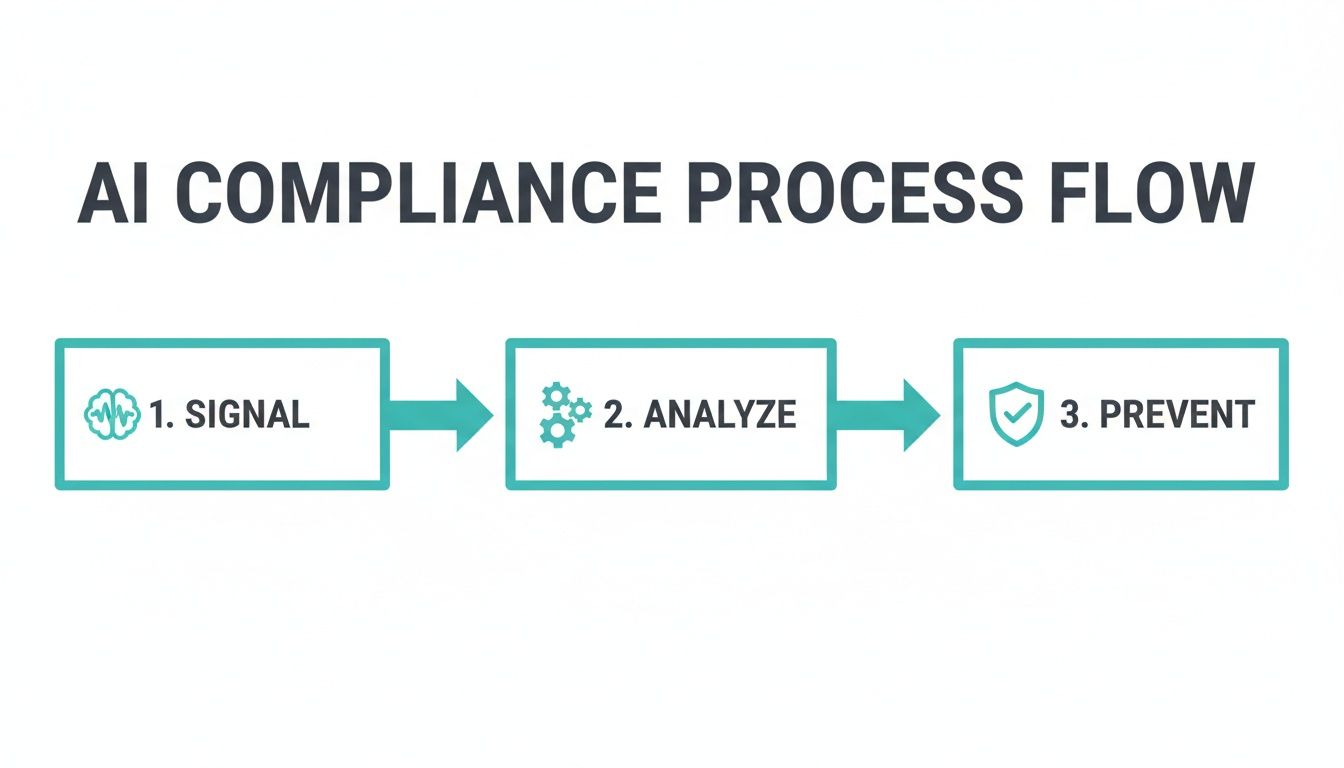
This workflow is simple but powerful: potential risk indicators are flagged, analyzed for their business impact, and then neutralized with preventive measures before they can cause any harm. To dig deeper into building a solid foundation, check out these 7 elements of an effective compliance program. Following this roadmap can make the new standard of proactive, ethical compliance a reality for your organization.
The New Standard of Enterprise Risk Prevention
The entire landscape of enterprise risk management compliance has been turned on its head. The old models—cobbled together with reactive forensics, invasive surveillance, and siloed departmental responses—aren't just ineffective anymore. They’re a direct source of legal and reputational liability. It's time to ditch these broken frameworks and embrace a new standard of risk prevention.
This new standard is defined by being proactive, ethical, and completely non-intrusive. It’s a fundamental shift, moving the goalposts from dealing with misconduct after the damage is done to preventing financial, legal, and reputational harm before it ever takes root. The heart of this modern approach is getting ahead of human-factor risks before they explode into full-blown crises, protecting both the organization and its people.
From Reactive Forensics to Proactive Prevention
For decades, the standard playbook for an internal incident was a hugely expensive and disruptive investigation. Let's call that what it is: a sign of failure. It means the internal risk wasn’t identified or managed in time. Post-incident forensics might tell you what happened, but it can’t undo the damage to your finances, your brand, or your culture.
The new standard rejects this model entirely. Instead of waiting for a disaster, it uses AI-driven insights to pick up on the subtle warning signs that always precede major compliance failures. This empowers leaders to step in and take preventive action, neutralizing an internal threat before it ever materializes.
The ultimate measure of a successful ERM compliance program is not how well it investigates failures, but how effectively it prevents them from ever occurring. Prevention is the new benchmark for excellence.
Championing Ethical, EPPA-Aligned Methodologies
A non-negotiable pillar of this new standard is an unwavering commitment to ethical, EPPA-aligned practices. Outdated alternatives like employee surveillance tools create massive legal exposure and obliterate the trust that’s essential for a healthy corporate culture. They often rely on legally and ethically toxic methods that put the organization on the wrong side of privacy regulations.
In stark contrast, a modern, ethical approach gets you far better results without sacrificing integrity. By focusing on risk signals and anonymized patterns instead of monitoring individuals, platforms like Logical Commander deliver actionable intelligence while upholding employee dignity. This methodology ensures you can be more effective at risk management while being more ethical.
No Surveillance: It completely avoids monitoring private communications, secret tracking, or any form of spying on employees.
No Coercion: It rejects any methods that resemble interrogation or psychological pressure, preserving a culture of respect.
Focus on Prevention: The goal is to give leaders the foresight to mitigate risk, not to police staff behavior.
This proactive, non-intrusive, and EPPA-compliant methodology isn't just a trend; it's the future. It’s a strategic imperative for any leader looking to build a resilient, reputable organization. The time has come to abandon failed reactive models and embrace the power of preventive, AI-driven enterprise risk management compliance.
Your Questions on Modern ERM Compliance, Answered
When leaders start looking at a modern approach to enterprise risk management, they naturally have questions. It’s a big shift, moving away from reactive fire-fighting toward a smarter, preventive strategy focused on human-factor risk. Let's tackle some of the most common ones we hear.
How Is AI-Driven Risk Prevention Different From Employee Surveillance?
This is the most important question, and the distinction couldn't be clearer. AI-driven risk prevention is built on an ethical, non-intrusive foundation, making it fundamentally different from employee surveillance. Our system is designed to be fully EPPA-compliant, focusing on anonymized data patterns and risk indicators to spot potential internal threats like conflicts of interest or signs of misconduct.
It never monitors private communications, tracks personal behavior, or uses any of the legally and ethically toxic methods that define surveillance. Old-school surveillance tools create massive liability by invading employee privacy. Our approach, in contrast, protects both the organization's reputation and its people.
Can This Type of ERM Platform Integrate With Existing Systems?
Absolutely—in fact, that integration is what makes it so powerful. A modern ERM compliance platform isn’t here to rip and replace the HR and security systems you already rely on. Instead, it acts as a unified intelligence layer that sits on top of them.
By connecting to your existing systems, it finally breaks down the dangerous data silos that keep you from seeing the full picture of internal risk. This creates a single, comprehensive view of your organization's human-factor risk landscape, turning fragmented data points into actionable, preventive intelligence.
What Is the First Step to Improving Our ERM Compliance?
The most practical first move is to conduct a targeted internal audit focused specifically on your risk detection gaps, particularly when it comes to human-factor threats. You need to ask the hard question: Where are our current processes failing to spot internal risks before they blow up into full-blown incidents with major business impact?
This gap analysis will shine a light on the specific vulnerabilities that traditional, reactive methods always miss. It provides a clear, data-driven business case for bringing in a purpose-built platform designed to address those exact weaknesses, moving your organization from a defensive posture to a proactive one.
At Logical Commander, we provide the new standard for ethical, proactive enterprise risk management compliance. Our AI-driven platform helps you prevent internal threats before they cause financial or reputational damage—all without surveillance.
Ready to see how a non-intrusive, EPPA-aligned approach can protect your organization?