%20(2)_edited.png)

A Practical Guide to Risk Management in Enterprise
- Marketing Team

- Jan 18
- 17 min read
Updated: Jan 20
Let's be honest, for a long time, "risk management" was seen as a purely defensive game—a box-checking exercise run by the compliance department to keep regulators happy. But that view is dangerously outdated. Today, effective enterprise risk management is one of the most powerful strategic advantages a company can have.
It’s all about taking a holistic, top-down look at identifying, assessing, and dealing with threats across the entire organization. When you pull this function out of its silo and turn it into a central driver of insight, you don't just build resilience. You gain a serious competitive edge.
Why Risk Management Is a Strategic Advantage
In today's world, businesses face a tangled web of interconnected threats. We're talking about everything from digital vulnerabilities and shifting regulations to internal misconduct and human capital risks. The old way of doing things—where each department managed its own little pocket of risk in isolation—just doesn't cut it anymore. That fragmented approach is how critical threats slip through the cracks, leading to nasty, unforeseen crises.
Modern enterprise risk management tackles this head-on by creating a unified, proactive strategy. Instead of just reacting to incidents after they've blown up, a mature risk program gets ahead of them. It reframes risk not as a hazard to be avoided at all costs, but as a source of invaluable strategic intelligence.
Moving Beyond Compliance
Viewing risk management solely through a compliance lens is a huge missed opportunity. Of course, meeting regulatory requirements is non-negotiable, but a truly effective program weaves risk awareness into the very fabric of strategic planning and daily operations.
This shift in perspective delivers some major benefits:
Smarter Decision-Making: When your leadership team has a clear, comprehensive view of the company's risk profile, they can make more confident, informed decisions that actually move strategic goals forward.
Real Resilience: A proactive stance builds organizational agility. It means the company can better absorb, and bounce back from, unexpected disruptions.
Greater Efficiency: Centralizing risk oversight cuts out redundant work, streamlines how you allocate resources, and forces better collaboration between critical departments like HR, compliance, and security.
By establishing a strong ERM program, organizations can better understand their risk appetite and improve decision-making capabilities, prioritizing initiatives and mitigation plans that support the company’s goals.
A Roadmap for Building a Robust Program
Making this transition to a strategic model requires a structured approach. It starts with something as simple as establishing a common language so different departments can talk about risk in a consistent way. From there, an effective program centralizes intelligence, breaking down the information barriers that keep you from seeing the full picture of potential threats.
This guide is your roadmap for building that kind of program. We'll walk through the foundational frameworks, unpack the five essential steps of the risk management lifecycle, and explore why fostering a proactive governance culture is so critical.
By the end, you'll understand how to operationalize risk management in a way that not only protects your organization but transforms potential vulnerabilities into a distinct competitive advantage.
Understanding Core Enterprise Risk Management Frameworks
Trying to manage risk across a large organization without a structured approach is like trying to build a skyscraper without a blueprint. You might get a few floors up, but the whole thing will be unstable and ready to collapse under the slightest pressure. Enterprise risk management (ERM) frameworks are that essential blueprint, giving you a proven, systematic way to identify, assess, and handle risks consistently across the entire business.
These frameworks aren't rigid, one-size-fits-all rulebooks. Think of them more as guiding principles that create a common language for risk. This ensures that the HR department, the IT team, and the C-suite are all operating from the same playbook. That shared understanding is what builds a resilient organization—one that can anticipate threats instead of just reacting to them.
COSO: The Internal Control Powerhouse
One of the most widely adopted frameworks out there is the COSO Enterprise Risk Management – Integrating with Strategy and Performance model. Developed by the Committee of Sponsoring Organizations of the Treadway Commission, COSO is famous for its intense focus on internal controls and how they tie directly into a company’s strategic goals.
Think of COSO as the detailed architectural plan ensuring every internal component—from governance and culture to daily operations—is designed to support your company's mission. It provides a highly structured way to embed risk management into every decision, at every level. The framework is built on five interrelated components and twenty underlying principles, guiding organizations to align their risk appetite with their strategy.
ISO 31000: The Flexible Global Standard
Another major player is ISO 31000: Risk Management – Guidelines. Where COSO is more prescriptive, ISO 31000 is a principles-based standard that offers a ton of flexibility. It’s less of a detailed schematic and more of a universal set of best practices that can be adapted to any organization, no matter its size, industry, or complexity.
The heart of ISO 31000 is its emphasis on weaving risk management into a company's existing governance and processes. It champions a continuous cycle of improvement, pushing businesses to regularly review and refine their approach. Its adaptability makes it a fantastic choice for global companies or those looking to implement an operational risk management framework that can grow with them.
The ultimate goal of any framework is to transform risk management from an isolated compliance activity into a strategic enabler that drives value and protects the organization. It's about making risk-aware decisions part of your company's DNA.
Choosing a framework is a huge step, but many organizations get stuck just adopting one on paper. This struggle has fueled a booming market for ERM solutions, which is projected to jump from US$10.5 billion to US$23.7 billion by 2028 as companies look for better tools. The need is urgent, especially when a shocking 18% of ERM leaders feel confident in their ability to spot emerging risks.
To help you decide which path is right for your organization, let's break down the core differences between these two leading frameworks.
Comparing COSO and ISO 31000 Frameworks
Attribute | COSO Framework | ISO 31000 Framework |
|---|---|---|
Primary Focus | Internal controls and alignment with strategic objectives. | Principles-based guidelines for risk management integration. |
Structure | Prescriptive, with 5 components and 20 principles. | Flexible and adaptable to any organization's context. |
Best For | Organizations needing a detailed control-based structure, often for SOX compliance. | Businesses seeking a versatile and universally applicable standard. |
Approach | Top-down, integrating ERM with strategy and performance. | Iterative, focused on continuous improvement and integration. |
Ultimately, whether you lean toward COSO, ISO 31000, or even a hybrid model, the real key is consistent application. It’s just like creating a layered defense system to mitigate risks in building security; a solid risk framework provides the layered defense your enterprise needs to not just survive, but thrive amidst uncertainty.
The Five Steps of the Risk Management Lifecycle
Effective enterprise risk management isn't a one-and-done project. It’s a living, breathing cycle. Forget thinking of it as a static wall you build once; it’s more like navigating a dynamic river. To reach your destination safely, you have to constantly read the currents, spot new obstacles, and adjust your course.
This structured journey is often broken down into five distinct but interconnected stages. Mastering this lifecycle is what turns risk management from a theoretical exercise into a practical, value-driving function that genuinely protects and strengthens your business.
The infographic below shows the high-level pieces you need to build a successful risk program. It starts with your guiding principles, moves to a structured framework, and leads into the repeatable process we're about to break down.
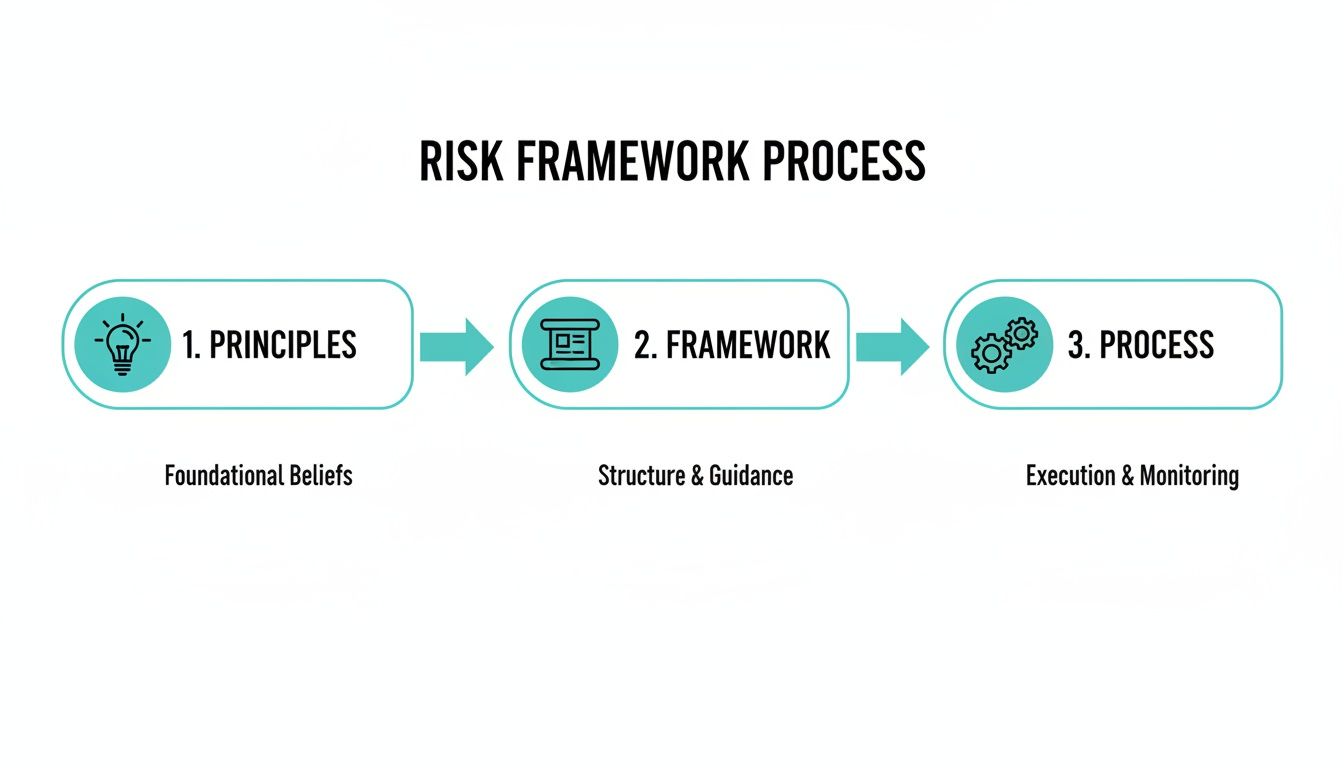
As you can see, a solid risk management process rests on a foundation of clear principles and a well-defined framework. This is what guarantees every step you take is consistent and strategically aligned.
Step 1: Risk Identification
It’s simple: you can't manage a risk you don't know exists. The first step, risk identification, is all about proactively finding potential threats before they ever have a chance to materialize.
This is far more than a few brainstorming sessions. It’s a systematic deep dive into your internal environment, your business processes, and the external world.
Some of the most effective techniques include:
Process Mapping: Charting out your workflows visually to uncover hidden vulnerabilities or single points of failure that could bring operations to a halt.
Root Cause Analysis: Digging into past incidents to understand what really caused them, not just the surface-level symptoms.
Horizon Scanning: Keeping an eye on emerging trends, new tech, and shifting regulations to see what risks might be coming around the corner.
The end goal is to build a comprehensive risk register—a living document that catalogs every single risk you've identified. This register becomes the central source of truth for your entire program, ensuring nothing falls through the cracks.
Step 2: Risk Assessment
Once you have a list of potential risks, you need to figure out which ones actually matter. Risk assessment is the process of analyzing each threat to understand its significance, which is how you prioritize your response.
This is where you move from a simple list of "what could go wrong" to a strategic understanding of "what we need to worry about most."
Typically, this comes down to evaluating two key dimensions:
Likelihood: How probable is it that this risk will actually happen?
Impact: If it does happen, how bad would the consequences be for the business?
By scoring each risk on these factors (often on a 3x3 or 5x5 grid), you can quantify its overall severity. A low-likelihood, low-impact risk might just need to be watched, but a high-likelihood, high-impact risk demands immediate attention. A thorough compliance risk assessment is a vital part of this stage, making sure regulatory and legal threats get the priority they deserve.
Step 3: Risk Mitigation
With a prioritized list in hand, it's time to decide what to do. Risk mitigation is all about developing and executing strategies to control, reduce, or even eliminate the threats you’ve identified. Your response will depend entirely on your organization’s risk appetite and the specific nature of the threat.
There are four primary ways to treat a risk:
Avoidance: Deciding not to move forward with an activity that carries the risk. A classic example is choosing not to enter a volatile new market.
Mitigation: Putting controls or processes in place to reduce the risk's likelihood or its potential impact. Installing new cybersecurity software is a perfect example.
Transference: Shifting the financial burden of a risk to someone else, most often through insurance policies or by outsourcing a specific function.
Acceptance: Making a conscious choice to live with the risk, usually because its potential impact is low or the cost to fix it is just too high.
The key is to pick a response that aligns with your strategic goals and risk tolerance. Every decision, even the choice to accept a risk, should be a deliberate and well-documented one.
Step 4: Monitoring and Review
Risk management is never a "set it and forget it" activity. The business world is always in motion, which means your risk landscape is, too. Monitoring and review is the critical, ongoing process of tracking identified risks, checking the effectiveness of your mitigation strategies, and scanning for new threats.
This stage pushes organizations beyond outdated annual reviews and into a state of continuous vigilance. It involves tracking key risk indicators (KRIs)—specific metrics that act as early-warning signals for increasing risk exposure. Consistent monitoring ensures your risk register stays relevant and your controls are actually working as intended.
Step 5: Reporting and Communication
The final step closes the loop. Reporting and communication is about turning raw risk data into actionable intelligence for stakeholders at every level, from the board of directors all the way to frontline managers.
Good reporting paints a clear, concise picture of the organization's risk profile, the status of mitigation efforts, and any emerging concerns. This transparency builds a risk-aware culture and ensures decision-makers have the information they need to navigate challenges with confidence. A unified platform is indispensable here, as it centralizes all this data and automates reporting, guaranteeing everyone is working from a single source of truth.
Building a Culture of Proactive Governance

Here’s the thing about risk management: it’s ultimately built by people, not just processes. While frameworks and technology give you the skeleton, it's the company culture that decides whether ERM becomes a genuine strategic asset or just another check-the-box exercise.
Cultivating a culture of shared responsibility is the human element that breathes life into any governance model. This means getting away from the idea that risk is just one department’s problem.
Instead, it becomes a collective mindset where every single employee feels empowered and trained to spot potential issues. This isn't about policing your staff; it's about fostering integrity and trust, where smart tools support your people instead of just monitoring them. When you get this right, you prevent silos and enable early intervention.
A proactive governance culture is your single greatest defense. It transforms risk management from a top-down mandate into a bottom-up reality, driven by engaged team members on the front lines.
Defining Key Roles in the Risk Ecosystem
A strong risk culture falls apart without absolute clarity on who is responsible for what. When roles are fuzzy, accountability disappears, and critical threats slip right through the cracks.
Think of it like the crew on a large ship. Everyone, from the captain to the deckhands, has a specific job that contributes to a safe voyage. A clear structure ensures risk management isn't some abstract concept but a tangible set of duties assigned to real people and teams.
The Board of Directors and C-Suite: This group sets the course. They are responsible for defining the organization's risk appetite—the amount and type of risk the company is willing to take on to hit its goals. Their leadership establishes the crucial tone from the top, signaling that ethical behavior and risk awareness are non-negotiable.
Risk Managers and the CRO: The Chief Risk Officer (CRO) and their team are the central coordinators. They facilitate the risk management process, offer their expertise, and make sure the chosen framework is applied consistently. They are the architects of the program, not the sole builders.
Business Unit Leaders: These are the frontline owners of risk. An operations manager or a sales director is in the best position to see and manage the specific risks tied to their department's daily activities. They are the ones who translate high-level strategy into practical, on-the-ground controls.
All Employees: Every employee has a part to play in identifying and reporting potential risks they run into in their daily work. An empowered workforce is the most effective early-warning system an organization can have.
You can learn more about how leadership shapes this environment by understanding the importance of the tone from the top in our detailed guide.
Breaking Down Silos for Cohesive Action
True proactive governance is impossible when key departments operate in their own little worlds. A cohesive risk ecosystem demands active partnership and seamless communication between functions like HR, Compliance, and Security.
When these teams actually collaborate, they can connect seemingly unrelated signals to form a complete picture of potential internal threats.
Cyber risk, for instance, isn't just an IT problem anymore. It now dominates global priorities, with 37% of enterprise risk managers ranking it as their top concern. And the threat is very real, as nearly 75% of enterprises were hit by at least one critical risk event last year, mostly from cyberattacks.
To effectively manage technology-related risks and build a proactive culture, implementing robust IT Asset Management best practices is critical. This is especially true when traditional ERM is falling short, with only 32% of leaders rating their oversight as mature. You can find more of these insights in the latest risk management statistics on secureframe.com.
A strong risk culture is not about creating a risk-averse organization. It's about creating a risk-aware organization that makes smarter, more informed decisions.
This collaborative approach ensures that a security vulnerability, a compliance lapse, and an HR-related integrity concern aren't viewed as three separate issues. Instead, they are seen as interconnected data points that, when put together, might reveal a much larger underlying risk that no single department could have identified on its own.
Shifting from Reactive to Proactive Risk Management
For years, enterprise risk management has operated like a fire department—waiting for an alarm before springing into action. This reactive stance, focused on damage control after something goes wrong, is a fundamentally losing strategy in today's world. It leaves organizations perpetually on the defensive, cleaning up messes that could have been avoided entirely.
The only way to win is to completely flip the script. It’s about shifting from being a firefighter to being a fire inspector—proactively seeking out and neutralizing hazards long before they ever have a chance to ignite. This means looking past the obvious, high-impact threats and learning to spot the subtle, early signals of risk that most companies miss.
This proactive shift isn't just about better defense; it's a strategic necessity. By anticipating and neutralizing threats early, organizations protect their reputation, build deep trust with stakeholders, and create a more resilient foundation for real, sustainable growth.
The Problem with a Reactive Approach
A reactive risk management model is always one step behind. It relies on historical data and known failure points, which means it’s completely blind to new and emerging threats. This backward-looking view creates massive vulnerabilities.
Organizations stuck in this cycle often find themselves dealing with the same problems over and over. They treat the symptoms—a compliance fine here, a data leak there—without ever digging in to fix the underlying procedural or cultural weaknesses that allowed the issue to surface in the first place.
This constant crisis management is exhausting and incredibly expensive. It drains resources that should be invested in innovation and growth, trapping the business in a loop of costly clean-ups and reputational repair.
Embracing Early Signal Detection
True proactive risk management hinges on one thing: the ability to identify the leading indicators of trouble. Think of it like a doctor monitoring faint changes in a patient's vitals to prevent a major health crisis. These early signals are often found in structured, operational data—not in invasive surveillance.
This is where technology can become a powerful decision-support tool. For instance, AI can be ethically used to analyze operational data for patterns that suggest potential integrity risks or internal misconduct, without ever crossing privacy lines.
This is a world away from employee monitoring. An ethical approach respects dignity, focusing only on structured indicators—like procedural deviations or undeclared conflicts of interest—rather than personal behavior. This aligns perfectly with stringent privacy regulations like GDPR and CCPA, ensuring compliance is baked into the process from the start.
"Proactive risk management is about transforming your organization's nervous system. Instead of waiting for the pain of a major incident, you learn to feel the faint tremors of risk and act before the earthquake hits."
This focus on early, structured signals allows HR, Compliance, and Security teams to intervene constructively and discreetly. It transforms risk management into a preventive function that protects both the organization and its people.
From Siloed Data to Unified Intelligence
One of the biggest roadblocks to proactive management is siloed information. When HR, Security, and Compliance teams operate in separate worlds, they each hold only one piece of the puzzle. A minor procedural issue in one department might seem insignificant on its own, but when combined with a security flag and a compliance concern, it could reveal a serious, systemic threat.
In the complex world of risk management in enterprise, insider threats have become a critical concern. In fact, a significant 46% of organizations plan to increase their investment in insider risk programs in 2025. This trend highlights a growing awareness that internal vulnerabilities can cause immense damage. Yet, many businesses are still exposed, with 48% relying on fragmented tools like spreadsheets that fail to connect these crucial early signals. You can discover more insights about these risk management statistics on procurementtactics.com.
A unified operational platform breaks down these walls. It creates a central hub where data from different departments can be correlated, providing a single, holistic view of internal risks. This integrated intelligence is what enables leaders to finally connect the dots and act on early signals with confidence.
The Strategic Value of a Preventive Stance
Adopting a proactive and ethical approach to risk management delivers profound strategic benefits. It's about far more than just avoiding losses; it’s about building a stronger, more trustworthy organization from the inside out.
Key advantages include:
Enhanced Reputation: Consistently preventing misconduct and integrity issues builds a powerful reputation as an ethical and well-run organization.
Increased Resilience: By addressing vulnerabilities before they are exploited, the business becomes better equipped to withstand unexpected disruptions.
Improved Culture: When employees see that the organization is committed to fairness and due process, it fosters a culture of trust and psychological safety.
Strategic Agility: With a firm handle on internal risks, leadership can pursue growth opportunities with greater confidence, knowing the organization has a solid and stable core.
Ultimately, shifting from reactive to proactive risk management transforms the function from a cost center into a value driver. It moves risk management from the backroom to the boardroom, making it an essential part of modern strategy and a cornerstone of lasting success.
Your Action Plan for Enterprise Risk Management
Knowing the theory is one thing, but translating that knowledge into action is what truly strengthens your organization's defenses. Building an effective enterprise risk management program doesn't happen overnight, but you can lay a powerful foundation by taking deliberate, strategic steps starting today. This isn't just some defensive chore; it's a forward-thinking driver of success.
The journey has to start with an honest look in the mirror. Assess your current risk management maturity to pinpoint the most critical gaps in your processes, technology, and culture. Are your departments operating in their own little kingdoms? Do you even have a defined risk appetite? Answering these tough questions is the only way to know your starting point.
Foster a Culture of Risk Awareness
Your people are your first and best line of defense. A proactive culture is built on shared responsibility, not top-down enforcement that nobody really buys into.
Implement Continuous Training: Get rid of the annual compliance snoozefest. Provide ongoing, role-specific training that actually empowers employees to recognize and report potential risks in their day-to-day work.
Establish Clear Communication: Make sure every single team member understands their role in the risk ecosystem and knows exactly how to escalate concerns without fearing any kind of backlash.
This cultural shift is what turns risk management from a siloed departmental function into a collective mindset, where integrity and awareness are just part of how business gets done.
Unify Your Operations and Frameworks
Fragmented tools and inconsistent processes are where threats love to hide. Breaking down those barriers is absolutely essential if you want a clear, holistic view of your risk landscape.
The ultimate goal is to create a unified operational backbone where risk intelligence is centralized, and every action is traceable. This transforms scattered data points into a cohesive, actionable strategy for proactive intervention.
Start by adopting a recognized framework like COSO or ISO 31000 to give your efforts a consistent structure. This creates a common language for identifying, assessing, and dealing with risks across the entire company. Next, bring in a unified platform that connects key departments like HR, Compliance, and Security. This integration is what lets you connect the dots between seemingly unrelated events, revealing those faint, early signals of trouble before they explode into full-blown crises.
Finally, prioritize ethical, privacy-first technologies that empower your team rather than making them feel like they're being watched. True risk management in enterprise is an ongoing journey of continuous improvement. With the right tools and a proactive mindset, you can protect your organization's reputation and build the kind of resilience that lasts.
Your Questions, Answered
Even with a solid plan, putting enterprise risk management into practice will bring up questions. Let's tackle some of the most common ones we hear from leaders in HR, Compliance, and Security as they get started.
What Is the First Step in Creating an ERM Program?
The very first move is to get your executive team on board and lock in a clear risk governance structure. Before you even think about frameworks like COSO or ISO 31000, you need to define who owns what, set up a risk committee, and tie the program’s mission directly to the company's strategic goals.
This critical first step ensures you have top-level backing from day one. It also weaves risk management into the fabric of the business, stopping it from becoming just another siloed compliance checklist.
How Do You Measure the Success of a Risk Management Program?
Success isn't just one number; you measure it with both hard data and qualitative shifts. The key quantitative metrics are pretty straightforward: a drop in how often risk events happen and how much they cost, better audit scores, and quicker incident response times.
But the qualitative side is just as important. Real success shows up as a stronger risk-aware culture across the company and leaders making smarter, more risk-informed decisions. It’s not just about dodging bullets; it’s about making bolder, more confident choices.
The real measure of success is when risk management in enterprise shifts from a defensive necessity to a proactive, strategic advantage that drives confident business growth and operational resilience.
What Is the Difference Between Risk Management and Compliance?
While they're related, they are definitely not the same thing. Think of it this way:
Compliance is about following the rules—the external laws, regulations, and industry standards you must adhere to. It’s the mandatory stuff.
Risk management, on the other hand, is a much bigger, more strategic game. It’s about identifying, assessing, and dealing with all potential threats to your business goals. This includes a ton of risks that aren't covered by any specific regulation, like damage to your reputation or operational screw-ups.
How Can We Get Employees to Actively Participate?
To get people genuinely involved, you have to build a culture of psychological safety where employees feel they can flag potential risks without fearing blame. If someone sees a problem, they should feel empowered to speak up, not worried about getting in trouble.
Provide regular, role-specific training so people know what to look for. Make the reporting process dead simple, and constantly communicate how their input directly helps keep the organization stable and successful. When people see the "why," they're far more likely to engage.
Logical Commander Software Ltd. provides an AI-driven platform to ethically prevent internal threats and human capital risks without surveillance. By identifying early, structured signals, we empower HR, Compliance, and Security teams to act proactively while preserving employee dignity and privacy. Know First, Act Fast with Logical Commander.