%20(2)_edited.png)

The Ultimate Guide to SaaS and B2B Strategy

Updated: Feb 16
In the world of business software, SaaS and B2B (Software-as-a-Service and Business-to-Business) have become an inseparable pair, fundamentally changing how companies get work done. This model lets businesses subscribe to powerful software over the internet instead of buying and installing it on their own servers, offering a level of flexibility we could only dream of a decade ago.
Understanding The SaaS Revolution in B2B

The move from traditional software to the SaaS model is one of the biggest shifts the B2B world has ever seen. Think of it as the difference between owning a massive, cumbersome DVD collection and subscribing to a sleek streaming service. The old way demanded a huge upfront investment, a dedicated IT team for constant maintenance, and painful, manual updates that nobody wanted to do.
In stark contrast, the SaaS model flipped the script. Companies can now get their hands on incredibly sophisticated software with a simple subscription, turning a huge capital expense into a predictable operating cost. This has leveled the playing field, giving small and medium-sized businesses access to tools that were once reserved for enterprise giants with deep pockets.
Key Benefits Driving Adoption
The stampede toward B2B SaaS isn't just a trend; it's a strategic move driven by clear, undeniable business benefits. This model empowers organizations to be more agile and responsive in a world that demands speed.
The biggest drivers are:
Scalability: Companies can easily adjust their subscription as they grow or as their needs change, without ever having to buy new hardware.
Reduced IT Overhead: The vendor handles all the updates, security patches, and server maintenance, freeing up your internal IT team for more important work.
Accessibility: Users can log in and work from anywhere with an internet connection, making it perfect for remote and hybrid teams.
Predictable Costs: Simple monthly or annual subscription fees make budgeting a breeze and eliminate the shock of unexpected maintenance bills.
The core appeal of SaaS in a B2B context is its ability to deliver immediate value without the long-term commitment and complexity of traditional software ownership. It aligns technology costs directly with business usage and growth.
This transformation has created a vibrant ecosystem of specialized platforms for every business function imaginable. From HR and finance to compliance and internal risk management, there's a focused SaaS solution for the job. To get a better handle on the mechanics, you can learn more about the SaaS B2B business model in our detailed guide. Understanding this foundation is essential for navigating the market, evaluating platforms like E-Commander, and making smart decisions that move your organization forward.
What’s Happening in the B2B SaaS Market Right Now?
The B2B SaaS market isn't just growing; it's fundamentally reshaping how modern businesses work. We’ve moved way past the early days of simply shifting software to the cloud. Now, the real game is about using data-driven insights and smart automation to get a competitive edge. This explosive growth is creating a market packed with incredible opportunities, but it’s also raising the stakes.
The numbers alone are staggering. The global B2B SaaS market was valued at USD 390 billion in 2025, but it's projected to jump to USD 492.34 billion in 2026 and then soar to an incredible USD 1,578.2 billion by 2031. This isn't slow and steady growth; it's a massive expansion driven by a 26.24% compound annual growth rate (CAGR).
This boom is happening because companies in critical sectors like HR and compliance are realizing they can streamline their entire operations without massive upfront investments. Even small and medium-sized enterprises (SMEs) are getting in on the action, with their adoption growing at a blistering 22.80% CAGR. Flexible pricing and easy onboarding from platforms like Logical Commander's E-Commander have made sophisticated tools accessible to everyone. You can dive into the full research on these exciting B2B SaaS market projections.
To put these figures into perspective, let's break down the projected growth.
B2B SaaS Market Growth Projections
This table showcases the projected year-over-year growth of the B2B SaaS market, highlighting key segments and their growth rates.
Metric | 2025 Value | 2026 Value | 2031 Projected Value | CAGR (Compound Annual Growth Rate) |
|---|---|---|---|---|
Total B2B SaaS Market | USD 390 Billion | USD 492.34 Billion | USD 1,578.2 Billion | 26.24% |
SME Segment Growth | N/A | N/A | N/A | 22.80% |
HR Tech Growth | N/A | N/A | N/A | ~24.50% |
Compliance Solutions Growth | N/A | N/A | N/A | ~21.10% |
These projections paint a clear picture: the demand for specialized, cloud-based business solutions is not just a trend but a foundational shift in enterprise technology.
The Rise of Vertical SaaS and Niche Specialization
One of the biggest forces shaping this market is the move toward vertical SaaS. Instead of trying to be a one-size-fits-all solution for every company (horizontal SaaS), vertical platforms are engineered to solve the highly specific problems of a single industry. Think of it as the difference between a general family doctor and a neurosurgeon—both are experts, but one has incredibly deep knowledge for a very particular need.
This focus is creating powerful new tools in high-stakes fields. For instance:
HR Tech: Platforms now do much more than just payroll. They manage everything from employee engagement to spotting proactive risk indicators, tackling the complex human capital challenges of a modern workforce.
Compliance Solutions: With regulations like GDPR and ISO standards getting tougher, specialized SaaS gives companies the tools they need to stay compliant and dodge crippling fines.
Internal Risk Management: Tools like E-Commander are offering ethical, proactive ways to identify insider threats and integrity risks without resorting to invasive surveillance—a critical need in today's business climate.
AI Is No Longer an Add-On; It’s the Engine
In the world of SaaS and B2B, artificial intelligence has gone from a buzzword to a core functional component. AI is being baked into platforms to automate complex workflows, predict future outcomes, and pull out insights that would be impossible for a human team to find on their own. This isn't about replacing people; it's about giving them superpowers.
For example, AI can sift through thousands of data points to flag potential compliance breaches before they happen or identify the subtle warning signs of employee misconduct. This lets HR, security, and legal teams get ahead of risks, neutralizing them before they can escalate into a full-blown crisis.
The real power of AI in B2B SaaS is its ability to transform mountains of raw data into actionable, preventive intelligence. It helps organizations switch from a reactive, defensive crouch to a proactive, forward-leaning posture, protecting both their assets and their reputation.
But this rapid expansion isn't without its challenges. The market is getting crowded, making it harder for new companies to make their mark. Customers are smarter and more demanding than ever, and they want to see a clear and undeniable return on investment (ROI) from their software subscriptions. To win, SaaS providers have to deliver real, tangible business value, a killer user experience, and a clear roadmap for helping their clients hit their goals.
The Core Metrics That Define B2B SaaS Success
In the world of B2B SaaS, a great product gets you in the game, but the numbers tell you if you’re winning. Thriving companies are obsessive about a specific set of key performance indicators (KPIs) that tell a clear story about their financial health, growth trajectory, and customer loyalty.
Think of it like running a high-end gym. It’s not enough to know how many members you have. You need to know how much revenue each member brings in annually, what it cost to get them through the door, how long they stick around, and how many cancel each month. These aren't just numbers; they're the heartbeat of the business, revealing its true strength.
This is especially true as the market evolves. As the trends below show, forces like cloud adoption, the demand for data, and AI integration are constantly reshaping what customers expect from their software partners.
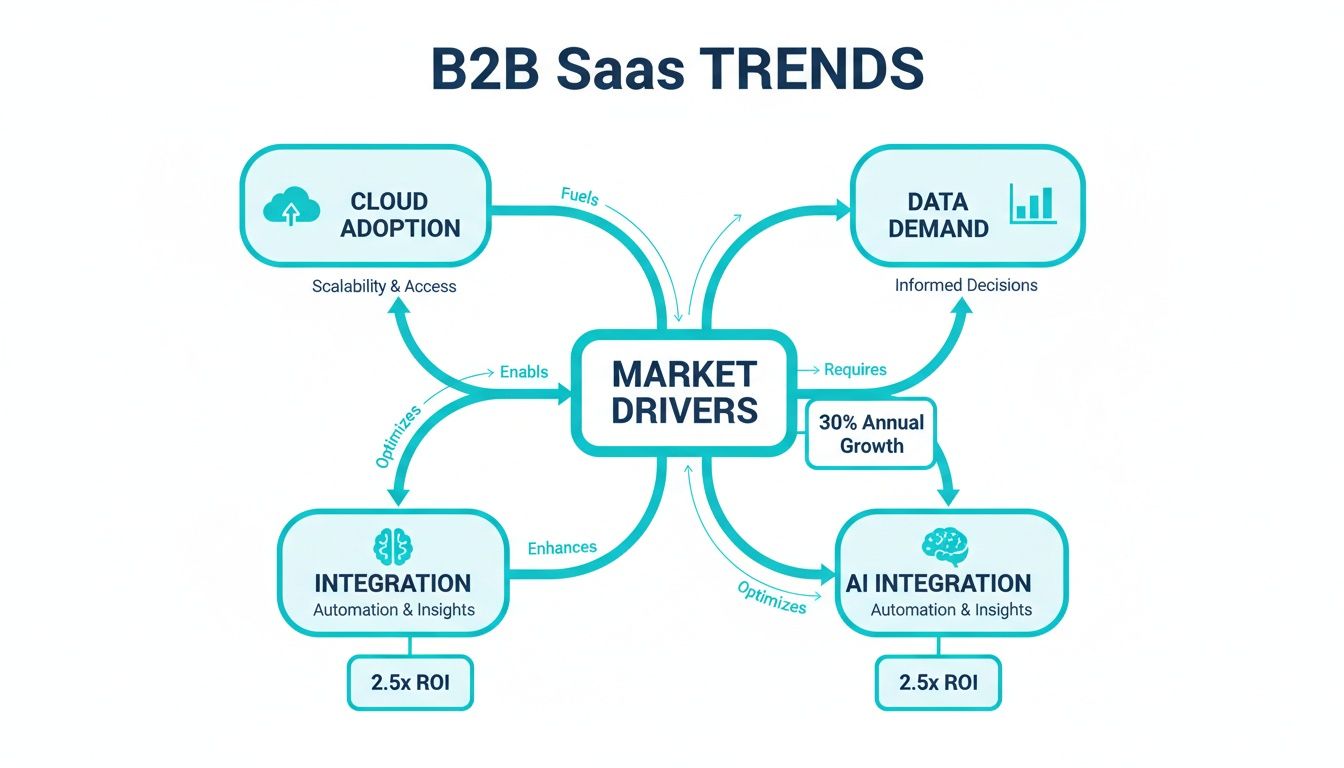
These interconnected drivers are pushing the need for more specialized and intelligent solutions, making it more important than ever to have a rock-solid grasp on your core metrics.
Annual Recurring Revenue (ARR) and Predictable Growth
The first and most fundamental metric is Annual Recurring Revenue (ARR). This is the predictable revenue a SaaS company can count on from all active subscriptions over a one-year period. It’s the ultimate measure of scale and stability.
Unlike the unpredictable nature of one-time sales, ARR gives you a clear, forward-looking view of your financial baseline. A steadily growing ARR is a sign of a healthy business with a product that customers find valuable enough to pay for year after year. It's the foundation on which every other strategic decision is built.
ARR is the north star for a B2B SaaS company. It smooths out the peaks and valleys of monthly sales, providing a stable metric that reflects long-term value and momentum.
This stability is critical, especially when the market gets choppy. While the broader market is adjusting, certain specialized verticals are showing incredible resilience. For instance, private B2B SaaS companies saw median annual revenue growth drop from 47% in 2024 to 28% in 2025.
Yet, as you can see from these 2025 B2B SaaS benchmarks, key sectors like HR, Legal, and Backoffice—which rely on platforms like E-Commander for internal risk management—actually accelerated their growth in 2025. This proves how a strong ARR in a focused niche can defy market-wide trends.
The LTV to CAC Ratio: The Engine of Sustainability
While ARR shows your current scale, the relationship between two other metrics determines if your growth is actually sustainable: Customer Lifetime Value (LTV) and Customer Acquisition Cost (CAC).
Customer Acquisition Cost (CAC): This is the total cost of your sales and marketing efforts to land one new customer. Think of it as your "buy-in" for each new gym member.
Customer Lifetime Value (LTV): This metric predicts the total revenue a business can expect from a single customer account over their entire relationship. It’s the total value of that gym membership over time.
A healthy SaaS business absolutely must have an LTV that is significantly higher than its CAC. The ideal LTV to CAC ratio is generally considered to be 3:1 or better. This means that for every dollar you spend to acquire a customer, you get at least three dollars back over their lifetime. If your ratio is too low, like 1:1, you’re basically spending all your revenue just to replace customers, leaving no room for profit.
Churn Rate: The Silent Killer
Finally, there’s the Churn Rate. This metric measures the percentage of customers who cancel their subscriptions over a given period. It's the leaky bucket of the SaaS world.
You can pour new customers in the top, but if existing ones are constantly flowing out the bottom, you’ll never achieve sustainable growth.
Churn is a direct reflection of customer satisfaction and product value. A high churn rate signals that something is wrong—maybe the product isn’t meeting expectations, the onboarding is poor, or the customer support is lacking. Keeping churn low is one of the most important jobs for any SaaS company, as retaining an existing customer is almost always cheaper than acquiring a new one.
Together, ARR, LTV, CAC, and churn provide a complete financial picture, guiding strategy and ultimately defining what success looks like.
Building a Winning Go-to-Market Strategy
Having a slick B2B SaaS product and solid financials is a great start, but it means very little if you can't actually get it into the hands of your target customers. This is where your Go-to-Market (GTM) strategy comes into play. Think of it as the master blueprint that maps out exactly how you'll engage with customers and convince them to buy, creating a clear path from a great idea to market leadership.
A winning GTM plan is what separates the companies that scale from those that stall. It starts with a modern B2B SaaS go-to-market strategy that gets your product, marketing, and sales teams all pulling in the same direction. It defines not just what you sell, but how you sell it.
Choosing Your Growth Engine: PLG vs. SLG
At the heart of any GTM strategy is your core growth engine. For most SaaS companies, it really boils down to two main paths: Product-Led Growth (PLG) and Sales-Led Growth (SLG).
Product-Led Growth (PLG): In this model, the product itself does the heavy lifting for acquiring, converting, and expanding customer accounts. Think of companies like Slack and Calendly. They offer freemium versions or free trials that let you experience the product’s value firsthand, long before you ever talk to a salesperson. The user experience is so good that it basically sells itself, spreading organically inside organizations.
Sales-Led Growth (SLG): This is the more traditional B2B route, where a dedicated sales team actively hunts down and nurtures leads through a structured sales cycle. SLG is almost always necessary for complex, big-ticket products that require a significant investment, customization, or heavy integration—like an enterprise-grade risk management platform.
These days, many of the smartest companies are running a hybrid model. They might use a PLG motion to hook a wide user base, then unleash a sales team to find and close the biggest enterprise deals hiding within that base. It’s a powerful way to combine the scale of PLG with the high-touch precision of SLG.
The Untapped Power of Partner Ecosystems
While direct sales and marketing are the lifeblood of most companies, one of the most powerful—and often overlooked—GTM levers is the partner ecosystem. Channel partners, resellers, and systems integrators can be a massive force multiplier, giving you reach into new markets and verticals far faster and more cost-effectively than you could ever manage on your own.
A well-built partner program essentially turns third-party experts into an extension of your own team. They already have established customer relationships, deep local market knowledge, and specialized expertise that builds instant trust and credibility. For any company trying to expand globally, partners aren't just a sales channel; they are your key to navigating local business cultures and regulations.
A strategic partner ecosystem doesn't just generate leads; it creates a network effect. Each new partner adds value not only to your company but to every other partner in the network, building a self-sustaining engine for growth.
Take a company like Logical Commander, for example. Its PartnerLC program is engineered to create a regulated and mutually beneficial growth model. By giving partners things like structured lead registration, transparent commission logic, and access to marketing resources, it ensures everyone knows the rules of the game. This approach lets partners confidently represent the E-Commander platform, knowing they're backed by a system built on trust and shared success.
If you're interested in the nuts and bolts, our guide to building a successful SaaS partner program ecosystem offers a much deeper dive.
Ultimately, a winning GTM strategy isn't a static document you create once and forget about. It's a living, breathing framework that has to be flexible enough to adapt to changing market conditions and customer needs. The trick is blending the right growth models and leveraging the power of partnerships to carve out a scalable, predictable, and defensible spot in the market.
How to Evaluate Enterprise SaaS Platforms
Choosing an enterprise SaaS platform, especially one that handles something as sensitive as internal risk, is about much more than just a feature checklist. For leaders in HR, Compliance, Security, and Legal, the real challenge is finding a solution that meshes with your company’s values, operational realities, and regulatory duties. A sleek dashboard means nothing if the technology underneath violates employee privacy or can't pass a basic compliance audit.
This is a buyer’s guide for vetting complex SaaS and B2B solutions designed to manage internal risk. We’ll go beyond the surface-level features to zero in on the crucial, often-missed criteria that define a platform's real value. The goal is to arm you with the right questions for vendors about security, data privacy, and deployment, ensuring you find a true partner, not just another product.
Security and Compliance by Design
When you're evaluating a platform, the first question shouldn't be "Is it secure?" but rather "Was it built to be secure and compliant from day one?" There's a world of difference between a platform that bolts on security features as an afterthought and one where compliance is baked into its very DNA.
Platforms engineered under strict regulatory frameworks like GDPR, EPPA, and ISO standards are fundamentally different. They are built with privacy and ethics as core architectural pillars, not just marketing fluff. This "compliance-by-design" approach means the system’s logic and workflows inherently respect legal boundaries, protecting your organization right out of the box.
A platform built on a foundation of regulatory compliance is a strategic asset. It demonstrates a vendor's commitment to ethical operation and provides a defensible posture that protects your organization from legal and reputational damage.
For example, a tool like E-Commander is designed to align with international standards such as ISO 37003 and OECD anti-corruption principles. This means its data processing, AI logic, and user permissions are all pre-configured to prevent overreach and ensure due process. Compliance becomes an automatic benefit, not an ongoing battle.
Proactive Ethics Over Reactive Surveillance
A critical dividing line in the internal risk space is the difference between proactive, ethical platforms and reactive, surveillance-based tools. Legacy solutions often rely on invasive methods like monitoring employee communications or tracking digital footprints, which can shatter trust and foster a toxic culture. These tools can only react after the damage is done.
The better approach is to identify objective risk indicators without sacrificing employee dignity. Ethical platforms focus on structured, verifiable signals—like procedural gaps or undeclared conflicts of interest—rather than trying to interpret an employee’s intent. This shift from subjective judgment to objective indicators is everything.
To see the difference, let’s compare these two philosophies side-by-side.
Ethical vs. Traditional Internal Risk Platforms
A modern, ethical platform is designed to build resilience and integrity, while legacy surveillance tools often create legal liabilities and a culture of fear.
Attribute | Ethical Platforms (e.g., E-Commander) | Traditional Surveillance Tools |
|---|---|---|
Focus | Proactive prevention of risk through objective indicators. | Reactive detection of misconduct after it happens. |
Method | Identifies structured signals without judgment or bias. | Often relies on keyword monitoring and behavioral tracking. |
Employee Impact | Preserves privacy, dignity, and trust. | Can create a culture of suspicion and fear. |
Compliance | Built to align with regulations like GDPR and EPPA. | May create significant legal and ethical liabilities. |
The choice here isn't just technical—it's a strategic decision that reflects your organization's commitment to its people and its principles.
Key Questions for B2B SaaS Vendors
When you’re deep in the procurement cycle, asking the right questions can reveal everything you need to know about a vendor’s philosophy and technical chops.
Make sure your team is armed with these critical inquiries:
Data Privacy and Governance: How do you segregate customer data, and what are your specific data encryption and anonymization protocols? Can you demonstrate how your platform helps us comply with GDPR's "right to be forgotten"?
Deployment and Integration: What deployment models do you offer (e.g., cloud, on-premise, hybrid)? How does your platform integrate with our existing HRIS, ERP, and security systems via APIs?
AI and Algorithmic Transparency: Can you explain exactly how your AI models identify risk indicators? What safeguards are in place to prevent algorithmic bias, and how do you ensure human oversight remains central to the process?
Vendor Security Posture: What third-party security certifications do you hold (e.g., SOC 2 Type II, ISO 27001)? Can you provide details on your incident response plan and data breach notification procedures?
The explosion of AI is supercharging the SaaS revolution, with the global AI-SaaS market projected to grow from USD 71.54 billion in 2023 to USD 775.44 billion by 2031. With enterprises juggling over 131 apps on average, specialized AI tools for compliance and HR are becoming mission-critical, especially platforms that identify preventive risk signals without surveillance. You can explore more SaaS growth marketing statistics to understand this massive market shift. Getting clear answers to these questions will help you select a platform that isn’t just powerful, but also principled.
The Future of B2B SaaS Is Proactive and Integrated
After looking at the entire SaaS and B2B landscape, one thing is crystal clear: the future of enterprise software isn't about raw technical power anymore. It’s about building responsible, integrated, and proactive systems that strengthen the very fabric of an organization. This is especially true in sensitive areas like internal risk, compliance, and HR, where trust is the ultimate currency.
The market is making a sharp turn away from fragmented, reactive tools that only show up after the damage is done. Instead, forward-thinking leaders are embracing unified platforms. These systems create a common operational language, connecting departments that rarely speak to each other—like HR, Security, and Legal—under a single, coherent framework for governance.
Prevention Over Reaction Is the New Mandate
The old model of waiting for a crisis to erupt and then launching a costly investigation is completely unsustainable. It’s expensive, it destroys morale, and it creates massive legal exposure. The new mandate is built on a simple principle: prevention over reaction. It’s about having the visibility to spot potential issues early, based on objective indicators, not invasive surveillance.
This proactive stance is only possible with platforms that can:
Identify early warning signs without violating employee privacy or dignity.
Centralize risk intelligence to finally break down the information silos between departments.
Provide a transparent, auditable trail for every action taken, ensuring total accountability.
The most resilient organizations will be those that adopt technologies designed to build institutional integrity from the inside out. They understand that true strength comes from a culture of transparency and proactive governance, not a state of constant suspicion.
Governance Through Integrated Systems
Ultimately, the future of B2B SaaS is one of deep integration and ethical design. The goal is to give leaders the tools they need to protect both the organization and its people. This means choosing platforms that do more than just solve a technical problem; they must reinforce the company’s core values and its commitment to due process. To go deeper, you can learn more about how a risk management API integration platform can unify these critical functions.
The final takeaway for enterprise leaders is a call to action. It’s time to adopt technologies that shift your organization from a defensive crouch to a forward-leaning posture. By creating a unified and transparent operational environment, you empower your teams to act fast precisely because they knew first, securing your company’s reputation and its future.
Your Questions, Answered
When you're evaluating a major software purchase in the B2B world, you’re bound to have questions. Let's dig into some of the most common ones we hear from leaders who are trying to make the right call for their organizations.
Getting these answers right is critical. The goal is to choose a platform that doesn't just solve a technical problem but becomes a genuine asset for your business, delivering real value long after the initial rollout.
What Is the Biggest Hurdle in B2B SaaS Adoption?
It’s almost never the technology. The single biggest challenge is managing organizational change and getting your people to actually use the new tool. It’s a classic mistake to assume that once you sign the contract, everyone will magically jump on board.
The reality is that people are creatures of habit. They’re comfortable with their existing workflows, and any change can feel like a disruption. If you don't handle the human side of the implementation, you’ll end up with low engagement and a terrible return on your investment.
A successful rollout is a human project, not just a technical one. You have to clearly and repeatedly communicate the "why" behind the new platform. Show your teams exactly how this tool will make their jobs easier, kill off tedious tasks, or help them hit their targets faster.
To get this right, you need to focus on a few key things:
Real Onboarding, Not Just a Login: Don't just send out an email with credentials. Provide structured training sessions, easy-to-find tutorials, and clear documentation that people can turn to when they get stuck.
Get Your Leaders on Board: When executives actively use and champion a new platform, it sends a powerful signal to the rest of the organization that this is a priority.
Create Feedback Loops: Give users a clear channel to ask questions, voice concerns, and offer suggestions. When you act on that feedback, people feel heard and become invested in the platform’s success.
How Do We Measure the ROI of a SaaS Platform?
Measuring the return on investment for any B2B SaaS platform goes way beyond just comparing the subscription cost to the budget. The true ROI is a measure of the total business value it creates versus its total cost of ownership. That means looking at both the hard numbers and the softer, qualitative benefits.
The best place to start is by identifying the specific metrics the platform is supposed to improve. If you’re looking at an internal risk platform like E-Commander, for example, your key metrics might be a reduction in compliance incidents or a faster average time for case resolutions.
The most effective way to demonstrate ROI is to tie the platform's impact directly to core business objectives. For example, show how improved operational efficiency from a new tool contributed to a 5% reduction in departmental overhead.
Here are the key areas you’ll want to measure:
Cost Savings: Add up the savings from reduced IT maintenance, the elimination of on-premise hardware, and the automation of tasks that used to be done by hand.
Productivity Gains: This is a big one. Measure the time your employees save on specific workflows. A 10% reduction in the time a whole department spends on administrative busywork can translate into massive savings.
Risk Mitigation: This can be tougher to put a number on, but it's often the most valuable. Reducing the likelihood of a single major compliance breach or data leak can save you millions in potential fines, legal fees, and reputational damage.
How Much Should a B2B SaaS Company Spend?
There’s no magic number here. Spending is going to vary wildly depending on a company’s funding stage, growth goals, and overall market strategy. That said, industry benchmarks can give you a pretty good feel for what’s typical.
For a B2B SaaS company in the $3 million to $5 million ARR range, a common breakdown of spending as a percentage of that revenue often looks something like this:
Research & Development: 20%
Selling Costs: 15%
General & Administrative: 15%
Marketing: 7%
Customer Support/Success: 7%
Now, companies backed by venture capital or private equity often spend far more aggressively—sometimes well over 100% of their ARR—to grab market share as quickly as possible. On the other hand, bootstrapped companies are usually much more conservative and tend to operate at or near profitability.
The key isn't to hit a specific number but to make sure your spending is perfectly aligned with your strategic goals, whether that’s all-out growth or steady, sustainable profitability.
At Logical Commander Software Ltd., we provide a unified operational platform that helps organizations prevent internal risks ethically and effectively. Instead of reacting to costly incidents, our E-Commander platform enables you to identify early signals, strengthen governance, and protect your most valuable assets: your people and your reputation. Discover how you can know first and act fast by visiting https://www.logicalcommander.com.