%20(2)_edited.png)

Operational Risk: Mastering a New Standard for Proactive Protection

Updated: Feb 11
Operational risk isn't some abstract compliance term—it's the potential for real financial loss from failures in your day-to-day operations. This internal threat stems from broken processes, flawed systems, human error, or even external events. These are the hidden cracks in your organization’s foundation that, if ignored, lead to catastrophic failure. For decision-makers in Compliance and Risk, this isn't just a line item; it's a fundamental business liability that directly threatens your resilience, reputation, and bottom line.
What Is Operational Risk and Why It Matters Now
Operational risk covers just about everything that can go wrong with how your business actually runs. Unlike market or credit risk tied to external financial forces, operational risk is rooted deep inside your company's DNA. It includes everything from a simple data entry mistake to a complex internal fraud scheme, representing the inherent risk of just being in business.
For decades, many leaders treated these problems as one-off incidents—an HR issue here, an IT failure there. That siloed thinking is dangerously outdated and a significant liability. Today, these internal vulnerabilities are more connected than ever. A single breakdown, often driven by the human factor, can spark a chain reaction, leading to staggering financial losses, brutal regulatory penalties, and reputational damage that takes years to repair.
The Central Role of the Human Factor
Processes and systems are vital, but the human element is consistently the primary driver of operational risk. People design the processes, operate the systems, and make thousands of decisions every day. This means that human error, misconduct, negligence, or outright malicious intent are often at the heart of the costliest operational failures—these internal threats begin and end with humans.
The trouble is, the old ways of managing these human-factor risks are broken. Reactive investigations and forensic audits only start after the damage is done. They are expensive, disruptive, and do absolutely nothing to stop the next incident. This old model leaves companies perpetually one step behind, lurching from one crisis to the next instead of proactively preventing them. You can get a broader view of these challenges in our guide on enterprise risk management.
Core Categories of Operational Risk
To get a real grip on operational risk, you first have to understand where it comes from. By breaking it down into its core sources, leaders in Compliance, Risk, and Internal Audit can start to pinpoint and address specific weak spots before they become a liability. A proactive strategy starts with a clear map of the threats.
An effective operational risk management framework isn't about eliminating all risk—that’s impossible. It’s about building the foresight to identify and neutralize the internal threats that pose the greatest danger to your organization’s objectives and reputation.
The table below breaks down the four pillars of operational risk. This framework gives you a clear way to start assessing your own organization's exposure.
The Four Pillars of Operational Risk
This table breaks down the main sources of operational risk, providing clear examples for each category to help leaders identify potential vulnerabilities within their organizations.
Risk Category | Description | Examples |
|---|---|---|
People | Risks originating from employee actions, errors, or misconduct. This is the human-factor element and a primary source of internal threats. | Internal fraud, compliance breaches, employee errors, lack of training, unethical behavior, conflicts of interest. |
Processes | Risks from failed or inadequate internal procedures, controls, and policies. | Poorly designed workflows, failed transaction processing, inadequate reporting, weak internal controls. |
Systems | Risks related to technology failures, including hardware, software, and data infrastructure. This is not just a "cyber" issue. | System outages, data breaches, software bugs, IT infrastructure failure, flawed data management. |
External Events | Risks caused by events outside the organization’s direct control. | Natural disasters, regulatory changes, supply chain disruptions, geopolitical instability, external criminal acts. |
By using these categories, you can move from a vague sense of unease to a structured approach, systematically identifying and shoring up the cracks in your foundation.
Identifying the Hidden Costs of People Risk
Of all the pillars propping up operational risk, the human element is by far the most unpredictable and, frankly, the most damaging. When we talk about “people risk,” we’re not just referring to minor HR infractions. We’re talking about a whole spectrum of behaviors—from accidental compliance slip-ups and negligence to calculated internal fraud and conflicts of interest—that create massive business liabilities.
These aren’t just isolated incidents. They are quiet, systemic vulnerabilities that can cripple an organization from the inside out. The real challenge is getting leaders to see that these human-factor risks aren't just personnel problems; they're core operational failures just waiting to happen. An employee error in handling data can easily trigger a multi-million dollar regulatory fine. A hidden conflict of interest can corrupt the procurement process, costing the company a fortune.

The Failure of Reactive Investigations
For years, the standard playbook for managing people risk has been purely reactive. An incident happens—fraud is discovered, a major policy is violated, or a whistleblower comes forward—and only then does the investigative machinery grind into motion. This after-the-fact approach is fundamentally broken and incredibly expensive.
Traditional investigations are a drain on every level:
Expensive: They burn through immense resources, pulling in internal audit teams, external consultants, and legal counsel, often with bills running into the hundreds of thousands of dollars.
Disruptive: They yank key people away from their real jobs, derail projects, and breed a climate of suspicion that torpedoes morale and productivity across the entire company.
Too Late: By their very nature, they only start after the damage is done. The money is already gone, the data is compromised, and the company's reputation is on the line.
This old model only treats the symptom, not the disease. It does nothing to prevent the next incident, trapping organizations in a costly and demoralizing cycle of reaction and recovery. The focus ends up on assigning blame instead of understanding and fixing the systemic weaknesses that let the risk materialize in the first place.
A New Standard for Prevention
The future of managing operational risk tied to people is all about proactive prevention, not reactive forensics. But the path to prevention is littered with legal and ethical landmines. Many organizations, desperate for a solution, have turned to invasive employee surveillance and monitoring tools. This approach isn't just counterproductive; it’s dangerous.
Invasive technologies that track employee activity create a culture of distrust, destroy morale, and expose the company to significant legal risks under regulations like the Employee Polygraph Protection Act (EPPA). They trade one liability for another and are a poor substitute for true risk management.
The new standard is built on ethical, non-intrusive prevention. It’s about using advanced, AI-driven risk assessments software to spot the behavioral precursors to high-risk events without ever resorting to surveillance. This approach respects employee privacy and dignity while giving leadership the foresight needed to act before a small issue becomes a full-blown crisis. You can explore this topic further in our detailed analysis of human capital risk management.
By identifying patterns and indicators associated with internal threats, an ethical platform empowers an organization to intervene constructively. This might mean targeted training, process improvements, or confidential counseling—actions that neutralize the risk while reinforcing a positive and secure work environment. This proactive posture is the only sustainable way to manage the complex and ever-present reality of people risk.
The Expanding Threat of External and Digital Risks
While the human element is a huge piece of the puzzle, the world of operational risk is getting bigger and more complex, thanks to pressures from the outside world. Supply chain breakdowns, sudden regulatory changes, and tech failures aren't just occasional headaches. They're now deeply tangled up with your internal operations, often acting as the spark that ignites hidden weaknesses in your people and processes.
Think about it. Digital systems are the backbone of just about every business function. This means a system failure is never just an "IT problem"—it’s a full-blown business crisis. An IT outage can shut down production lines, a data breach can obliterate customer trust, and a simple software bug can create financial chaos. These are all operational risks, live and in action, and they are not purely cyber-related; they are rooted in business operations.
The real danger is where these external threats crash into your internal human factor. The most expensive cybersecurity defenses can be completely undone by one employee clicking a single phishing link. A disgruntled insider with valid credentials can do far more damage than an outside hacker ever could. It's this critical connection between your people and your technology where so many operational failures begin.
Cyber Incidents Are Now a Top Operational Risk
Digital threats aren't just a concern; they've become a primary source of operational risk for businesses everywhere. The sheer speed and scale of these threats can feel overwhelming, turning everyday business activities into high-stakes gambles.
A recent analysis makes this shift crystal clear. In the high-stakes world of financial services, operational risk has exploded, with cyber incidents taking a top spot. According to the Allianz Risk Barometer 2025, things like ransomware attacks, data breaches, and IT outages were the #1 global risk for the fourth straight year, cited by 38% of responses from over 4,000 experts.
That puts it a full 7 percentage points ahead of business interruption. It's a massive jump from just a decade ago when it ranked eighth with only 12% of responses. This shows just how much digital business models have cranked up the vulnerability for major companies worldwide. You can explore the complete findings and get more details on the 2025 risk landscape.
This data is proof that managing digital operational risk isn't optional anymore. It demands a dedicated strategy that recognizes how human behavior can either make or break your digital defenses. A solid security risk assessment is the first step in building this kind of proactive defense. You can learn more by reading our guide on proactive security risk assessment strategies.
Navigating the Regulatory Minefield
As the digital world evolves, companies are also facing a growing mountain of rules and regulations. For example, understanding the serious risks of HIPAA non-compliance shows how these demands add another heavy layer of complexity. Failing to protect sensitive data can lead to staggering fines, drawn-out legal battles, and reputational damage that's almost impossible to fix.
These regulatory pressures make the consequences of internal slip-ups even worse. A simple process error or a moment of employee carelessness in handling protected information can quickly spiral into a full-blown compliance crisis.
The core challenge is that external threats and digital vulnerabilities are not just technological issues. They are business-wide risks that are frequently enabled or worsened by internal human factors, turning predictable operational challenges into major liabilities.
Ultimately, a proactive approach to operational risk requires a unified view. You can't effectively manage digital threats without also addressing the human behaviors that make them possible. By focusing on AI human risk mitigation through an ethical, non-intrusive platform, you can find and fix the internal vulnerabilities that attackers and system failures love to exploit. This is the new standard for building real organizational resilience.
How Geopolitical Instability Impacts Your Operations
Not too long ago, geopolitical events were just distant headlines, things discussed in boardrooms but rarely felt on the front lines. That reality is over. Today, global conflicts, sudden trade disputes, and shaky political alliances are a major and unpredictable source of operational risk for any business with a global footprint. These macro events create real, immediate threats that can send shockwaves through your entire organization.
This volatility isn't just a high-level strategic problem; it messes with your day-to-day functions. Supply chains can snap overnight. Access to key markets can vanish with little warning. New, tangled compliance burdens can appear out of nowhere thanks to sanctions or regulations. These external pressures put immense strain on your people and processes, creating the perfect breeding ground for errors, misconduct, and system failures.
The New Reality of External Threats
For risk leaders, managing this chaos is no longer optional. Geopolitical volatility is reshaping the operational risk landscape, climbing fast in global rankings and posing a severe challenge for multinational companies. Aon's Global Risk Management Survey ranks it as the ninth-biggest global risk in 2025, and it’s forecasted to surge to fifth by 2028 as conflicts, trade disruptions, and political instability escalate. You can read the full research on global risk trends to see the data for yourself.
This dramatic shift means your operational risk framework has to look far beyond your own four walls.
An organization's resilience is no longer just a measure of its internal controls. It's now equally dependent on its ability to anticipate and absorb shocks from an increasingly unstable global environment. Ignoring these external factors is a critical oversight.
When external pressures mount, they expose and magnify your internal human-factor risks. Think about it. An employee under pressure to meet a deadline because of a supply chain disruption is far more likely to cut corners on compliance. A team facing uncertainty may be more susceptible to social engineering attacks. This is where the outside world crashes directly into your internal threat landscape.
Connecting Global Events to Internal Vulnerabilities
A truly comprehensive approach to operational risk has to bridge the gap between what’s happening in the world and what’s happening inside your company. This means moving beyond traditional risk assessments that only look at internal processes and systems.
Here’s a clearer picture of how these external factors create internal risk:
Supply Chain Breakdowns: A sudden tariff or a regional conflict can force you to make last-minute changes to suppliers. This introduces new, unvetted partners into your ecosystem, cranking up the risk of fraud or quality control failures.
Market Access Restrictions: Getting locked out of a key market creates immense pressure to hit revenue targets somewhere else. This can easily lead to risky or unethical sales practices as teams scramble to make up the difference.
Sudden Compliance Burdens: New sanctions or trade laws demand rapid changes to internal processes. That haste often leads to implementation errors, creating significant compliance gaps and legal liabilities.
Ultimately, protecting your organization from the outside in requires a new level of foresight. By using an AI human risk mitigation platform like Logical Commander, you can finally see how these external pressures are affecting internal behaviors. This proactive, ethical risk management approach gives you the intelligence to reinforce controls, provide targeted training, and support your teams before external chaos turns into an internal crisis.
Adopting a New Standard for Proactive Risk Mitigation
Traditional approaches to managing operational risk are simply failing. For far too long, organizations have been stuck in a reactive loop—waiting for an incident to blow up, then launching costly, disruptive investigations. This after-the-fact forensics does absolutely nothing to prevent the next failure. It just leaves companies in a perpetual state of crisis management, always one step behind the next internal threat.
The business impact is painfully clear: lost revenue, shredded reputations, and mounting legal liabilities.
A fundamental shift is needed. It's time to move from reactive forensics to proactive prevention. This new standard, E-Commander / Risk-HR, means getting beyond the outdated practice of policing your staff and instead focusing on identifying the early warning signs of human-factor risk before they escalate into a full-blown crisis. It’s about building institutional resilience from the inside out by finally addressing the root cause of so many operational failures—the human element.
Shifting from Reaction to Prevention
Adopting this new standard means moving toward intelligent, AI-driven platforms that deliver preventive insights. Unlike invasive surveillance systems that destroy morale and create massive legal exposure under regulations like the Employee Polygraph Protection Act (EPPA), this modern approach is both ethical and non-intrusive. It respects employee privacy while empowering leadership with the foresight to act decisively.
This preventative model allows Compliance, HR, and Security teams to spot the behavioral precursors to misconduct, fraud, or compliance breaches. Armed with this intelligence, they can intervene constructively through targeted training, process adjustments, or confidential support. The goal is to neutralize the operational risk long before it can cause any real harm.
The infographic below shows just how quickly external events can trigger internal operational risks, highlighting why a proactive posture is so critical for anticipating and mitigating these interconnected threats.
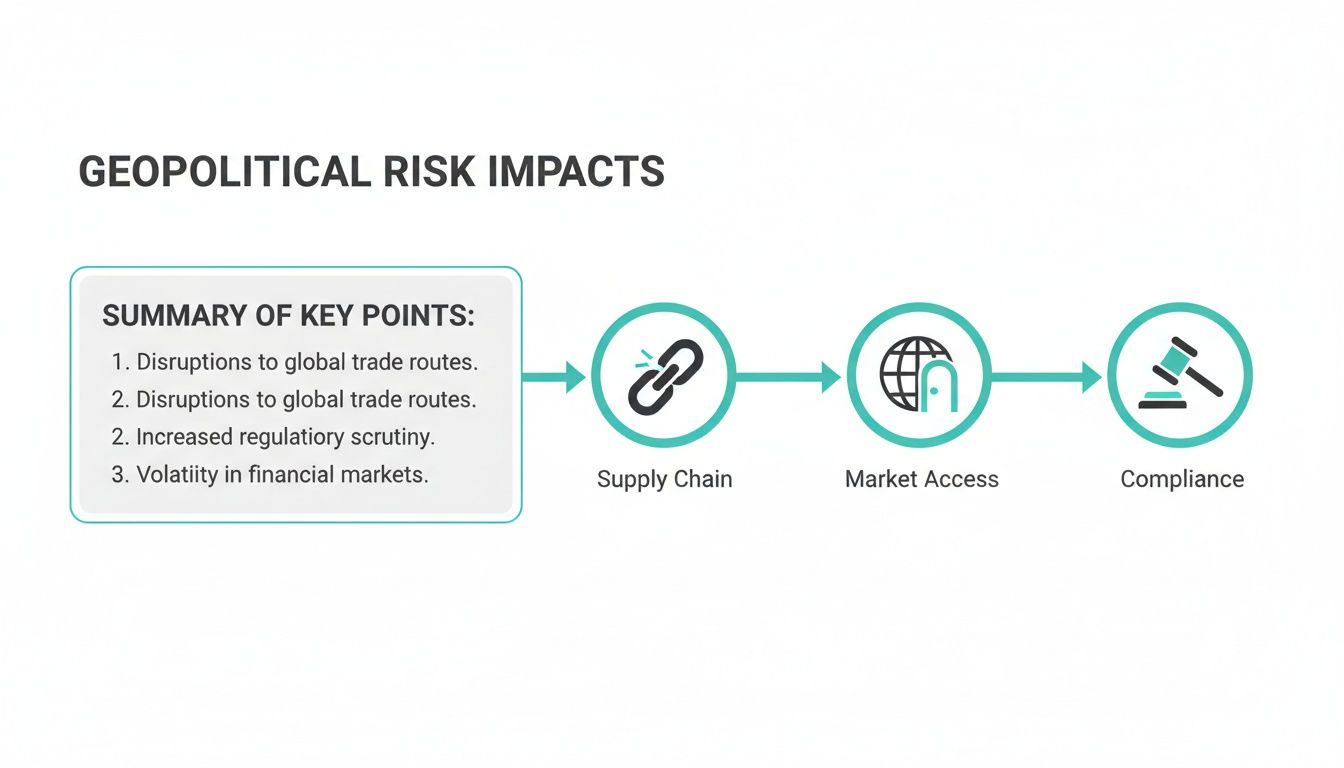
This visualization makes it clear: external pressures directly strain internal operations, creating vulnerabilities that a proactive system can help identify and manage before they lead to failure.
The stark contrast between the old, broken model and this new, preventive standard is impossible to ignore. One keeps you chasing problems, while the other puts you in control.
Attribute | Reactive Investigations (Old Standard) | Proactive Prevention (New Standard) |
|---|---|---|
Timing | Post-incident forensics; action taken after damage is done. | Pre-incident identification; action taken before damage occurs. |
Focus | Assigning blame and conducting costly clean-up. | Identifying and addressing root-cause vulnerabilities. |
Methodology | Often involves invasive surveillance, creating legal and ethical risks. | Utilizes non-intrusive, ethical AI to analyze risk indicators. |
Employee Impact | Creates a culture of fear, suspicion, and distrust. | Fosters a culture of integrity and psychological safety. |
Business Outcome | High costs, reputational damage, and operational disruption. | Reduced liabilities, protected reputation, and enhanced resilience. |
The choice is clear. Proactive prevention isn't just a better strategy; it's the only sustainable one for a modern, responsible organization.
The Power of Ethical AI in Risk Management
The engine driving this new standard is ethical AI. A platform like Logical Commander’s E-Commander acts as a central intelligence hub for internal risk, finally unifying the data and workflows for HR, Legal, and Compliance. It replaces fragmented, manual processes with a coordinated, real-time system for internal threat detection and mitigation.
Crucially, this is all achieved without resorting to legally toxic methods:
No Surveillance: The platform absolutely does not monitor or spy on employees. It analyzes risk indicators based on organizational data, not personal activity.
EPPA Aligned: It operates in full alignment with the EPPA, ensuring no lie-detection logic or coercive analysis is ever used.
Focus on Prevention: The goal is not to punish misconduct but to identify and address the systemic vulnerabilities that create risk in the first place.
Adopting a new standard often involves implementing structured cybersecurity risk assessment frameworks to identify and evaluate potential threats. In the same way, Logical Commander provides a framework for human-factor risk, giving you a structured way to understand and mitigate your most unpredictable vulnerabilities.
The core principle of proactive prevention is simple: identify risk before it becomes damage. This protects the institution and its people, ensuring operational integrity and safeguarding the bottom line without compromising on ethics.
By embracing this forward-looking model, organizations can finally escape the expensive cycle of reaction. It empowers leaders to build a more resilient, compliant, and secure organization—one that addresses operational risk at its source. This shift isn't just an upgrade in technology; it's a strategic evolution in governance and reputation protection. It is the future of ethical risk management.
Time to Implement Your Proactive Defense
Making the switch from a reactive to a proactive stance on operational risk isn't just an operational tweak—it's a strategic decision that makes your entire organization stronger. The core idea we've covered is simple: prevention beats reaction every single time. Waiting for an incident to blow up before you act is a failed model, one that guarantees financial losses, reputational hits, and regulatory headaches. The future of risk management is all about identifying and neutralizing internal threats before they can do any harm.
This journey starts when you acknowledge the massive liability tied to the human factor and commit to a new standard of prevention. It means leaving behind the expensive, disruptive cycle of reactive forensic investigations and embracing a modern, ethical approach. A proactive strategy doesn't just protect your bottom line; it builds a more resilient, secure, and responsible organization.
Your Path to Proactive Prevention
Shifting to a proactive defense is a clear, actionable process. It involves bringing in tools and frameworks designed to give you foresight into human-factor risks without resorting to invasive or legally toxic methods. The mission is to arm your Compliance, HR, and Security teams with the intelligence they need to act first.
Here are the first steps you can take to get started:
Honestly Assess Your Gaps: Start with a hard look in the mirror. Where are your blind spots when it comes to internal threat detection? What are reactive investigations really costing your business, both in direct expenses and lost productivity?
Explore Ethical Alternatives: Look into modern, EPPA-aligned platforms like Logical Commander. See for yourself how AI human risk mitigation technology can deliver preventive insights without the legal baggage of surveillance. For a deeper dive, check out our resources on building a solid enterprise risk management software strategy.
Request a Demo: Seeing a proactive system in action is the fastest way to understand its value. A tailored demo will show you exactly how the E-Commander platform unifies risk intelligence and delivers actionable insights for your specific industry and structure.
A proactive defense strategy isn’t about replacing human judgment; it’s about augmenting it. It gives your leadership the critical intelligence needed to make smarter, faster decisions that protect the entire company from preventable harm.
Partnering for a More Secure Future
For B2B SaaS companies and consulting firms, elevating your clients' operational risk posture is a huge opportunity. Integrating a proactive prevention capability into your services adds immense value and sets you apart in a crowded market.
By joining our PartnerLC program, you can seamlessly embed Logical Commander’s ethical, AI-driven platform into your existing solutions. This lets you offer your clients a new standard in governance and reputation protection. It's a strategic partnership designed to build more resilient businesses, together.
Frequently Asked Questions About Operational risk
When you're trying to get a handle on operational risk, a few key questions always come up. Here are some straight answers to the things leaders ask most, cutting through the noise to focus on what really matters: protecting your organization by addressing the human element head-on.
What Is the Biggest Source of Operational Risk Today?
Systems fail and external events happen, but the human factor is hands-down the most unpredictable and damaging source of operational risk. Things like internal fraud, conflicts of interest, compliance slip-ups, or even simple human error are the real culprits behind the most spectacular business failures.
Think about it. A weak process or a system vulnerability is just a dormant problem until a person interacts with it. That’s what makes human-related risk the central challenge for any serious risk management program.
How Is Proactive Prevention Different from Employee Monitoring?
This is a critical distinction, and it’s not just about technology—it’s about philosophy. Proactive prevention and employee monitoring are worlds apart.
Employee Monitoring: This is the old, broken standard. It relies on invasive surveillance tactics like keyloggers, reading private emails, or screen recording. This approach is a legal minefield, absolutely toxic for employee morale, and often violates regulations like the Employee Polygraph Protection Act (EPPA).
Proactive Prevention: This is the new standard of internal risk prevention. It uses ethical, non-intrusive AI human risk mitigation to spot risk indicators within your company’s systems, without spying on anyone. It’s focused on systemic weaknesses and behavioral precursors to risk, enabling you to step in early and protect both the company and your people.
Why Are Reactive Investigations No Longer Enough?
Because they start after you've already lost. A reactive investigation is a sign of failure—it only kicks off after the money is gone, the data is stolen, and your reputation is on the line.
These after-the-fact forensic deep dives are incredibly expensive and disruptive. They grind your business to a halt and do absolutely nothing to stop the next incident. It’s a broken model that traps organizations in an endless, costly cycle of cleanup and repair.
How Does AI Help Manage Operational Risk Ethically?
Ethical AI platforms, like Logical Commander's E-Commander, act as an intelligent hub for internal threat detection. Instead of surveillance, the system analyzes organizational data to find patterns and anomalies that point to elevated risk.
This EPPA compliant platform gives leadership the intelligence they need to fix vulnerabilities before they can be exploited, all while respecting employee privacy. It’s about managing the human side of operational risk without crossing ethical lines, creating a far more secure and resilient place to work.
Ready to stop cleaning up messes and start preventing them? Logical Commander provides the ethical, AI-driven platform you need to manage internal threats before they turn into disasters. Request a demo to see our E-Commander platform in action, get platform access, or contact our team for enterprise deployment. For B2B software and consulting firms, join our PartnerLC ecosystem to become an ally in building safer, more resilient businesses.