%20(2)_edited.png)

A Practical Guide to Workplace Ethics and Culture

Updated: Jan 20
Let's be honest, the term "workplace ethics" often conjures images of a dusty policy binder nobody ever reads. But that’s not what it’s really about.
What Are Workplace Ethics Really About?

True workplace ethics are the invisible operating system that powers a healthy organization. Think of it as the "why" behind your company's rules, guiding every decision from how a team member handles a customer complaint to how the C-suite navigates a major business deal.
A strong ethical foundation isn't just a "nice-to-have." It’s a powerful strategic asset, absolutely essential for building trust, navigating complex regulations, and creating a resilient culture that won’t buckle under pressure.
From Reactive Rules to a Proactive Culture
Too many organizations treat ethics like a fire alarm—they only pay attention after something has gone wrong. This reactive, "detect and respond" model is outdated and incredibly risky.
A far more effective approach is to build a proactive, principles-based culture. This means embedding ethical thinking into the core of your operations instead of just policing for violations. It’s about creating an environment where people feel safe to speak up, fairness is the default setting, and accountability applies to everyone, no exceptions.
"A proactive ethical culture is built on the belief that most employees want to do the right thing. The organization's role is to make doing the right thing as easy as possible and doing the wrong thing as difficult as possible."
The Four Pillars of a Modern Ethical Workplace
To truly embed ethics into your organization's DNA, you need to move beyond abstract ideas and focus on four concrete pillars. These elements work together to create a framework that is both resilient and practical, turning good intentions into reliable daily practice.
Pillar | Description | Real-World Impact |
|---|---|---|
Trust & Transparency | Creating an open environment where information is shared honestly and employees feel safe to voice concerns without fear of retaliation. | Higher employee morale, faster problem-solving, and a dramatic reduction in the kind of "cover-up" culture that leads to major scandals. |
Fairness & Consistency | Applying policies, rewards, and consequences evenly across the entire organization, regardless of role or seniority. | Stronger employee loyalty and a culture where people believe the system is just, which is critical for retaining top talent. |
Accountability | Ensuring that everyone, from the front line to the executive suite, takes ownership of their actions and their impact on the organization. | A culture where mistakes are treated as learning opportunities (not reasons for blame), leading to continuous improvement and higher performance. |
Integrity | A shared commitment to doing the right thing, even when it's difficult or when no one is watching. | Enhanced brand reputation, stronger customer trust, and long-term business sustainability built on a foundation of ethical decision-making. |
By building your culture around these four pillars, you're not just creating a set of rules. You're fostering a resilient, high-integrity environment where ethical behavior is simply the way business gets done.
The Gap Between Policy and Practice
Here's the hard truth: just having a code of conduct is not enough. The real challenge is closing the gap between the policies you write and the behaviors that actually happen day-to-day.
Recent research shows a massive disconnect here. For instance, a detailed study found that only 31% of organizations systematically evaluate ethical behavior during performance reviews. You can learn more about this disconnect between ethics policies and real-world actions from LRN’s comprehensive report.
This gap is a critical vulnerability. Without consistent reinforcement from leadership, even the best-written policies become meaningless, leaving companies wide open to risk. The goal isn’t to create a document that satisfies auditors; it’s to build a living, breathing ethical culture that guides every decision.
The Core Principles of an Ethical Culture
Moving from vague mission statements to real-world impact means getting clear on what an ethical culture actually looks and feels like day-to-day. It’s not about lofty ideals on a poster; it’s about observable behaviors that become part of the company’s DNA. These foundational principles are the compass that guides every decision, at every level.
When these principles are lived out, they create a psychologically safe environment where people feel genuinely valued and respected. This foundation of trust isn't just a nice-to-have. Research shows that a staggering 92% of workers prioritize employers who care about their well-being, drawing a direct line from ethical practices to productivity and retention.
The principles themselves are straightforward, but they demand disciplined and consistent effort. They are the building blocks that transform a company from simply having a code of conduct to truly living an ethical culture.
Radical Transparency Builds Trust
Transparency is so much more than just sharing good news or sunny quarterly results. It’s about cultivating an environment of open, honest communication—especially when the news is tough. Radical transparency means leaders are willing to discuss challenges, own up to mistakes, and explain the "why" behind their decisions.
Imagine a company is heading into a tough quarter. Instead of hiding the numbers until the last minute, a transparent leader pulls the team together. They openly discuss the market challenges, lay out the plan to tackle them, and invite real feedback. This simple act shuts down the rumor mill, cuts down on anxiety, and builds a powerful sense of shared ownership. It turns employees from passive spectators into active partners in the company's success.
Transparency fosters trust by eliminating the information asymmetry that often creates a divide between leadership and employees. When people feel they have the full picture, they are more empowered to make better decisions and contribute meaningfully.
Unwavering Accountability for Everyone
Accountability is the bedrock of fairness. It means the rules, standards, and consequences apply equally to everyone, from a new intern to the top-performing executive. In a truly ethical workplace, there's no separate set of rules for different people based on their title or tenure.
This principle gets its toughest test when a high-performer violates a core company policy. A culture of accountability means the issue is addressed directly and consistently, sending a powerful message that integrity is valued more than short-term wins. It reinforces that no one is above the company's ethical standards.
Genuine Fairness and Mutual Respect
Fairness goes way beyond just following the law. It’s about ensuring impartiality is woven into every workplace process—from hiring and promotions to how projects are assigned and conflicts are handled. It requires leaders to actively check their own biases and build systems that promote equitable opportunities for all.
Respect, its close partner, is about recognizing the inherent dignity of every single person. An ethical culture is built on this foundation, requiring deliberate effort in creating inclusive work environments for neurodivergent individuals and people from all backgrounds. You see it in how colleagues communicate, how feedback is delivered, and how disagreements are managed. For any organization looking to go deeper, exploring resources on how to build an ethical workplace culture can offer some powerful, actionable insights.
These principles don't exist in a vacuum; they create a powerful feedback loop.
Transparency creates an environment where people feel safe enough to speak up.
Accountability ensures that when they do, their concerns are taken seriously.
Fairness and respect guarantee the entire process will be handled with dignity and impartiality.
Together, these core tenets form the moral architecture of a resilient, trustworthy organization, turning abstract workplace ethics into a tangible, everyday reality.
How to Navigate Common Ethical Dilemmas
While having strong ethical principles on paper is a great start, the real test comes when your people are face-to-face with a messy, real-world gray area. These are the moments where the "right" answer isn't obvious, and the pressure to just make a call—any call—can lead to some seriously poor outcomes.
Getting through these dilemmas takes more than a rulebook. It demands a practical way of thinking and, just as importantly, a culture where people feel safe enough to hit pause, ask hard questions, and raise a flag before a small issue snowballs into a full-blown crisis. The goal is to give your team the tools to dissect a problem and make a sound, ethical choice.
The Subtle Conflict of Interest
A conflict of interest pops up whenever someone's personal interests could potentially cloud their professional judgment or clash with their duties to the company. The blatant examples are easy to spot, but the subtle ones are far more common—and often more dangerous because they can fly completely under the radar.
Imagine a manager hiring for a new role. One of the top candidates happens to be the nephew of a close friend. The candidate is qualified, but so are several others. That personal relationship creates a potential conflict. Can the manager stay truly objective in their evaluation?
To handle this, the manager needs a simple framework:
Acknowledge the Conflict: The first step is just admitting the potential for bias exists, even if it’s unintentional.
Disclose Transparently: The manager should immediately let their own boss or HR know about the relationship.
This approach protects both the manager's integrity and the fairness of the hiring process, reinforcing a culture of transparency.
Responsible Use of Company Data
In our data-driven world, employees often have access to a staggering amount of sensitive information, from customer details to internal financial forecasts. The ethical dilemma here is all about using that data strictly for its intended business purpose and keeping it locked down from misuse or prying eyes.
Consider an analyst who stumbles upon a fascinating—but non-essential—trend in customer purchasing habits. They’re tempted to share this interesting tidbit with a colleague in another department out of sheer curiosity. This seemingly harmless action, however, could violate data privacy policies and create unnecessary risk.
The ethical path is to treat all company data with a strict "need to know" mindset. Information should only be shared when there's a clear, legitimate business reason to do so.
Addressing Harassment and Microaggressions
Workplace discrimination and harassment are still some of the most pressing ethical challenges we face. While overt harassment is a clear violation, microaggressions—those subtle, often unintentional slights or insults—can be just as corrosive to a culture of respect. These behaviors create a toxic environment that systematically erodes trust and psychological safety.
A recent shift in S&P 500 boardrooms shows White male directors are now a demographic minority, signaling some progress at the highest levels. Yet, huge gaps persist on the ground. For instance, only 56% of workers feel safe enough to try new things at work, with non-managers reporting much lower psychological safety than executives. You can explore more about the state of business ethics and corporate culture.
When an employee makes a comment that marginalizes a colleague, even if they frame it as a joke, it's an ethical issue. The responsibility falls on leaders and peers to address it constructively, reinforcing that the workplace must be a space where everyone feels respected and included.
Ignoring these "small" incidents sends a powerful message that disrespectful behavior is acceptable, which almost always leads to more severe problems down the road. Building a truly ethical workplace means taking these subtle issues just as seriously as the major violations. An effective framework for handling these dilemmas is what equips every single team member to contribute to a culture of integrity.
Why Ethical Leadership Sets the Tone for Everyone
An ethical culture doesn’t just bubble up from the grassroots. It’s a direct, undeniable reflection of its leaders. This principle, often called the tone at the top, is the single most important factor in building a company with a strong ethical backbone. The way leaders act, especially when the pressure is on, sends a message that’s far louder than any mission statement ever could.
Think of it like a soundcheck at a concert. If the lead microphone is buzzing with feedback, it doesn't matter how talented the rest of the band is—the entire performance will be distorted. In the same way, if leadership’s actions are out of tune with their stated values, the entire organization’s ethical performance will suffer.
Actions Speak Louder Than Mission Statements
Your employees are smart. They don't just listen to what leaders say; they watch what leaders do. When an executive champions integrity at a town hall but is later seen cutting corners to hit a quarterly number, the real message is crystal clear: ethics are optional when they’re inconvenient.
This is where the concept moves from a nice idea to a practical reality. It’s not about grand, public speeches. It's about the small, consistent, and often difficult decisions made every single day.
Handling Mistakes: Does a leader own a strategic mistake openly, or do they hunt for a scapegoat?
Applying the Rules: Is a high-performing but abrasive employee held to the same code of conduct as everyone else?
Allocating Resources: Do decisions about budgets and promotions reflect fairness and transparency, or do they reek of favoritism?
Every one of these moments is a test. Passing them consistently builds a deep reservoir of trust and psychological safety. Failing them can shatter credibility in an instant, creating a cynical culture where employees believe the only real rule is not to get caught.
The Real Cost of Ethical Lapses at the Top
When ethical leadership fails, the consequences are severe and they spread like a virus. Leaders who don't model integrity give implicit permission for everyone else to follow suit, poisoning the culture from the inside out. This isn't just a theoretical risk; it comes with tangible financial and reputational costs.
Recent years are littered with high-profile leadership failures that led to a spike in CEO churn, with top executives at major companies ousted for breaching the very conduct codes they signed off on. This trend highlights a critical truth: ethical governance drives real results. For example, companies recognized for their strong ethical cultures have consistently outperformed their peers financially. Ethisphere's World's Most Ethical Companies, for instance, outperformed a comparable index of companies by 7.8% between 2020 and 2025. You can get more details on the link between ethical governance and performance.
An ethical lapse in leadership is like a crack in a dam. It may start small, but the pressure of the organization will inevitably widen it, leading to a catastrophic failure of trust and integrity.
This data proves that a strong ethical tone from the top isn't just a moral nice-to-have—it’s a powerful driver of business success and resilience.
How Leaders Can Champion Workplace Ethics Authentically
Setting the right tone requires more than just avoiding misconduct. It demands active, visible championship of the company's values. Leaders must become the most vocal and consistent advocates for workplace ethics, weaving integrity into the fabric of daily operations.
For any leader looking to strengthen their impact, understanding the nuances of setting an effective tone from the top is the essential first step. It all starts with self-awareness and an unwavering commitment to consistency.
Here are a few actionable steps leaders can take:
Integrate Ethics into Every Decision: When discussing a new project or strategy, make it a habit to explicitly ask, "What are the ethical implications here?" Turn it into a standard part of the conversation.
Reward Ethical Conduct: Publicly recognize and promote employees who demonstrate integrity, especially when they make a difficult but ethical choice that might not have had the best short-term outcome.
Show Vulnerability: When you make a mistake, own it. Apologize, explain what you learned, and outline the steps you'll take to do better. This models accountability and builds immense trust.
Ultimately, ethical leadership isn't a separate function—it is the very foundation of effective leadership. When leaders consistently model integrity, they don’t just enforce rules; they inspire a shared commitment to doing the right thing, building an organization that is both successful and worthy of its people's trust.
Building Your Practical Ethical Framework
Turning abstract principles into a tangible, working system requires a deliberate plan. An ethical framework isn’t just a stack of documents; it’s the living architecture that guides behavior, supports decision-making, and protects the entire organization. This is where you move from theory to action with a clear blueprint for governance.
This means creating a code of conduct that people actually use, establishing confidential reporting channels that build trust, and designing ethics training that engages people instead of boring them to tears. The goal is to weave workplace ethics into the company’s daily rhythm, not just create a binder that sits on a shelf to satisfy auditors.
Start with a Dynamic Code of Conduct
The foundation of any ethical framework is the code of conduct. But let’s be honest—traditional, legalistic codes often fail because they are dense, intimidating, and totally disconnected from an employee’s everyday reality. A modern, effective code has to be a living document that is accessible, relevant, and easy to understand.
Instead of a long list of prohibitions, frame your code around your core company values. Use simple language, real-world scenarios, and maybe even an FAQ section to illustrate key points. Think of it less as a rulebook and more as a practical guide for navigating the common ethical dilemmas your employees will actually face in their roles.
A great code of conduct answers the question, "What does doing the right thing look like here?" It should empower employees with clarity and confidence, not overwhelm them with jargon.
Establish Trustworthy Reporting Channels
A code of conduct is only as strong as the mechanisms in place to uphold it. Your people absolutely must have access to safe, confidential, and genuinely non-retaliatory channels to report concerns. Without this, a culture of silence will take root, and small problems will fester into major crises.
Effective reporting systems usually offer multiple options to accommodate different comfort levels:
Anonymous Hotlines: An independent, third-party service where employees can report concerns without revealing their identity.
Designated Ethics Officers: A specific, trained individual in HR or Compliance who serves as a trusted point of contact.
Direct Manager Reporting: Encouraging open dialogue with immediate supervisors, which requires training managers to handle sensitive issues appropriately.
The key is to ensure every single report is taken seriously, investigated impartially, and followed up on. This process builds the institutional trust necessary for a speak-up culture to thrive.
Define Clear Roles and Responsibilities
A robust ethical framework demands clear ownership. While ethics is everyone's job, specific departments have distinct responsibilities for keeping the system running. Fragmented oversight, where teams work in silos using scattered spreadsheets, is a recipe for inconsistency and risk.
This infographic shows how ethical leadership inspires employees and builds a strong culture.
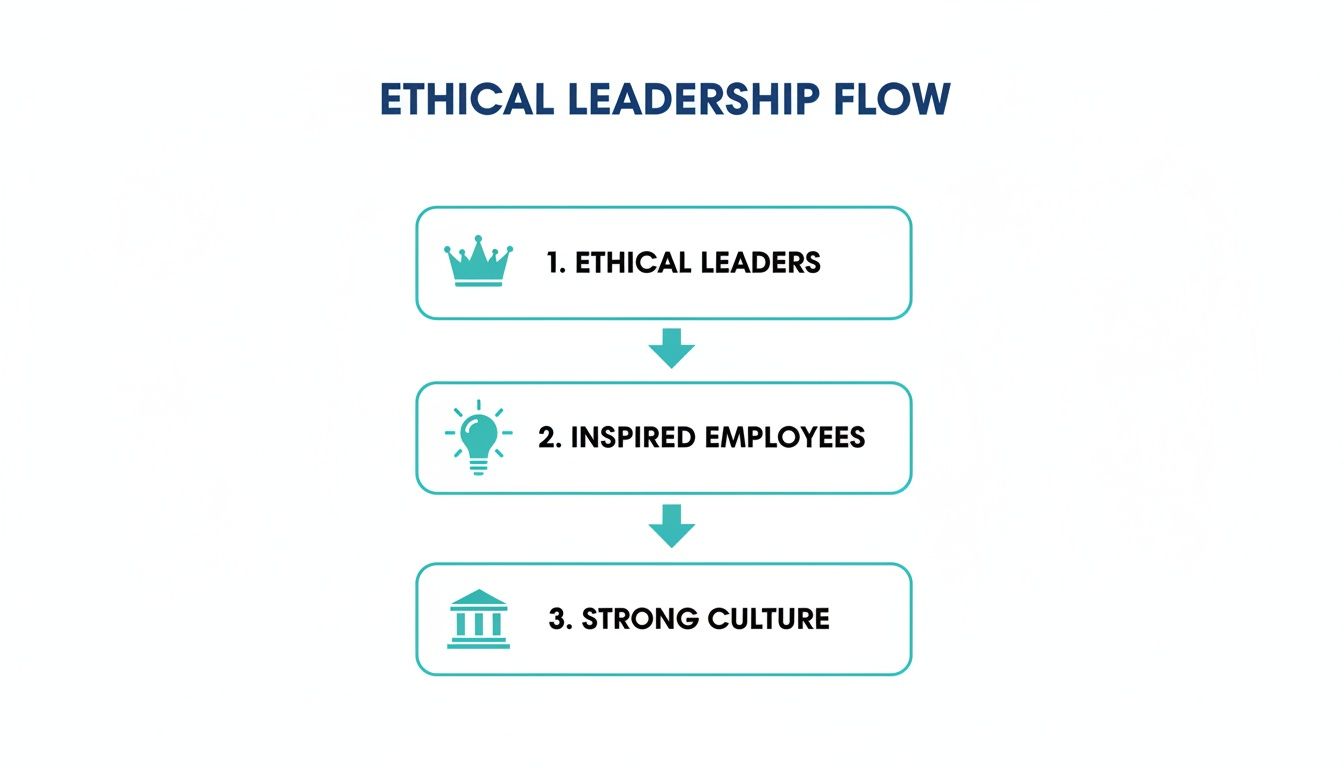
This flow shows that a strong ethical culture starts at the top and cascades through the organization, creating a powerful feedback loop.
A unified operational platform can connect these teams, ensuring everyone is working from the same playbook and adhering to the same processes.
Here’s a breakdown of the key players and their roles:
Human Resources (HR): HR is often the first line of defense, managing employee relations, conducting training on topics like harassment, and investigating many initial complaints. They are central to fostering a positive, respectful work environment.
Compliance: This function makes sure the organization adheres to all relevant laws, regulations, and internal policies. Compliance typically owns the code of conduct, manages the ethics hotline, and oversees mandatory training programs.
Legal: The legal department provides guidance on complex regulatory issues, manages high-stakes investigations, and protects the company from legal liability. They ensure the entire framework is defensible and locked in with legal requirements.
By creating a clear governance structure, you replace ambiguity with accountability. This practical framework provides the tools, processes, and clarity needed to transform ethical principles into consistent, everyday actions.
Using Technology to Support Workplace Ethics
Technology can be an incredible ally in upholding workplace ethics, but it has to be wielded with care. For years, the conversation around tech and risk management drifted toward invasive surveillance—tools that treat employees with suspicion and erode the very trust you’re trying to build. That approach isn’t just ethically questionable; it’s counterproductive, creating a culture of fear instead of integrity.
A modern, ethical approach flips that script entirely. Instead of monitoring people, the right technology analyzes processes to spot objective risk signals. It’s all about building systems that support human decision-making, not replace it, ensuring privacy and dignity are always at the forefront.
AI as a Decision Support Tool
The future of ethical technology lies in its power to act as a smart assistant for HR, Compliance, and Security teams. Think of it less like a judge and more like a skilled analyst that sifts through procedural data to spot anomalies that might point to a bigger problem.
For example, an AI-driven system can flag a potential conflict of interest by identifying a procedural gap—like a manager approving their own expense report. The system makes no subjective judgment about the person’s character or intent. It simply identifies a pre-defined risk indicator, allowing a human to step in and conduct a structured, fair verification process. This method reinforces accountability while staying fully aligned with strict data privacy laws like GDPR.
The core principle of ethical AI in the workplace is simple: it flags potential issues in processes, not people. This preserves trust and ensures that technology serves as a tool for prevention, not a mechanism for accusation.
This "Know First, Act Fast" approach lets organizations catch the earliest signs of potential misconduct. It gives them the chance to address vulnerabilities before they escalate into major ethical breaches or financial losses. It’s about being proactive and preventive, which is the cornerstone of any mature ethics program.
Protecting Privacy While Managing Risk
In the digital age, using technology effectively means putting data protection first. It's critical to implement secure document sharing practices, especially those adhering to HIPAA compliance, to protect sensitive information. The exact same principle applies to managing internal risk. Ethical technology must be built from the ground up to respect privacy, ensuring data is handled responsibly at every single step.
An ethical system operates under a clear and transparent set of rules:
No Surveillance: It avoids monitoring employee communications, emails, or private activities.
Focus on Structure: It analyzes structured, objective data related to procedures and policies, not personal behavior.
Human Oversight: It always leaves the final decision in the hands of trained professionals.
This focus on objective signals and structured verification is also critical in other areas, like when using tools for communication analysis. Organizations can learn more about ethical approaches by exploring different types of voice analytics software and their applications in regulated environments.
By adopting technology designed with ethics at its core, companies can strengthen their culture of integrity, uphold employee dignity, and build a more resilient and trustworthy organization.
Your Workplace Ethics Questions, Answered
When you're trying to move from theory to reality, a lot of practical questions come up. Leaders in HR, Compliance, and Risk need clear, actionable answers to the real-world challenges that pop up when building a culture of integrity. Here are some of the most common questions we get.
What Is the First Step to Improving Workplace Ethics?
Everything starts with genuine, visible commitment from the top. Without a strong "tone at the top," any ethics program is dead in the water. Leaders have to be the champions of the initiative, making it clear that ethical conduct is a non-negotiable part of the business.
Once that buy-in is locked in, the very next step is a thorough risk assessment to figure out where your organization's specific weak spots are. From there, you can build out or refresh your code of conduct, making sure it’s practical, easy to understand, and actually relevant to what your employees do every single day.
How Can We Measure the Effectiveness of Our Ethics Program?
Measuring the real impact of an ethics program means looking beyond basic compliance metrics. You need a mix of quantitative and qualitative data to get a true feel for the health of your culture.
Of course, you can track key indicators from your reporting systems. But you have to be smart about it. For instance, an increase in reports can, paradoxically, be a great sign—it often signals growing trust in the process, not a sudden spike in misconduct.
A truly effective program creates an environment of psychological safety where employees feel confident speaking up. Tracking anonymous employee survey data on trust in leadership and willingness to report concerns provides a powerful measure of your program's success.
Don't forget to analyze trends in exit interviews and keep an eye on turnover rates in different departments. Over time, a healthy ethical culture should directly correlate with better retention and higher employee satisfaction.
Can Technology Support Ethics Without Being Invasive?
Absolutely. The key is to completely shift the focus from surveillance to structured, objective analysis. Modern ethical technology is designed to identify procedural risk signals, not to monitor or judge people. It acts as a decision-support tool that actually enhances human oversight.
For example, instead of scanning employee emails, an ethical system flags a predefined risk indicator, like a potential conflict of interest based on procedural data. It doesn't make an accusation; it simply alerts a trained professional to review the situation according to established governance.
This approach respects employee privacy while empowering the organization to get ahead of risks. It’s all about using technology to prevent problems in the first place, reinforcing a culture of trust and integrity.
At Logical Commander Software Ltd., we believe that technology can and should reinforce ethics. Our AI-driven platform helps you prevent internal threats and misconduct by identifying early risk signals—all without invasive surveillance. We enable you to act fast while preserving employee dignity and ensuring full regulatory compliance. Discover how our ethical-by-design approach can strengthen your organization's integrity at https://www.logicalcommander.com.